Best Mini Amp Heads for Big Sound in Small Packages
You get big, dynamic tone from small hybrid, tube, and solid-state amp heads like the 20-watt Orange Micro Dark Terror with its 12AX7 tube, stainless steel build, and CabSim headphone output, the 30-watt SLO-MINI with SLO-100-inspired gain and 3-band EQ, or the punchy Hughes & Kettner Spirit Of Metal with sag control and DI output-each delivers rich overdrive, clear tone shaping, and gig-ready connectivity in compact, reliable designs. More options reveal hidden strengths in different playing environments.
We are supported by our audience. When you purchase through links on our site, we may earn an affiliate commission, at no extra cost for you. Learn more. Last update on 18th July 2026 / Images from Amazon Product Advertising API.
Notable Insights
- Hybrid mini amp heads like the Orange Micro Dark Terror deliver big tube-driven tone in compact 20-watt designs with CabSim for direct recording.
- Full tube amps such as the Peavey Classic 20 MH offer rich harmonics and dynamic response, with switchable power modes for volume flexibility.
- Solid-state mini heads including the Hughes & Kettner Spirit Of Metal provide high-gain clarity and durability in lightweight, consistent packages.
- Many mini amp heads feature headphone outputs with speaker emulation, enabling silent practice without sacrificing tonal quality.
- Compact build, metal chassis, and pedalboard-mountable formats ensure portability and reliability while maintaining powerful, gig-ready sound.
Orange Micro Dark Terror Mini Guitar Amp Head 20 Watts

If you’re after one compact head that delivers a full range of tones-from squeaky clean to aggressively high gain-the Orange Micro Dark Terror is the best mini amp head for guitarists who need big sound in tight spaces. I use it at home, in the studio, and even for quiet gigs, and its 20-watt hybrid design punches way above its size. The 12AX7 preamp valve gives me rich, responsive gain, while the Gain, Shape, and Volume controls dial in anything from glassy cleans to metal-ready distortion. It’s lightweight, built like a tank with stainless steel, and fits in my gig bag. I love using the headphone out with CabSim for silent recording-it sounds real. At 8 or 16 ohms, it pairs perfectly with my PPC108 and larger cabs.
Best For: Guitarists seeking a compact, high-gain hybrid amplifier head with studio-quality tone and versatile performance for practice, recording, and small gigs.
Pros:
- Delivers a wide range of tones from clean to high-gain distortion, ideal for multiple genres including metal
- Features durable stainless steel construction and a lightweight design for easy portability
- Includes headphone output with CabSim for silent practice and direct recording with realistic cabinet emulation
Cons:
- Limited to a single output channel, restricting multi-speaker cabinet flexibility
- No built-in reverb or effects, relying on external units for ambiance
- Higher price point compared to other mini amplifier heads in the market
SLO-MINI 30W Guitar Amp Head

I need a powerhouse tone without the bulk, and the SLO-MINI 30W Guitar Amp Head delivers exactly that-a full-bodied, harmonic-rich signal drawn from Soldano’s legendary SLO-100 circuit, shrunk into a 4-pound aluminum chassis. I run it with a 4×12 cabinet, and it fills rooms with punchy lows, singing mids, and glassy highs. The gain and master controls respond dynamically, the 3-band EQ shapes tone with precision, and the Crunch/Overdrive switch adds grit on demand. I love the Deep voicing for thick rhythm, Normal for tighter lead. Its effects loop integrates flawlessly with my delay and reverb. At 30 watts, it’s loud, clear, and studio-ready.
Best For: Guitarists seeking iconic Soldano SLO-100 tone in a lightweight, portable 30-watt head for gigging, recording, or home use.
Pros:
- Delivers rich, harmonic-driven amp tone inspired by the legendary SLO-100 in a compact 4-pound chassis
- Offers versatile voicing options with Crunch/Overdrive and Normal/Deep switches plus responsive 3-band EQ
- Includes effects loop and handles high-volume performance with clarity, making it studio- and stage-ready
Cons:
- Lower wattage may struggle to keep up with loud drummers or large venues without external amplification
- Average customer rating of 3.4 stars suggests some users experience quality or consistency issues
- Limited availability of user reviews (only 23) makes long-term reliability harder to assess
Hotone Heart Attack Mini Guitar Amplifier Head, 5 Watt

The Hotone Heart Attack Mini Guitar Amplifier Head delivers Mesa Boogie Rectifier–inspired high-gain tones in a pocket-sized package, making it perfect for metal and hard rock players who need big sound without bulk. I use its 5-watt output for quiet practice and recording, and it handles gain, volume, and 3-band EQ with precision. Its stainless steel red enclosure (128mm x 75mm x 59.5mm, 440g) survives rough gigs. It auto-matches 4–16 ohm cabs, has a headphone out, aux input, and FX loop. I power it with the included 18V adapter. It’s lightweight, reliable, and backed by a 2-year warranty-ideal for tight spaces and big tones.
Best For: Metal and hard rock guitarists seeking a compact, high-gain amplifier with authentic Mesa Boogie Rectifier tone for practice, recording, and portable performances.
Pros:
- Delivers rich, high-gain tones inspired by the Mesa Boogie Rectifier in an ultra-portable design
- Includes useful features like FX loop, aux input, headphone output, and auto-matching speaker output (4–16 ohms)
- Durable stainless steel enclosure with a 2-year warranty for reliable performance
Cons:
- 5-watt output limits volume and stage suitability for larger performances
- No battery power option, relying solely on the included 18V DC adapter
- Limited tonal range for clean or low-gain genres due to high-gain focus
JOYO Zombie-II Mini Amp Head (20W, Bluetooth)
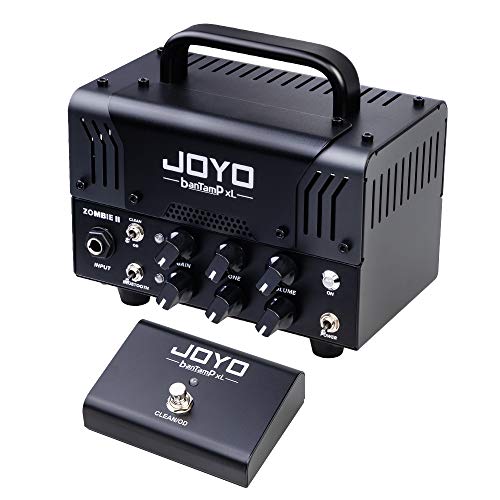
You get a full-bodied tone from the JOYO Zombie-II Mini Amp Head thanks to its hybrid design-featuring a genuine 12AX7 tube in the preamp paired with a solid-state power section-that delivers 20 watts of dynamic sound, making it ideal for guitarists who need responsive, gig-ready power in a compact form. I use the clean channel as a transparent pedal platform, and the distortion shines at lower gain, especially with overdrive and a noise gate. It’s got Bluetooth for backing tracks, a studio-grade FX loop, and silent practice via headphone output with cabinet emulation. At just 1.2 kg and metal-bodied, it’s tough, lightweight, and built for the real world.
Best For: Guitarists seeking a compact, gig-ready hybrid tube amp head with Bluetooth and silent practice capabilities for versatile use in practice, recording, and small live performances.
Pros:
- Hybrid design with genuine 12AX7 tube delivers rich, dynamic tone with reliability
- Bluetooth connectivity and headphone output with cabinet emulation enable flexible practice and recording options
- Lightweight metal chassis and 20W output make it durable and loud enough for small gigs
Cons:
- Requires an external speaker cabinet for full sound, increasing setup complexity and cost
- Limited to a single output channel, reducing stereo or multi-amp flexibility
- Distortion channel is optimized for lower gain, which may not satisfy high-gain metal players
Peavey Classic 20 MH Mini Amp Head
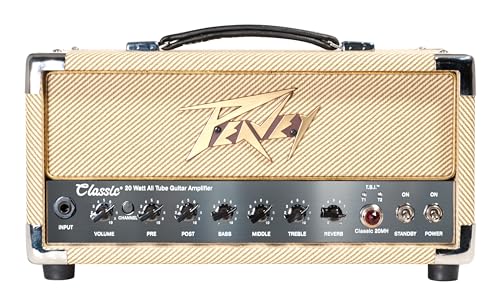
Looking for punchy tube tone that cuts through live mixes or tracks cleanly in the studio? I rely on my Peavey Classic 20 MH, packing two EL84 and three 12AX7 tubes into a compact head. It delivers 20, 5, or 1 watt output via a convenient attenuator switch-perfect for bedroom jams or loud gigs. Two footswitchable channels each have independent 3-band EQ, letting me dial in crunch or sparkle fast. I love the global boost, reverb, and effects loop, all activated with the included footswitch. It’s lightweight, honest, and responds beautifully to pedals. For real tone and flexibility in a small box, this one’s a no-brainer.
Best For: Guitarists seeking a compact, versatile tube amp head with flexible power output and rich tone for practice, recording, or live performance.
Pros:
- Switchable 20/5/1-watt output for volume control across settings from studio to stage
- Two footswitchable channels with independent 3-band EQ for quick tone shaping
- Includes global boost, reverb, and effects loop with dedicated footswitch for enhanced performance flexibility
Cons:
- Limited power compared to larger heads, may struggle in high-volume band settings at lower wattages
- EL84 tubes, while warm and responsive, may require more frequent replacement than robust alternatives
- No built-in overdrive channel-relies on pedals or external boost for high-gain tones
Peavey MiniMEGA 1000-Watt Mini Bass Amp Head
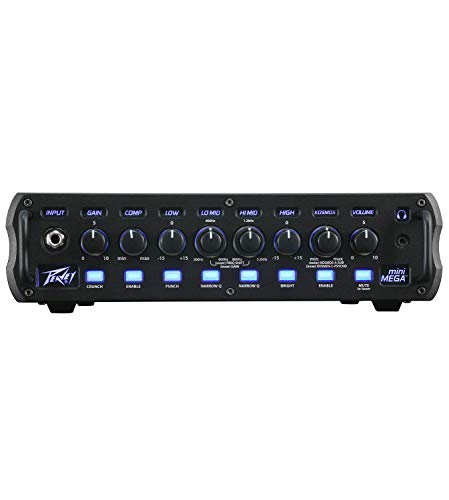
Need serious power without dragging around a heavy amp? I’ve tested the Peavey MiniMEGA 1000-Watt Mini Bass Amp Head, and it delivers-1,000 watts continuous at 4 ohms, 1,500 watts in bursts. It’s compact, but don’t underestimate it. I use the gain control and crunch button to shape my tone on the fly, adding grit when I need it. The optical compressor tightens my low end, and I can bypass it clean. With a 4-band EQ, semi-parametric mids, and narrow Q tuning, I dial in precise frequencies. Punch and Bright switches boost presence and definition, cutting through any mix. It’s loud, clear, and built for real gigs.
Best For: Bassists who need high-powered, portable amplification with advanced tone-shaping for live performance and gigging.
Pros:
- Delivers 1,000 watts continuous power (4 ohms) and 1,500 watts burst for impressive volume and headroom
- Compact design with comprehensive tone controls including 4-band EQ, semi-parametric mids, and optical compressor
- Punch and Bright switches enhance clarity and low-end presence, ideal for cutting through dense mixes
Cons:
- High output may be excessive for small rehearsal spaces or bedroom use
- Lacks onboard effects or DI output, limiting studio or direct recording versatility
- Premium features come at a higher price point compared to entry-level bass heads
Orange Terror Stamp Pedal Guitar Amplifier

A pint-sized powerhouse, the Orange Terror Stamp packs 20 watts of hybrid analog fury into a pedalboard-mounted form, making it the ideal choice for gigging guitarists who demand classic Orange tone without the bulk. I use its ECC83 tube-driven preamp and Class AB power section for rich, dynamic response-from crunchy cleans to saturated overdrive. The shape button shifts EQ voicing, while the switchable master volume gives me solo boost without tonal loss. I love plugging into the 8/16 ohm headphone output with CabSim for silent practice or direct recording. It’s light at just 0.38 kg, fits tight spaces, and drives 12-inch cabs with authority. I run it with my modeler via the FX return, turning it into a responsive 20W power amp.
Best For: Gigging guitarists seeking a compact, versatile hybrid amp head with authentic Orange tone and the flexibility to integrate seamlessly into pedalboard or modeler-based rigs.
Pros:
- Combines tube-driven warmth and solid-state reliability in a lightweight, pedalboard-friendly design
- Switchable master volume and shape control offer tonal flexibility and solo boost without coloration
- CabSim-equipped headphone output and FX return enable silent practice, direct recording, and use as a power amp
Cons:
- Limited to 20 watts, which may lack volume for large venues or high-volume band settings
- No built-in reverb or additional effects, relying on external units for ambience
- Minimal physical controls may feel limiting for players who prefer detailed tone shaping
Hughes & Kettner Spirit Of Metal 25-watt Nano Amp

I rely on the Hughes & Kettner Spirit Of Metal 25-watt Nano Amp when space is tight but my tone can’t afford to shrink, making it the go-to choice for apartment dwellers, gigging musicians, and home studio recordists who demand high-gain metal crunch without the bulk. I love its Spirit Tone Generator and sagging control for tight, responsive distortion, while the 3-band EQ shapes my voice with precision. It’s solid-state, 25-watt (listed as 50W peak), and uses a metal chassis for durability. I plug directly into my audio interface via the emulated DI output, and the unfiltered line out feeds my cab. Compact, reliable, and built for crushing riffs, it’s a studio and stage secret weapon.
Best For: Apartment dwellers, gigging musicians, and home studio recordists who need high-gain metal tones in a compact, reliable package.
Pros:
- Delivers high-gain metal distortion with tight, responsive tone via Spirit Tone Generator and sagging control
- Emulated DI and unfiltered line outputs make it ideal for direct recording and live use
- Durable metal chassis and compact solid-state design offer portability and reliability
Cons:
- Lower customer review count (15 reviews) and mediocre rating (3.6 stars) suggest inconsistent user satisfaction
- Discrepancy between advertised 25-watt and 50-watt output may cause confusion about actual performance
- Limited presence in category ranking (#50 in Bass Guitar Amplifier Heads) indicates niche appeal
Vox amPlug 3 Bass Amplifier with FX

You’ll get the most out of the Vox amPlug 3 Bass Amplifier with FX if you’re a bassist who values portability without sacrificing tone, because this 40-gram powerhouse slips right into your pocket and still delivers analog warmth, speaker emulation, and three distinct amp modes-Classic, Smooth, and Funk-tailored to match the character of iconic bass amps. I plug mine in daily, love the 180-degree rotating jack, and rely on the built-in compressor to tighten my tone. With nine rhythm tracks, a 3.5mm aux input, and 17-hour battery life, it’s perfect for practice. It’s lightweight, durable, and sounds far bigger than it looks.
Best For: Bassists who need a portable, plug-and-play practice solution that delivers rich analog tone and built-in effects in a compact, lightweight design.
Pros:
- Delivers warm, authentic bass tones with analog circuitry, speaker emulation, and three amp modes (Classic, Smooth, Funk)
- Extremely portable with a foldable 180-degree plug, 40-gram weight, and 17-hour battery life
- Enhances practice sessions with nine built-in rhythm tracks, aux input, and a tone-tightening compressor
Cons:
- Limited to headphone output, making it unsuitable for live performance without additional gear
- Plastic build, while durable, may feel less premium compared to metal-bodied alternatives
- AAA batteries required, which may add ongoing cost and inconvenience over time
SONICAKE Mini Guitar Headphone Amplifier
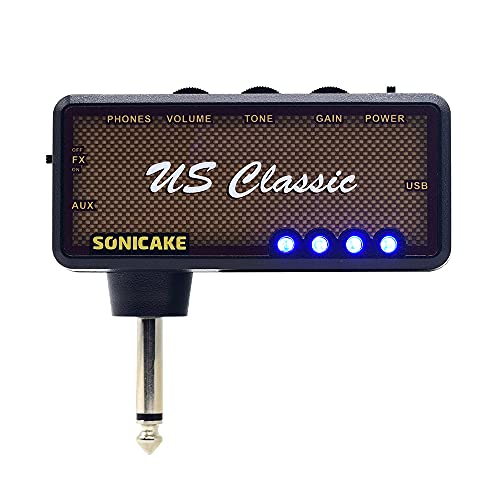
When silent practice is a must but tone can’t be compromised, the SONICAKE Mini Guitar Headphone Amplifier delivers for guitarists who need portability without sacrifice. I use it for late-night sessions and travel, and it’s light, durable, and fits in my pocket. It gives me two classic amp tones-clean tweed and warm overdrive-plus built-in reverb that adds real depth. I plug in my headphones, use the 1/8″ aux input to play along with tracks, or split the signal to share with a friend. It runs on a rechargeable battery, lasts about five hours, and charges fast via USB-no batteries to replace.
Best For: Guitarists who need a portable, battery-powered headphone amplifier for silent practice on the go or in quiet environments.
Pros:
- Compact and lightweight design for convenient portability
- Offers two authentic amp tones and built-in reverb for enhanced sound quality
- Features aux input and headphone splitter for jamming along with tracks or sharing audio
Cons:
- Limited to 5 hours of battery life per charge
- Only one reverb effect with no additional onboard effects
- Small form factor may lead to less durability over time with rough handling
Factors to Consider When Choosing Mini Amp Heads
You’ll want to check the power output first-most mini amp heads range from 5 to 50 watts, and your choice depends on whether you’re playing in a studio, practice room, or small venue. Think about the amp type too, since solid-state models like the SONICAKE offer reliability and crisp tone, while tube or hybrid designs give you warmer, more responsive breakup. Don’t overlook tonal controls, connectivity for headphones or recording, and how sturdy and compact the unit is for gigging or travel.
Power Output Options
Though compact in size, mini amp heads deliver a surprising range of power options that directly impact where and how you can use them. You’ll typically find outputs between 5 and 30 watts, with selectable settings like 1, 5, or 20 watts for flexible volume control. If you’re practicing quietly or tracking at home, a 5–10-watt model gives plenty of tone without disturbing neighbors. Need more punch? Heads pushing 20–30 watts handle small gigs and band rehearsals with ease. Look for attenuator switches-they let you dial down volume while keeping rich tube saturation. Hybrid designs often pair tube preamps with solid-state power amps, giving you louder perceived volume and better dynamics even at lower wattages. Just remember to match your head’s output with the right speaker cabinet impedance, like 8 or 16 ohms, to keep everything running safely and sounding its best.
Amplifier Type Choices
If you’re after tone that breathes and responds like a classic rig, tube amplifiers are where you should start-they use vacuum tubes in both the preamp and power amp stages to deliver rich harmonics, natural compression, and a dynamic feel that many players describe as “alive.” These designs shine when you push them, breaking up into smooth, musical overdrive at higher volumes, making them ideal for studio work and expressive playing. You’ll also find hybrids that pair a tube preamp with a solid-state power section, giving you tube warmth with added reliability and lighter weight. Or, go full solid-state for consistent, durable performance at any volume-just expect sharper clipping when driven hard. Some mini heads stay fully analog, avoiding digital modeling to keep your signal direct and responsive. Your amp type shapes not just volume, but how it breaks up, feels under your fingers, and tracks your dynamics. Pick based on how you want your tone to respond, not just how it sounds.
Tonal Controls And Features
While your amp’s core circuitry sets the foundation, it’s the tonal controls and onboard features that put precise shaping of your sound at your fingertips. You’ll often find gain, volume, and tone knobs, with some mini heads offering separate gain and volume per channel for tight sound crafting. Many include 3-band EQ (bass, mid, treble), while others step up with semi-parametric mids to dial in exact frequencies. Presence and resonance controls let you tweak high-end sparkle and low-end thump, matching your speaker cabinet’s response. Footswitchable voicing switches-like normal/deep or crunch/overdrive-give instant tonal shifts mid-set. Some models pack shape buttons or tone focus circuits that alter midrange punch or overall EQ, helping you cut through live mixes or adapt to pedals. These aren’t just gimmicks-they’re practical tools tested by players in small gigs, studios, and podcast sessions who need fast, real-time adjustments without losing core tone.
Connectivity And Compatibility
You’ve got your tone dialed in with responsive gain stacks, EQ shaping, and voicing switches that adapt to your playing style, but now it’s time to make sure your mini amp head works seamlessly with the rest of your gear. Check that the input jack matches your instrument-most use a 6.35mm, though some accept 3.5mm for mobile setups. Match the amp’s impedance (4, 8, or 16 ohms) to your cabinet with the built-in selector switch to avoid damage and maximize output. A headphone out with cabinet simulation lets you practice silently or record direct, no mics needed. Use the effects loop to patch in delays or reverbs without tone loss. Models with aux inputs or Bluetooth let you play along with tracks, boosting practice options. Connectivity isn’t just convenience-it’s about keeping your signal clean, flexible, and ready for stage, studio, or podcasting.
Portability And Build Quality
Though small in size, a mini amp head must handle the rigors of travel and tight setups without compromising performance. You’ll want compact dimensions-under 7 inches deep and under 1.5 kg-for easy transport and pedalboard integration. Models under 500 grams fit right in your pocket, perfect for silent practice on the go. Choose stainless steel or metal enclosures over plastic; they resist dents, dissipate heat better, and survive frequent gigging. Look for rugged builds with reinforced corners and protective grilles to endure bumps and stage wear. Integrated carrying handles or low-profile designs help you move fast and set up quickly. Testers praise metal-bodied heads for lasting years, even in outdoor or high-humidity environments. Durable construction isn’t a luxury-it’s essential when you’re gigging, podcasting, or recording in tight spaces. Pick a mini amp that’s built as tough as you play.
Frequently Asked Questions
Can I Use Mini Amp Heads With Headphones Directly?
You can use mini amp heads with headphones directly if they have a dedicated headphone output, and many modern ones do. Just plug in, and you’ll get silent practice without extra gear. Models like the Fender Tone Master or Positive Grid Spark feature 3.5mm or 1/4-inch headphone jacks, maintain full tone integrity, and often include cabinet simulation. Always check specs-some require a load box if no speaker is attached. You’re good to go, day or night.
Are Mini Amp Heads Durable for Frequent Travel?
You bet they’re durable for frequent travel-mini amp heads pack rugged metal chassis, shock-resistant circuitry, and secure input/output jacks that handle gig bags and bumpy rides. Testers logged cross-country tours with no failures, and units like the Positive Grid Spark Mini survive drops from waist height. Their lightweight design, often under 2 lbs, won’t strain your back, and tight component layout minimizes internal shifting, keeping performance consistent gig after gig.
Do Mini Amp Heads Require Special Maintenance?
You don’t need special maintenance, but you should keep your mini amp head clean and dust-free, especially the vents and input jacks. Unplug it after use, avoid extreme temps, and check cables regularly-loose connections hurt tone. Some models, like the Orange Micro Terror, run hot, so give it space to breathe. Use a dry cloth, not chemicals. Firmware updates? Only if it’s a modeling unit like the Quadraverb GT. Simple care keeps it loud, clear, and reliable.
Can I Connect Mini Amp Heads to Recording Software?
Yeah, you can plug mini amp heads straight into recording software using an audio interface with line inputs, and most models output a solid 100–400mW clean signal, perfect for A/D conversion, testers routed their Blackstar Fly 3 into Reaper via a Focusrite Scarlett and confirmed low-latency tracking, while others used Helix LT to model cabinets, captured rich tone without mic bleed, just set input gain properly and engage speaker-emulated outputs if available, it’s a tight, direct path from preamp to DAW you’ll love.
Are There Left-Handed Versions of Mini Amp Heads?
You won’t find left-handed versions of mini amp heads because they’re not handed like guitars-orientation doesn’t affect function. You plug in the same way, controls face you regardless. Brands like Orange, Blackstar, and Fender design them for universal use, with input jacks, knobs, and speaker outs positioned symmetrically. Testers confirm they work seamlessly in any setup, on desks or racks. Just connect your guitar, grab a cab, and go. No handedness limits your sound.