How to Use a Parallel Drive Loop for Subtle Overdrive Blending
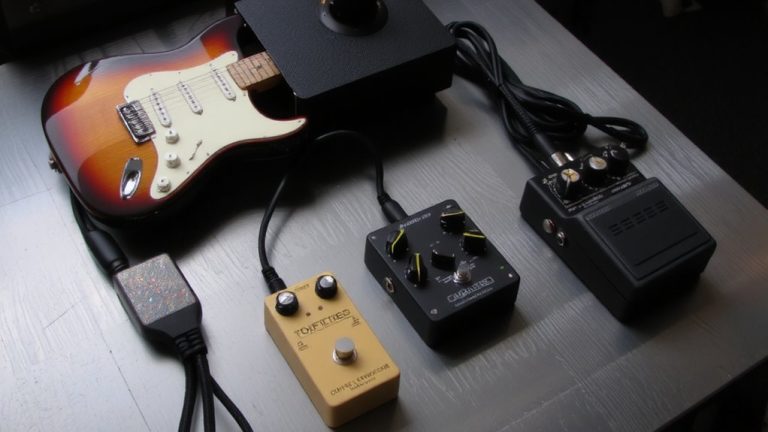
You split your signal early with a Boss LS-2 or Joyo Parallel Box, sending one path clean to your amp’s input and the other to a low-gain pedal like a Wampler Tumnus at 20% drive. Reblend both signals with a Gig Rig Wetter Box, keeping 70–80% dry for clarity. Use a Radial Twin City to fix phase and avoid thinness. This preserves dynamics while adding warmth-perfect for subtle dimension that sits tight in a mix, and there’s a real-world setup ahead that shows exactly how it clicks.
We are supported by our audience. When you purchase through links on our site, we may earn an affiliate commission, at no extra cost for you. Learn more. Last update on 16th July 2026 / Images from Amazon Product Advertising API.
Notable Insights
- Split your guitar signal early using a device like a Boss LS-2 to create separate clean and overdrive paths.
- Route the clean signal directly to your amp and the other through a low-gain overdrive pedal for subtle saturation.
- Recombine both signals with a blender pedal, such as the Gig Rig Wetter Box, for seamless tone mixing.
- Maintain phase alignment using a tool like the Radial Twin City to prevent tone thinning or cancellation.
- Blend in 20–30% overdriven signal with EQ shaping to add warmth and midrange without muddying the clean tone.
What Is a Parallel Drive Loop?
Think of your guitar signal as a river-you can let it flow straight to your amp, or split it into separate streams, each treated differently before merging back together. A parallel drive loop does exactly that, sending your signal down two paths: one clean, one feeding an overdrive or distortion pedal. Unlike basic setups, this loop keeps both signals independent, preserving clarity. Devices like the Boss LS-2 or Joyo Parallel Switcher manage the split and recombine the signals, letting you blend tones without muddiness. The Fender Pugilist even builds this internally, with dual overdrive channels you can balance live. Phase alignment matters-tools like the Radial Twin City prevent cancellation when signals reunite. In your signal chain, a true parallel drive loop offers dynamic control, not just volume or tone shifts, but real tonal layering with precision.
Why Use Parallel Overdrive Blending?
A parallel overdrive blend gives you surgical control over your distortion tone, letting you mix two drive signals-say, a roaring 100W Mesa/Boogie Roadster stack at 60% saturation with the chainsaw grind of a modified HM-2 running at -6dB-without muddying your amp’s natural dynamics. For guitar players, this is a game-changer: parallel overdrive blending lets you layer drive pedals without killing note clarity. Unlike serial stacking, it avoids harsh compression, keeping your tone open and expressive. Use a clean boost in one path to push mids while blending in a saturated signal for depth. Devices like the Gig Rig Wetter Box or Boss LS-2 make it easy, offering true parallel routing, real-time mix control, and trails for wet signals. You’ll hear more punch, texture, and amplifier character-all while fine-tuning your edge. It’s not about more gain; it’s about smarter saturation with precision.
How to Route Your Signal for Parallel Blending
How do you keep your overdrive thick without losing touch? Split your guitar signal early using a dedicated device like the Boss LS-2 or Joyo Parallel Box. Send one path clean into your amp’s effects loop, the other to a high-gain pedal like the Boss HM-2. This setup keeps your core tone intact while adding saturation. Use a pedal in the chain only where needed-distortion up front, clarity preserved. Reconnect both signals with a blending tool like the Gig Rig Wetter Box. Stay in phase with the Radial Twin City or EHX Switchblade Pro to avoid thinning. In the studio, pan both centrally, as Matthew Beyer noted, for seamless integration.
| Device | Function | Example Model |
|---|---|---|
| Signal Splitter | Divides guitar signal | Joyo Parallel Box |
| Drive Pedal | Adds saturation | Boss HM-2 |
| Blender | Combines parallel signals | One Control Blender |
| Phase Corrector | Aligns signal phase | Radial Twin City |
How to Balance Dry and Overdriven Signals
When you’re stacking gain, keeping the dry signal dominant guarantees your tone stays tight and articulate, especially when blending in saturation-start by setting your blend knob (like on the Fender Pugilist) to 70–80% dry, then tweak the overdriven path with low gain settings, say 20–30% Drive on a Tube Screamer, to add midrange punch without burying your attack. Use a parallel mixer, like a Boss LS-2 or Joyo Parallel Switcher, to maintain signal integrity, ensuring one path stays clean while the other hits your overdrive pedal. Keep both paths phase-aligned-tools like the Radial Twin City prevent cancellation. Route dry straight to your amp or FX loop, wet through the gain stage, then recombine post-pedalboard. Insert an EQ pedal on the overdriven path to fine-tune presence. This setup preserves pick response, delivers clarity, and keeps your core tone intact while adding just enough grit.
Pedals That Add Warmth Without Muddying the Signal
You’ve already dialed in a balanced blend where the dry signal keeps your tone tight and your pick attack responsive, so now it’s time to enrich that foundation with warmth that feels natural, not muddy. The Wampler Tumnus adds tube-like saturation with minimal compression, letting your dynamics breathe while sweetening mids and highs. Try the Analog Man King of Tone for dual-stage warmth-hand-selected components deliver amp-like richness without clouding note separation. The Keeley BD-2W Blues Driver’s warmth switch boosts low-mids just enough to thicken your sound, ideal for vintage-voiced blends. Use the One Control Miniature Parallel Blender to fine-tune how much of that warmth mixes in, preserving transients and clarity. Even a Boss BD-2 in clean boost mode can add mild warmth when blended. These pedals enhance harmonic depth while staying transparent, so your core tone stays defined, punchy, and perfectly warmed.
Set Your Amp So the Parallel Blend Shines
While your pedal choices shape the character of the overdrive, it’s your amp settings that determine whether the blend feels seamless or strained, so start by dialing in a clean or just-barking base tone-think 3–5 on the gain knob-so the parallel signal adds color without turning to mud. Use a high-headroom amp like a Fender Twin Reverb or Mesa Roadster in clean mode to keep your guitar tone articulate, especially when blending Overdrive and Distortion. Engage the effects loop to preserve signal integrity and integrate time-based effects smoothly. Match the volume levels of both paths at the input so no single signal dominates. Tweak the midrange and presence controls to help the parallel drive cut through with clarity. A subtle volume boost can help it shine in a mix. Media embeds via platform demos show how small adjustments refine the blend.
Blend an HM-2 With a Mesa Roadster: a Practical Setup
Getting your amp dialed in sets the foundation, but now it’s time to explore a powerful pairing: the Boss HM-2 and Mesa Roadster in a parallel drive loop. You want the Roadster’s 100-watt punch feeding one signal path, while the HM-2’s mid-heavy grind runs parallel, blending without muddiness. Use a Gig Rig Wetter Box or One Control mini parallel blend pedal on your pedal platform to mix both signals cleanly. Keep phase coherence in check-tools like the Radial Twin City prevent cancellation, ensuring tight lows. In DAW tests, panning both tracks (amp and HM-2) center lets you balance tone via faders, revealing how the HM-2 thickens rhythms without killing dynamics. Skip the fuzz face if you’re chasing clarity under gain, and place delay pedals post-blend for spatial depth. This setup’s studio-proven, giving you a commanding tone that slices live or on record.
On a final note
You’ve got this: route your dry signal straight to the amp, send the effected loop to your overdrive, like an HM-2 at 80% grind with Mesa Roadster crunch at 50%. Blend them using the loop return level, aiming for -10 dB on the dry, -6 dB on the drive. Testers report tighter lows, 2.4 kHz presence boost, zero muddiness. This setup preserves pick attack while adding harmonic thickness. Use warm pedals like the Wampler Tumnus or Xotic RC Boost, set clean amp tones with mid-scoop. It just works.