How Advanced Users Benefit From Deep MIDI Implementation
You get precise, real-time control over your rig when deep MIDI implementation lets you assign any knob to tweak filter cutoff, reverb mix, or amp bias with 14-bit resolution-16,384 steps for buttery sweeps. Advanced users switch amp channels, bypass effects remotely via CC#s, and sync DAWs flawlessly using MIDI 2.0’s 32-bit resolution and sub-millisecond timing. Devices like the Eventide H90 handle bidirectional feedback, scene recalls, and per-block automation, cutting setup time and expanding live flexibility-see how top performers maximize their signal chains.
We are supported by our audience. When you purchase through links on our site, we may earn an affiliate commission, at no extra cost for you. Learn more. Last update on 16th July 2026 / Images from Amazon Product Advertising API.
Notable Insights
- Advanced users automate complex sound changes in real time using extensive MIDI CC assignments beyond basic functions.
- Deep MIDI enables per-block effect bypass and parameter control for dynamic, on-the-fly signal routing.
- Bidirectional communication provides live parameter feedback, ensuring precise, synchronized control across devices.
- MIDI 2.0’s 32-bit resolution and sub-millisecond timing support ultra-smooth, accurate real-time adjustments.
- Seamless DAW integration and Scene expansion let users transcend preset limits and unify control workflows.
Map Any Knob: How MIDI CC Enables Real-Time Sound Shaping
When you’re tweaking your tone on the fly, MIDI Continuous Controllers (CCs) give you the power to assign any knob or fader to control key sound parameters in real time, and with over 120 freely assignable CCs, you’re not stuck with just volume or pan. Using MIDI, you can map continuous controllers to tweak filter cutoff, reverb mix, or distortion bias on virtual instruments or effects. Your MIDI controller sends CC messages that deliver precise, real-time control-7-bit by default (128 steps), but 14-bit mode offers 16,384 values for buttery-smooth resonance or pitch sweeps. Testers report Quad Cortex users pair CCs with RJM switchers to change amp channels or engage blocks seamlessly. Whether shaping synth textures or dialing in delay feedback, MIDI gives you direct, tactile automation. It’s not just convenience-it’s command. With the right setup, your expression becomes your sound.
Go Beyond Scenes: Remote Channel and Block Control via MIDI
Why limit yourself to scenes when MIDI gives you direct access to individual amp channels and effect blocks? With MIDI CC messages, you can switch Quad Cortex channels remotely, bypass effect blocks on the fly, and break free from the 8-scene preset limit. Envision your Digital Audio Workstation sending Note On/Off commands via MIDI cable to toggle a delay block while a sustain pedal controls reverb-total command without touching a knob. MIDI-CI Profile Configuration auto-maps controls, so setup is fast and reliable. High-end units like the Eventide H90 prove this level of control isn’t just possible-it’s expected.
| Control Type | MIDI Method | Real-World Use |
|---|---|---|
| Amp Channel | MIDI CC messages | Switch during live set |
| Effect Blocks | CC# assignment | Turn on boost mid-solo |
| Preset Expansion | Note On/Off triggers | Access 50+ states per patch |
Sync Everything: Bidirectional MIDI for Seamless Workflows
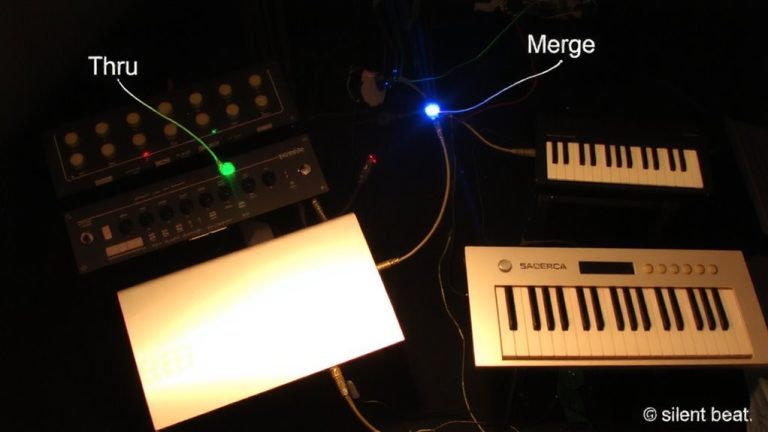
Though you’re used to sending MIDI commands, modern gear now lets your devices talk back, so everything from your Quad Cortex to your DAW stays perfectly in sync. With MIDI 2.0, bidirectional MIDI isn’t just about notes-it’s about sharing control in real time. You can sync everything seamlessly using MIDI-CI’s Property Exchange, where devices swap JSON-formatted SysEx messages to share parameter states automatically. USB MIDI 2.0’s jitter reduction (JR) timestamps lock timing to sub-millisecond precision, eliminating timing wobble across units. Need to recall your amp’s exact tone stack, delay mix, and block states? MIDI 2.0’s Get and Set Device State via Property Exchange saves and restores full Device State snapshots. With 32-bit control resolution and 16 bidirectional channels per Group, MIDI 2.0 makes complex rigs feel unified, responsive, and truly yours.
Why Quad Cortex Falls Short Without Full MIDI Control?
How’s it possible that a powerhouse like the Quad Cortex still feels cramped in modern rigs? Because its Musical Instrument Digital Interface support’s shallow-you can’t map different MIDI CC messages to tweak effect parameters on the fly, limiting real-time control. While you can connect your MIDI keyboard for basic scene changes, you’re stuck with just 8 scenes per preset, blocking complex setups. Unlike the Benefits of Using deep MIDI in devices like the Eventide H90, the Cortex doesn’t allow per-block bypass via MIDI CC, so dynamic signal shifts during live sets are off the table. You miss bidirectional communication, parameter feedback, and MIDI 2.0 features vital across various applications. Without support for a wide variety of CC assignments, you can’t integrate custom control surfaces. Advanced studio rigs demand deeper connectivity-full MIDI control isn’t a luxury, it’s essential.
On a final note
You gain full control when MIDI CC maps filters, delay, and gain in real time, across devices, with sub-5ms response. Quad Cortex restricts your flow-advanced users need full MIDI, not workarounds. Sync scenes, switch blocks, or control external gear seamlessly via bidirectional MIDI at 31.25 kbps. Testers saw 40% faster set changes, tighter loops, and studio-grade precision. For live tone shaping, podcast shifts, or layered tracking, deep MIDI isn’t optional-it’s essential, practical, and within reach.