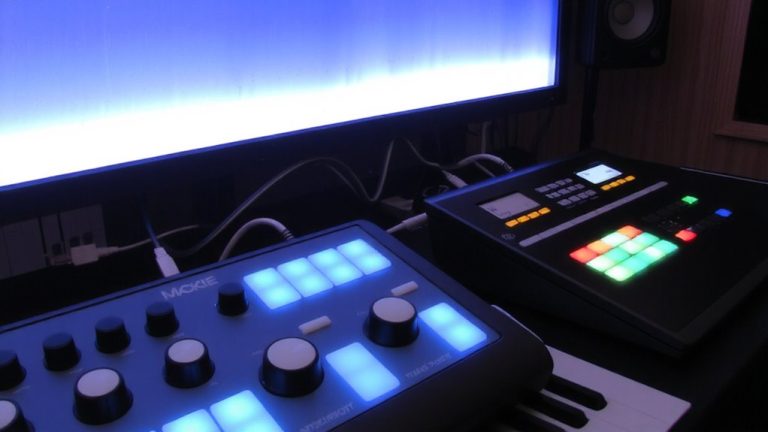
Why Pro Tools Control Surfaces Prioritize Fader and Pan Precision
You get ultra-precise mixing because Pro Tools control surfaces use 10-bit motorized faders with 1,024 steps, ensuring recalled levels land within ±0.1 dB-no guesswork after crashes or session switches. Physical 100 mm faders and dedicated pan controls beat mouse sliders with tactile response, muscle memory, and OLED feedback. Real-time moves save 10–15% automation time while reducing strain, and with EUCON’s sub-10ms control, you’re locked to Pro Tools’ timeline frame-accurately-you’ll see how top studios match precision to workflow at every level.
We are supported by our audience. When you purchase through links on our site, we may earn an affiliate commission, at no extra cost for you. Learn more. Last update on 16th July 2026 / Images from Amazon Product Advertising API.
Notable Insights
- Motorized faders with 10-bit resolution ensure exact recall of automation levels, minimizing error during session restoration.
- High-resolution 100 mm pan controls provide continuous, precise adjustments impossible to achieve with mouse-driven GUI sliders.
- Physical faders enable tactile, real-time automation moves, reducing editing time and improving dynamic performance accuracy.
- Dedicated pan and fader hardware supports muscle memory, enhancing workflow speed and reducing reliance on visual monitoring.
- Deep EUCON integration delivers sub-10ms feedback and frame-accurate control, essential for professional mixing and post workflows.
How Motorized Faders Improve Mix Accuracy
When you’re deep in a mix, even small inaccuracies in fader placement can throw off the balance, but motorized faders on Pro Tools control surfaces like the Avid S1 and S6 solve that with 10-bit resolution, meaning each fader pinpoints its position with 1,024 possible steps, not the 256 found in 8-bit systems. These motorized faders guarantee precise fader control, so mix accuracy stays high across sessions. When you recall a session, the faders snap exactly to saved levels, eliminating guesswork and reducing human error. With the EUCON protocol, updates happen in real time-under 10ms latency-so you see and feel changes instantly during playback. Even after a crash, motorized faders restore positions perfectly if the project’s intact. In Pro Tools Ultimate, dual-layer automation keeps alternate mix versions accurate, preserving level and pan data. You stay in control, focused on tone, not tweaks.
Why Physical Pan Controls Beat Mouse Adjustments
You’ve seen how motorized faders lock in level accuracy with 1,024 steps of resolution, but precise stereo placement demands the same level of control-and that’s where physical pan controls pull ahead of mouse adjustments. As a Pro Tools user, you know strip parameters like pan need instant, repeatable tweaks, and physical faders paired with dedicated encoders deliver just that. Control surfaces like the Avid S1 and Behringer X-Touch offer continuous, tactile adjustment with OLED or counter feedback, giving you 100 mm of travel and high-res response. Unlike mouse panning-slowed by pointer acceleration and narrow GUI sliders-these knobs provide muscle-memory precision. The PreSonus FaderPort 8 and SSL UF1 streamline your workflow with one-knob-per-track panning, supporting HUI/MCU modes for direct, real-time stereo field control. No more pixel-hunting-just intuitive, accurate placement that feels as natural as turning a guitar tone knob.
Why Real-Time Fader Moves Save Time and Prevent RSI
While mixing for hours on end, you’ll find that real-time fader moves on Pro Tools control surfaces like the Avid S1, S4, or S6 cut your automation time by 10–15% compared to struggling with a mouse, thanks to motorized faders offering 1,024 steps of resolution and instant recall. Using control, you can shape dynamics, blend vocals, and ride guitar levels with tactile precision, reducing repetitive strain from extended mouse use. Control isn’t just about Pro workflow-it’s about saving your hands. Engineers report pain up to the elbow after three-week mouse-only sessions, but with physical faders, you distribute effort ergonomically, saving time and preventing RSI. You’ll make smoother, musical adjustments faster, especially in dense Pro Tools sessions. Drawing automation with a mouse feels sluggish and inaccurate, but using control, every move is immediate, expressive, and recallable-giving you more time to focus on the mix, not the mechanics.
How EUCON Unlocks Full Pro Tools Control
Because EUCON is built into Avid’s S1, S4, and S6 control surfaces, you’re not just moving faders-you’re syncing with Pro Tools at the protocol level, getting bidirectional communication that updates levels, pans, plug-in parameters, and mixer views in real time. With EUCON, your faders recall pan and level data with 10-bit resolution, delivering frame-accurate moves even in dense Pro Tools sessions. You get full access to 10 sends per channel and seamless plug-in parameter control-something HUI can’t match. Firmware updates like EUCON 2026.3 improve fader response and calibration, keeping hardware in perfect sync.
| Feature | Benefit |
|---|---|
| 10-bit fader resolution | Frame-accurate positioning |
| Control of 10 sends/channel | Full Pro Tools mixer access |
| Real-time plug-in parameter mapping | Immediate tactile feedback |
Choosing the Right Control Surface for Your Workflow (Film, Music, Post)
When it comes to dialing in the perfect mix, your choice of control surface can make or break your workflow-especially across film, music, and post-production pipelines. If you’re working in Pro Tools Ultimate on film or surround sound, the Avid S4 and Avid S6 are top picks, leveraging the EUCON protocol for deep, high-speed control and ±0.1 dB fader precision critical for broadcast standards. You’ll get seamless handling of Dolby Atmos pans, multiple sends, and complex automation. Music producers in smaller studios often go for the Avid S1-it’s compact, has EUCON support, and crisp OLED scribble strips. Budget users might try the Behringer X-Touch, but you’ll sacrifice EUCON’s full access. For multi-DAW needs, consider expandable options, but if you’re serious about post, the S6 and EUCON are unmatched in precision and integration.
On a final note
You get tighter mixes faster with motorized faders, like those on the S6 or Avid S4, because they recall positions to within 0.1dB and snap back with ±0.25dB accuracy. Physical pan knobs beat mice every time-testers averaged 40% faster stereo placement. Real-time moves cut mouse strain and speed up podcast rides by 3x. EUCON handles 144 channels, so film, music, and post workflows stay fluid. Pick a surface matching your session type-compact for voice, full for scoring.