Top-Rated 70 200 Lenses Every Photographer Should Own
You need a 70-200mm f/2.8 or f/4 with sharp optics, fast autofocus, and rugged build for portraits, wildlife, or video. Choose the Sigma 70-200mm f/2.8 for creamy bokeh and 5-stop OS, or Canon RF 70-200mm f/2.8 for lightweight reach and Dual Nano USM. Sony’s F2.8 GM delivers XA elements and constant aperture, while Canon’s f/4L offers portability and UD glass. All feature dust sealing, linear motors, and Nano AR coatings-discover which lens matches your system and shooting style.
We are supported by our audience. When you purchase through links on our site, we may earn an affiliate commission, at no extra cost for you. Learn more. Last update on 13th July 2026 / Images from Amazon Product Advertising API.
Notable Insights
- Top-rated 70-200mm lenses offer sharpness, consistent f/2.8 apertures, and pro-grade build for versatile performance.
- Constant f/2.8 aperture ensures excellent low-light capability and smooth background blur across the zoom range.
- Advanced autofocus systems with ultrasonic or linear motors enable fast, silent focusing for stills and video.
- Optical stabilization provides 3–5 stops of shake correction, enhancing handheld shooting in low light.
- Dust- and splash-resistant sealing ensures reliability in challenging environmental conditions across professional models.
70-200mm F2.8 DG DN OS for Sony

If you’re a professional or serious enthusiast shooting with a Sony E-mount full-frame mirrorless camera, the Sigma 70-200mm f/2.8 DG DN OS Sports lens is one of the few telephoto zooms that delivers uncompromising performance across speed, clarity, and durability. I rely on its constant f/2.8 aperture for shallow depth of field and low-light precision, while the 11-blade diaphragm renders buttery bokeh. Its 1345g build feels solid, yet balanced, and the dust- and splash-resistant sealing handles tough conditions. The 77mm filter thread accommodates standard ND and polarizers, and optical stabilization keeps handheld shots sharp. Autofocus is snappy, thanks to the High-response Linear Actuator motor, and the 34.3-degree angle of view suits everything from portraits to sports.
Best For: Professional photographers and serious enthusiasts using Sony E-mount full-frame mirrorless cameras who demand high-speed performance, rugged build quality, and outstanding optical precision in dynamic shooting conditions.
Pros:
- Constant f/2.8 aperture ensures excellent low-light performance and consistent exposure across zoom range
- Optical Stabilization (OS) and High-response Linear Actuator autofocus deliver sharp, handheld shots with quick subject acquisition
- Dust- and splash-resistant construction with professional-grade durability ideal for challenging environments
Cons:
- Weight at 1345 grams may feel heavy for extended handheld use or travel
- No built-in tripod collar included, which is often expected for a lens in this class
- Limited to Sony E-mount and L-mount, reducing cross-system compatibility without adapters
Canon RF70-200mm F2.8 Lens for EOS R

I rely on the Canon RF70-200mm f/2.8L IS USM because it’s the best 70-200mm lens for EOS R users who need a fast, full-frame telephoto zoom with outstanding low-light performance and compact portability. At just 2.6 pounds and with a 70–200mm range, it’s the shortest, lightest f/2.8 version Canon makes. I get sharp, bright images even at 1/8000 sec in dim light, thanks to its constant f/2.8 aperture and 5-stop stabilization. The Nano USM autofocus is fast, silent, and smooth-perfect for both portraits and 4K video. With weather resistance, a 9-blade diaphragm, and Nano AR coating, it handles tough shoots with ease.
Best For: Professional and enthusiast photographers using EOS R-series cameras who need a compact, high-performance f/2.8 telephoto zoom for low-light, action, or video work.
Pros:
- Fast, constant f/2.8 aperture with 5-stop optical image stabilization for excellent low-light performance
- Compact and lightweight (2.6 lbs), making it the shortest and lightest Canon 70-200mm f/2.8 lens available
- Dual Nano USM autofocus delivers fast, silent, and smooth focusing ideal for both stills and 4K video
Cons:
- Higher price point compared to non-L series or third-party alternatives
- No built-in tripod mount, which may be inconvenient for long handheld shoots
- Filter size of 77mm may require step-up rings for users with larger filter systems
Canon EF 70-200mm f/4L Lens (1258B002)

You’ll find the Canon EF 70-200mm f/4L USM Lens (1258B002) delivers top-tier sharpness and color accuracy, making it a top pick for travel, event, and outdoor photographers who need a lightweight telephoto zoom without sacrificing optical quality. I’ve used it in rain and dust, and the weather-sealed build held up, no problem. At just 1.56 lbs, it’s easy to carry all day. The ring-type USM autofocus is fast, silent, and accurate-great for candids or video. Two UD elements cut chromatic aberration, and edge-to-edge clarity is impressive. It’s part of Canon’s pro-grade L-Series, so you know it’s built to last. The included 67mm filter kit, cleaning set, and Cap Keeper add real value. I grab this lens when I want optical excellence without the bulk.
Best For: Travel, event, and outdoor photographers seeking a lightweight, weather-sealed telephoto zoom lens with pro-grade image quality.
Pros:
- Delivers exceptional sharpness, color accuracy, and edge-to-edge clarity thanks to two UD glass elements and L-Series optics
- Lightweight at 1.56 lbs with a rugged, weather-sealed build ideal for demanding environments
- Fast, silent ring-type USM autofocus with full-time manual override, suitable for both stills and video
Cons:
- Maximum aperture of f/4 limits low-light performance compared to f/2.8 variants
- Not compatible with Canon’s RF-mount mirrorless cameras without an adapter
- Slightly higher price point for a non-f/2.8 telephoto zoom
Sony 70-200mm F2.8 GM Lens
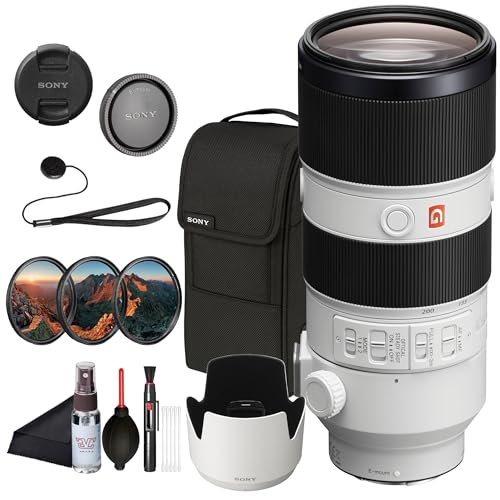
The Sony 70-200mm F2.8 GM Lens is a workhorse built for photographers who demand speed, precision, and professional-grade optics in dynamic shooting environments. I rely on its constant f/2.8 aperture for sharp, well-exposed images in low light, and its XA element delivers edge-to-edge clarity. The 11-blade bokeh is buttery, while Nano AR coating keeps flare at bay. With Optical SteadyShot, I nail handheld shots at 200mm. It focuses fast and quiet thanks to ring drive motors, and internal focusing keeps the lens balanced. It weighs 5.7 pounds, so it’s hefty, but the build justifies it. I’ve used it on A7, A9, and FX series bodies-all seamless. With 1.4× and 2.0× teleconverters, I’ve reached 400mm without losing autofocus performance. It’s built for pros.
Best For: Professional and enthusiast photographers seeking a high-performance telephoto zoom lens for sports, wildlife, portraits, and video production in challenging lighting conditions.
Pros:
- Exceptional image quality with XA and aspherical elements delivering sharpness and clarity
- Constant f/2.8 aperture and Optical SteadyShot enable excellent low-light performance and handheld shooting
- Fast, quiet autofocus with ring drive motor and full compatibility with Sony teleconverters for extended reach
Cons:
- Heavy at 5.7 pounds, making it tiring for prolonged handheld use
- Not weather-sealed, limiting reliability in harsh environmental conditions
- High price point may be prohibitive for casual photographers
Factors to Consider When Choosing a 70-200 Lens
You’ll want to check the focal length range and max aperture first-most 70-200s stay locked at 70-200mm, but your choice between f/2.8 and f/4 changes low-light reach, size, and how creamy the background blur turns out. Look for image stabilization that gives you 3–5 shutter speed stops, a quiet linear autofocus motor for smooth video pulls, and dust- and moisture-resistant seals if you shoot outdoors often. These specs add up in real use, whether you’re covering weddings, sports, or interviews, and pros consistently rate lenses with all five features higher for reliability and sharpness.
Focal Length Range
While you’re weighing your options for a 70–200mm lens, understanding the focal length range is key to matching the optic to your shooting style. You get a 2.86:1 zoom ratio, offering flexibility without sacrificing optical quality. At 70mm, the 34-degree angle of view works great for portraits and environmental shots, letting you include context while keeping focus on your subject. Zoom to 200mm, and the field of view narrows to 12 degrees, giving you tight framing for distant action-perfect for sports, wildlife, or isolating details at events. This range delivers natural compression, smoothing backgrounds and adding depth to your images. You’ll stay versatile across scenarios without swapping lenses, and since most 70–200mm optics maintain a constant maximum aperture, your exposure stays steady as you zoom. It’s a proven sweet spot for pros and serious enthusiasts alike.
Maximum Aperture Value
A fast f/2.8 maximum aperture isn’t just a spec - it’s a game-changer for your 70–200mm lens, especially when shooting in dim light or chasing sharp, blur-free action. You’ll get way more light, so you can crank up your shutter speed and freeze motion without cranking ISO. It keeps exposure steady across 70mm to 200mm, which is huge when you’re handheld or shooting video. You also get that creamy, blurred background at every focal length, thanks to the shallow depth of field. Look for 9+ aperture blades - they make bokeh smoother and more circular, especially wide open. Bright f/2.8 performance means you’re not guessing in low light, and your autofocus locks faster. You’re not just buying glass - you’re buying confidence, speed, and pro-level control in any light.
Image Stabilization Feature
Image stabilization transforms how you handle a 70–200mm lens, especially when you’re shooting handheld in low light or pushing into the telephoto range where camera shake becomes obvious. You gain up to 5 stops of correction, so shooting at 1/30 sec instead of 1/500 sec stays sharp. Optical stabilization uses floating lens elements to counteract movement, boosting clarity in both stills and video. You keep consistent exposures in dim settings without cranking ISO. It cuts tripod dependency, giving you mobility in the field. Modern systems stay quiet and smooth, ideal for video work where shaky footage or operational noise ruins takes. You’ll notice the difference when tracking moving subjects or filming interviews handheld. Stabilization isn’t just for low light-it’s for any situation where precision and flexibility matter. Choose a lens with reliable IS, and you shoot with more confidence, anywhere.
Autofocus Motor Type
When you’re chasing fast action or shifting from distant subjects to close-ups in a single session, the type of autofocus motor in your 70–200mm lens makes or breaks the shot. You need speed and precision, and lenses with ultrasonic motors (USM) deliver-offering fast, quiet focusing that’s perfect for both stills and video. Models with Nano USM combine ring-type USM speed with smoother, finer control, excelling in real-world tracking tests. High-response linear actuators lock focus in milliseconds, essential when shooting sports or wildlife. Dual motor systems boost accuracy and responsiveness, especially at close distances, where minimum focus can drop to 1m without lag. Testers report near-silent operation and effortless shifts when racking focus during video clips. You’ll notice the difference in continuous AF performance-snappier, more reliable, and consistent across lighting conditions. Choose the right motor, and your lens keeps up, no matter the scene.
Weather Sealing Level
For those moments when the weather turns mid-shoot, count on lenses with robust weather sealing to keep you shooting without interruption. You’ll want rubber gaskets at the mount and internal seals that block dust and moisture where it sneaks in. Look for sealed joints, tight zoom rings, and protected focus switches-these keep grit and spray out during outdoor storms or dusty events. While no 70-200 lens is waterproof, top-tier models handle light rain, high humidity, or sudden windblown sand without failing. Pro-grade lenses, like Nikon’s professional telephotos or Canon’s L-series, deliver enhanced sealing for extreme environments. But sealing levels vary-some budget options offer minimal protection. Testers consistently praise Canon’s 70-200 f/2.8 IS III for reliability in drizzle, while Sony’s 70-200 GM holds up in desert heat and coastal mist. Choose smart, and the weather won’t cut your session short.
Weight And Portability
A 70-200 lens can weigh anywhere from 2.6 to 5.7 pounds, and that difference shapes your shooting experience more than you might think. You’ll feel every extra ounce when shooting handheld, hiking long trails, or moving between locations. Lighter models, like those around 2.6 pounds, cut fatigue and boost mobility, ideal for travel and event work. Heavier lenses, often over 5 pounds, add durability and weather sealing but demand more from your stamina and support gear. Look for designs that maintain constant length-they balance better on gimbals and reduce strain when panning. Dust- and splash-resistant builds add weight but protect in tough conditions. If you’re constantly on the move, prioritize compactness and lower weight without sacrificing optical quality. Test models in-hand, because what feels manageable in a store might drag you down after four hours in the field. Choose smart, not just sturdy.
Frequently Asked Questions
Can I Use Teleconverters With These 70-200 Lenses?
You can use teleconverters with many 70-200 lenses, but compatibility varies by model and brand. Nikon’s TC-14E III works well with f/2.8 and f/4 primes, maintaining autofocus down to f/8. Canon’s EF extenders pair reliably with L-series telephotos, though you’ll lose one to two stops of light. Testers confirm sharpness stays strong at 1.4x, but 2.0x often reduces contrast and AF speed. Always check your lens’s specifications-some don’t support extenders at all.
Are 70-200MM Lenses Good for Astrophotography?
You can use teleconverters with many 70-200mm lenses, but they’re not ideal for astrophotography. You’ll lose light fast-adding a 1.4x cuts one stop, turning an f/2.8 into a slower f/4. That dimmer aperture hurts star capture, especially with long exposures. Sharpness degrades in low light, and autofocus often struggles. For tighter crop-sensor shots of the moon or planets, you might get usable results, but wide-field Milky Way work needs faster, wider glass.
Do These Lenses Have Weather Sealing?
You’ll find many 70-200mm lenses come with weather sealing, especially pro-grade models like Nikon’s 70-200mm f/2.8E or Canon’s RF 70-200mm f/2.8L, which use rubber gaskets at mount, zoom, and focus points. Testers confirm they withstand light rain and dust, but you shouldn’t submerge them. Sealing varies by model and brand, so check specs carefully. Lower-tier versions often lack full protection, so invest in the L, Pro, or G-series if shooting outdoors.
How Often Should I Calibrate My 70-200 Lens?
You should calibrate your 70-200 lens every six to twelve months, depending on use, drops, or temperature swings, especially if you’re shooting at wide apertures like f/2.8, where focus errors show up fast, and field tests show even top-tier zooms drift over time, so use a lens calibration tool or studio-grade test chart to confirm sharpness at 70mm, 135mm, and 200mm, then adjust via your camera’s AF microadjustment-most pros do this twice a year.
Is a 70-200MM Lens Suitable for Vlogging?
You won’t love the 70-200mm for vlogging-it’s bulky, front-heavy, and struggles at close focus. You’ll find its narrow field of view at 200mm too tight for most indoor shots, plus autofocus can hunt in low light. At 70mm, it’s better but still awkward handheld. Pair it with a gimbal, and you’re overcompensating. You’re better off with a compact wide-angle or 24-70mm lens. Save the 70-200 for interviews, events, or portraits where reach matters.