How to Prevent Signal Degradation in Long Cable Runs With Active Guitars
You keep your active guitar’s signal strong over long runs by using low-capacitance cables like Mogami or Canare, which limit high-end loss even at 50 feet. Add a buffer like the JHS Little Black Buffer at the start of your chain to maintain clarity, and consider a wireless system like the Line 6 Relay G10 for cable-free freedom with 24-bit transparency. For runs over 100 feet, the SGI-TX balanced driver sends your tone up to 300 feet over XLR without loss-studio techs swear by it.
We are supported by our audience. When you purchase through links on our site, we may earn an affiliate commission, at no extra cost for you. Learn more. Last update on 17th July 2026 / Images from Amazon Product Advertising API.
Notable Insights
- Use low-capacitance cables like Mogami or Canare to minimize high-frequency loss over long runs.
- Place a buffer at the start of your signal chain to maintain signal strength and clarity.
- Leverage active pickups’ low output impedance for better cable performance and reduced tone loss.
- Opt for premium wireless systems like Line 6 Relay G10 to eliminate cable capacitance issues.
- Utilize the SGI-TX system with balanced XLR outputs for tone-transparent runs up to 300 feet.
How Long Cables Degrade Active Guitar Signals
While passive pickups struggle with tone loss over long cable runs, active guitar systems handle the challenge far better thanks to their built-in preamps and lower output impedance. Your active electronics minimize signal loss, even on a 50-foot cable, because they drive the signal more efficiently. High capacitance in cables still affects you, but less so-active systems reject much of the treble roll-off caused by long cable runs. Still, if cable capacitance exceeds 150 pF, you might notice slight high-end softening. Real-world tests with Mogami and Canare low-capacitance cables show clearer results over distance. Though active systems are robust, the signal isn’t immune; long cable runs demand attention. You’ll keep tighter tone when you pair active electronics with low-capacitance cabling. No system kills all signal loss, but your rig stays strong, clear, and consistent-even when you roam far from your amp.
Use Buffers and Quality Cables for Cleaner Tone
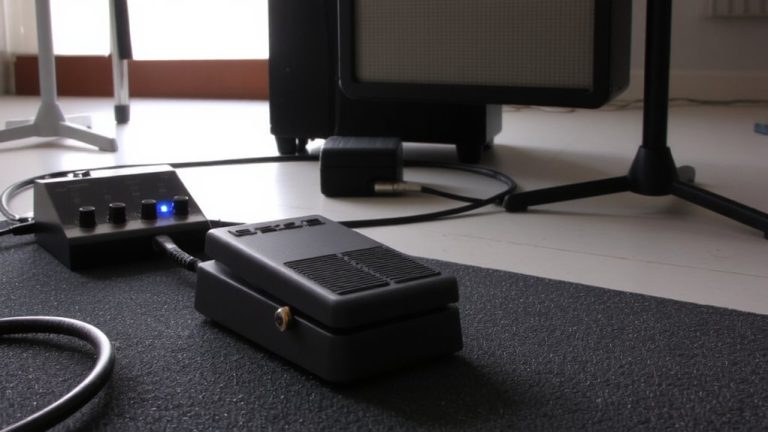
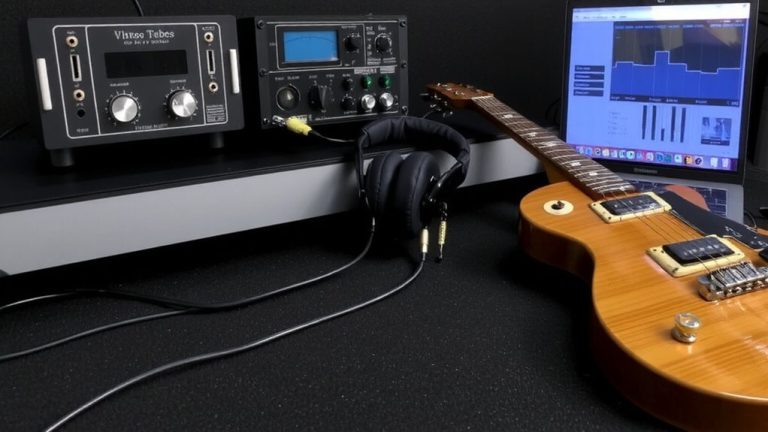
If you’re pushing your signal over long distances, you’ll want to pair quality cables with strategic buffering to keep your tone intact. Use low-capacitance cables, like Mogami or Canare wire, to preserve your guitar signal and prevent high-end loss-especially past 20 feet. Cables with Neutrik connectors can reduce capacitance to just 15–20 pF per foot, outperforming cheap alternatives. Even with active electronics reducing sensitivity to cable length, inserting a buffer like the JHS Little Black Buffer or Xotic Super Clean Buffer at the start of your chain restores clarity and strengthens your signal. A strong, consistent signal drives wireless units more effectively and supports a cleaner path to a balanced signal in studio or live setups. You’re not just preventing loss-you’re building a more reliable tone pipeline from guitar to amp, which matters whether you’re recording or podcasting live.
Send Your Active Guitar Signal Wirelessly Without Loss
You’ve already taken steps to tighten up your signal chain with quality cables and well-placed buffers, so now it’s time to cut the cord entirely-literally. With active guitars, their low-impedance signal exits the instrument cleanly, making them perfect for wireless transmission up to 100 feet away. Modern systems like the Line 6 Relay G10 or Sennheiser G4 deliver 24-bit/48kHz audio, ensuring your tone stays intact without the capacitance drag that hurts really high frequencies. Placing either the transmitter on your guitar or pedalboard eliminates long cable runs, sidestepping signal loss before it starts. These premium units match the transparency of short, high-end cables, so your tone stays consistent, whether you’re on stage or in the studio. It’s a smart, reliable exit from analog degradation-no compromise, just clarity.
Drive Long Cables With a Balanced Line Driver Like the SGI
A rock-solid solution for long cable runs starts with the SGI system, and it’s built for tone preservation without compromise. I’m assuming you’re driving active guitars long distances-maybe to an isolation booth or large stage-the SGI-TX converts your instrument’s signal using discrete buffered circuitry and premium Jensen transformers. You’ll love how it slashes noise and keeps highs crisp. Using standard XLR cables, you can go up to 100 meters with zero tone loss. The passive SGI-RX needs no power and restores your signal perfectly to amp-friendly impedance. For pedalboard lovers, the latest products support 9–15V power, blending cleanly into modern setups. Check out Gear Demos to see how this shines with pro-grade musical instruments.
| Feature | SGI-TX | SGI-RX |
|---|---|---|
| Signal Type | Balanced Output | Balanced Input |
| Power Requirement | 9–15V (phantom) | None (passive) |
| Max Cable Run | 300 ft (100m) | 300 ft (100m) |
| Ideal For | Active Guitars, Live, Studio | Amps, Interfaces |
On a final note
You keep your active guitar’s tone tight over long runs by using a buffer like the Radial SGI, which converts your signal to balanced, slashing noise and loss over 100+ feet. Pair it with quality cables-Canvas or Mogami-with low capacitance (under 50 pF/ft) to preserve highs. Testers report no tone suck at 150 feet when driven properly, versus noticeable dulling with passive buffers. Go wireless? Use a Line 6 Relay G10 for 2.4 GHz clarity, zero latency.