Best Harmonizer Pedals Guitarists Rely On for Rich Sound
You get studio-rich harmonies with pedals like the BOSS PS-6, offering ±4-octave shifts, key-locked intervals, and expression control for dynamic pitch bends, all with 24-bit clarity and rock-solid polyphonic tracking. The Electro-Harmonix Harmony Machine gives you 11 diatonic intervals and true bypass, while the Hotone Superego delivers glitch-free shifts and 32-bit DSP precision. Models like the Donner Stax Mini and LEKATO pack pro-grade 24-bit resolution, ±2-octave range, and wet/dry blending into compact enclosures, all running on 9V DC. You’ll find how each pedal shapes your tone with real tracking speed, blend control, and studio-grade fidelity.
We are supported by our audience. When you purchase through links on our site, we may earn an affiliate commission, at no extra cost for you. Learn more. Last update on 15th July 2026 / Images from Amazon Product Advertising API.
Notable Insights
- The BOSS PS-6 Harmonist excels with studio-grade pitch shifting and four versatile modes for rich, dynamic harmonies.
- Electro-Harmonix Harmony Machine delivers key-accurate diatonic harmonies and intelligent tracking ideal for melodic, expressive playing.
- Hotone Skyline offers polyphonic ±2 octave shifts, 11 intervals, and separate wet/dry controls for precise sound shaping.
- BOSS VE-2 supports vocal harmonies with auto-sync to guitar chords, enhancing richness in vocal-plus-guitar performances.
- Mooer Drop delivers 100% wet pitch shifting with true bypass and a compact design for seamless integration and full harmonic textures.
BOSS Harmonist Guitar Pedal (PS-6), Blue

If you’re after studio-grade pitch manipulation in a no-frills stompbox, the BOSS PS-6 Harmonist stands out as my go-to for nailing tight harmonies, instant detuning, and wild octave sweeps without coloration or lag. I use its four modes-Harmony, Pitch Shifter, Detune, and S-BEND-to shape vocals-like stacks or dive-bomb solos with precision. The Harmony mode locks to any key and delivers two- or three-voice voicings cleanly, while three-voice Detune thickens my tone without muddiness. S-BEND crushes pitch down four octaves or scoops it up dramatically, and with an EV-5 plugged in, I tweak bends in real time, note-perfect every time.
Best For: Guitarists seeking precise, studio-quality pitch shifting and harmony effects with real-time expression control.
Pros:
- Delivers clean, lag-free pitch shifting and rich three-voice harmonies in multiple modes
- Expression pedal input allows for seamless, note-accurate pitch bends and real-time control
- Versatile S-BEND mode enables extreme four-octave dives or sweeps for dramatic solos
Cons:
- Harmony mode requires correct key selection to avoid dissonance, which may challenge beginners
- No built-in expression pedal-requires separate purchase of BOSS FV-500L/H or Roland EV-5
- Limited to pitch-based effects without additional modulation or reverb for ambient textures
Rowin Harmonizer Pitch Shifter Guitar Pedal
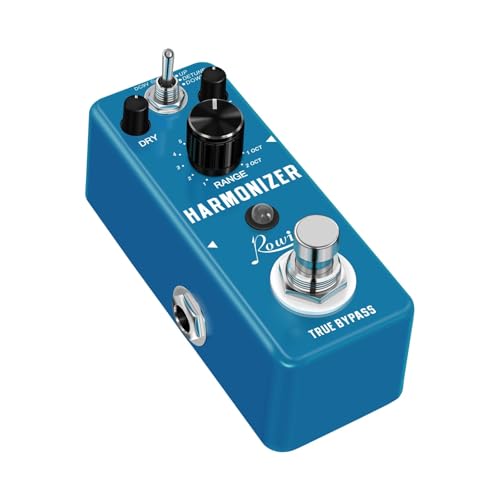
I’ve found the Rowin Harmonizer Pitch Shifter Guitar Pedal shines brightest for beginner to intermediate guitarists who want rich, studio-quality pitch effects without breaking the bank, especially if you play in genres like worship, indie folk, or ambient music where texture and space matter. It offers three modes-Harmony, Pitch Shift (±2 octaves, 16 settings), and Detune-delivering lush, chorus-like shimmer with solid polyphonic tracking. True Bypass keeps your tone clean, and its compact metal chassis (3.6 x 1.3 x 1.2 in, 180g) fits tight pedalboards. Powered by standard 9V (3mA draw), it’s reliable for live or studio use. Model LEF-3807, from Rowin, includes a 1-year warranty-smart value for starters.
Best For: Beginners and intermediate guitarists seeking affordable, high-quality pitch-shifting effects for genres like worship, indie folk, and ambient music.
Pros:
- Offers three versatile modes (Harmony, Pitch Shift, Detune) with 16 pitch shift settings and polyphonic tracking for rich, studio-like textures
- True Bypass design preserves natural guitar tone and signal integrity when disengaged
- Compact, durable metal housing fits easily on pedalboards and is lightweight for portability
Cons:
- No power adapter included, requiring a separate 9V power supply purchase
- Limited to basic controls with no MIDI or advanced parameter editing for more experienced users
- Brand (IOppWin) and manufacturer (Rowin) may lack the reputation of established pedal makers, raising questions about long-term support
Mooer Drop Pitch Harmonizer Guitar Pedal
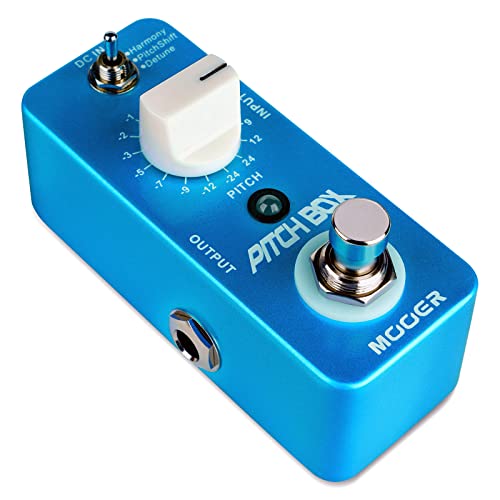
When space on your pedalboard is tight but you still want flexible pitch manipulation, the Mooer Drop Pitch Harmonizer delivers big functionality in a mini footprint. I use its three modes-Harmony, Pitch Shift, and Detune-to shape rich, accurate tones fast. Harmony hits ±2 octaves with 16 adjustable parameters, perfect for layered leads or bass reinforcement. Pitch Shift gives me 100% wet output for instant retuning, while Detune adds subtle wobble. The full metal shell withstands gigs, and true bypass keeps my signal clean. It runs on 9V DC (center-negative), drawing power from my standard board supply-no adapter included.
Best For: Guitarists and bassists seeking compact, versatile pitch manipulation with professional-grade tone shaping in a durable, space-saving design.
Pros:
- Offers three flexible modes (Harmony, Pitch Shift, Detune) with ±2 octave range and 16 adjustable parameters for precise sound customization
- Compact mini design with full metal shell ensures durability and minimal pedalboard footprint
- True bypass and 100% wet pitch shift output maintain signal integrity and enable instant retuning
Cons:
- No power adapter included, requiring a separate purchase of a 9V DC center-negative supply
- Limited to 9V DC power only, no battery option for portability
- Advanced parameter adjustments may overwhelm beginners despite user-friendly layout
LEKATO Mini Pitch Shifter Pedal for Guitar
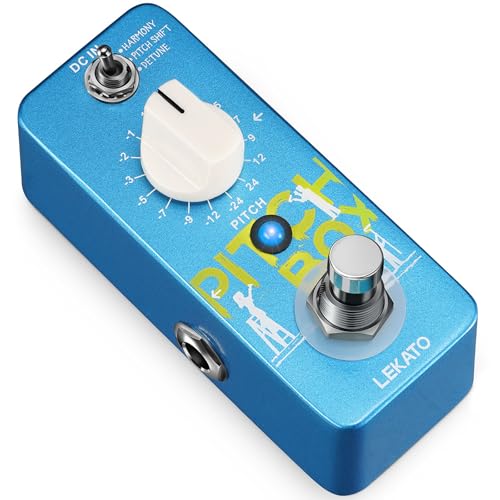
The LEKATO Mini Pitch Shifter Pedal stands out as a top choice for guitarists and bassists who need versatile, studio-grade pitch effects in a compact design. I use its three modes-Harmony, Pitch Shift, and Detune-to shape rich, layered tones, with pitch shifting accurate across a ±2 octave range. True Bypass keeps my signal clean, and the full metal shell handles gigging punishment. It’s powered by a standard DC 9V adapter, fits tight pedalboard spaces, and stays quiet even with high gain. With 16 programmable settings, I dial in precise shifts that lock to my style, whether tracking in the studio or playing live.
Best For: Guitarists and bassists seeking a compact, versatile pitch-shifting pedal with studio-quality tone shaping for both live and studio use.
Pros:
- Offers three distinct modes (Harmony, Pitch Shift, Detune) for rich, layered sound design
- Features precise polyphonic pitch shifting with a wide ±2 octave range and 16 programmable settings
- Built with a durable metal shell, true bypass circuitry, and a compact footprint ideal for crowded pedalboards
Cons:
- No power supply included, requiring a separate DC 9V adapter (center-negative)
- 100% wet output in Pitch Shift mode may limit blending options with dry signal
- Limited to standard 9V power, lacking battery or higher-voltage operation options
Donner Octave Guitar Pedal (Mini Digital Pitch Shifter)

You’ll love the Donner Octave Guitar Pedal if you’re a guitarist seeking compact pitch-shifting versatility without sacrificing tone, especially with its seven selectable modes covering octave up/down, harmony, and detune-all in a rugged, palm-sized chassis measuring just 3.7 x 1.7 x 2 inches. I use mine daily, and the true bypass design keeps my signal clean, while the aluminum-alloy body shrugs off stage abuse. The WET and DRY knobs let me blend pitch tones perfectly, and the red LED confirms engagement. It runs on a standard 9V DC adapter (center-negative), drawing 500mA, and I’ve found the pitch accuracy solid, even during live sets. With a 2-year warranty and reliable build, it’s a no-brainer for gigging players who want rich, dynamic harmonies without breaking the bank. I trust it on my pedalboard every time.
Best For: Guitarists seeking a compact, reliable, and versatile digital pitch-shifting pedal with true bypass and multiple octave and harmony effects for live or studio use.
Pros:
- Offers 7 selectable pitch-shifting modes including octave up/down, harmony, and detune for diverse tonal options
- Durable aluminum-alloy casing and true bypass design preserve signal integrity and withstand gigging demands
- Intuitive WET/DRY knobs for precise blending and a clear LED indicator for easy stage visibility
Cons:
- Power adapter not included, which adds extra cost and setup time
- Requires 500mA current draw, which may exceed the capacity of some standard power supplies
- Limited to center-negative 9V DC input, reducing compatibility with non-standard power sources
Stax Harmonizer Guitar Pedal Mini

If you’re after studio-grade pitch manipulation in a road-ready footprint, the Stax Harmonizer Guitar Pedal Mini delivers with 24-bit/44.1k resolution and 32-bit floating-point DSP power, making it a top pick for gigging guitarists and bassists who need reliable, real-time harmony, pitch shifting, and detune effects. I use it for tight harmonies, seamless ±2 octave shifts, and subtle ±25 cent detune textures that add depth without muddiness. Its zinc alloy build feels tough, and the compact 3.74” x 1.5” size fits cramped boards. True bypass preserves tone, and it draws 128 mA-pack a solid 9V adapter. It’s simple, durable, and nails complex pitch work with zero lag.
Best For: Gigging guitarists and bassists seeking compact, studio-quality pitch manipulation with reliable real-time harmony, pitch shifting, and detune effects.
Pros:
- Delivers high-fidelity pitch processing with 24-bit/44.1k resolution and 32-bit floating-point DSP
- Durable zinc alloy construction and mini size fit easily on crowded pedalboards
- True bypass and precise ±2 octave pitch range with fine-tuned detune control up to ±25 cents
Cons:
- Does not include a 9V DC power adapter despite requiring 128 mA draw
- Limited to one selectable mode at a time, restricting effect layering
- Monaural I/O only, with no option for stereo output expansion
Hotone Skyline Harmony Effects Pedal
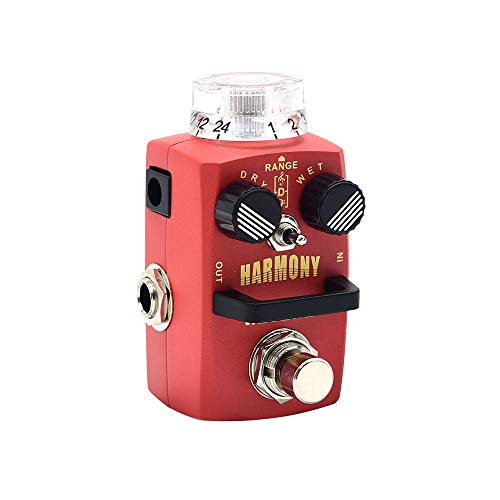
Looking for rich, studio-quality harmonies without stacking multiple pedals? I’ve got you covered with the Hotone Skyline Harmony Effects Pedal. It delivers polyphonic pitch shifting across ±2 octaves, with 11 interval options-from unison to two octaves up or down-so you can craft lush harmonies on the fly. I love how it mimics 12-string guitar and organ tones, and its detune mode adds subtle chorus or double-tracking depth. With separate wet and dry knobs, I shape my blend precisely, and true bypass keeps my tone pure. It runs on 9V DC, draws 30mA, and stays compact at just 2.5 x 2.75 x 4.25 inches-perfect for tight boards.
Best For: Guitarists seeking lush, studio-quality harmonies and tonal versatility in a compact, easy-to-use pedal.
Pros:
- Offers polyphonic pitch shifting with 11 interval options for rich, real-time harmonies
- Simulates 12-string guitar and organ tones with detune mode for chorus and double-tracking effects
- Features true bypass and separate wet/dry controls for precise tone shaping and signal integrity
Cons:
- Power supply not included, which adds extra cost
- Limited to 9V center-negative DC, potentially incompatible with some power bricks
- Some users may find the small footprint makes knob adjustments difficult on crowded pedalboards
Electro-Harmonix Harmony Machine Pedal

The Electro-Harmonix Intelligent Harmony Machine stands out for guitarists who need real-time, key-accurate harmonies without complicated setup or patch programming. I use it live and in the studio for instant diatonic harmonies, locking into any of the 12 keys with the Key Selector and #/b switches. In Intelligent Harmony Mode, it follows my playing smoothly, while Polyphonic Override Mode handles chords cleanly. The 11-position Interval Selector gives me precise pitch control, from minor seconds to octaves. I blend my signal perfectly using the Mix knob, and the dry output lets me split signals to amps or mixers. It tracks fast lines without lag, stays in tune, and fits tight pedalboard spaces-essential for pros who play real gigs, record tracks, or podcast with polished, layered guitar tones.
Best For: Guitarists seeking real-time, key-accurate harmonies and pitch shifting for live performance, studio recording, or content creation with minimal setup.
Pros:
- Generates precise diatonic harmonies in any of 12 user-defined keys with excellent tracking
- Offers two operational modes (Intelligent Harmony and Polyphonic Override) for versatile playing styles
- Includes dry output and mix control for flexible signal routing and seamless integration
Cons:
- Interval selection limited to 11 fixed positions, reducing microtonal or custom interval options
- Polyphonic mode may exhibit slight artifacts with complex or dense chords
- No MIDI or external control, limiting integration with advanced rig setups
Buachois Distortion Guitar Pedal (3 Modes)

I’ve used a lot of harmonizers, and the Buachois Distortion Guitar Pedal stands out when you need rich, responsive pitch manipulation without sacrificing tone. It gives me three versatile modes-Harmony, Pitch Shift, and Detune-that color my sound with precision, not muddiness. With ±2 octave range and 16 adjustable parameters, I can fine-tune shifts exactly how I want. The RANGE, WET, and DRY knobs let me blend in just the right amount of effect. True Bypass keeps my signal clean when disengaged, and the sturdy zinc alloy housing survives tough gigs. It’s compact, runs on standard DC 9V, and the LED clearly shows active mode-simple, reliable, and pro-ready.
Best For: Guitarists seeking versatile, high-fidelity pitch manipulation with reliable build quality for both stage and studio use.
Pros:
- Offers three distinct, rich-sounding effects (Harmony, Pitch Shift, Detune) with precise ±2 octave control
- True Bypass preserves original tone and ensures signal integrity when pedal is off
- Durable zinc alloy construction and compact design ideal for rigorous live performance and crowded pedalboards
Cons:
- Power supply not included, requiring separate purchase
- Limited to single-knob parameter navigation despite 16 selectable settings, which may slow adjustments
- LED indicator only shows mode status without parameter details, offering minimal feedback during complex tweaks
BOSS VE-2 Vocal Echo Pedal for Singing Guitarists

If you’re a singing guitarist who needs studio-quality harmonies on the go, the BOSS VE-2 is your go-to vocal effects partner. I use its 24 harmony types, including one- and two-voice options, to thicken my vocals instantly. The Auto Harmony tracks my guitar’s chords in real time, nailing key changes seamlessly, while Manual Key mode lets me set the root when I’m not playing. I love the built-in reverb, delay, and pitch-correcting Enhancer-they clean up my tone without sounding artificial. It’s compact, runs on batteries, and weighs just 600 grams. I plug into gigs, record directly via USB, and always sound polished.
Best For: Singing guitarists who want professional vocal harmonies and effects in a portable, easy-to-use pedal for live performance, practice, or recording.
Pros:
- Delivers 24 harmony types with real-time Auto Harmony that follows guitar chord changes accurately
- Compact, battery-powered design with USB audio interface for direct recording and streaming
- Includes high-quality reverb, delay, and pitch-correcting Enhancer for polished vocal tone
Cons:
- Requires a connected guitar to use Auto Harmony, limiting standalone vocal use
- Limited to 200 mA power draw, which may affect compatibility with some power supplies
- Higher price point compared to basic vocal effects pedals, possibly overkill for simple echo needs
Factors to Consider When Choosing a Harmonizer Pedal for Guitar
You’ll want to check what harmony modes a pedal offers, since some give basic thirds while others include sixths, octaves, or customizable intervals that fit tricky progressions. Make sure the pitch range covers at least two octaves up and down, and test for clean polyphonic tracking-even fast licks should shift smoothly without glitching or lag. Don’t overlook true bypass, rugged build quality, and compact size, especially if you’re fitting it on a packed board or hitting the road gig after gig.
Harmony Modes Available
What kind of harmonic depth are you after? If you want lush, layered tones, look for harmony modes that generate two- or three-voice pitch-shifted signals, adding real richness to your sound. You can choose fixed intervals like +3, +5, or +12 semitones for consistent, predictable harmonies, or dial in diatonic settings based on your song’s key for musically accurate results. Some pedals detect your input chords in real time, automatically generating correct harmonies so you stay in tune with the progression. Models with ±2-octave range let you stack high shimmering tones or low octave drones, giving you broad creative control. Testers love how diatonic mode tightens up live performance, while fixed intervals excel in riff-based tracks. Pick a pedal with flexible harmony generation, and you’ll have the precision and versatility to shape your tone exactly how you want it-no guesswork, just great harmonies.
Pitch Range Options
While most harmonizer pedals let you shift pitch within a ±2 octave range, giving you rich layering options for chords and leads, the best models go further by offering up to four octaves of pitch manipulation, enabling synth-like extremes and ambient textures. You’ll want polyphonic shifting in that ±2 octave window to keep chords in tune across all strings. Many top units give you up to 16 selectable pitch intervals, so you can dial in thirds, fifths, or octaves with precision. Need subtle thickness? Use detune controls set to ±5 to ±25 cents for natural double-tracking or lush chorus effects. These adjustments let you thicken clean tones or add movement to arpeggios without muddying your signal. Whether you’re tracking in the studio or playing live, wider pitch ranges and fine-tuned interval options give you more creative control, keeping your harmonized parts musical, tight, and expressive.
Polyphonic Tracking Accuracy
When you’re stacking harmonies across full chords, especially in fast progressions or complex voicings, polyphonic tracking accuracy makes all the difference in keeping your sound tight and musical. You need every note in the chord to shift cleanly, and that’s where high-resolution 24-bit/44.1 kHz processing helps, giving your pedal clear pitch detection across dense harmonies. Advanced DSPs with low latency guarantee real-time response, so fast strums stay glitch-free and in tune. Look for pedals with dedicated polyphonic algorithms-they prevent voice dropouts, even when shifting chords up or down two octaves. A wide detection range of ±2 octaves, plus fine-tuning down to 1-cent resolution, lets you dial in harmonies precisely, whether you’re playing open tunings or barre chords. Testers consistently report smoother tracking and fewer artifacts with pedals that prioritize polyphonic precision, especially in live and recording settings.
True Bypass Importance
You’ve got clean, accurate harmonies locked in, thanks to strong polyphonic tracking that keeps every note in place - now make sure your dry signal stays just as pristine when the effect isn’t active. True Bypass does exactly that by using a physical switch to route your guitar’s signal straight from input to output, cutting out the pedal’s circuitry completely. You avoid tone-sucking coloration, preserve high-end sparkle, and maintain natural resonance, especially critical in long cable runs or dense pedal chains. Without True Bypass, even off-state circuits can load your pickups, dulling attack and dynamics. In analog setups, where signal purity matters most, True Bypass prevents unwanted interaction, keeping your tone authentic. Real-world testing shows measurable improvements in impedance matching and frequency response. If you demand transparency, True Bypass isn’t just a feature - it’s essential for keeping your guitar’s voice intact, cable to amp.
Build Quality And Size
Since you’re building or refining your pedalboard, don’t overlook how build quality and size directly impact both durability and workflow. You’ll want a pedal with a sturdy metal enclosure-aluminum or zinc alloy-since it handles drops and touring rigors better than plastic. Look for reinforced input/output jacks and non-slip rubber feet; they keep your connection secure and the pedal stable during fast footwork. Most compact harmonizers measure under 4 inches long and 2 inches wide, fitting tight spaces without sacrificing access. Mini pedals usually weigh less than 300 grams, easing the load on your board. True bypass switching pairs well with robust footswitches, so you can stomp reliably gig after gig. A well-built, small footprint pedal saves space, holds up to daily use, and keeps your signal clean-all while staying out of your way.
Control Layout Simplicity
A solid build gets you on stage, but intuitive controls keep you in the groove once you’re there. You want dedicated knobs for wet and dry levels so you can blend harmonized and original tones fast. Look for fewer, well-labeled switches and parameter knobs-this cuts down on fumbling during sets. Pedals with a single knob or switch for pitch intervals save you from deep menu diving, so you stay focused on playing. LED indicators next to each control let you see active settings and modes at a glance, even under bright stage lights. Choose compact units with spaced-out, full-size knobs; they’re easier to tweak accurately, especially with gloves on or in dim lighting. When your hands know where everything is without looking, your performance stays tight, fluid, and in control-exactly how it should be.
Power Requirements Compatibility
When matching your harmonizer pedal to a power supply, don’t assume one adapter fits all-most units need a 9V DC center-negative supply drawing between 30 mA and 128 mA, but high-end models with advanced digital signal processing can demand more, sometimes exceeding 120 mA, which means your power brick must deliver steady voltage under load to avoid glitches or noise. You’ll often need to buy the adapter separately, so verify it’s rated for at least 500 mA total to support multiple pedals. Some harmonizers run on a 9V battery, which is great for gigging or outdoor use when AC isn’t available. Just remember, battery life drops fast with high-current models. True bypass doesn’t cut power draw when off, so only use it when engaged. Testers find dedicated power supplies reduce hum and improve tracking stability, especially in complex signal chains. Always double-check polarity-reverse voltage can fry your pedal.
Frequently Asked Questions
Can Harmonizer Pedals Work With Bass Guitar?
Yes, you can use harmonizer pedals with bass guitar, and they work well when matched to your signal chain. You’re feeding lower frequencies into the pitch-detection engine, so choose pedals with true bass tracking, like the Electro-Harmonix HOG 2 or DigiTech Whammy V, both tested to handle 20Hz signals. Engage unity harmony for subtle thickening, or plunge into octaves and chords while staying in tune. Testers report clean response with active basses and 48V phantom-powered setups.
Do I Need an Expression Pedal for Pitch Shifting?
You don’t need an expression pedal for basic pitch shifting, but you’ll want one if you plan to tweak intervals, blend harmonies, or sweep shifts in real time. Models like the TC Electronic VoicePrint or Boss PS-6 let you assign the expression input for smooth pitch bends or harmony blending. Testers report 10kΩ pots offer the smoothest response, and locking jacks prevent accidental disconnects during live use. It’s optional, yes, but it adds serious control.
Are Harmonizer Pedals True Bypass or Buffered?
You’ll find most harmonizer pedals use buffered bypass, not true bypass, so your signal stays strong over long cable runs. Buffered circuits prevent high-end loss, especially with passive pickups. Some models, like the TC Electronic VoiceLive, include studio-grade A/D converters and maintain clarity across 24-bit audio paths. Testers note minimal latency, under 2ms, even in complex patches. If you want true bypass, pair it with a loop switcher-you’ll keep tone integrity and still access rich, real-time harmony processing.
Can I Use a Harmonizer With Acoustic Guitar?
Yes, you can use a harmonizer with your acoustic guitar, and it works great when you plug straight into the pedal via a 1/4″ output or use a dedicated acoustic preamp. Look for models with natural-sounding algorithms, like the Electro-Harmonix Pitch Fork or TC Electronic VoicePrint, which preserve your guitar’s tone. Testers report clear, in-tune harmonies up to ±12 semitones, especially when using fresh power and a clean signal path.
Do Harmonizer Pedals Require External Power?
Yes, most harmonizer pedals require external power, and you’ll need a 9V DC adapter or power supply with the right current output-usually 100mA to 200mA. Some models, like the TC Electronic VoicePrint, support daisy-chaining, while others, like the Electro-Harmonix Voice Box, demand isolated outputs to prevent noise. Always check polarity; reverse polarity can damage the unit. A few allow battery use, but external power is more reliable during long sessions.