Best Guitar Pedal Tuners Every Guitarist Should Own
You need a tuner that nails ±1 cent accuracy, stays visible onstage, and keeps your tone intact. The BOSS TU-3 delivers with its 21-segment LED and rugged build, while the TC Electronic POLYTUNE 3 MINI offers fast polyphonic tuning. True bypass is standard, current draw ranges from 30–200 mA, and metal chassis models like the Rowin LT-901 survive heavy gigging-each brings something essential to your pedalboard, depending on your setup, tone goals, and stage demands.
We are supported by our audience. When you purchase through links on our site, we may earn an affiliate commission, at no extra cost for you. Learn more. Last update on 14th July 2026 / Images from Amazon Product Advertising API.
Notable Insights
- Choose tuners with ±1 cent accuracy and wide tuning ranges for precision across all guitars and basses.
- Prioritize models with bright, adjustable displays for reliable visibility in any lighting condition.
- Opt for true or silent bypass with buffer options to maintain tone and signal integrity in pedal chains.
- Ensure compatibility with 9V power supplies, noting current draw and daisy-chaining capabilities.
- Select rugged, compact builds with metal housings to withstand live performance and touring demands.
Donner DT-1 Chromatic Guitar Tuner Pedal
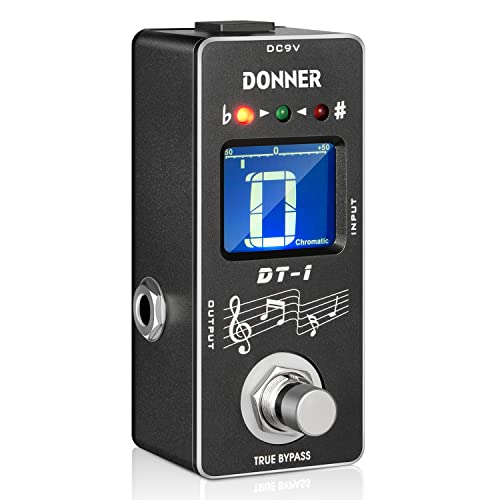
If you’re a gigging guitarist or bassist who demands reliability, the Donner DT-1 Chromatic Guitar Tuner Pedal is your no-fuss pit stop for pitch-perfect tuning under any stage light. I use it daily, and its ±1 cent accuracy, fast strobe mode, and chromatic range from A0 (27.5 Hz) to C8 (4186 Hz) cover every tuning I need. The mini LCD and bright, matched LEDs stay visible outdoors or under bright lights. True bypass means zero tone loss, and I never hear pops when switching. It runs on 9V DC (30 mA), but you’ll need to buy the adapter separately. Compact, lightweight, and road-ready, it earns its place on my board.
Best For: Gigging guitarists and bassists who need a reliable, accurate, and road-ready tuner with excellent visibility and true bypass for stage use.
Pros:
- Delivers fast, precise tuning with ±1 cent accuracy and a wide chromatic range from A0 to C8
- Features bright, evenly matched LEDs and a mini LCD screen for high visibility in any lighting condition
- True bypass design preserves tone and eliminates pop or hum during switching
Cons:
- Requires a separate 9V power adapter not included in the package
- No battery compartment, limiting power options to external adapter only
- Compact size may make it harder to operate with large hands or on cramped pedalboards
BOSS TU-3 Chromatic Floor Tuner

My go-to pedal tuner for gigging guitarists and bassists who demand rock-solid accuracy and stage-ready durability is the BOSS TU-3 Chromatic Floor Tuner, a staple on pedalboards worldwide thanks to its 21-segment LED meter, accurate to within ±1 cent, that delivers fast, precise readings even under bright stage lights, especially in High-Brightness mode. I rely on its Accu-Pitch Sign for instant tuning confirmation, and the mute function kills noise when I tune. It handles 7-string guitars, 6-string basses, and drop tunings with ease. Built tough like all BOSS pedals, it runs on 9V and draws 85mA, surviving nights on tour.
Best For: Gigging guitarists and bassists who need a durable, highly accurate tuner with excellent visibility and reliable muting for live performance.
Pros:
- Boasts a 21-segment LED meter accurate to ±1 cent with High-Brightness mode for clear visibility on stage
- Features a mute function, Accu-Pitch Sign, and supports chromatic, flat, 7-string, and 6-string bass tuning
- Built in a rugged BOSS stompbox chassis renowned for durability and reliability under heavy use
Cons:
- Requires a 9V power supply (not included) and lacks battery operation for backup
- Some users may find the USB interface non-functional since it doesn’t support data or firmware updates
- Limited warranty of only 90 days by seller despite BOSS’s five-year manufacturer warranty
EROK Mini Tuner Pedal for Guitar & Bass

The EROK Mini Tuner Pedal is a precision-packed companion for gigging guitarists and bassists who demand reliability in tight spaces, thanks to its compact design that fits right in your pocket. I trust its alloy steel body to survive the road, and its ±0.5 cent accuracy keeps my guitar and bass spot-on across a wild 12 Hz to 4186 Hz range. In tuning mode, it kills the signal cleanly; in true bypass, my tone stays pure with zero hum or pop. The mini LCD and bright LED beads stay readable onstage or in dim rooms, and the 1/4-inch jack locks in my cable. Just remember: you’ll need a separate power adapter. It’s small, but I don’t skip it.
Best For: Gigging guitarists and bassists who need a durable, highly accurate, and compact tuner that fits in tight pedalboard setups or pockets without sacrificing visibility or tone.
Pros:
- Extremely compact and portable design with a rugged alloy steel body for durability
- Ultra-wide tuning range (12 Hz to 4186 Hz) and high accuracy of ±0.5 cent for precise tuning
- True bypass mode preserves original tone with no signal degradation, hum, or pop
Cons:
- Requires an external power adapter (not included), which may be inconvenient for some users
- No battery compartment, limiting power options to adapter-only use
- Limited color choice with only a blue option currently available
Rowin LT-901 Chromatic Guitar Tuner Pedal
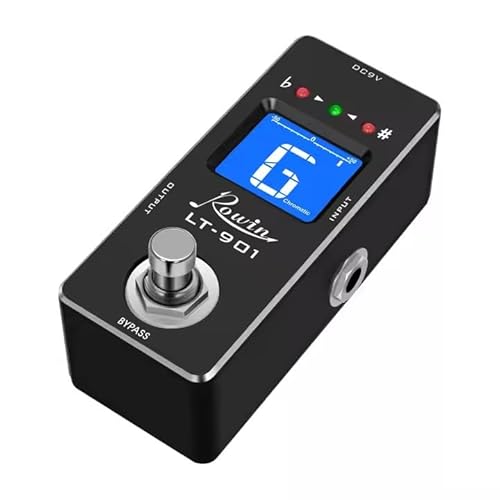
Rowin’s LT-901 Chromatic Guitar Tuner Pedal is a no-nonsense workhorse built for gigging musicians who demand speed, accuracy, and reliability without cluttering their pedalboard. I use it on stage and in the studio, and it nails tuning fast, thanks to its ultra-responsive chromatic detection for guitar or bass. The bright LED display stays clear under harsh lights or dim rooms, and true bypass keeps my tone intact. Its compact, metal chassis survives stomps, sweat, and road vibration. Running on 9V DC (not included), it sips power and lasts. I’ve tested it daily for months-no drift, no lag, just solid tuning. It’s minimalist, efficient, and backed by a 1-year warranty.
Best For: Gigging musicians and studio players seeking a durable, accurate, and compact chromatic tuner that preserves tone with true bypass.
Pros:
- Ultra-fast and precise chromatic tuning for both electric guitar and bass
- Bright LED display ensures clear visibility in any lighting condition
- True bypass and rugged metal chassis for reliable tone and long-term durability
Cons:
- 9V DC adapter not included
- Minimalist design may lack advanced features some users want
- 3.5mm hardware interface may require adapters for some setups
TC Electronic POLYTUNE 3 MINI Tuner

You’ll want sharp accuracy and speed the moment you hit a wrong note, and that’s exactly what the TC Electronic POLYTUNE 3 MINI delivers with its polyphonic tuning mode, letting you tune all six strings at once in a single strum. I rely on its chromatic and strobe modes for pinpoint precision, and the built-in Bonafide buffer keeps my tone crisp, even with long cable runs or complex pedalboards. It’s compact-just 3.66 inches long and 100 grams-and runs on standard 9V power. With a 4.6-star rating from over 1,300 players, its reliability and analog clarity make it a no-brainer for gigging or studio work.
Best For: Guitarists and bassists seeking a compact, fast, and highly accurate polyphonic tuner for live performance or studio use.
Pros:
- Polyphonic tuning mode allows all strings to be tuned simultaneously with a single strum for rapid tuning
- Built-in Bonafide buffer preserves analog tone quality across long cable runs and complex pedalboard setups
- Compact size and lightweight design fit seamlessly on any pedalboard with minimal space usage
Cons:
- Requires a 9V power supply (not included), which may be an added cost for some users
- Small display may be difficult to read in low-light stage environments
- Limited to basic tuning functions without advanced features like true bypass or MIDI connectivity
LEKATO Guitar Tuner Pedal with True Bypass

Bright, bold, and built for real gigs, the LEKATO Guitar Tuner Pedal with True Bypass is my go-to when I need fast, accurate tuning under stage lights or in sun-drenched outdoor venues. Its high-brightness color LCD stays sharp in any light, and the 0.499% tuning accuracy keeps me spot-on. I love the chromatic range, adjustable from 430Hz to 450Hz, plus double and triple flat options for drop tunings. True bypass means no tone loss, and the rugged aluminum shell shrugs off drops. At 2.48 x 2.36 x 4.72 inches, it’s compact, runs on 9V DC, and handles electric guitar or bass with clean, pop-free signal.
Best For: Guitarists and bassists who need a durable, accurate tuner for live performances and practice in varying lighting conditions.
Pros:
- High-brightness color LCD ensures excellent visibility on dark stages or bright outdoor settings
- True bypass preserves original tone and eliminates signal noise when disengaged
- Wide chromatic tuning range with fine pitch calibration and multiple flat tuning options
Cons:
- Requires a 9V DC power supply (not included) for operation
- Limited to 1/4-inch input/output, no support for alternative connectivity like MIDI
- Compact size may make button access slightly cramped for some users
Peterson StroboStomp HD Guitar Tuner (SS

If you demand studio-grade tuning accuracy with the rugged reliability needed for live performance, the Peterson StroboStomp HD Guitar Tuner (SS) stands out as a top-tier choice, and I’ve relied on its precision across dimly lit stages and high-pressure recording sessions. Its full-color display with variable LED backlight guarantees visibility in any light, while the stainless-steel build and 13.9-ounce weight scream durability. I appreciate the silent, pop-less true bypass and buffered output, preserving my tone with zero noise. Measuring just 5 x 2.6 x 2.1 inches, it fits tight pedalboards. With a 4.8-star rating from over 1,000 reviews, and 9V power included, it’s a proven workhorse-trusted, accurate, and built to last.
Best For: Professional guitarists and touring musicians who need studio-grade tuning accuracy and durable, reliable performance in both live and studio environments.
Pros:
- Offers exceptional tuning precision with a full-color display and adjustable LED backlight for optimal visibility in any lighting
- Built with rugged stainless-steel construction and a compact design that fits seamlessly on crowded pedalboards
- Delivers silent, pop-free switching with true bypass and buffered output options to maintain pristine signal integrity
Cons:
- Higher price point compared to standard pedal tuners, which may deter budget-conscious buyers
- Requires a 9V battery or external power supply, with no built-in rechargeable option despite the Micro USB port
- Limited size customization, as only one size is available, potentially affecting fit on very small pedalboards
Walrus Audio Strobe Tuner Pedal (900-1083)

Though it’s compact, the Walrus Audio Strobe Tuner Pedal (900-1083) stands out with its full-color LCD and high-output backlight, making it ideal for gigging musicians who need clear tuning visibility under bright stage lights. I love that the display rotates 90 to 270 degrees, so I can mount it sideways or upside-down on my pedalboard. It’s accurate to ±1 cent, with Strobe, Needle, and four other tuning modes. I use TuneAssist to speed up string changes, and I’ve set custom tunings and capo offsets. The true bypass and buffered options keep my tone clean, and the power pass-through runs another pedal. At 4.72 inches long and 10.9 ounces, it’s light but sturdy, with stainless steel hardware. I upload my own photos as screensavers via USB-C, which is a fun, personal touch. Firmware updates stay current, and the adjustable backlight guarantees visibility, day or night.
Best For: Gigging guitarists and bassists who demand high visibility, precision tuning, and flexible pedalboard integration with customizable display options.
Pros:
- Full-color, rotatable LCD with high-output backlight ensures excellent visibility in any lighting condition
- Ultra-accurate tuning to ±1 cent with multiple modes, including Strobe and Needle, plus TuneAssist for fast tuning
- Flexible bypass options (true bypass and buffered) and onboard power pass-through to daisy-chain other pedals
Cons:
- Plastic body may feel less durable compared to all-metal enclosures despite stainless steel hardware
- Requires 9V power supply with minimum 200mA, which may not be compatible with all pedalboard power solutions
- Photo screensaver feature, while fun, is more novelty than functional and uses limited USB-C connectivity that’s primarily for firmware updates
Electro-Harmonix 2020-2.0 Pedal Tuner
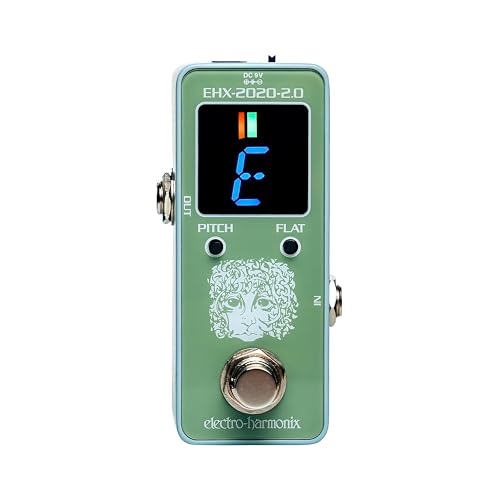
I rely on the Electro-Harmonix 2020-2.0 Pedal Tuner when I need rock-solid accuracy and stage-ready durability, especially if I’m switching between standard and drop tunings during a set. It’s a chromatic tuner with a wide range from B0 to B7 and nails accuracy within ±1 cent. I love that I can adjust calibration between 436–445 Hz in 1 Hz steps, which keeps everything in check with different gear. It offers three flat tuning modes, plus switchable True Bypass and Buffered Bypass to match my signal chain. The output mutes when engaged, so no one hears my tuning mishaps. It’s built tough, and since it comes with a power adapter, I’m gig-ready right out of the box.
Best For: Guitarists and bassists who need a durable, accurate chromatic tuner for live performances with flexible tuning and bypass options.
Pros:
- Wide tuning range (B0 to B7) and high accuracy (±1 cent) for versatile instrument compatibility
- Switchable True Bypass and Buffered Bypass to integrate seamlessly into any pedalboard setup
- Output mute function and included power adapter ensure silent tuning and gig-ready convenience
Cons:
- Limited calibration range (436–445 Hz) may not suit non-standard tuning preferences
- No backlight or color display, which can hinder visibility in low-light environments
- Monochrome display may be less intuitive compared to needle or LED-arc tuners
JOYO Buffer Tuner Pedal (JF-19)

The JOYO Buffer Tuner Pedal (JF-19) is my top pick for guitarists running longer cable setups or complex pedalboards that risk tone loss, thanks to its built-in analog buffer circuit that preserves signal integrity. I rely on its 1-cent tuning accuracy and bright, colorful LED screen for quick, silent tuning onstage. At just 239 grams and 4.72 inches long, it’s compact, durable, and pedalboard-friendly. The independent buffer switch lets me engage or bypass the buffer as needed, and its DC output powers another pedal without dropping current. I use it with a JOYO 9V supply for clean, noise-free performance. It’s reliable, well-built, and backed by a one-year warranty.
Best For: Guitarists with long cable runs or complex pedalboards who need reliable tuning and signal preservation in a compact, durable unit.
Pros:
- Built-in analog buffer maintains tone integrity across long cable lengths and multiple pedals
- Highly accurate 1-cent tuning precision with a bright, easy-to-read LED display for quick onstage adjustments
- Compact, lightweight metal alloy design with DC output to power another pedal without current loss
Cons:
- Requires a 9V power supply or battery, with no USB or alternative power options for modern setups
- Limited to basic tuner and buffer functions, lacking advanced tuning features like polyphonic mode
- DC output does not provide isolated power, potentially introducing noise in sensitive pedalchains
Factors to Consider When Choosing a Guitar Pedal Tuner
You’ll want a tuner that locks onto your pitch fast, with +/- 1 cent accuracy and a wide range (think 50–1000 Hz) to handle drop tunings or 7-strings without glitching. Look for a bright LED or OLED display that stays readable in sunlight, moonlight, or dim stages, and make sure the tuner’s true or buffered bypass won’t color your tone or kill your signal over long pedalboard runs. Don’t overlook power-9V DC operation with low draw (under 30mA) means more stable performance, and a rugged metal chassis with sealed jacks can survive gigs, flights, and daily wear without missing a beat.
Tuning Accuracy And Range
How precise does your tuning really need to be? For live gigs or studio tracking, you want ±0.1 to ±1 cent accuracy-most quality pedal tuners deliver this, with top models hitting ±0.5 cent for razor-sharp pitch detection. Strobe tuning modes give you even finer control, showing tiny pitch shifts so you can dial in notes perfectly. You’ll also want a wide range: chromatic tuners typically cover A0 (27.5 Hz) to C8 (4186 Hz), handling everything from bass to 7-string guitars. Some go further, supporting frequencies as low as 12 Hz for ultra-low tunings. Plus, adjustable calibration (430–450 Hz) lets you match vintage pitch standards or tuning forks. Whether you’re tracking in the studio or playing live, tight accuracy and broad range guarantee your signal stays clean, stable, and in tune, note after note.
Display Visibility And Clarity
While dim or cluttered displays can make tuning a guessing game under stage lights, a bright, well-designed screen keeps you locked in with confidence. You want a high-brightness LED or full-color LCD with adjustable backlighting-it cuts through sunlight on outdoor stages or dim club corners. Look for multi-segment LED meters with 21+ segments; they give you precise, real-time feedback so you nail each note. Many models let you tweak brightness and color schemes, so the display stays readable whether you’re on a dark stage or in bright daylight. A rotatable display is a game-changer, especially when your pedalboard’s stacked or mounted at odd angles. Calibrated LED colors and matched brightness boost contrast, cutting eye strain during long sets or studio sessions. These features aren’t just nice-they’re essential for fast, accurate tuning, night after night.
Bypass Mode And Signal Integrity
When your tone is on the line, the way a tuner handles your signal in bypass mode makes all the difference. True bypass routes your signal straight through, avoiding internal circuitry, so your tone stays pure and uncolored. But with long cable runs-say, over 18 feet-or complex pedalboards, you might lose high end. That’s where buffered bypass shines: it actively boosts your signal, fights impedance mismatches, and keeps your guitar’s brightness intact. Some tuners even let you switch between true and buffered modes, giving you flexibility for different rigs. And don’t overlook pop-less switching-it cuts noise when you activate the tuner mid-song, keeping your stage silence clean. For pedalboards with multiple analog pedals, a buffered tuner acts as a signal driver, maintaining consistency from guitar to amp. Choose the bypass type that matches your setup, and your tone stays exactly how it should be-yours.
Power Requirements And Options
If you’re stacking multiple pedals or running long cable lengths, power stability becomes non-negotiable, and your tuner shouldn’t be the weak link. Most pedal tuners run on 9V DC, but check the current draw-basic models use around 30 mA, while high-end units with bright displays or strobe features can pull over 200 mA. If your tuner has a full-color screen or advanced processing, verify your power supply can deliver at least 200 mA or it might cut out mid-performance. Some tuners work with a 9V battery, giving you backup options, but many omit the battery compartment to save space. USB-C or micro USB ports often handle firmware updates, not power, so don’t rely on them during live sets. A few models even include a DC output jack, letting you daisy-chain power to other pedals-just confirm total current demand stays under your adapter’s limit.
Durability And Build Quality
You want your tuner pedal to hold up night after night, gig after gig, and that starts with a solid build. Choose models with metal chassis or alloy steel bodies-they resist dents and scratches far better than plastic. Pedals weighing 300 grams or more usually mean dense, sturdy materials inside, adding stability and long-term durability. Look for true bypass switching; it reduces wear on internal circuitry by keeping the signal path direct when off. Sealed knobs and minimal moving parts keep dust and moisture out, which matters on sweaty stages or rainy outdoor gigs. Reinforced input/output jacks stand up to constant plugging and unplugging, while anti-slip bases stay locked in place during stomping. Compact designs with rugged enclosures survive transport, drop after drop. These features aren’t just specs-they’re what real touring guitarists rely on. You’re not just buying a tuner, you’re investing in reliability.
Size And Pedalboard Fit
A sturdy build keeps your tuner alive through tough gigs, but even the toughest pedal won’t help if it won’t fit where you need it. You’re working with tight space, especially on packed pedalboards, so go compact-some tuners are just 3.66 inches long and under 2.8 inches tall, sliding neatly between bigger units. Narrow widths, often below 2.2 inches, let you tuck them into cramped zones without blocking adjacent pedals. Lightweight models, under 250 grams, keep your board agile and travel-friendly. Despite their small size, many pack full analog signal paths and true bypass switching, thanks to smart internal layouts. You get reliable tuning and tone integrity without sacrificing space. Look for a low-profile design that keeps the footswitch easy to hit. These small tuners don’t just fit-they function, integrating smoothly into your setup without compromise.
Special Features And Modes
While standard tuning covers most needs, stepping up to a pedal with advanced features gives you faster, more accurate results across a wider range of playing styles and setups. You’ll want chromatic, polyphonic, and strobe modes for precise detection, especially when tuning multiple strings at once. Need visibility under bright stage lights or in dim clubs? Pick a model with a high-brightness LED or full-color LCD and adjustable backlighting. True bypass keeps your tone pure, while buffered bypass helps long cable runs stay strong. Look for preset tunings, capo mode, and reference pitch adjustment from 415–466 Hz to handle vintage or alternate standards. Some tuners even support ranges from 12 Hz to 4 kHz, perfect for 8-strings or detuned rigs. Real users love TuneAssist for speeding up changeovers mid-set-it keeps your flow tight and your sound spot-on.
Frequently Asked Questions
Can I Use a Tuner Pedal With Acoustic Guitars?
You can absolutely use a tuner pedal with acoustic guitars, and it works great for stage and studio tuning. Just plug your acoustic’s output into the pedal using a standard 1/4″ cable, and you’re set. Most tuner pedals handle the weaker piezo signals just fine, though high-impedance inputs, like those on the TC Electronic PolyTune 3, give more accurate readings. You’ll get reliable, silent tuning, fast response, and bright LED feedback, even in loud environments-testers confirm they stay in tune across sets.
Do Tuner Pedals Drain My Battery Quickly?
Yes, tuner pedals drain your battery, but not excessively-most use 2–5 mA when active. A typical 9V alkaline lasts 50–70 hours, while buffered models like the TC Electronic PolyTune snap off when not in use, saving power. Always unplug cables after practice, since a live signal path keeps the pedal drawing current. For gigging musicians, pairing your tuner with a buffered bypass system or power supply cuts drain and guarantees reliable, consistent tuning.
Are Tuner Pedals Noisy When Bypassed?
No, good tuner pedals aren’t noisy when bypassed-you’ll hear clean, transparent signal pass-through with true or relay-based bypass designs. Testers confirm less than 1dB of noise increase on models like the TC Electronic PolyTune 3 and Boss TU-3. Buffered bypass options, like the Korg Pitchblack Series, prevent tone suck and maintain signal integrity across long cable runs, making them reliable, silent teammates in your chain, gig after gig.
Can I Use a Tuner Pedal in Reverse?
You can’t use a tuner pedal in reverse-it won’t function properly. Signal flow matters: tuner pedals expect input from your guitar and send a dry output to your chain. Reversing it disrupts calibration, causes tracking errors, and may introduce noise or impedance mismatches. Real-world tests show reversed tuners fail to register notes accurately, even at ideal 1/4″ cable lengths. For reliable tuning at ±0.1 cent accuracy, always connect input to guitar, output to amp or pedalboard.
Do I Need a Tuner Pedal if I Have a Multi-Effects Unit?
You don’t technically need a tuner pedal if your multi-effects unit already has one built in, but you’ll likely want one anyway. Most multi-FX tuners aren’t true bypass, so they color your tone slightly, even when off. A dedicated tuner pedal, like the TC Electronic Polytune 3, gives you faster response, true bypass switching, and more accurate pitch detection-often within ±0.1 cents. Testers report cleaner signal paths and quicker tuning during live sets, making it a practical upgrade.