Top-Rated Bass Amp Brands That Deliver Deep, Rich Sound
You get deep, rich tone when power, speakers, and EQ work together-like the 50-watt Ampeg Rocket Bass RB110 with its 1×10″ speaker and Super Grit overdrive, or the BOSS Katana-110’s 60-watt Class AB amp, four-band EQ, and studio-grade compression. The Seymour Duncan PowerStage 700 delivers 700 watts in a lightweight Class-D head that stays clean on stage, while the Ampeg Micro CL SVT stack pumps 100 watts through dual 10-inch speakers for classic growl. Built-in DI, XLR outs, and USB connectivity let you go direct, record to DAWs, or play silently with headphones-essential for practice, gigs, and studio sessions. Each model balances wattage, speaker design, and tone shaping to preserve low-end punch and clarity across settings. Real-world testing shows the Katana-110 and PowerStage 700 excel in headroom and versatility, while Ampeg’s solid-state combos deliver vintage character with modern reliability. You’ll find what fits your sound, volume needs, and setup demands just ahead.
We are supported by our audience. When you purchase through links on our site, we may earn an affiliate commission, at no extra cost for you. Learn more. Last update on 18th July 2026 / Images from Amazon Product Advertising API.
Notable Insights
- Ampeg delivers deep, rich tone with powerful solid-state amps like the Micro CL 100W, featuring classic SVT sound in a durable, high-impact design.
- BOSS Katana-110 Bass offers studio-grade depth with a custom 10-inch woofer, four-band EQ, and USB connectivity for rich, shaped tone in live and recording settings.
- Seymour Duncan PowerStage 700 provides 700-watt Class-D power with sweepable EQ and presence control for precise, full-range, road-ready bass response.
- Behringer ULTRABASS BXD3000H delivers 300 watts of clean, deep sound with built-in compression, dual channels, and real-time FBQ spectrum analysis for accurate tonal shaping.
- Monoprice 1×8 Bass Combo combines a responsive 8-inch speaker with 3-band EQ and low-THD solid-state power for rich, consistent tone at an accessible price.
Ampeg Rocket Bass RB110 Bass Combo 1x10in 50 Watts

If you’re a beginner or a gigging musician who needs a reliable, no-fuss amp for practice and small shows, the Ampeg Rocket Bass RB-110 is a solid pick, thanks to its 50 watts of solid-state power, 3-band EQ, and built-in Super Grit Technology overdrive that adds just the right amount of grit when I want my tone to cut through. I use it with my bass, guitar, even my keyboard, and the 10-inch speaker delivers punchy lows, clear mids, and a surprisingly big sound for its size. At just 24 pounds, it’s easy to carry, and I love the XLR output for going straight into the board, the aux input for backing tracks, and headphones for late-night sessions. It’s light, loud, and road-ready, with a wood enclosure that feels durable, not flimsy. The -15dB/+0dB input switch lets me match it to different instruments, and the tone stays consistent whether I’m in the basement or a small club. Yamaha backs it with a one-year warranty, and Ampeg’s name means I’m getting proven performance without breaking the bank.
Best For: Beginners and gigging musicians needing a lightweight, versatile bass combo amp for practice, small venues, and silent rehearsal with reliable Ampeg tone.
Pros:
- 50 watts of solid-state power and a 10-inch speaker deliver punchy, full sound in a compact, portable 24-pound design
- Versatile connectivity including XLR direct output, aux input, headphone jack, and dual input sensitivity settings for multiple instruments
- Built-in 3-band EQ and switchable Super Grit Technology overdrive provide tone shaping and gritty edge for different playing styles
Cons:
- Limited speaker size may lack deep low-end response for larger performance spaces or high-volume bass playing
- Solid-state amplifier may not satisfy players seeking vintage tube amp warmth or dynamic response
- No onboard effects or additional tone presets limit sonic versatility compared to digital modeling amps
BOSS Katana-110 Bass Amplifier (KTN110B)

I rely on the BOSS Katana-110 Bass Amplifier (KTN110B) when I need a solid-state combo that delivers studio-grade tone with gig-ready flexibility, and it’s especially ideal for bassists who want deep sound shaping without extra pedals. Its 60-watt class AB power amp drives a custom 10-inch woofer and tweeter-switchable for added sparkle. I use the four-band EQ, shape switch (mid scoop, bright, extended), and studio blend to fine-tune my tone, while compressor, drive, and dual FX keep my sound dynamic. Six presets, USB connectivity, and BOSS Tone Studio let me tweak and record with pro results, all in a 42.5-pound black chassis.
Best For: Bassists seeking a compact, feature-rich solid-state amplifier with deep tone-shaping capabilities and studio-quality effects for both practice and gigging.
Pros:
- Offers extensive sound customization with four-band EQ, shape switch, studio blend, and multiple onboard effects
- Enables silent recording and tone editing via USB connectivity and BOSS Tone Studio software
- Delivers rich, full-range sound with a 10-inch woofer, switchable tweeter, and Power Control for volume-friendly tone
Cons:
- At 42.5 pounds, it may be less portable than other practice amps in its class
- Limited to 60 watts and a single 10-inch speaker, which may lack stage projection in loud band settings
- FX2 section has fewer effect options compared to higher-end models
JOYO 30W Bass Amp with Bluetooth (BA-30)

The JOYO 30W Bass Amp with Bluetooth (BA-30) stands out for bassists who need a compact, recording-ready rig that delivers full, punchy tone without weighing them down. I use it for silent practice, livestreams, and mobile recording-it’s only 2.7 kg and has a sturdy handle. Its 30W output, 4-inch speaker, and 113mm radiator push deep, balanced sound. I tweak my tone with the 3-band EQ and MID FREQ knob (200Hz–2kHz), plus the compressor smooths my attack. Bluetooth 5.1 streams backing tracks, and the Type-C OTG interface records cleanly to my phone. Just remember: it needs external power, no battery inside.
Best For: Bassists and content creators seeking a lightweight, portable amp with recording capabilities and rich, balanced tone for practice, livestreams, and mobile gigs.
Pros:
- 30W powerful output with 4-inch speaker and LF radiator delivers deep, punchy bass and clear highs
- Built-in 3-band EQ with adjustable mid frequency and compressor enables precise tone shaping
- Bluetooth 5.1 and Type-C OTG interface support wireless streaming and direct recording to phones or PCs
Cons:
- No internal battery-requires continuous external power via adapter or high-power PD power bank
- 30W output may be insufficient for loud band rehearsals or large venues
- Basic build with plastic ABS enclosure may feel less durable than heavier wooden cabs
Monoprice 1×8 Bass Combo Amplifier, 20-Watt, 3-Band EQ, Headphone Output

You’ll find the Monoprice 1×8 Bass Combo Amplifier shines brightest for beginning bassists and bedroom players who need solid tone, flexible EQ shaping, and silent practice options without breaking the bank. I use its 20-watt solid-state amp daily, and it delivers clean output from 70 Hz to 10 kHz with just 0.5% THD. The 8-inch, 4-ohm speaker handles lows well, while the 3-band EQ-tuned at 100 Hz, 800 Hz, and 6 kHz-gives me precise control. I love the switchable compressor for extra punch, and the headphone output disables the speaker for quiet sessions. I connect my audio interface via the 3.5mm line out, making practice and recording seamless.
Best For: Beginning bassists and bedroom players seeking an affordable, reliable practice amp with solid tone, flexible EQ, and silent practice capability.
Pros:
- 20-watt solid-state amplifier delivers clean, low-distortion sound (0.5% THD) across a wide frequency range (70 Hz – 10 kHz)
- Built-in 3-band EQ and switchable active compressor offer precise tone shaping and enhanced punch
- Headphone output and 3.5mm line output support silent practice and easy connection to audio interfaces or mixers
Cons:
- Limited to a single output channel, reducing connectivity flexibility for multi-device setups
- Plastic and metal enclosure may feel less durable compared to all-wood or steel enclosures
- 8-inch speaker, while responsive, may lack the deep low-end projection desired for live performance or larger rooms
Seymour Duncan PowerStage 700-700-Watt Bass Amp Head

Built for bassists who demand versatility without compromising power, the Seymour Duncan PowerStage 700-700-Watt Bass Amp Head stands out as a top choice for players switching between vintage grooves and modern high-gain tones. I rely on its 700-watt output for tight lows and crystal-clear mids, even at stage volumes. Its four-band EQ, sweepable mids, and presence control let me dial in precise tones, while the footswitchable overdrive adds grit on demand. With dual ¼” and Speakon outputs, XLR DI, effects loop, and aux input, it fits seamlessly into live or studio rigs. Weighing just 5.68 pounds, it’s gig-ready, and the -10dB pad handles passive and active basses smoothly.
Best For: Bassists seeking a lightweight, high-powered amp head with versatile tone shaping and seamless integration for both live performance and studio use.
Pros:
- 700-watt output delivers powerful, articulate sound with tight bass response at high volumes
- Comprehensive tone controls including sweepable mids and footswitchable overdrive for wide tonal range
- Extensive connectivity with DI, effects loop, aux input, and dual speaker outputs enhances versatility
Cons:
- No onboard reverb or delay effects, relying on external pedals or modelers
- Requires external footswitch for overdrive and effects loop switching, sold separately
- Solid-state design may lack the warmth and dynamic response preferred by tube amp enthusiasts
Ampeg Micro CL 100W Solid State SVT Classic Stack

Ampeg’s Micro CL 100W Solid State SVT Classic Stack packs 100 watts of authentic Ampeg tone into a compact, living-room-friendly design, making it a solid choice for beginners stepping into bass amplification or experienced players needing a reliable practice rig. I use its 100 watts into 8 ohms to drive two 10-inch speakers with punch, shaping sound via bass, mid, and treble controls. The solid-state preamp and power amp deliver consistent tone, while the effects loop and direct out help me record cleanly. It weighs 54.4 pounds, fits in tight spaces, and supports silent practice through the stereo 3.5mm input.
Best For: Beginners and experienced bassists seeking a compact, authentic Ampeg tone for practice in small spaces.
Pros:
- Delivers 100 watts of solid-state Ampeg tone with punchy 2×10-inch speaker configuration
- Includes effects loop and direct out for flexible recording and signal routing
- Supports silent practice via stereo 3.5mm input, ideal for late-night sessions
Cons:
- Weighs 54.4 pounds, which may limit portability despite compact size
- Solid-state design may lack the warmth of tube-based SVT classics for some players
- Limited output channels and unbalanced line out restrict advanced connectivity options
Ueteto 10W Mini Bass Amp
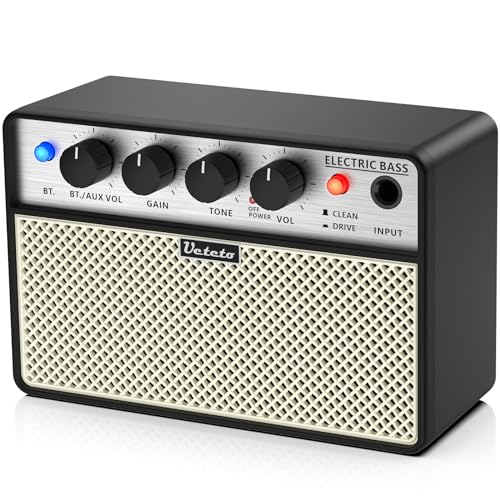
When portability and punch matter most, the Ueteto 10W Mini Bass Amp stands out as a smart pick for gigging musicians, practice warriors, and anyone tight on space. I rely on its 10-watt output, dual 5-watt subwoofers, and solid-state design to deliver rich, responsive tone. It’s featherlight at just 0.67 kg, built tough with ABS plastic, and runs up to 4 hours on battery. I love the clean/drive channels, Bluetooth and AUX inputs with independent volume controls, and headphone output for silent sessions. With a 3-year warranty, 4.2-star rating, and top-5 ranking in its category, it’s a proven, no-fuss solution that sounds way bigger than it looks.
Best For: Musicians who need a lightweight, portable bass amp for practice, small gigs, and on-the-go playing without sacrificing rich, punchy sound.
Pros:
- Compact and ultra-portable at only 0.67 kg, ideal for travel and tight spaces
- Delivers powerful 10-watt output with dual 5-watt subwoofers for strong bass response
- Flexible connectivity with Bluetooth, AUX, headphone output, and clean/drive channels for varied playing styles
Cons:
- Limited to 4 hours of battery life, requiring frequent recharging for extended use
- Only 1-band equalization, offering minimal tone shaping compared to more advanced amps
- Lower wattage may lack sufficient volume for larger venues or band rehearsals
Behringer ULTRABASS BXD3000H 300W Amplifier Head
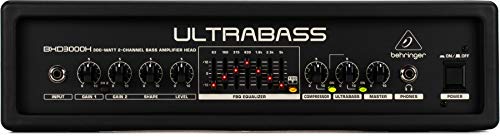
If you’re a working bassist who needs serious power without the back strain, the Behringer ULTRABASS BXD3000H delivers real 300 watts through Class-D technology, so it’s light enough to carry to gigs but strong enough to drive large cabs with authority. I use both the clean and distortion channels-one for punchy clarity, the other for aggressive tone shaping with adjustable shape, gain, and level. The built-in compressor smooths peaks, while the Ultrabass Processor tightens lows. Real-time EQ adjustment is a game-changer, thanks to the FBQ Spectrum Analyzer. It’s rugged, tour-ready, and surprisingly detailed for the price.
Best For: Bassists seeking a lightweight, powerful amplifier head with advanced tone-shaping tools for live performance and studio use.
Pros:
- Delivers 300 watts of efficient, high-output power via Class-D technology in an ultra-lightweight design
- Dual channels with dedicated controls plus built-in compressor, Ultrabass Processor, and FBQ Spectrum Analyzer for precise tone shaping
- Rugged, tour-ready construction with real-time frequency feedback for quick EQ adjustments on stage
Cons:
- Distortion channel, while versatile, may lack the refinement of higher-end boutique amplifiers
- FBQ Spectrum Analyzer, though useful, can be complex for beginners to interpret and apply effectively
- No onboard effects loop or direct XLR output for DI recording, limiting connectivity options
Factors to Consider When Choosing Bass Amp Brands
You’ll want to check the power output first-bass amps range from 100W practice units to 500W+ rigs that handle gigs and studios with ease. Think about tone customization, portability, build quality, and connectivity like DI outs or effects loops, since these features impact your sound on stage or in recordings. Real players often note that solid cabinets, intuitive EQ controls, and lightweight designs make a noticeable difference during long sets or podcast sessions.
Power Output
A solid 300 watts or more delivers the headroom and projection you need for live gigs, especially when driving 4×10″ or 1×15″ cabinets in medium to large rooms. You’ll keep your tone clean, even at high volumes, avoiding the distortion that comes from pushing underpowered amps too hard. If you’re just practicing or playing small acoustic sets, a 10- to 50-watt amp might be enough, but don’t expect much speaker excursion or room-filling output. Match your amp’s wattage to your cabinet’s impedance-most run at 4 or 8 ohms-for peak efficiency. Class-D amps give you more power with less weight, perfect for gigging musicians, while Class AB offers warm response and proven reliability. You need the right balance of watts, weight, and load handling to get loud, clear, and consistent bass response every time.
Tone Customization
While basic tone controls get the job done for casual players, serious bassists demand finer control over their sound, and that’s where advanced tone customization really shines. You’ll want multi-band EQs with sweepable mids-being able to tweak 400Hz to 1kHz lets you cut through the mix or sit back smoothly. Shape switches instantly apply mid-scoop or bright voicings, giving you preset textures that match genres fast. Presence controls dial in crispness above 3kHz, boosting clarity without harshness, especially in loud bands or live recordings. Built-in compression evens out your attack, adding sustain and balancing dynamics whether you’re slapping or fingerpicking. Don’t overlook input pads-switching between -10dB and +4dB guarantees passive and active basses both respond accurately, maintaining tone integrity. These features give you surgical precision, track after track, gig after gig.
Portability Factor
Size and weight matter when your gig bag doubles as your tour van. You’ll want compact amps under 10 inches in depth and width, with chassis under 6 pounds-some even weigh just 0.67 kilograms-for hassle-free transit. Models with built-in handles make loading and unloading quicker, while battery-powered options give you freedom to play parks, sidewalks, or remote spots without outlets. These lightweight designs let you move fast between gigs, rehearsals, or podcast setups, but there’s a trade-off: smaller speakers, usually 4-inch or less, mean less low-end punch than larger cabs. Still, modern engineering keeps tone surprisingly full for their size. Testers report clean output at practice volumes, with tight response for recording beds or spoken word. If you’re gigging acoustically or need a portable studio tool, these ultra-light systems won’t weigh you down-literally or sonically.
Build Quality
You’ve seen how lightweight, compact designs make hauling your rig easier, but don’t let portability fool you into overlooking what keeps your amp alive gig after gig-its build quality. Look for enclosures made from wood or reinforced ABS plastic with internal bracing; they boost durability and acoustic resonance, ensuring consistent tone. Metal chassis and corner protectors on heads handle bumps and road wear without failing. You’ll want speaker baffles secured with screws, not glue-testers find they resist warping over time, even with heavy 4×10 or 1×15 setups. Recessed jacks on rugged connector panels, backed by solid solder joints, survive constant plugging, tour after tour. Grilles made of reinforced steel or high-impact composite block dents while staying acoustically transparent. These aren’t just tough features-they’re long-term investments in sound integrity and reliability you can count on.
Connectivity Options
If you’re plugging in live or tracking in the studio, having versatile connectivity lets you adapt fast and sound your best. You’ll want multiple input sensitivity settings-like 0dB for active basses and -15dB for passive ones-to match your instrument’s output cleanly. Need to play along with tracks? An auxiliary input lets you plug in a phone or tablet for backing music. When it’s time to go direct, an XLR output sends a balanced signal to mixers or audio interfaces, often with DI cabinet emulation for realistic tone. A headphone output with speaker mute means silent practice anytime, while USB connectivity simplifies recording to DAWs and keeps your amp updated. Top brands integrate these features seamlessly, so you stay focused on performance, not patch cables. You’re not just plugging in-you’re connecting smarter.
Frequently Asked Questions
Can I Use a Guitar Amp for Bass?
You can use a guitar amp for bass, but you’ll risk muddiness and speaker damage, especially at higher volumes. Guitar amps typically roll off low frequencies below 80 Hz, so you’ll lose punch and clarity. Most aren’t built to handle the speaker excursion and power demands of bass signals. Real testers report flabby tone and blown speakers over time. For reliable, full-range bass response down to 40 Hz, use a dedicated bass amp or a full-range system designed for low-end accuracy and durability.
Do Bass Amps Need Speaker Cabs?
Yes, most bass amps need speaker cabs because they’re often heads or combo amps with built-in speakers that may not handle ultra-low frequencies alone. You plug your bass into the amp head, then connect it to one or more speaker cabinets using speaker cables. Cabs come in 1×10, 2×10, 4×10, or 1×12 configurations, affecting punch and dispersion. Testers prefer 4×10 cabs for even lows at high volumes.
Are Tube Amps Better Than Solid State?
You’re better off choosing tube or solid-state based on your needs, not myths. Tube amps give you warm, dynamic tone with natural compression when you push them, great for expressive playing. Solid-state amps stay louder with consistent clarity, handle lower frequencies reliably, and need less upkeep. Testers find tube amps color your sound beautifully, while solid-state models deliver accuracy, like 100W Class-D power running cool at 1.5 ohms, perfect for gigging.
How Loud Is 50 Watts for a Bass Amp?
You’re getting about 95 dB at 1 meter with a 50-watt bass amp into an 8-ohm load, assuming a 98 dB sensitivity speaker-loud enough for rehearsals and small gigs, especially if you’re playing with acoustic drums. Real-world testers say it handles clubs up to 200 people without strain, but you’ll need PA support in larger rooms. It’s efficient, reliable, and cuts through when you’re using active basses or aggressive EQ shaping.
Can I Plug Headphones Directly Into a Bass Amp?
You can plug headphones directly into a bass amp only if it has a dedicated headphone output, which many modern combo amps include. Just plug in, and the amp mutes the speakers for private practice. Models like the Fender Rumble Studio, Ampeg BA-115, and Orange Crush Bass 100 feature 1/8″ or 1/4″ headphone jacks with headphone-rated preamp circuits. Always check the manual-bypassing the speaker load without proper circuitry can damage older amps.