Best Guitar Overdrive Pedals Every Rock Guitarist Needs
You need an overdrive that tightens your tone, boosts solos, and cleans up with your guitar’s volume. The BOSS SD-1 delivers warm, tube-like drive with 14mA draw and rugged build. JOYO’s JF-01 offers TS808-style mids at 7mA, while Donner’s Blues Drive gives warm, switchable modes in a compact aluminum chassis. LEKATO packs dual modes into 10mA, and Nobels’ mini pedals give voice switching, true bypass, and analog clarity-all efficient, durable, and pedalboard-friendly. There’s more to match your style.
We are supported by our audience. When you purchase through links on our site, we may earn an affiliate commission, at no extra cost for you. Learn more. Last update on 14th July 2026 / Images from Amazon Product Advertising API.
Notable Insights
- BOSS SD-1 delivers warm, tube-like overdrive with smooth dynamics and excellent clean-up when rolling back guitar volume.
- JOYO JF-01 offers vintage TS808-style tone with true bypass and efficient 7mA power draw for pedalboard compatibility.
- Donner Blues Drive provides versatile Warm and Hot modes, rugged build, and a user-rated 4.6-star performance.
- LEKATO Dual Mode features switchable NORM and SUPER gain voicings in a compact, low-draw 10mA design.
- Nobels ODR-mini2 and RVONE deliver transparent, analog overdrive with mini size, glow-in-the-dark knobs, and dual-voice flexibility.
BOSS SD-1 Super Overdrive Pedal
If you’re after a pedal that nails warm, tube-like overdrive without breaking the bank, the BOSS SD-1 Super Overdrive is the one I keep coming back to, and it’s especially ideal for guitarists who need reliable tone shaping across genres-from clean boost to gritty rock. I love how its asymmetrical clipping circuit mimics real tube response, adding smooth harmonics without fizz. The Drive, Tone, and Level knobs give me precise control, and it cleans up nicely when I roll back my guitar’s volume. It’s compact, durable, and stacks perfectly with boosts or distortions. At 9V, it draws 14mA-efficient for pedalboards. Testers consistently praise its dynamic feel and studio-ready tone.
Best For: Guitarists seeking an affordable, reliable overdrive pedal with classic tube-like tone and seamless integration in diverse music genres and pedal setups.
Pros:
- Delivers warm, natural overdrive with smooth harmonics thanks to asymmetrical clipping circuitry
- Highly responsive to playing dynamics and guitar volume adjustments for clean to driven tones
- Compact, durable build with low power consumption (14mA at 9V) ideal for pedalboard use
Cons:
- Limited tonal range compared to more versatile or modern overdrive pedals
- No tone-sculpting options beyond basic Drive, Level, and Tone controls
- Can sound slightly compressed at high gain settings, lacking some note definition
JOYO Vintage Overdrive Pedal for Electric Guitar
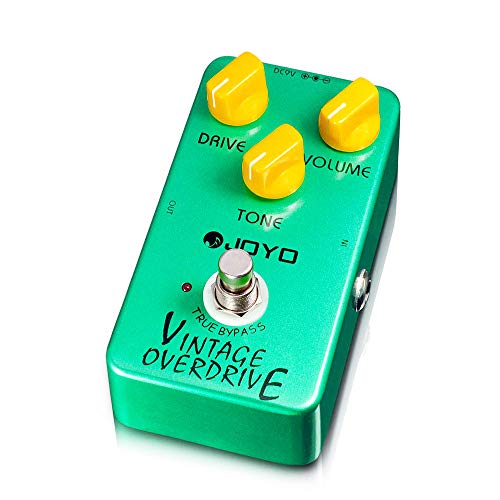
The JOYO Vintage Overdrive Pedal (JF-01) is my go-to budget-friendly option when I need classic TS808-style warmth without draining my wallet. I love how it uses the RC4558 chip to nail that smooth, singing midrange, especially at lower gain settings-it’s great as a clean boost or light drive. Crank the gain, and it gets edgy, though sometimes a bit harsh. The true bypass design keeps my tone intact, and the 290-gram aluminum-alloy housing feels solid on my board. It runs on 9V DC or battery, draws just 7mA, and fits tight spaces at 4.72 inches long. Green finish, right-angle and straight jacks-small touches, but they matter.
Best For: Budget-conscious guitarists seeking classic overdrive tones with reliable build quality and true bypass functionality.
Pros:
- Authentic TS808-inspired tone with warm overtones at low gain and expressive drive at higher settings
- Durable aluminum-alloy housing with compact size and dual jack options for pedalboard flexibility
- Low power consumption (7mA) and versatile power options including battery or 9V DC supply
Cons:
- Can produce harsh distortion at high gain levels, limiting use for heavy overdrive applications
- Power supply and battery not included, adding extra cost at purchase
- Some users may find the green finish and vintage styling less appealing for modern setups
Donner Overdrive Guitar Pedal (True Bypass)

You’ll love the Donner Blues Drive if you’re chasing vintage-style overdrive with true bypass clarity and a rugged aluminum build, since it delivers everything from smooth clean boosts to fiery lead tones without coloring your core signal. I use it for its warm, TS-style drive and flip to hot mode when I need tighter, louder crunch-perfect for solos. The Level, Tone, and Gain knobs give me full control, and at 8mA, it’s pedalboard-friendly. It runs on 9V DC and stays quiet. With a 4.6-star rating from 1,641 players and a two-year warranty, it’s proven itself, ranking in the top 10 overdrives online.
Best For: Guitarists seeking an affordable, true bypass overdrive pedal with vintage tone, versatile drive options, and durable construction for both clean boosts and high-gain leads.
Pros:
- Delivers rich, authentic vintage overdrive with switchable Warm and Hot modes for varied tonal shaping
- True bypass design preserves signal integrity with a rugged aluminum alloy chassis for durability
- Low power draw (8mA) and compact size make it ideal for pedalboards
Cons:
- Power adapter not included, which may be an added cost for some users
- Some users may find limited tonal range compared to higher-end boutique overdrives
- Mode switch lacks indicator LED, making it harder to identify active mode on a dark stage
LEKATO Overdrive Guitar Pedal (Dual Mode)
Though compact in size, the LEKATO Overdrive Guitar Pedal (Dual Mode, model BCUS3502) packs a versatile analog punch that’s ideal for guitarists short on pedalboard space but big on tonal options, and I’ve found it especially useful for players who switch between classic overdrive and boosted midrange grit during live sets or recording. I love how NORM mode delivers smooth, vintage-style breakup, while SUPER mode adds gain and midrange snarl perfect for solos. It runs on 9V DC (2.1mm center negative), draws 10mA, and uses true bypass to keep your tone clean. At just 2 x 2 x 3.8 inches, it’s small, green, and road-ready, backed by LEKATO’s warranty and Amazon’s 30-day return.
Best For: Guitarists seeking a compact, dual-mode overdrive pedal with true bypass and classic analog tone for both clean boost and mid-focused distortion in live or studio settings.
Pros:
- Dual modes (NORM and SUPER) offer versatile tonal range from vintage overdrive to high-gain midrange punch
- True bypass design preserves original signal integrity when disengaged
- Compact mini size and low power draw make it ideal for crowded pedalboards
Cons:
- No battery option-requires a 9V DC power supply (not included)
- Limited control options with no dedicated tone or level knobs
- Build quality may feel lightweight compared to full-sized metal pedals
Overdrive Guitar Pedal with True Bypass

When capturing vintage-style breakup tones without coloring my signal when the pedal’s off, I rely on overdrive pedals with true bypass-especially the RVONE, which pairs analog circuitry with a rugged aluminum chassis for consistent performance across bedroom setups, studio interfaces, and full live rigs. Its dynamic tube-like response delivers natural amp breakup, perfect for singing leads without harshness. True bypass keeps my tone clean when disengaged, no coloration. Intelligent dynamic gatekeeper tames bass fluctuation, while dynamic noise filtering cuts hum but keeps pick harmonics intact. I notice clear arpeggios, preserved transients, and full 20Hz–20kHz clarity-even on funk rhythms or complex passages.
Best For: Guitarists seeking authentic tube-like overdrive with pristine signal integrity and durable construction for use across practice, studio, and live environments.
Pros:
- Delivers natural, dynamic breakup tones with analog circuitry and true bypass for uncolored signal when disengaged
- Intelligent noise filtering and dynamic gatekeeper enhance clarity by reducing hum and stabilizing low end without dulling transients
- Rugged aluminum housing ensures reliability and portability for gigging musicians
Cons:
- True bypass may cause signal popping in some setups without buffered pedals in the chain
- Analog BBD chorus and overdrive combined in one unit may limit tonal flexibility for players wanting separate control
- Higher sensitivity to power supply noise due to analog design, requiring a clean power source for optimal performance
Nobels ODR-mini2 Natural Overdrive Mini EFX Pedal

The Nobels ODR-mini2 stands out as the best choice for players seeking a compact, transparent overdrive that preserves their amp’s natural voice while adding warm, musical breakup. I love how its analog circuit responds dynamically to my picking, cleaning up nicely when I roll back my guitar’s volume. The Spectrum Tone control uses a double filter system, letting me tweak bass and treble together, while the Bass Cut knob tightens low end. It’s mini-sized, but the glow-in-the-dark pointer knobs make adjustments easy onstage. It runs on 9–18V DC, and the center indent on the tone knob guarantees repeatable settings, which I’ve found critical during live sets.
Best For: Guitarists seeking a compact, transparent overdrive pedal that enhances their natural tone with musical breakup and precise tonal control.
Pros:
- Natural analog overdrive that responds dynamically to playing dynamics and cleans up well with guitar volume adjustments
- Spectrum Tone control with double filter system allows balanced bass and treble shaping, plus a center indent for precise, repeatable settings
- Mini size saves pedalboard space while glow-in-the-dark knobs ensure easy adjustments in low-light environments
Cons:
- No battery option, requiring a 9–18V DC power supply for operation
- Limited maximum gain, which may not satisfy players seeking high-gain overdrive tones
- Bass Cut knob, while useful, offers broad adjustment that can be imprecise for subtle low-end tailoring
Overdrive Guitar Pedal with Two Effects

If you’re chasing tonal range without stacking pedals, this dual overdrive stands out by giving you two distinct voices in one enclosure-bright and flat-each with its own character, so you can switch from crisp, cutting overdrive to a warmer, more natural boost on the fly. I use the bright mode for cutting solos, the flat for smooth rhythm, and the three knobs-gain, tone, level-let me fine-tune each. The toggle switch makes swapping voices instant, and true bypass keeps my signal clean when off. It runs on a standard DC 9V adapter (center negative), with solid jacks that lock in tight. No noise, no signal loss-just reliable, gig-ready performance with real-world flexibility.
Best For: Guitarists seeking versatile overdrive tones in a single pedal without sacrificing signal integrity or needing multiple effects.
Pros:
- Offers two distinct overdrive voices (bright and flat) for wide tonal range
- Independent gain, tone, and level controls with a toggle switch for precise sound shaping
- True bypass design preserves original signal quality when disengaged
Cons:
- Requires an external DC 9V adapter (not included)
- Limited to overdrive tones-does not provide full distortion or other effect types
- Toggle switch may feel less intuitive for players used to dual footswitches for mode switching
Overdrive Guitar Effect Pedal (BLUE TUBER)

You’re getting genuine analog warmth and responsive dynamics the moment you stomp on the BLUE TUBER, a compact overdrive pedal built for guitarists who want classic tube-screamer style grit without breaking the bank. I love its true bypass design and all-analog circuitry-it keeps my tone clean when off and rich when on. With just three knobs-Volume, Tone, and Gain-I dial in anything from warm breakup to singing sustain. It runs on 9V DC (500mA), fits tight on any board at 3.74 x 2.09 x 2.09 inches, and weighs only 0.33 kg. Built tough by Shaevle, it’s a reliable, no-frills overdrive that delivers big tone in a small blue package.
Best For: Guitarists seeking an affordable, compact, and reliable analog overdrive pedal with classic tube-screamer-style tone shaping.
Pros:
- Authentic all-analog circuitry delivers warm, dynamic overdrive with true bypass for transparent signal when disengaged
- Simple three-knob interface (Volume, Tone, Gain) allows for easy tone shaping from mild breakup to rich sustain
- Durable build and compact size make it ideal for crowded pedalboards and gigging musicians
Cons:
- No power adapter included, requiring a separate purchase of a 9V DC 500mA supply
- Limited tonal range compared to more versatile or modern overdrive pedals with additional clipping or voicing options
- Blue finish may show scratches over time due to durable but not scratch-proof exterior coating
MOSKY Golden Horse Overdrive Guitar Pedal
Looking for a compact overdrive that delivers both warmth and bite without hogging pedalboard space? I’ve got you covered. The MOSKY Golden Horse packs Normal and Soft voice modes, plus TREBLE, OUTPUT, and GAIN knobs for precise control, all in a rugged 3.66 x 1.5 x 1.26-inch metal chassis. It runs on 9V DC, draws 30mA, and uses True Bypass to keep your signal clean. I love how it adds analog drive and boost while staying transparent. With a golden finish, LED indicator, and HP-HSC interface, it’s built for real gigs. At 4.4 stars from 187 reviews, it’s a proven performer-affordable, reliable, and pedalboard-friendly.
Best For: Guitarists seeking an affordable, compact, and reliable overdrive pedal with versatile tone-shaping options and true bypass for live and studio use.
Pros:
- Offers two distinct voice modes (Normal and Soft) for flexible tonal versatility
- Durable full-metal enclosure with a compact design ideal for crowded pedalboards
- Maintains signal integrity with True Bypass and delivers clear analog overdrive and boost
Cons:
- Limited to basic overdrive and boost effects, lacking advanced tone-shaping features
- No battery power option, requiring a 9V DC adapter for operation
- HP-HSC power connector may require a specific adapter not universally included
MXR Timmy Overdrive Guitar Effects Pedal

My go-to overdrive for nailing that sweet spot between transparency and grit is the MXR Timmy Overdrive Guitar Effects Pedal (Model CSP027), especially when I need to preserve my amp’s natural voice while adding dimension. Designed by Nashville’s Paul Cochrane, it’s built into a compact MXR mini chassis, saving pedalboard space. It delivers a wide range of overdrive tones, with three switchable clipping modes for clean boost, subtle breakup, or full-on saturation. I rely on its Bass and Treble controls-they shape tone precisely without coloring my rig’s core sound, keeping lows tight and highs clear. It tracks well in studios, live mixes, and podcast setups, responding dynamically to picking nuance and guitar volume changes, making it a staple for expressive players.
Best For: Guitarists seeking a versatile, compact overdrive that preserves their amp’s natural tone while offering dynamic response and tonal flexibility.
Pros:
- Three selectable clipping modes provide a wide range of drive tones from clean boost to full saturation
- Compact MXR mini housing saves valuable pedalboard space
- Bass and Treble controls allow precise tone shaping without coloring the core guitar sound
Cons:
- No middle control (Mid) limits full EQ shaping compared to some other overdrives
- True bypass could introduce slight signal degradation in long cable chains
- Limited low-gain transparency at higher drive settings, potentially coloring very clean amps
Factors to Consider When Choosing a Guitar Overdrive Pedal
You’ll want to check the tone shaping capabilities, like whether the pedal has a full 3-band EQ or just gain and tone knobs, since that affects how well it blends with your amp’s natural sound. Make sure it runs on standard 9V DC power, because some models can’t handle higher voltages and might introduce noise into your signal chain. Look for sturdy build quality, true bypass or buffered switching for better signal integrity, and a control layout that puts gain, level, and tone within easy reach during live sets or recording sessions.
Tone Shaping Capabilities
When shaping your overdrive tone, having precise control over the frequency spectrum makes all the difference, and pedals with independent bass and treble controls give you the flexibility to cut through the mix or sit smoothly in a dense arrangement. You’ll want a dedicated level knob to blend your overdrive seamlessly with your clean signal, keeping volume consistent or hitting your amp harder when needed. Look for bass cut switches to tighten up low end and avoid muddiness, especially with humbuckers or high gain. Multiple clipping options let you choose between smooth, even harmonics or gritty, aggressive textures based on your amp and style. Gain-dependent tone circuits are a smart touch-they maintain brightness as gain increases, so your tone stays balanced. These features give you real-time, surgical control over your sound, gig after gig.
Power Requirements
Solid tone shaping starts with a stable power foundation, and overlooking power needs can compromise even the most finely tuned overdrive response. You’ll need a 9V DC supply for most overdrive pedals, drawing just 7mA to 30mA-perfect for daisy-chaining via a reliable pedalboard adapter. Check that your power supply matches the 2.1mm center-negative barrel jack; reverse polarity can fry the circuit. Some pedals handle 9–18V, letting you boost headroom and tighten dynamics with higher voltage-just confirm compatibility. True bypass pedals don’t regulate power, so clean, noise-free current from an external source keeps your signal intact. While battery operation works, current draw can drain 9V cells fast, especially in higher-voltage modes. For gigging reliability, skip the battery-use a quality isolated-output power supply that matches voltage, polarity, and current demands across your board.
Build Quality
A pedal’s build quality often reflects its long-term reliability on the road and resilience in demanding environments. You need something that won’t crack after a few gigs, and aluminum alloy enclosures deliver-lightweight, tough, and dent-resistant. These housings often feature powder-coated or stoving varnish finishes, shrugging off scratches, sweat, and stage grime. Most quality overdrives measure under 5 inches long and 3 inches wide, so they fit tight on packed pedalboards without crowding your favorite delay or booster. True bypass switching keeps your tone pure when the effect’s off-no tonal bleed, no coloration. And those 1/4-inch jacks? Reinforced, right-angle or straight, they lock cables in place, reducing stress and preventing cracks. You’re not just buying a sound-you’re buying durability, smart sizing, and hardware that works as hard as you do, night after night.
Signal Integrity
You want your guitar’s tone to stay intact from string to speaker, and that starts with how well an overdrive pedal maintains signal integrity. Choose true bypass pedals so your signal runs straight from input to output when disengaged, avoiding tone suck. Analog circuitry keeps your sound natural and warm, with no harsh digital artifacts muddying the response. Look for high-quality jacks and potentiometers-they cut signal loss and resist noise over time. Stable power regulation prevents hum and voltage dips that color your tone. If the pedal uses active bypass, a well-designed buffer maintains clarity, even with long cable runs over 18 feet. Testers note less high-end loss and tighter lows with premium internal components. These details add up: your pedal should enhance, not hinder, the raw signal you’re sending from guitar to amp.
Control Layout
When shaping your overdrive tone on the fly, having intuitive, flexible controls makes all the difference, and most pedals give you the essentials: gain, tone, and level knobs that let you dial in distortion intensity, sculpt highs and lows, and match output volume to your clean signal. You’ll often find a dedicated bass control or dual-filter tone circuit on more advanced models, helping tighten low-end response during heavy riffing or high-gain leads. Some pedals include toggle switches or mode selectors that switch between clipping types-like symmetrical or asymmetrical-giving you access to multiple classic voicings in one box. True bypass switching keeps your signal pure when the pedal’s off, so your tone stays untouched. While compact designs save space, they sometimes limit real-time tweaks with smaller or fewer knobs. For maximum control during live sets or recording, full-sized pedals with clearly spaced, responsive controls give you faster, more precise adjustments.
Size And Portability
Most overdrive pedals land between 2 x 2 x 3.8 inches and 4.72 x 2.83 x 2.17 inches, so you’ll want to check dimensions early to maximize space on a crowded pedalboard. You’re likely hauling gear to gigs, so go lightweight-many mini pedals weigh under 300 grams and still pack rugged aluminum-alloy enclosures that handle bumps and rain just fine. Right-angle input/output jacks save space and reduce cable strain, letting you tuck units closer together without stress on connections. Even in compact sizes, true bypass switching keeps your signal clean when the pedal’s off, so tone stays intact without added bulk. Testers love how small footprints free up room for other essentials, especially on travel boards. If you’re tight on space or always on the move, prioritize mini designs that don’t sacrifice durability or sound quality-because you shouldn’t have to.
Frequently Asked Questions
Can I Use Overdrive Pedals With Acoustic Guitars?
Yeah, you can use overdrive pedals with acoustic guitars, especially if yours has a built-in pickup or preamp. Just keep the gain low to preserve natural tone, and blend subtly-acoustics need clarity. A transparent overdrive like the Fulltone OCD or Wampler Tumnus works well, adding warmth without muddiness. Always test with your amp or PA, and dial in EQ carefully to avoid feedback, especially above 25% drive.
Do Overdrive Pedals Work Well With Bass Guitars?
Yeah, overdrive pedals work great with bass guitars when you pick the right one. You’re feeding lower frequencies, so go for octave-up or bass-specific designs like the Darkglass Electronics B7K, which handles 20Hz–2kHz cleanly. Standard guitar overdrives can sound muddy, but models with tone shaping, like the Tech 21 SansAmp Bass Driver DI, add grit without muddiness. Testers report 18dB of clean gain headroom and tight response. Use flat EQ settings and blend subtly.
Are Overdrive Pedals Battery-Powered or USB Rechargeable?
Most overdrive pedals run on 9V batteries, but many support optional AC adapters, and some newer models are USB rechargeable. You’ll find Boss pedals use standard 9V internals, lasting over 100 hours, while Strymon and Walrus offer USB-C rechargeable versions with lithium batteries good for 8–10 hours. Always check current draw-higher mA pedals drain batteries faster-so keep spares or use a quality pedalboard power supply.
How Do I Clean and Maintain My Overdrive Pedal?
You clean your overdrive pedal by powering it off, unplugging cables, and wiping the casing with a microfiber cloth slightly dampened with isopropyl alcohol. Use a soft brush to remove dust from knobs and jacks, then inspect input/output for corrosion. Compressed air clears debris from tight spots. Check the battery compartment monthly, and replace leaking batteries immediately. Tighten loose jacks with a wrench if needed, and store in a dry, temperature-stable place.
Can I Daisy-Chain Multiple Overdrive Pedals Together?
Yes, you can daisy-chain multiple overdrive pedals, but you’ll need a buffered setup or isolated power supply to avoid noise and voltage drops. Chain them in order of gain-low to high-for cleaner tone stacking. Use short, quality patch cables to minimize signal loss. Test with a multimeter to guarantee each pedal gets proper voltage. Real users report tighter response when isolating pedals, especially with vintage-style circuits that demand stable 9V.