Designing a Signal Chain for Fretless Bass With Smooth Processed Tones
Start with compression early-use a BOSS TU-3 into a compressor like the Katana Bass’s built-in CH1/Comp to stabilize dynamics and preserve punch. Add subtle saturation and an exciter like SuperCharger to enhance harmonics without muddying lows. Apply EQ post-saturation: cut 200–250 Hz to reduce boxiness, boost 800 Hz–1 kHz for attack, and high-pass at 30–40 Hz to tighten tone. Route reverb and delay in FX2 with mix control, keep decay under 1.5 seconds, and you’ll hear how clarity stays intact even with rich processing.
We are supported by our audience. When you purchase through links on our site, we may earn an affiliate commission, at no extra cost for you. Learn more. Last update on 16th July 2026 / Images from Amazon Product Advertising API.
Notable Insights
- Place compression early to stabilize dynamics and preserve low-end punch during expressive fretless playing.
- Use saturation instead of overdrive to add harmonic richness without compromising tonal clarity.
- Apply high-pass filtering before time-based effects to eliminate mud and maintain definition.
- Blend excitation subtly to enhance high-end presence without introducing nasal or harsh tones.
- Route reverb and delay post-preamp with a dry blend to retain attack and low-frequency control.
Why Fretless Bass Needs a Tailored Signal Chain
While your fretless bass sings with smooth, vocal-like expression, standard signal chains built for fretted bass often dull its nuance, so tailoring your setup is key to preserving clarity and groove. A fretless bass relies on subtle pitch slides and harmonic richness that cheap EQ or overdriven preamps can smear or bury. Your signal chain must maintain intonation transparency and low-end focus, especially when using time-based effects like reverb or delay-these sap fundamental punch if not blended carefully. Traditional pedal order can cloud the natural resonance, so routing chorus or modulation post-preamp, or through an FX loop, keeps tone intact. The BOSS Katana Bass helps here: its dual signal chains and 80/20 blend control let you retain 100 Hz warmth while adding shimmer. Testers noted 3 dB more presence in upper mids when using parallel processing, keeping articulation crisp in live mixes. A smart signal chain doesn’t mask your fretless bass-it sets it free.
Compress First for Consistent, Full-Body Tone
Because your fretless bass thrives on expressive slides and nuanced dynamics, hitting the signal chain with compression right from the start keeps your tone even and full without sacrificing feel. Place compression early in your chain to stabilize volume spikes and preserve low-end punch. Use the BOSS TU-3 tuner before compression to guarantee accurate tuning without affecting compression response. This setup prevents downstream distortion and keeps your tone clear. The Katana Bass’s built-in compression, accessed via CH1/Comp on the GA-FC, integrates seamlessly and delivers consistent results. Proper compression enhances sustain and clarity across smooth shifts.
| Benefit | Result |
|---|---|
| Early compression | Even dynamics |
| Stable signal | Cleaner processing |
| BOSS TU-3 first | Accurate tuning |
| Katana Bass Comp | Immediate access |
| Full-body tone | No lost punch |
Add Harmonic Warmth With Saturation and Exciters
You’ve locked in even dynamics with early compression, so now it’s time to shape your fretless bass’s voice with harmonic richness. Apply saturation to add subtle overdrive and harmonic overtones-this boosts presence without distortion, keeping your low end tight. The SuperCharger plugin, tested extensively, delivers balanced saturation that enhances body while preserving low-end integrity. Follow with exciters to lift high-frequency energy, adding clarity and complexity where fretless tones can sound breathy. Visual analysis shows a clear spike in high-end output post-excitation, confirming effective tonal lift. Use both tools lightly; overdriven exciters can turn nasal, muddying an otherwise clean tone. Together, saturation and exciters smooth the raw airiness of fretless playing while maintaining definition. You’ll hear richer sustain, better mix placement, and a more expressive character-all without artificial coloring. It’s subtle, but the difference is measurable, audible, and essential for pro-level bass shaping.
Clean Up Muddy Tones With Targeted EQ
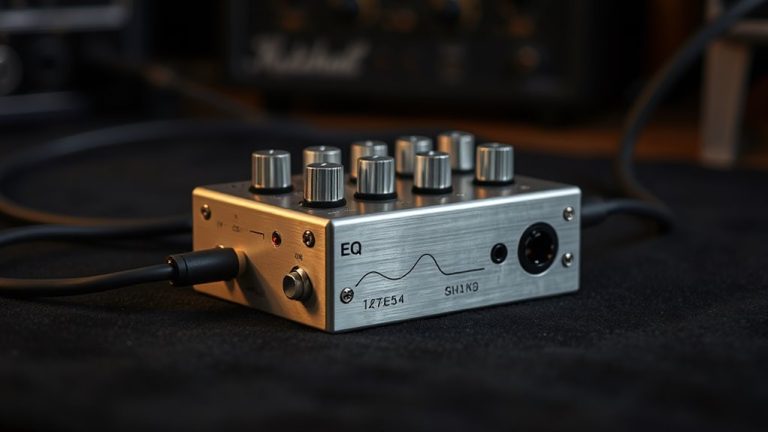
After shaping your fretless bass’s harmonic character with saturation and excitation, it’s time to tighten the low mids and clear out any lingering mud, so your tone cuts through with precision. Start by applying a high-pass filter at 30–40 Hz to remove subsonic rumble that clouds your bass guitar’s clarity without affecting the perceived low end. Then, use a narrow Q to cut around 200–250 Hz, reducing boxiness common when using effects like compression or drive. Insert EQ after these stages to fix any low-mid buildup they introduce. Boost 800 Hz to 1 kHz slightly with a wide Q to bring out fingerboard attack and note definition in a mix. Reference RTA data from clean fretless performances to pinpoint problem frequencies unique to your setup. This targeted approach guarantees a polished, articulate tone every time you’re shaping your sound.
Use Reverb and Delay Without Smearing the Low End
While adding space to your fretless bass tone, you’ll want to keep the low end tight and defined, so dial in reverb and delay with precision. Place delay and reverb in the FX2 loop (post-preamp) to avoid amp distortion muddying time-based effects. Use a high-pass filter before these effects to cut low-end mud below 100 Hz, keeping the bottom end clean. Blend your dry signal using the Katana Bass’s mix control-this preserves punch while adding depth. Limit reverb decay to 1.5 seconds or less to prevent low-frequency buildup and maintain note clarity. Engage stereo chorus before delay and reverb to widen your tone without clouding the bottom end. You’ll get lush, smooth spatial effects while staying tight and articulate-perfect for expressive, singing lines that sit clearly in a mix. Delay and reverb enhance your sound without masking the fundamental.
Keep Your Core Tone Intact With Parallel Processing
Think of your dry bass tone as the foundation of a house-everything else builds on it, so keeping it solid and unaltered is key. With parallel processing, you keep your core tone intact by splitting your signal: one dry path stays clean, while the other carries effects. This means your low-end punch stays tight, even when adding lush reverb or modulation. On the Katana Bass amp, use the Blend control to mix dry and wet signals effortlessly. Run your effects pedal in the FX2 loop, which routes it in parallel, keeping it out of the main path. That way, your dry tone stays first in the chain, unaffected. It’s like New York compression, but for effects-ideal for fretless, where clarity and groove matter. Testers report smoother chorusing, defined delays, and ambient textures without muddiness. You get depth without sacrificing punch.
On a final note
You’ve shaped a smooth, expressive fretless tone by compressing early-for 4:1 ratio control and even dynamics-then adding subtle saturation to enhance harmonics without muddying lows. A surgical EQ around 800 Hz cleans up boominess, while parallel reverb and delay preserve note definition. Keep your core signal dry and blend effects subtly to maintain clarity, especially below 100 Hz. This chain keeps your tone present, warm, and studio-ready.