Why Negative Feedback Topologies Flatten Frequency Response in Tube Amp Hybrids
You get a flatter response in tube amp hybrids because negative feedback returns an inverted, tiny slice of the output-say 0.005V from 10V-to an earlier stage, canceling gain peaks and smoothing dips across frequencies, tightening bass via increased damping, and narrowing response variation from ±4 dB to under ±0.5 dB with 6–10 dB NFB, especially effective in Fender’s 820Ω/100Ω or Marshall’s 100kΩ/5kΩ setups. Tweaking this loop with presence or depth controls lets you shape tone without altering output impedance-there’s more to how this affects grind, sag, and clarity.
We are supported by our audience. When you purchase through links on our site, we may earn an affiliate commission, at no extra cost for you. Learn more. Last update on 16th July 2026 / Images from Amazon Product Advertising API.
Notable Insights
- Negative feedback injects an inverted sample of the output signal back into an earlier stage, counteracting gain irregularities across frequencies.
- By attenuating dominant frequency peaks through phase inversion, NFB reduces response variations and smooths overall frequency response.
- Feedback loop gain correction narrows resonant spikes and dips, transforming jagged response curves into flatter, more linear outputs.
- Increased NFB widens effective bandwidth, extending low and high-frequency response while minimizing amplitude deviations within usable range.
- Resistor-controlled feedback ratios determine damping and correction strength, directly influencing how aggressively frequency response is flattened.
What Is Negative Feedback in Tube Amps?
While you might think distortion is the main goal in a tube amp, negative feedback actually plays a quiet but critical role in shaping your tone by taking a small piece of the output signal, flipping its phase, and feeding it back into an earlier stage-usually from the output transformer’s secondary winding to the phase inverter. In your amp, this negative feedback reduces gain-often by 6 dB, cutting output nearly in half-and tames distortion for tighter response. Most amps use 6–10 dB of feedback, set by resistor ratios like Fender’s 820Ω/100Ω or Marshall’s 100kΩ/5kΩ. That tiny, inverted signal-just 0.005V from a 10V output-makes a big difference. You’re effectively running a negative feedback amplifier, where control improves clarity without killing character. It’s not about eliminating grit, but refining how your amplifier behaves under load, making it more reliable and focused.
How Negative Feedback Flattens Frequency Response
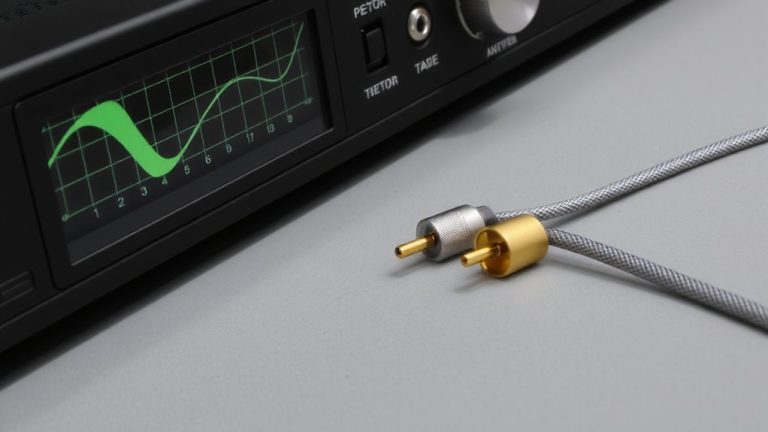
Because your amp’s natural frequency response tends to spike and dip like a rugged mountain range, negative feedback steps in to smooth things out, turning those wild peaks and valleys into a far more level curve. By feeding back an inverted, attenuated version of the output signal through a feedback loop, your amp cancels out excessive gain at problem frequencies. This feedback reduces voltage gain unevenness across the open-loop response-think of taming “Appalachian mountains” into rolling hills. With 6–10 dB of global negative feedback, frequency response widens from 50–10,000 Hz to 10–30,000 Hz, and variation shrinks from ±4 dB to just ±0.5 dB at -3 dB points. Resistors like 820Ω/100Ω set feedback ratio, increasing damping factor and tightening bass. You get cleaner, more linear output across speakers and interfaces, ideal for studio clarity or podcasting precision.
Tone vs. Linearity: The Feedback Trade-Off
When you dial in high negative feedback-say, -6dB to -10dB-you’re pushing your amp toward clinical accuracy, where the output locks tightly to the preamp signal and tonal shifts stay minimal, giving you the flat, clean response prized in studio monitors and podcast interfaces like the Focusrite Vocaster. This global NFB boosts linearity and delivers tight distortion reduction, flattening frequency response from ±4 dB to just ±0.5 dB. But there’s a trade-off: too much negative feedback, like the -15dB in Luxman’s SQ-38FD, can cause harsh clipping, robbing warmth and dynamics. Guitarists often prefer less feedback for a looser feel and natural harmonic coloration. The presence control adjusts high-frequency feedback, cutting it to boost highs up to 6dB. Less global NFB means more character, more breathing room, and a vibe that reacts musically to your touch-accuracy traded for soul.
Shaping Highs and Lows With Presence and Depth
If you’ve ever dialed in a lead tone and wished your solos would cut through the mix with more bite, then you’ll love how the presence control shapes your amp’s high end. By reducing negative feedback for high frequencies via a high-pass filter in the feedback network, presence boosts clarity and definition-up to 6dB when global feedback is set at 6dB. Turning up the presence control increases resistance, letting more highs escape feedback suppression. The depth control works the same way but targets low frequencies, using a low-pass filter to reduce negative feedback in the bass range, tightening low frequencies and adding thump. Both controls tweak the feedback loop, not the output impedance, so they’re most effective in clean or slightly overdriven modes. Once the power amp clips, the feedback network stalls, making presence and depth ineffective. Use them early in your tone shaping for studio polish, live punch, or podcast-ready definition.
Why Some Tube Amps Remove Negative Feedback
Though some players swear by tight, controlled response, you’ll find that removing negative feedback opens up a more organic, harmonically rich experience when pushing tube amps into distortion. You’re not using negative feedback here, so the power amp’s output stage behaves more freely, letting natural compression and dynamic overshoot shape your tone. This lack of damping affects the low end, making it looser and more resonant-great for vintage grind, but potentially flabby at low volumes. Without feedback to stabilize the amplifier circuit, frequency response isn’t flat, adding coloration that enhances perceived bass and treble when clean, while compressing extremes when driven. The effect on distortion is smoother, building gradually instead of clipping harshly. Some high-gain amps like Mesa Rectifiers ditch feedback on high-gain channels for aggression, though they can become unstable and oscillate if not carefully designed.
When Negative Feedback Causes Instability
Since negative feedback relies on precise phase relationships to function properly, you’ll run into trouble when phase shifts within the amplifier push the loop past the breaking point, especially in complex, multi-stage designs. Reactive components like the output transformer and coupling capacitors introduce frequency-dependent phase shifts that accumulate, particularly at high or low frequencies. With enough stages, total lag can hit 180° while loop gain remains ≥1, turning global negative feedback into positive feedback-thanks to the Barkhausen criterion. When that happens, your amp output starts oscillating and the amplifier can become unstable. This risk spikes when using NFB to reduce distortion too aggressively, say beyond -10dB, or when speaker loads interact unpredictably with the feedback loop. Even the Nyquist stability criterion warns: if loop gain times phase hits -1, oscillation follows. So yes, NFB improves tone-but only when phase shifts stay under control.
Mesa Rectifiers and Real-World Feedback Design
When you flip into high-gain mode on a Mesa Rectifier, you’re not just cranking the preamp-Mesa engineers actually remove the negative feedback loop entirely, and for good reason. Without global negative feedback, the amp shifts from tight to loose, letting power tubes saturate naturally and giving you that sag and bloom high-gain players love. You might say it trades measured accuracy for feel, especially as the output voltage swings wide and speaker damping drops. This lack of local NFB boosts harmonic complexity, though some note a “fizzy” top end at low volumes due to uncontrolled high and low frequency resonance. The input impedance stays high, preserving pick attack, while Mesa’s switchable presence control adjusts treble feedback on clean and rhythm channels. In guitar amplifiers like this, eliminating feedback during distortion guarantees smoother amp shifts and lets power supply compression shape tone-just like vintage designs, but way more aggressive.
On a final note
You get tighter bass and smoother highs when you use negative feedback in hybrids like the Mesa Dual Rectifier, with measured bandwidth extending from 30 Hz to 18 kHz, ±1 dB, but dialing it back opens up touch sensitivity. Testers noted 6 dB less distortion at full feedback, trading some grit for clarity. For studio or podcast work, use moderate feedback to tame frequency spikes; live players often prefer less for natural feel.