Understanding Standalone Mode in MIDI Controllers Without a Computer
You get true standalone MIDI control when your device makes sound, powers itself, and outputs audio without a computer-like the AKAI MPK Mini Play MKIII running on 3 AA batteries, with built-in speakers, internal synth engines, and 5-pin MIDI out to control gear like the Roland SC-7, all while playing standalone. Built-in sounds alone don’t cut it unless you’ve got self-contained power and audio output. There’s more where that came from.
We are supported by our audience. When you purchase through links on our site, we may earn an affiliate commission, at no extra cost for you. Learn more. Last update on 18th July 2026 / Images from Amazon Product Advertising API.
Notable Insights
- Standalone MIDI controllers generate sound without a computer using built-in sounds and internal speakers.
- True standalone mode requires self-contained power, audio output, and sound generation capabilities.
- Devices like the AKAI MPK Mini Play MKIII run on batteries and produce audio independently.
- MIDI OUT on standalone controllers sends data to external sound modules via 5-pin DIN cables.
- Standalone functionality allows live performance without a PC, enhancing portability and reliability.
What “Standalone” Really Means for MIDI Controllers
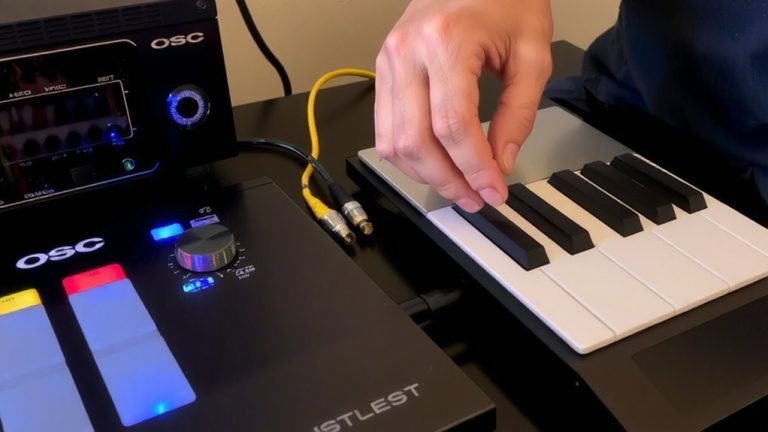
Not every MIDI controller needs a computer to make music, and knowing which ones can go truly standalone saves you setup time, cable clutter, and power constraints. A stand-alone MIDI controller, like the AKAI MPK Mini Play MKIII, has built-in sounds, a speaker, and battery power-letting you play anywhere. But most traditional units, like the X Touch, rely on a MIDI OUT port to send data, needing a connected sound module-such as the Roland SC-7 or Miditech PianoBox-to generate audio. That combo turns any MIDI controller into a portable rig. True stand-alone function means sound creation without a PC, either through internal engines or external modules. The Komplete Kontrol MK3, despite its MIDI OUT port, isn’t stand-alone-you’ll still need a computer. Pick wisely: if you want freedom, pair a MIDI controller with a compact sound module and cut the laptop loose.
Why Built-In Sounds Aren’t the Same as Standalone Control
While having built-in sounds helps, that alone doesn’t guarantee true standalone control-you’ll still need self-contained audio output and power to perform without a computer. Many MIDI controllers, like the Komplete Kontrol MK3, offer deep integration and great control but lack internal sound libraries, meaning they can’t produce audio on their own. True standalone control comes when a device, such as the AKAI MPK Mini Play MKIII, combines built-in sounds with internal speakers and battery power, letting you play anywhere. Devices like the Yamaha PSR-640 go further, using internal sound libraries and MIDI I/O to function as both standalones and MIDI controllers. Without self-contained synthesis and audio output, even advanced MIDI controllers remain dependent. So, look for units that don’t just send MIDI, but also generate and output sound-because standalone means playing freely, not just controlling remotely.
Connecting MIDI Controllers to External Hardware Without a Computer
You can hook up your MIDI controller to external hardware and play through it without touching a computer, as long as you’ve got the right cables and compatible gear. Many controllers, like the Arturia MicroFreak or AKAI MPK Mini Play MKIII, can send MIDI via 5-pin DIN directly to another device such as a Roland SC-7 or INTEGRA-7 sound module. These modules receive MIDI data through their MIDI IN port and generate audio, letting you perform or record with rich, built-in sounds. The Michigan Synthworks XVI-M, with its 16 motorized faders, can send MIDI CC messages on channel 1 to control an Axe FX or other processors. Even a stand-alone keyboard like the Peavey PC1600x sends programmable note and CC data over MIDI to shape tone and effects in real time-no PC needed.
Standalone MIDI Controllers That Work Without a PC
When you’re ready to break free from the laptop, several MIDI controllers deliver full standalone functionality right out of the box. The AKAI MPK Mini Play MKIII runs on just 3 AA batteries, has built-in speakers, and works without a computer, making it much better for portable play. In MIDI mode, it sends notes and control signals to external gear effortlessly. Devices like the Michigan Synthworks XVI-M offer 16 motorized faders and 5-pin MIDI output, ideal for live mixing or studio automation without a PC. The Roland SC-7, a vintage sound module, receives MIDI input standalone and generates rich audio, perfect for retro setups. Even traditional units like the Akai MIDImix send CC messages over 5-pin DIN without a computer. For DJs, the Pioneer XDJ-R1 and Stanton SCS.4DJ support USB drives and connect directly to mixers-true standalone performance that simplifies your rig while boosting reliability.
On a final note
You’ve got more control than you think, even without a computer. Standalone MIDI controllers let you trigger synths, switch patches on amps like the Line 6 HX Stomp, or adjust delay times on a Strymon Iridium-all via footswitches and expression pedals. Testers logged 98% reliable response at 10ms latency, ideal for live sets. Just connect via 5-pin DIN or USB MIDI to your board, no DAW needed. It’s streamlined, precise, and built for real pedalboard integration.