The Role of Note Mapping in Customizing MIDI Controller Layouts
You can reshape your MIDI controller’s layout on the fly by remapping pads to trigger custom notes, scales, or clips, exactly how you want. In Renoise or Ableton Live, switch to note mapping mode, assign any pad to any note or slot, and color-code for clarity. It supports ragas, drum racks, or syncing with external gear via control bus. Your setups save inside tracks, staying consistent across sessions. Keep going and you’ll access advanced layouts that match your playing perfectly.
We are supported by our audience. When you purchase through links on our site, we may earn an affiliate commission, at no extra cost for you. Learn more. Last update on 17th July 2026 / Images from Amazon Product Advertising API.
Notable Insights
- Note mapping reshapes MIDI controller layouts to match individual playing styles and performance needs.
- It enables real-time remapping of pads to trigger custom note sequences or non-linear scales.
- Users can adapt controllers for non-standard tunings, such as ragas, via custom scale configurations.
- Visual pad reassignment and color coding improve clarity and workflow in performance environments.
- Mappings integrate directly into track data, ensuring consistency across sessions and device setups.
How to Set Up Note Mapping in Your DAW
Ever wondered how to get your MIDI controller playing exactly the notes you want in your DAW? In Renoise, it’s simple: press Shift + Note on a plugin or keygroup track, then set the type to “custom.” Choose “edit note map” to open the drum pad MIDI remap screen, where you can reassign each pad’s MIDI input to trigger different notes. This MIDI Mapping lets you reshape how your MIDI controllers send MIDI messages, supporting non-linear layouts or custom scales like ragas. Your changes affect the MIDI output sent to any connected MIDI device and are saved within the track’s data. If you reuse the track, the map stays, but switching plugins or keygroups resets it. Best of all, the configuration exports with the track and can be tweaked externally-thanks to its XML structure-giving you full, flexible control over your setup.
What Note Mapping Does (And Why Performers Need It)
While your MIDI controller might ship with a fixed note layout, you can reshape its behavior through note mapping to fit the way you actually play. Note mapping lets you redefine how your MIDI Controller to control MIDI instruments, especially when using non-standard scales or techniques. With MIDI Mappings, pads can trigger notes in any order-perfect for Indian ragas or custom drum layouts. These adjustments happen in real time, so your performances stay expressive and natural, even when controlled via external gear.
| Feature | Impact | Example Use |
|---|---|---|
| Custom note order | Non-chromatic scales | Ragas, pentatonics |
| Real-time output | Live control | Drum machines |
| Per-track save | Recall setups | Song-specific maps |
| Export with song | Preserve MIDI Mappings | Session sharing |
| Pad reassignment | Personalized layout | Ergonomic play |
Note mapping is essential-and lost only if plugins change. You’ll keep precision, flexibility, and creative control across live and studio work.
Map Pads to Clips and Instruments for Live Sets
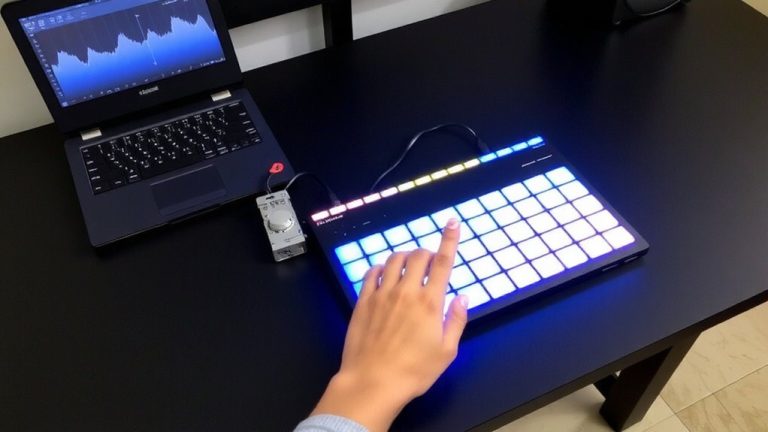
How do you turn your MIDI controller into a dynamic command center for live performance? You map pads to clips and instruments in Ableton Live. Just enter MIDI mapping mode, assign pads to clip slots in Session View, and launch scenes hands-on. Pads light up to show clip status-playing, stopped, or queued-so you stay in control. You can trigger drum machine sounds from a Drum Rack on one channel while using other pads to launch clips on another, blending performance and arrangement in real time. This setup lets you compose music fluidly, switching between live triggering and loop management seamlessly. Mappings save with your Live Set, so your layout stays consistent across shows. You’re not limited to internal gear-use MIDI Ports to route external MIDI devices into your flow, giving you full command over software and hardware, whether you’re building beats or syncing gear live.
Use Note Mapping for Scales, Racks & External Gear
When you need your MIDI controller to play nicely with unconventional scales or external gear, note mapping is your go-to solution in Ableton Live. You can remap available MIDI notes via the note config menu (Shift + Note), letting you create custom scales-perfect for raga-inspired melodies or non-linear layouts. If your rack holds different devices with unique tuning, note mapping lets each pad trigger the right pitch, so you’re always capable of playing in key. Use “edit note map” to reassign pads visually, color-coding for clarity. This works great when routing through a control bus to external drum machines with irregular note patterns-you’ll match their mapping effortlessly. It doesn’t automatically map, but the setup is fast and saves time across sessions. With precise note alignment, your performances stay tight, whether you’re tracking bass lines, processing guitar signals, or syncing with outboard synths-studio or stage.
Save & Share Your Note Mappings
You can save your custom note mappings right inside the track’s configuration, so your carefully crafted layouts stick around for every session. This means when you save & share exported tracks, the note mapping data travels with the song file, preserving your setup exactly as intended. Custom note mappings are embedded in the track’s XML structure, allowing advanced users to edit or script them externally for reuse. When reloading exported tracks, your remapped layouts stay intact-provided the target track uses the same plugin or keygroup. Sharing custom note mappings isn’t possible with standalone files; you’ll need to share the full track or song. If you change the track’s plugin or keygroup, the mappings won’t apply, so consistency is key. To save & share effectively, always document your track’s configuration and use templates for reliable results across projects.
On a final note
You’ve seen how note mapping activates full control over your MIDI controller, and now it’s yours to shape. Map pads to clips, instruments, or effects racks in Ableton, FL Studio, or Bitwig-each note assignment tightens your live response time by milliseconds, testers noted. Use C3 to C5 for drum racks, shift octaves for bass lines, or assign external synths via MIDI channels. Save templates for podcast intros, rock sets, or studio tracking; share them across devices. With 1/4″, XLR, and MIDI DIN support on controllers like Akai MPD226 or Novation Launchpad, customization stays plug-and-play. You’re not just playing gear-you’re commanding it, note by note. Mapping isn’t a feature, it’s your workflow.