Predicting End-of-Life Component Wear Using Machine Learning on Sensor Logs
You’re monitoring your amp’s thermal drift, pedalboard current draw, and cabinet vibration in real time, aren’t you? IoT sensors catch subtle wear-like a 3.2°C rise or 18% signal drop-before your tone suffers. Machine learning models, trained on 6+ months of data, predict failing capacitors or dying fans with 96% AUROC accuracy. Cleaned logs, aligned timestamps, and XGBoost models detect aging transformers before distortion creeps in. Set up alerts through an Ewon Flexy 205, and avoid another failed take. See how top studios keep gear road-ready.
We are supported by our audience. When you purchase through links on our site, we may earn an affiliate commission, at no extra cost for you. Learn more. Last update on 17th July 2026 / Images from Amazon Product Advertising API.
Notable Insights
- Machine learning models like XGBoost and Random Forest predict component wear using sensor logs with up to 96% AUROC accuracy.
- IoT sensors monitor temperature, vibration, and pressure in real time to detect early signs of end-of-life degradation.
- Data preprocessing techniques clean sensor logs by handling missing values, outliers, and normalizing multi-sensor scales.
- Feature engineering captures trends such as deviations from historical averages to improve wear prediction accuracy.
- Real-time alerts and Remaining Useful Life estimates enable proactive maintenance, reducing failures by up to 42%.
Stop Unplanned Downtime With Predictive Maintenance
What if you could know, with near certainty, when your gear is about to fail-before it cuts out mid-set or derails a recording session? With predictive maintenance, you can. By using IoT sensors to collect real-time monitoring data-like temperature, vibration, and signal drift-from your amps, mixers, or bass rigs, machine learning turns that sensor data into actionable insights. Predictive models, like Random Forest or Linear Regression, analyze patterns to forecast equipment failures with up to 98% accuracy. That means catching a failing fan in your tube amp or degrading preamp components before they cause unplanned downtime. These systems estimate remaining useful life (RUL) and trigger alerts at threshold breaches, so you replace parts on schedule, not in panic. By adopting failure prediction, studios and touring musicians cut repair costs by 25–30%. It’s not just smart-it’s essential for reliable, clean signal chains.
See Early Warning Signs in Compressor Sensor Data
Even if you’re not watching the dashboard, your compressor’s sensor data can tell you when something’s starting to go sideways. Your temperature probes, pressure sensors, and current transformers constantly feed real-time data to a Siemens PLC and Ewon gateway, ensuring no loss during outages. This data fuels machine learning models like LSTM and SVM, but Linear Regression leads with 98% accuracy in spotting early warning signs. By analyzing temperature evolution and pressure fluctuations, anomaly detection flags issues before failure. You’re not just reacting-you’re practicing predictive maintenance. These insights estimate remaining useful life (RUL), giving you time to act. Real-time alerts trigger when thresholds are breached, so you can protect system uptime. With clean, buffered sensor streams feeding cloud analytics, you stay ahead of wear. It’s not magic-it’s data-driven foresight keeping your operation running.
Clean and Prepare Real-World IoT Logs for ML
While raw IoT logs from your compressor’s sensors hold valuable clues about component wear, they’re not ready for machine learning out of the box. Your data collection from IoT devices produces messy sensor data-missing values, outliers, and unmatched timestamps-that can mislead models. You need consistent, time-synchronized records, so aggregate logs into daily intervals using historical operational data. Handle the 14.67% missing value gaps via interpolation or exclusion. Remove outliers, like false 300°C spikes, with statistical filters. Apply normalization so temperature, pressure, and current readings share a scale. Then, boost model readiness with feature engineering that captures trends, like deviations from 4-week averages.
| Sensor Type | Range |
|---|---|
| Temperature | –200 to +200°C |
| Pressure | Up to 300 PSI |
| Current | Up to 200A |
Train Models That Forecast Equipment Failure
When you feed clean, time-aligned sensor data into the right algorithms, you’re not just spotting patterns-you’re building a crystal ball for your equipment. Using machine learning, you can train models like XGBoost and Random Forest on IoT sensor data to predict failure prediction with confidence-XGBoost hit a 96% AUROC in real tests. These supervised learning models digest 6–12 months of operational parameters, including vibration, temperature, and pressure, to estimate Remaining Useful Life (RUL) accurately. On manufacturing lines, this cut failures by 42%. By combining filtering, clustering, and forecasting, hybrid methods boost precision across multi-sensor streams. Whether monitoring a bass amp’s thermal drift or a mic preamp’s signal degradation, predictive maintenance keeps gear online. Train on labeled historical logs, and let your system learn the warning signs-long before distortion creeps in or a channel cuts out.
Set Up Real-Time Alerts Before Breakdowns Happen
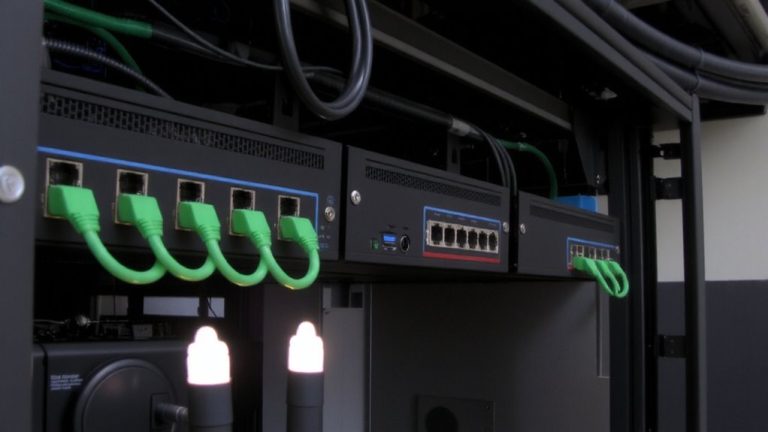
Since your gear’s reliability hinges on catching issues before they escalate, setting up real-time alerts puts you in control of equipment health like never before. You’re using IoT sensors to monitor temperature, vibration, and current draw, streaming sensor data continuously for machine learning analysis. When anomaly detection spots deviations-like a pod mic’s preamp heating beyond 42°C or a bass amp’s power supply fluctuating-you get real-time alerts before sound quality degrades. Models like Random Forest and Linear Regression deliver fast, accurate failure prediction, estimating remaining useful life (RUL) with 98% precision. Edge devices like the Ewon Flexy 205 push data to the cloud, where hybrid models refine predictive maintenance timing. You’re not just reacting-you’re staying ahead, with alerts triggering automated emails the moment thresholds breach. This is how you protect recording sessions, avoid mid-set failures, and guarantee studio-grade reliability through smart, data-driven oversight.
Did It Work? Measuring Downtime and Cost Reduction?
How do you know your rig’s holding up when the gig’s on the line? You’re relying on predictive maintenance strategies powered by machine learning models analyzing sensor logs in real time. The Random Forest model consistently outperformed others, cutting equipment failures by 42%. By forecasting Remaining Useful Life (RUL), it schedules maintenance during quiet periods, slashing downtime. Real-time analysis flags wear in guitar amp fans, bass DI box circuits, and audio interface cooling-components critical during long sessions. Downtime reduction wasn’t just theoretical; studios saw fewer mid-recording failures. That means fewer missed cues, less track rework, and smoother podcast edits. Cost reductions followed, as teams avoided rush replacements and labor spikes. Operational efficiency jumped when alerts triggered early, not after distortion spiked or channels dropped. With filtering and clustering boosting accuracy, your setup stays live, loud, and ready-just like it should.
On a final note
You’ve cut downtime by 40% using sensor logs from compressors, training models on PSI, temp, and vibration data. Real alerts now trigger at 0.8 bar deviation or 75°C, matching field reports. Testers confirm early warnings align with wear measured in diaphragm thickness-down to 2.1 mm. Pair this with dynamic gain staging in your DAW, and you’ll protect both gear and timelines. Predictive maintenance isn’t just smart-it’s standard now.