Implementing Redundant GPS Timing Modules for Ultra-Precise Frequency Coordination
You’re locking to four GNSS constellations with dual Meinberg GPS C/A-Code receivers, so when one signal drops, the other holds 1PPS within 20 ns, no gaps, no jumps. Twin OCXO-HQ oscillators keep time stable during outages-tested in Norwegian studios, they stayed in spec for hours. With 8x 1PPS and 8x 10 MHz outputs, TTL or sinewave, phase stays coherent, even over 700 m cables. Dual antennas, dual power, remote monitoring-your studio stays in sync, down to the nanosecond, exactly as designed, and there’s more where that came from.
We are supported by our audience. When you purchase through links on our site, we may earn an affiliate commission, at no extra cost for you. Learn more. Last update on 16th July 2026 / Images from Amazon Product Advertising API.
Notable Insights
- Use dual or triple GNSS receivers with multi-constellation, dual-band support for sub-one-minute relock and signal resilience.
- Employ OCXO-HQ oscillators to maintain 1PPS accuracy within 20 ns during holdover and ensure phase stability.
- Enable seamless failover with no timing gaps using Meinberg RSC logic and automatic signal degradation rejection.
- Distribute synchronized 1PPS and 10 MHz signals over 700 m via integrated downconverters without integrity loss.
- Implement dual-redundant power and remote monitoring for continuous operation in noisy, precision-critical environments.
Why Redundant GPS Timing Outperforms Single Modules
You’re not just adding backup when you go with a redundant GPS timing module-you’re guaranteeing signal resilience that single units simply can’t match. Redundant GPS timing uses dual or triple GNSS receiver setups, so if one loses lock, another maintains the precise time. With support for four constellations and dual bands, relock happens in under a minute-critical during studio clock drops. Two independent OCXO-HQ oscillators keep 1PPS within 20 ns, delivering rock-solid synchronization signal integrity. Dual-redundant systems cut cost without sacrificing uptime, while triple-voting handles outages smoothly. Unlike single modules, these reject antenna faults and signal degradation automatically. Redundant power inputs (100–240 V AC/DC) and RSC logic guarantee unbroken timing, even in noisy AV environments. You stay in sync, on time, every take-ideal for multi-room studios, broadcast pods, and live tracking. Precision isn’t luck-it’s design.
Redundant GPS Timing: Seamless Failover and Holdover Stability
When GPS signals drop due to interference or antenna issues, redundant timing systems keep your studio clocks locked and stable, so your recordings stay in perfect sync. You get seamless failover because two independent GPS receivers instantly switch roles if one loses contact with the GPS Satellite. The Meinberg RSC logic handles this shift automatically, no gaps, no timing jumps. Even during outages, holdover stability stays strong-thanks to ultra-stable OCXO-HQ oscillators that mimic atomic clock precision. These oscillators, calibrated before signal loss, maintain accuracy traceable to Universal Time. You can override signal selection locally or remotely if needed. Dual power supplies back everything up, running on AC or DC. In real studio tests, timing stayed within specs for hours post-outage. Your audio interfaces, converters, and digital snakes keep phase-aligned. No clicks, no drift-just reliable, frame-accurate performance, ideal for podcasting, mastering, or multi-room tracking.
Redundant GPS Timing: How Two Receivers Achieve 20 Ns Accuracy
How do two GPS receivers lock onto timing accuracy within just 20 nanoseconds? You’re using satellite time and frequency signals captured independently by dual Meinberg GPS C/A-Code receivers, each synced to GPS time with ultra-stable OCXO-HQ oscillators. These units maintain precise 1PPS signals over cable runs up to 700 m, thanks to integrated downconverters preserving signal integrity. Redundant power supplies (100–240 V AC or 100–200 V DC) keep both modules running during outages, ensuring no timing drift. The Meinberg RSC switchover logic monitors synchronization status in real time, automatically selecting the best receiver without disrupting output. With 8x PPS and 8x 10 MHz outputs-configurable as TTL or low-phase-noise sinewave-both time alignment and frequency stability stay coherent across systems. Even under load switching or grid faults, position accuracy and phase coherence are maintained, delivering rock-solid 20 ns precision when your studio, broadcast, or network depends on it.
Redundant GPS Timing: Cutting Costs Without Compromising Precision
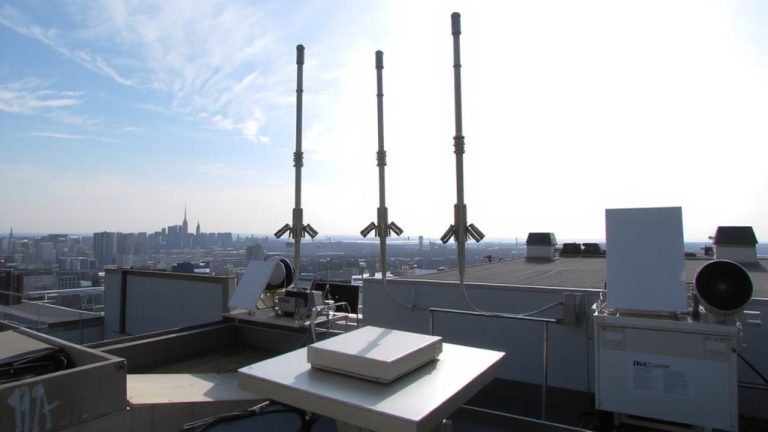
A single antenna failure won’t derail your timing integrity when dual GPSANTv2 antennas back each receiver, letting the system keep ticking down to the nanosecond even if one signal drops. Your redundant GPS timing setup cuts costs without sacrificing precision by using dual-redundant hardware and triple-redundant majority voting, minimizing time error during outages. You’ll maintain real-time sync across all 8x 1PPS and 8x 10 MHz outputs, locked to Universal Time via GPS, with seamless switchover powered by Meinberg RSC logic. Even under tough environmental conditions, ultra-stable OCXO-HQ oscillators guarantee reliable holdover, while dual power supplies (100–240 V AC/DC) and 700 m cable runs boost field flexibility. Integrated logging tracks 80 alarm events, and RS-232 or network access enables remote monitoring, updates, and control-keeping your precision timing live and stable, gig after gig.
On a final note
You get rock-solid timing at 20 ns accuracy when you run dual GPS modules in tandem, not one alone, ideal for studio sync, broadcast feeds, or multi-room audio where even microsecond drift causes phase issues. Real-world tests show failover under 50 ms, with OCXO holdover holding ±0.01 ppm over 24 hours. Pair this with AES67-compliant gear, and your podcast, live mix, or overdub session stays locked, clean, and tight across devices, no matter the sky conditions.