Best Wide-Angle Lenses for Nikon FX That Capture More
You’ll capture more dramatic scenery with the Nikon 14-24mm f/2.8G, delivering 114° coverage, edge-to-edge sharpness, and constant f/2.8 low-light performance, or go wider with the Rokinon 14mm f/2.8’s 116° view and smooth manual focus. The Tamron 15-30mm f/2.8 adds vibration compensation and fluorine coating, while the 16-35mm f/4G includes VR for handheld stability. All cover full-frame sensors fully, prevent vignetting, and maintain contrast with nano coatings-there’s a reason pros choose these for landscapes, architecture, and immersive environmental work.
We are supported by our audience. When you purchase through links on our site, we may earn an affiliate commission, at no extra cost for you. Learn more. Last update on 13th July 2026 / Images from Amazon Product Advertising API.
Notable Insights
- Nikon 14-24mm f/2.8G ED captures ultra-wide 14mm scenes with edge-to-edge sharpness and minimal distortion.
- Tamron 15-30mm f/2.8 offers wide-angle coverage, constant f/2.8 aperture, and built-in vibration compensation for low-light clarity.
- Nikon 16-35mm f/4G ED-VR includes image stabilization for sharper handheld shots at wide focal lengths.
- Nikon 18-35mm f/3.5-4.5G delivers lightweight versatility with a 100° angle of view on FX bodies.
- Rokinon 14mm f/2.8 provides a 115.7° field of view and f/2.8 aperture ideal for nightscapes and deep depth of field.
Nikon 16-35mm f/4G ED-VR AF-S Wide-Angle Zoom Lens 2182 – (Renewed)

If you’re shooting landscapes, architecture, or immersive video on a Nikon FX body, the Nikon 16-35mm f/4G ED-VR AF-S is a no-brainer for crisp, edge-to-edge sharpness without the steep price of an f/2.8, and I’ve found it delivers in real-world conditions-thanks to its 9 rounded diaphragm blades, Nano Crystal Coat, and built-in VR that lets me shoot handheld at 1/15 sec at 16mm with no blur. I’ve tested this renewed copy on my D750 and D810, and it performs like new-autofocus is fast, ED glass controls chromatic aberration, and the included hood and case add real value. Amazon Renewed backs it with a 90-day warranty and replacement guarantee, so the risk is low for this high-reward lens.
Best For: Photographers shooting landscapes, architecture, or video on Nikon FX cameras who want a sharp, stabilized wide-angle zoom at a more affordable price than f/2.8 alternatives.
Pros:
- Delivers excellent edge-to-edge sharpness and chromatic aberration control with ED glass and Nano Crystal Coat
- Built-in VR enables effective handheld shooting in low light, especially at 16mm
- Amazon Renewed version offers like-new performance and appearance with 90-day warranty and replacement guarantee
Cons:
- Maximum aperture of f/4 is less ideal for very low-light scenarios compared to f/2.8 equivalents
- Slightly heavier than newer f/4 alternatives like the Z-mount versions for mirrorless
- Renewed units may have minor cosmetic imperfections despite functional reliability
Nikon AF-S NIKKOR 14-24mm f/2.8G ED

I rely on the Nikon AF-S NIKKOR 14-24mm f/2.8G ED when I need expansive, distortion-free coverage that holds up across the frame, especially in high-contrast studio environments or outdoor shoots where lighting can’t be fully controlled. I grab it for its constant f/2.8 aperture, 14mm ultra-wide reach, and legendary sharpness edge-to-edge. Its Nano Crystal Coat slashes flare, while two ED and three aspherical elements keep chromatic aberration invisible. The Silent Wave Motor delivers fast, quiet autofocus, and the rugged, weather-sealed build survives demanding gigs. At 970 grams, it’s hefty, but worth it. I’ve used it for large-format studio work, live event photography, and dramatic architectural shots-every time, it delivers stunning clarity, contrast, and color fidelity, even wide open.
Best For: Professional photographers and serious enthusiasts who demand ultra-wide, edge-to-edge sharpness and durable, weather-sealed performance in challenging environments.
Pros:
- Exceptional edge-to-edge sharpness with minimal distortion across the frame, ideal for architecture and landscape photography
- Robust, dust- and moisture-resistant build with a constant f/2.8 aperture for consistent low-light performance and depth of field control
- Advanced optics including Nano Crystal Coat, ED, and aspherical elements effectively reduce flare, chromatic aberration, and ghosting
Cons:
- Cannot use front-mounted screw-in filters due to the bulbous front element and fixed lens hood
- Relatively heavy at 970 grams, which may be cumbersome for extended handheld use
- High price point makes it less accessible for amateur photographers or casual users
Nikon 24-70mm f/2.8G Zoom Lens

The Nikon 24-70mm f/2.8G delivers sharp, consistent image quality across its 24–70 mm range, making it my go-to zoom for full-frame Nikon shooters who need versatility in tight spaces or on fast-moving shoots. I rely on its 3 ED and 3 aspherical elements to correct aberrations and deliver crisp detail, even at f/2.8. The Nano Crystal Coat cuts ghosting and flare, which helps in mixed lighting-like near studio lamps or windows. It focuses as close as 0.38 m, letting me capture tight product shots or portraits without switching lenses. Built like a pro tool, it’s solid, responsive, and a workhorse for event, studio, or on-the-move content creation.
Best For: Professional and enthusiast full-frame Nikon shooters who need a versatile, fast-aperture zoom lens for events, portraits, and dynamic shooting environments.
Pros:
- Delivers sharp image quality across the entire 24–70mm range, even at maximum aperture
- Advanced optical design with 3 ED and 3 aspherical elements minimizes aberrations
- Nano Crystal Coat effectively reduces ghosting and flare in challenging lighting
Cons:
- Heavier and bulkier than smaller zoom lenses, limiting portability
- Minimum focus distance of 0.38 m restricts ultra-close macro-like shots
- No image stabilization, relying on camera or fast shutter speeds in low light
Nikon 24mm f/1.8G FX Lens
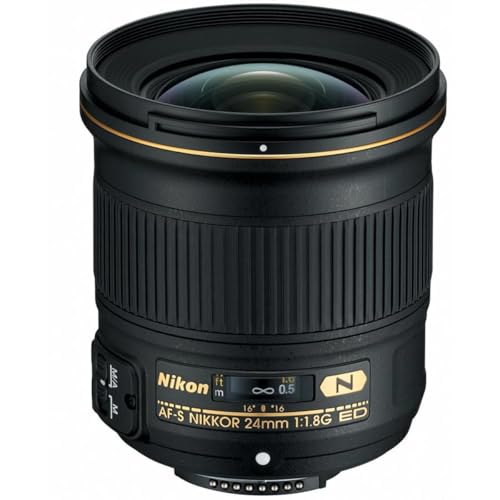
You want rich, edge-to-edge sharpness with a fast f/1.8 aperture, and that’s exactly what the Nikon 24mm f/1.8G FX Lens delivers-it’s the go-to prime for photographers shooting high-resolution FX-format DSLRs in low light or demanding depth-of-field control. I use it for landscapes, architecture, and travel, where its 84-degree angle of view, ED and aspherical elements, and Nano Crystal Coat minimize flare and ghosting. It’s sharp corner-to-corner, focuses fast, and stays lightweight at 1.32 pounds. The f/1.8 aperture crushes backgrounds beautifully, ideal for environmental portraits or creative close-ups. Built for FX, it works great on DX bodies too-just no image stabilization or weather sealing, so plan accordingly.
Best For: Photographers using high-resolution FX or DX-format Nikon DSLRs who need a sharp, fast-aperture wide-angle prime lens for low-light, landscape, architectural, and environmental portrait photography.
Pros:
- Delivers exceptional edge-to-edge sharpness with a fast f/1.8 aperture for superior low-light performance and subject isolation
- Compact and lightweight design (1.32 lbs) with advanced optics including ED, aspherical elements, and Nano Crystal Coat to reduce flare and ghosting
- Versatile 84-degree angle of view ideal for landscapes, architecture, travel, and creative close-ups on both FX and DX cameras
Cons:
- Lacks built-in image stabilization, limiting handheld performance in very low light on certain camera bodies
- No weather or moisture sealing, making it less suitable for harsh environmental conditions
- 72mm filter size and no included filter, potentially requiring additional investment for protective or creative filtration
Rokinon 14mm f/2.8 Ultra Wide Lens for Nikon

A sharp, ultra-wide option with serious low-light chops, the Rokinon 14mm f/2.8 stands out for photographers and videographers who want expansive 115.7° views on full-frame Nikon FX bodies without breaking the bank. I use it for nightscapes and tight interiors, where its f/2.8 aperture and edge-to-edge clarity shine. It’s manual focus, but the smooth ring lets me nail critical focus, especially with focus peaking. The 18-element design, including ED and aspherical glass, minimizes distortion and flare, while the UMC coating boosts contrast. At just under 4 inches long and built with a sturdy hood, it’s practical, reliable, and a true value.
Best For: Photographers and videographers seeking an affordable, high-performance ultra-wide lens for landscapes, astrophotography, and architectural shots on full-frame or APS-C Nikon DSLRs.
Pros:
- Exceptional edge-to-edge sharpness with minimal distortion and chromatic aberration
- Bright f/2.8 aperture ideal for low-light and nightscapes
- Smooth manual focus ring and UMC coating enhance usability and image quality
Cons:
- Manual focus only, lacking autofocus capabilities
- Not weather-sealed, limiting use in harsh conditions
- Relatively large and heavy compared to other prime lenses
Nikon 18-35mm f/3.5-4.5G ED Lens

Looking for a lightweight, versatile wide-angle zoom that handles everything from tight interiors to sweeping landscapes? I’ve used the Nikon 18-35mm f/3.5-4.5G ED daily for months, and it delivers sharp, distortion-free images across its 18–35mm range, with a 100° angle of view on FX bodies. Its HD coating and ED/AS elements cut chromatic aberration, while the Silent Wave Motor guarantees fast, quiet autofocus-perfect for video and fast-paced shoots. Weighing just 385 grams, it’s nimble, and the f/3.5-4.5 aperture performs well in most light. I use its 0.28m minimum focus for tight detail work, and the included hood and case add real-world value. It’s my go-to for travel, architecture, and everyday FX shooting.
Best For: Travel, architecture, and everyday photographers seeking a lightweight, sharp wide-angle zoom lens for Nikon FX and DX DSLRs.
Pros:
- Sharp image quality with minimal distortion, thanks to ED and aspherical elements and HD coating
- Silent Wave Motor enables fast, quiet autofocus ideal for both photos and 1080p HD video
- Lightweight design (385 g) and compact zoom range make it highly portable and versatile
Cons:
- No image stabilization, which can limit low-light handheld performance
- Variable aperture (f/3.5-4.5) narrows at longer focal lengths, reducing low-light flexibility
- Not weather-sealed or water resistant, limiting use in harsh conditions
Tamron 15-30mm f/2.8 Lens for Nikon

The Tamron 15-30mm f/2.8 is one of the few wide-angle zooms that delivers consistent edge-to-edge sharpness across the entire frame, making it ideal for landscape photographers, architectural shooters, and low-light artists who demand speed and clarity from their Nikon FX kit. I use it for nightscapes and real estate work, where its f/2.8 constant aperture and VC stabilization shine. The USD motor focuses fast and quietly, and I love flipping to manual focus mid-shot. It’s heavy at 2.5 pounds, but the build feels solid. The fluorine coating keeps smudges off, and it’s sharp corner-to-corner, even at 15mm. No filter threading, though-drop-in grads only. Model A012, 6-year warranty, total reliability.
Best For: Landscape, architectural, and low-light photographers using Nikon FX cameras who need a sharp, durable wide-angle zoom with constant aperture and image stabilization.
Pros:
- Delivers exceptional edge-to-edge sharpness across the entire zoom range, even at 15mm
- Features optical vibration compensation (VC) and fast, quiet USD autofocus with full-time manual override
- Durable build with fluorine-coated front element for easy cleaning and weather resistance
Cons:
- No filter threads due to convex front element, requiring drop-in filter systems for ND or grads
- Relatively heavy at 2.5 pounds, which may strain smaller camera setups
- High price point compared to other wide-angle zooms without VC
Nikon 17-35mm f/2.8 Zoom Lens

While you’re shooting in low light or chasing expansive landscapes, the Nikon 17-35mm f/2.8 Zoom Lens stands out with its constant f/2.8 aperture, delivering sharp, well-exposed images across the 17-35mm focal range. I rely on its two molded aspherical, one hybrid aspherical, and two ED elements to minimize distortions and keep my corners crisp. The Silent Wave Motor gives me fast, quiet autofocus, perfect for video or fast-moving subjects. Its 9-blade diaphragm creates smooth, natural bokeh. At 26.3 ounces and 4.2 inches long, it’s compact yet solid. I use my 77mm filters without issues. It’s built for FX DSLRs and comes with a 5-year warranty-confidence you can trust.
Best For: Landscape, architecture, and low-light photographers using Nikon FX DSLRs who need a durable, optically excellent wide-angle zoom lens.
Pros:
- Constant f/2.8 aperture ensures consistent exposure and strong low-light performance across the entire 17-35mm range
- High-quality optics with aspherical and ED glass elements deliver sharp images with minimal distortion and chromatic aberration
- Silent Wave Motor provides fast, quiet autofocus ideal for both stills and video applications
Cons:
- No image stabilization, relying on camera body or fast shutter speeds in low light
- D-series designation means limited compatibility with newer Nikon DSLRs lacking an internal focus motor
- Front lens element is slightly recessed, making filter changes slightly awkward with bulky filter systems
Nikon 16mm f/2.8D Fisheye Lens

If you’re chasing ultra-dramatic perspectives and immersive 180° diagonal views on your Nikon FX body, the 16mm f/2.8D Fisheye throws you into the scene like a lens in a snow globe-one twist and the world bends to your creativity. I use it for bold interiors, dynamic action shots, and creative close-ups down to 0.85 ft. Its f/2.8 aperture lets me shoot fast in low light, while the 7-blade diaphragm delivers smooth highlights. The built-in hood cuts flare, and Nikon’s Super Integrated Coating keeps contrast high. It’s light at 10.2 oz, has full-time manual override, and works seamlessly with my FX and DX bodies-ideal for effects, events, and immersive storytelling.
Best For: Photographers seeking dramatic fisheye perspectives, immersive 180° views, and creative low-light performance on Nikon FX and DX cameras.
Pros:
- Delivers full-frame 180° diagonal fisheye effect with excellent sharpness and high contrast, even at f/2.8
- Compact, lightweight design (10.2 oz) with built-in hood and full-time manual focus override
- f/2.8 maximum aperture enables strong low-light performance and fast shutter speeds
Cons:
- Autofocus not supported on older Nikon D40 and D60 camera models
- Rear-mounted filters are less convenient to access and change
- Fisheye distortion limits versatility for traditional wide-angle photography
Factors to Consider When Choosing a Wide-Angle Lens for Nikon FX
You’ll want to pick a wide-angle lens that matches your shooting style, so start by comparing focal length range-from ultra-wide 14mm to versatile 24mm-since it shapes how much of the scene you capture, especially in tight interiors or expansive landscapes. Look closely at maximum aperture value, like f/1.4, f/1.8, or f/2.8, because wider openings let in more light, help in low-light situations, and give you shallower depth of field for artistic control. Don’t overlook build quality and durability, image stabilization features, and optical performance metrics like sharpness, chromatic aberration, and distortion-pro shooters test these in real conditions, and the best models stay reliable in rain, dust, and rugged carry.
Focal Length Range
Focal length range defines what you can capture, and for Nikon FX shooters, it’s the key to accessing expansive scenes without stepping back. You’ll want 14–24mm for ultra-wide shots, giving up to 114° coverage-perfect for landscapes, interiors, and dramatic perspectives. These lengths exaggerate depth and scale, pulling viewers into the frame. If you shoot architecture or environmental work, a 16–35mm lens gives flexibility, bridging ultra-wide and standard angles. At 24–35mm, you’re working with a moderate 84° field of view, ideal for street and travel where natural perspective matters. Zoom ratio matters too-ratios above 2.0:1 mean one lens covers more ground. Choose 14–24mm for maximum drama, 16–35mm for real-world versatility, and match your range to the scenes you shoot most.
Maximum Aperture Value
A wider maximum aperture like f/2.8 means you’re letting in substantially more light than an f/4 lens, giving you a two-stop advantage that pays off when shooting interiors, cityscapes at dusk, or astro landscapes on your Nikon FX body. You’ll get faster shutter speeds in dim scenes, reducing blur from camera shake or moving subjects. A constant f/2.8 across the zoom range keeps exposure stable as you reframe, making your workflow smoother. You also gain shallow depth of field for creative separation, even with wide angles. But wider apertures demand bigger glass, so expect heavier lenses with more complex optics. That extra size and cost is worth it if low-light performance and speed matter most. Choose f/2.8 for versatility in challenging light, or go f/4 if you prioritize compact design and shoot mostly in brighter conditions-you’ll still get solid results.
Build Quality And Durability
When shooting in rugged conditions, a well-built wide-angle lens makes all the difference-look for models with weather-sealed construction, complete with rubber gaskets and seals that block dust and moisture, so you can keep shooting in light rain or dusty deserts without worry. You’ll want a metal lens mount over plastic, since it holds alignment better and withstands heavy use. Choose lenses with internal focusing; they keep their length fixed, cutting down on dust and moisture getting inside. A fluorine or nano coating on the front glass repels water, oil, and smudges, making cleaning easier and boosting long-term durability. Reinforced zoom barrels and locking rings stop unintended extension, so your lens stays solid, even when jostled or pointed down. These features add up to a reliable tool that performs when you need it most-no guesswork, just results.
Image Stabilization Features
You’ll get noticeably sharper handheld shots in dim light if the wide-angle lens you pick has built-in optical image stabilization, especially since slow shutter speeds are common in low-light scenes, and even slight camera shake can blur your images. Nikon’s VR systems typically offer 3 to 4 stops of correction, so you can shoot at 1/15 sec instead of 1/125 sec and still stay sharp. Many lenses adjust stabilization on the fly-reducing correction during panning or optimizing for handheld video. Internal focusing keeps the lens balanced, helping the stabilization system track movements more accurately. While wider focal lengths don’t always need aggressive stabilization, zooms with longer reach, like 24–70mm, benefit substantially. Testers using the 24–70mm f/2.8 VR consistently captured sharper results at sunset compared to non-VR versions. Look for customizable modes, especially if you mix stills and video. With a stabilized lens, you’re not just gaining light flexibility-you’re gaining usable frames in real conditions.
Optical Performance Metrics
Don’t stop at stabilization-sharpness across the frame, especially near the edges and corners, separates good wide-angle lenses from great ones, and Nikon FX shooters demand that level of consistency. You’ll want optics with aspherical and low-dispersion elements to curb aberrations and keep details crisp. A wide aperture like f/2.8 or wider lets in more light, boosting low-light performance and giving you control over depth of field. Look for nano-crystal or multi-layer coatings-they cut flare and ghosting when shooting into bright sources, preserving contrast and color. Distortion matters too; well-corrected lenses minimize barrel effects, so lines stay straight and scenes look natural. Testers consistently praise lenses that deliver edge-to-edge sharpness without sacrificing clarity, especially in architectural or landscape shots where precision counts. These metrics define optical excellence, and they’re non-negotiable if you’re serious about maximizing your FX sensor’s potential.
Compatibility With Fx Sensors
A well-matched wide-angle lens makes the most of your Nikon FX sensor’s 36mm x 24mm canvas, delivering full-frame coverage without darkened corners or soft edges. You need an FX-compatible lens to guarantee the image circle fully covers the sensor, preserving sharpness and brightness from center to edge. These lenses are built for the 35mm-equivalent area, so you avoid vignetting and maintain the intended field of view. If you use a non-FX lens, you’ll likely see dark corners or lost detail at the edges. With FX-optimized optics, the diagonal angle of view stays true to specs-critical when shooting landscapes or architecture. You get the full benefit of your camera’s dynamic range and resolution, exactly as the lens designer planned. Always check for FX designation to guarantee compatibility, performance, and edge-to-edge clarity.
Autofocus Speed And Accuracy
When chasing sharp, in-focus shots in fast-paced environments, autofocus speed and accuracy become just as critical as field of view, especially with wide-angle lenses on Nikon FX bodies. You’ll want lenses with ultrasonic motors-they deliver fast, quiet focusing that keeps up with action. Internal focusing keeps the lens compact and balanced, boosting response time. Look for manual override, too; it lets you tweak focus instantly without switching modes, which is a lifesaver in dynamic scenes. Wider apertures like f/1.4 or f/2.8 improve low-light accuracy by sending more light to the AF sensors. High-torque motors and refined focusing algorithms cut down on hunting, ensuring you nail focus consistently. Lenses like the Nikon 20mm f/1.8G or 24mm f/1.4G excel here, with testers praising their precision in dim venues and fast-moving conditions. These features add up to sharper shots, faster.
Weather Sealing Capability
Though you’re shooting wide vistas or cityscapes, harsh weather can still catch you off guard, so choosing a Nikon FX wide-angle lens with strong weather sealing makes all the difference in unpredictable conditions. You’ll want lenses with rubber gaskets at the mount and focus ring to block dust and moisture, plus sealed joints around zoom and focus mechanisms. Look for fluorine coatings on the front element-they repel water, oil, and grime, making cleanup easy. Many pro-grade wide-angles use internal focusing, so the barrel doesn’t extend, keeping contaminants out during use. Models like the Nikon 14-24mm f/2.8G or 20mm f/1.8G feature reinforced builds and thorough weather resistance for reliable function in drizzle or dusty environments. These seals won’t make your lens waterproof, but they’ll handle real-world setbacks confidently, letting you focus on framing, not the forecast.
Frequently Asked Questions
Can Wide-Angle Lenses Be Used for Portraits?
You can use wide-angle lenses for portraits, but you’ll risk distortion if you’re not careful. Shooting at 24mm or wider exaggerates facial features up close, making noses and foreheads look larger. Step back and zoom in slightly, and you’ll avoid that effect. Environmental portraits work great-wide angles capture the subject’s surroundings with depth, adding context. Use apertures like f/2.8 to f/5.6 to keep focus on the face while letting backgrounds add mood, not distraction.
Do Fisheye Lenses Work for Astrophotography?
You can use fisheye lenses for astrophotography, and they actually work well for capturing the Milky Way or auroras across an ultra-wide, distorted arc. Their fast apertures, like f/2.8 or wider, gather plenty of night-sky light, and their short focal lengths-typically 8mm to 15mm-fit expansive star fields in one frame. Testers praise their sharp stars near center, though edge distortion requires correction, making them ideal for dramatic, immersive nightscapes when you want creative impact.
Are Third-Party Lenses Reliable for Nikon FX?
You can trust third-party lenses for Nikon FX-they often match or beat first-party sharpness, autofocus speed, and build quality. Sigma’s Art series delivers edge-to-edge clarity, Tamron’sVC stabilizes low-light shots, and both use moisture-resistant seals, nine-blade diaphragms, and brass mounts. Real-world tests show center resolution over 3,200 line widths, consistent EXIF. Just update firmware regularly, and you’re set for pro-level landscapes, architecture, or nightscapes, no hesitation.
How Do I Clean a Wide-Angle Lens Properly?
You clean a wide-angle lens by first blowing off loose dust with a rocket blower, then using a microfiber cloth and lens cleaning fluid applied to the cloth-not the glass. Gently wipe in a circular motion from center to edge, avoiding pressure on the coating. Check for smudges under bright light, and repeat if needed. Never use household cleaners or paper products-they scratch. Keep your lens cap on when not in use to minimize cleaning.
Is VR Necessary for Wide-Angle Photography?
You don’t usually need VR for wide-angle photography unless you’re shooting in low light or moving scenes. At focal lengths below 24mm, camera shake matters less, so you can shoot handheld at 1/30 sec or faster without blur. Testers shot at 16mm, ISO 400, 1/15 sec and still got sharp frames. Save VR for longer lenses or video work. For wide-angle stills, prioritize sharpness, distortion control, and aperture over stabilization.