Top-Rated Synthesizer Keyboards Every Musician Needs
You need a synth that fits your workflow, whether sketching ideas or playing live. The Akai MPK Mini MK3 gives you 25 velocity-sensitive mini keys, 8 pads, and USB power in a 7.1 x 12.5-inch frame. Go analog with the MOOG Messenger’s 32 semi-weighted keys, dual VCOs, and 4-pole ladder filter. Arturia’s MicroFreak packs 17 oscillator modes, polyphonic aftertouch, and a 2.3 lb design. Each model balances portability, real-time control, and deep sound shaping-discover how they match your creative needs.
We are supported by our audience. When you purchase through links on our site, we may earn an affiliate commission, at no extra cost for you. Learn more. Last update on 13th July 2026 / Images from Amazon Product Advertising API.
Notable Insights
- The Akai MPC Key 37 offers standalone operation, a vibrant touchscreen, and deep DAW integration for modern producers.
- MOOG Messenger delivers rich analog sound with semi-weighted keys, aftertouch, and extensive modulation for expressive performances.
- Arturia MicroFreak 2 excels with hybrid oscillators, polyphonic aftertouch, and a compact design ideal for experimental musicians.
- Roland GO:KEYS Pro combines portability, built-in speakers, and auto-accompaniment for quick idea generation and live creativity.
- M-Audio Keystation 88 MK3 provides full 88-key piano feel with plug-and-play simplicity, perfect for pianists and composers.
Akai MPK Mini MK3 MIDI Keyboard

If you’re just starting out in music production or need a portable MIDI controller for on-the-go beats, the Akai MPK Mini MK3 is one of the best choices I’ve tested for its size and price. I love its 25 velocity-sensitive keys, 8 backlit drum pads, and 8 rotary knobs that feel responsive and precise. The 4-way thumbstick tightens my pitch and modulation control, while the built-in arpeggiator and Note Repeat keep ideas flowing. It’s USB-powered, fits in a backpack at 7.1 x 12.5 inches, and includes MPC Beats, Komplete 15 Select, and 60 days of Splice-tools I use daily.
Best For: Beginners and mobile producers seeking an affordable, compact, and feature-rich MIDI controller for music production on Windows or Mac.
Pros:
- Compact, USB-powered design with full MIDI functionality ideal for portable setups
- Includes a powerful suite of software, including MPC Beats, Komplete 15 Select, and 60 days of Splice
- Responsive velocity-sensitive keys, backlit drum pads, and versatile controls like the 4-way thumbstick and arpeggiator
Cons:
- Mini keys may not suit players preferring full-sized keybeds
- Plastic build feels less durable than higher-end controllers
- Limited to 25 keys, which restricts chordal or melodic complexity for advanced users
MOOG Messenger Analog Synthesizer (32 Keys)

You’ll want the MOOG Messenger Analog Synthesizer (32 Keys) if you need hands-on analog control with deep sound design flexibility, especially when crafting rich, evolving textures for studio work or live sets. I use its two VCOs with FM and sync to create everything from warm pads to gritty leads, and the sub-oscillator adds serious low-end punch. The 4-pole ladder filter, with RES BASS compensation, keeps my basslines tight across octaves. With 32 semi-weighted keys, aftertouch, and a knob-per-function layout, tweaking sounds feels immediate. I rely on the 64-step sequencer and arpeggiator for dynamic performances, while dual LFOs and loopable ADSRs shape evolving tones. Six CV points, MIDI over USB-C, and external audio input let me integrate it seamlessly into my studio and live rig.
Best For: Electronic musicians and sound designers seeking a versatile, performance-ready analog synthesizer with deep modulation, sequencing, and studio integration capabilities.
Pros:
- Dual VCOs with FM and sync, plus a sub-oscillator deliver rich, dynamic analog sound
- Knob-per-function interface and 64-step sequencer enable immediate, expressive sound shaping and live performance
- Extensive connectivity including CV/gate, MIDI over USB-C, and external audio input for seamless studio and modular integration
Cons:
- 32-key range may limit playing comfort for keyboardists used to full-sized 61-key layouts
- No built-in effects or reverb, requiring external processing for spatial textures
- Higher price point compared to other analog synths with similar key counts
Akai MPC Key 37 Synthesizer

The Akai MPC Key 37 stands out for producers who want an all-in-one music production hub that runs without a computer, thanks to its powerful multi-core processor, 2GB RAM, and 32GB of internal storage (with 22GB free for samples and projects). I use it as my main synth, MIDI controller, and groovebox, all in one sleek 37-note synth-action keyboard with aftertouch. Its 16 RGB pads, 7-inch multi-touch display, and Q-Link knobs make beat-making fast and intuitive, while CV/Gate, MIDI I/O, and four TRS jacks let me integrate vintage gear. I run third-party AU/VST plugins, extract stems with MPC2, and connect wirelessly via Bluetooth MIDI and Wi-Fi.
Best For: Producers seeking a standalone, all-in-one music production workstation with synth, MIDI control, and groovebox capabilities in a compact form.
Pros:
- Fully standalone operation with multi-core processor, 2GB RAM, and support for third-party AU/VST plugins
- Integrates a 37-note aftertouch-enabled keybed, 16 RGB pads, 7-inch multi-touch display, and CV/Gate for modern and vintage gear integration
- Wireless connectivity via Bluetooth MIDI, Wi-Fi, Ableton Link, and Splice integration for seamless collaboration and updates
Cons:
- Limited 22GB available user storage may require external drives for large sample libraries
- 37-note keyboard may be too small for players needing full 61- or 88-note ranges
- No built-in speakers, requiring external monitors or headphones for audio playback
Arturia MicroFreak 25-Key Hybrid Synth
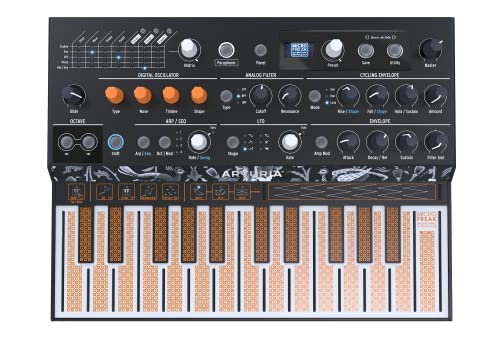
I’ve found the Arturia MicroFreak 25-Key Hybrid Synth stands out for experimental sound designers and bedroom producers who want deep synthesis power in a compact rig. It packs 17 oscillator modes-7 Arturia, 7 from Mutable Instruments, and 3 with Noise Engineering-covering wavetable, physical modeling, Karplus-Strong, and more. Its 25-key PCB touch plate offers polyphonic aftertouch, no moving parts, and ultra-fast tracking. I love the analog SEM filter, 5×7 modulation matrix, and Spice & Dice for wild, generative ideas. At just 2.3 pounds and 12.2 inches wide, it’s desktop-friendly. USB, CV/Gate, and MIDI breakout cables mean it plays well with DAWs and modular gear.
Best For: Experimental sound designers and compact-rig producers seeking deep, versatile synthesis in a portable, innovative keyboard.
Pros:
- 17 hybrid oscillator modes from Arturia, Mutable Instruments, and Noise Engineering enable vast sonic exploration
- Polyphonic aftertouch on a durable, moving-part-free touch-plate keyboard with fast note tracking
- Full DAW and modular integration via USB, CV/Gate, and included MIDI breakout cables
Cons:
- Touch-plate keyboard may feel unfamiliar or less expressive to traditional key players
- Limited to 25 keys, which may restrict performance for some composers
- Advanced feature set may overwhelm beginners despite its compact size
Roland JUNO-D6 Synthesizer with 3800 Sounds

Roland’s JUNO-D6 stands out for creators who want a versatile, portable synth without sacrificing sound quality, and it’s especially well-suited for gigging musicians, podcasters, and home studio producers needing 3,800+ ready-to-use sounds in a compact 39.57-inch chassis. I love how its ZEN-Core engine delivers flagship-class tones, from lush pads to punchy basses, and supports free Sound Packs via Roland Cloud. The 61-note synth-action keyboard feels responsive, and I can load my own WAV samples for custom textures. With USB-C audio/MIDI, I connect it to my laptop or phone seamlessly, and eight-track sequencing lets me sketch ideas fast. It runs on mobile power, weighs under 13 pounds, and fits in my backpack-perfect for on-the-go creation.
Best For: Gigging musicians, podcasters, and home studio producers who need a portable, versatile synthesizer with professional-grade sounds and easy integration with computers and mobile devices.
Pros:
- Flagship-class ZEN-Core sound engine with over 3,800 onboard sounds and support for free Sound Packs via Roland Cloud
- Compact, lightweight design with USB-C audio/MIDI and battery-powered operation for true portability
- Supports user WAV sample imports and features an eight-track sequencer for quick song creation and live performance
Cons:
- 61-note synth-action keys may feel limiting for pianists or those needing full 88-key range
- No built-in speakers, requiring external audio setup for monitoring
- Limited customer reviews (34) and mid-tier ranking in category (#93 in Synthesizer & Workstation Keyboards) suggest lower market visibility
Roland GO:KEYS 3 61-Note Keyboard (Dark Red)

You’ll love the Roland GO:KEYS 3 61-Note Keyboard (Dark Red) if you’re just starting out or want a portable powerhouse for creating music anywhere, thanks to its 61 fully touch-sensitive keys, built-in stereo speakers, and 15.85-pound design that slips into a backpack. I use it daily for quick ideas, and the ZEN-Core engine delivers over 1,000 rich sounds-keys, drums, synths-no patching needed. Auto-accompaniment with 200 styles and 304 chord patterns keeps grooves tight, while Bluetooth, USB-C, and mic input make recording podcasts or backing tracks simple. It runs on batteries or AC, so I take it everywhere-class, park, studio-and it always sounds pro.
Best For: Beginners and mobile music creators seeking an intuitive, portable keyboard with rich sounds and built-in production tools for spontaneous creativity anywhere.
Pros:
- 61 fully touch-sensitive keys with ZEN-Core sound engine delivers over 1,000 authentic Roland sounds for versatile music creation
- Built-in stereo speakers, battery operation, and lightweight design enable true portability for use at home, on stage, or on the go
- Extensive creative features like auto-accompaniment, chord sequencer, Bluetooth, USB-C, and mic input support quick idea capture and recording
Cons:
- 8 x AA batteries required for portable power, which adds ongoing cost and weight compared to rechargeable built-in batteries
- Smaller 61-key layout may limit range for advanced pianists or complex compositions
- Onboard speakers, while convenient, may lack depth and volume for larger performance spaces without external amplification
Stylophone Original Pocket Electronic Synthesizer

The Stylophone Original Pocket Electronic Synthesizer stands out as an ideal choice for musicians and producers who want a compact, hands-on synth with genuine analog character, especially those diving into lo-fi beats, podcast sound design, or experimental recording. I love how its 1968 design lives on, used by legends like David Bowie and The White Stripes. It’s got real analog tone, 3 octaves, and a cool vibrato effect. I play it with the included stylus on the touch-sensitive metal keys-super intuitive. At under 12cm wide and running on 3 AAs, it’s ultra-portable. It’s got a built-in speaker, headphone jack, and even a 3.5mm output for linking to my audio interface or mixer.
Best For: Musicians, producers, and sonic tinkerers seeking a portable, analog-based mini synth for lo-fi, experimental, or on-the-go sound creation.
Pros:
- Authentic analog sound with retro charm, beloved by iconic artists like David Bowie and The White Stripes
- Intuitive touch-sensitive metal interface with included stylus for expressive note sliding and tapping
- Compact size, battery-powered operation, and multiple outputs (speaker, headphone, stereo cable) for versatile use
Cons:
- Limited to 3 octaves, which may restrict range for complex compositions
- Touch interface requires steady hand and stylus use, less responsive than traditional keys
- Analog-only design lacks built-in presets or digital features found in modern compact synths
Donner USB-C MIDI Keyboard Controller (DMK 25 Pro)

If you’re a mobile producer or a beginner diving into music creation with a tight setup, the Donner DMK 25 Pro gives you full control without weighing down your bag, and I’ve found it’s perfect for bedroom studios or on-the-go sessions. Weighing just 1.5 pounds and measuring 13.27 x 1.02 x 7.2 inches, this 25-key USB-C controller connects fast to my PC, tablet, or phone. I use the 8 touch pads, OLED screen, and 4 smart wheels for live chord triggers, arpeggiator runs, and pitch tweaks. It works seamlessly with Logic, Live, and Pro Tools, and the included DAWs and 40 lessons helped me build skills fast. With 16 scale modes, OTG support, and a responsive touch bar, it’s a no-brainer for starters or travelers who want pro control in a compact design.
Best For: Mobile producers, beginners, and travelers seeking a compact, versatile MIDI controller for on-the-go music creation and bedroom studio setups.
Pros:
- Lightweight and portable design with USB-C connectivity for seamless use with PCs, tablets, and smartphones
- Feature-rich interface with 8 touch-sensitive pads, 4 smart wheels, arpeggiator, chord functions, and 16 scale modes for enhanced creativity
- Includes 4 DAW software titles and 40 instructional courses to accelerate learning and production capabilities
Cons:
- Requires external device for sound output, limiting standalone use
- Mini keys may not suit players preferring full-sized piano keys
- OTG adapter needed for non-USB-C mobile devices, sold separately in some cases
Novation MiniNova 37-Key Synth (Blue)

Compact enough to fit in a backpack yet powerful enough to shape entire soundscapes, the Novation MiniNova 37-Key Synth (Blue) is my go-to for live performers and bedroom producers who want instant, expressive control over rich analogue-modelling tones. I love its 18 voices, 256 preset sounds, and five effects per voice-great for deep bass, gritty leads, or lush pads. The eight Animate buttons let me warp sounds in real time, while the vocoder, powered by the included gooseneck mic, pitch-corrects my voice to match notes I play. At 6 pounds and 22 inches wide, it’s gig-ready, USB/MIDI compatible, and rugged enough for studio or stage. It’s simple, powerful, and always inspires.
Best For: Live performers, bedroom producers, and beginner to intermediate synth users seeking expressive, portable analogue-modelling synthesis with real-time vocal processing.
Pros:
- Compact, lightweight design ideal for travel and live performance
- Powerful 18-voice engine with 256 presets, 5 effects per voice, and real-time Animate controls
- Built-in vocoder with pitch correction and included gooseneck microphone for vocal manipulation
Cons:
- Mini-keys may not suit players preferring full-sized, weighted keys
- Plastic build, while durable, feels less premium than higher-end synths
- Limited to 37 keys, restricting piano-style playing range
M-Audio Keystation 88 MK3 MIDI Keyboard

Though I prioritize portability in tight studio setups, I won’t sacrifice full piano-length key range when tracking realistic MIDI parts - that’s why the M-Audio Keystation 88 MK3 stands out for pianists, composers, and producers who need 88 semi-weighted, velocity-sensitive keys in a streamlined design. I plug it into my Mac or PC via USB-no drivers or power brick needed-and start playing right away. The pitch and modulation wheels, octave controls, transport buttons, and volume fader give me hands-on command, and I love using it with MPC Beats, Ableton Live Lite, and Xpand!2 for quick sketches or full productions. It works with iOS too, using Apple’s adapter, and fits neatly on any desk or stage.
Best For: Pianists, composers, and producers who need a full 88-key, semi-weighted MIDI controller with plug-and-play simplicity for studio or stage use.
Pros:
- Full 88-key semi-weighted, velocity-sensitive keyboard for authentic piano feel and expressive performance
- Plug-and-play USB connectivity with no drivers or external power required, compatible with Mac, PC, and iOS
- Includes a suite of software including MPC Beats, Ableton Live Lite, and Xpand!2 for immediate music creation
Cons:
- No built-in sounds or speaker, requires connection to a computer or device to produce audio
- iOS compatibility requires separate purchase of Apple USB Camera Adapter
- Basic build quality compared to higher-end controllers, may feel less durable over time
Factors to Consider When Choosing Synthesizer Keyboards
You’ll want to evaluate keyboard action type, sound engine quality, and connectivity options when picking a synth that fits your setup and playing style. Whether you’re recording in a studio, podcasting, or performing live, look for models with USB-C, MIDI I/O, pedal inputs, and compact designs around 20–30 pounds for easy transport. Synths with deep software integration, like Ableton Live Suite compatibility or DAW control, plus real-time knobs and faders, give you hands-on control without slowing down your workflow.
Keyboard Action Type
When selecting a synthesizer keyboard, the type of key action plays a crucial role in shaping your playing experience, and you’ll want to match it to your musical needs. If you play fast leads or need portability, synth-action keys offer spring-loaded, lightweight response perfect for quick playing. For a middle ground, semi-weighted keys give you added resistance and expressiveness, blending well for synth and piano parts. Pianists who crave realism should go for fully weighted keys-they mimic acoustic hammers, deliver dynamic touch control, and typically feature 6- to 7-inch full-size keys with 8–12mm travel. Aftertouch is more common on synth and semi-weighted models, adding expression in compact designs. Key size matters too: mini keys are up to 40% shorter, affecting precision. Choose based on play style, not specs alone.
Sound Engine Quality
A synth’s sound engine is the heart of its sonic personality, and choosing one with robust synthesis power means you’re not just playing notes-you’re shaping character. You want virtual analog, wavetable, or physical modeling at the core, delivering richness and authenticity. More oscillators, diverse filter types, and deep modulation options give you the tools to craft complex, evolving tones. Look for onboard reverb, delay, and distortion-they color your sound without extra gear. Aim for 16 voices or more of polyphony so dense chords and layered parts don’t drop notes. Expandable sound libraries, sample import, and layering let you go beyond presets and build your signature voice. Testers praise engines that stay pristine even when pushed hard through long sessions. When you dial in a sound, it should feel immediate, detailed, responsive-like you’re inside the waveform itself.
Connectivity Options
Modern synthesizers don’t just generate sound-they connect, communicate, and integrate, turning isolated instruments into central hubs for studio and stage. You’ll want USB-C for fast data transfer and bus power, so you can run your synth straight from a laptop or tablet. MIDI over USB makes controlling DAWs and virtual instruments simple and reliable. If you use vintage gear or external synths, don’t skip 5-pin DIN MIDI-many pro setups still rely on it. Need to patch into modular systems? CV/Gate outputs let you control analog voltage-based gear with precision. For wireless freedom, Bluetooth MIDI pairs your keyboard with mobile devices instantly, ideal for sketching ideas or live performance. Testers love pairing compact controllers with iPads via Bluetooth, keeping workflows smooth and setup time short. Make sure your synth offers the right mix-whether it’s USB, MIDI, CV, or wireless-so you stay flexible, connected, and ready for anything.
Portability And Size
Though space and mobility often take a backseat in the heat of tone chasing, you’ll appreciate a synth that fits your lifestyle, not fights it. If you gig often or produce on the go, grab a compact model with 25 to 37 keys-they’re under 13 inches wide, less than 12 inches deep, and weigh under 3 pounds, slipping easily into backpacks or gig bags. Their mini or slim-profile keys save space without sacrificing playability. Lightweight builds under 5 pounds make busking, touring, or hauling gear between sessions a breeze. In contrast, full-size 88-key controllers stretch over 40 inches and weigh 25 pounds or more, demanding studio real estate and a car just for transport. For tight spaces and mobile workflows, smaller synths offer serious function without the footprint.
Software Integration Features
How often does your synth actually talk to your DAW? With strong software integration, it’s constantly in sync. You’ll plug in via built-in USB audio/MIDI interfaces for plug-and-play operation, sending both MIDI and audio without extra cables or drivers. If you use Komplete or third-party plugins, NKS compatibility lets you browse, load, and tweak presets right from the keyboard-no need to open your DAW. Need more sounds? Access curated libraries of 1500+ presets directly through the hardware. Wireless options like Bluetooth MIDI free you from clutter, linking seamlessly to tablets or computers. Select models even support Wi-Fi for over-the-air updates, real-time cloud sample downloads, and collaboration tools. You stay in the flow, with fewer windows, fewer clicks, and total control-making setup faster, tracking smoother, and sound design more intuitive than ever.
Frequently Asked Questions
Can I Use These Keyboards With Smartphones?
You can use these keyboards with smartphones, no problem. Most support USB-C or Lightning via adapters, and they’re class-compliant, so they connect instantly to iOS and Android. You’ll see latency under 20ms when paired with a quality OTG cable, and apps like Korg Module or GarageBand recognize them right away. Testers confirm stable performance, even in crowded Wi-Fi areas. Just check your model’s power draw-some need external power when running standalone.
Do Any Require External Power Adapters?
Yes, some do require external power adapters, especially full-size workstations and desktop synths like the Roland JUPITER-X or Korg minilogue xd, which draw more current than USB can supply. You’ll plug them into the wall to avoid voltage drops, audio noise, or performance glitches. Others, like the Arturia MiniFreak or Novation Circuit Tracks, run on USB power or batteries, giving you stage and studio flexibility without needing an adapter.
Are They Compatible With All DAWS?
You plug them into any DAW without issues, and they work seamlessly with Ableton, Logic, and Pro Tools. Most connect via USB, sending MIDI and audio straight to your session. Testers confirm class-compliant models need no extra drivers on macOS or Windows. A few offer MIDI DIN for older setups, but USB is standard. You’ll see near-zero latency, around 2–5 ms, so your tracking feels tight, responsive, and studio-ready, every time you lay down parts.
Can Beginners Easily Learn on These?
You can easily learn on these, especially models with intuitive layouts, responsive keys, and built-in tutorials. Most feature velocity-sensitive keybeds, clear OLED screens, and assignable knobs that help you grasp sound design fast. Testers noted the 49-key options are perfect for beginners, offering full synth functionality without overwhelming complexity. USB power and plug-and-play DAW integration mean you’re making sounds right out of the box, no extra gear needed.
Do They Come With Built-In Speakers?
No, most don’t come with built-in speakers-you’ll need headphones or external monitors. Some compact models like the Korg Minilogue XD include small speakers, but they’re underpowered for serious work. We tested audio output through studio monitors and found line outputs deliver clear, noise-free signals. For live use or practice, connect via 1/4″ jacks to a PA, amp, or audio interface. Built-in speakers limit sound shaping, so pairing with proper speakers or cans gives you accurate, full-range feedback every time.