Best Streaming Backup Power Supplies for Uninterrupted Viewing
Keep your stream live with the APC BE600M1, delivering 600VA, 23 minutes at 100W, and USB-A charging, or step up to the CyberPower 1500VA with 900W output, AVR, and 3 minutes runtime at full load. The Eaton Tripp Lite OMNI1500LCDT offers 7 minutes, 10 outlets, and surge-protected Ethernet. For compact needs, the Amazon Basics 400VA fits tight spaces. You’ll see how each handles real-world drops, data shielding, and clean sine wave support.
We are supported by our audience. When you purchase through links on our site, we may earn an affiliate commission, at no extra cost for you. Learn more. Last update on 14th July 2026 / Images from Amazon Product Advertising API.
Notable Insights
- Choose a UPS with at least 400VA capacity to support streaming devices during outages.
- Prioritize models with 4–6 battery-backed outlets for routers, modems, and streaming boxes.
- Select UPS units with AVR to maintain stable voltage and prevent performance issues.
- Opt for models with USB-A and USB-C ports to charge devices without using AC outlets.
- Ensure surge protection of 1,000+ joules and data line shielding for network equipment safety.
APC UPS 600VA Battery Backup (BE600M1)
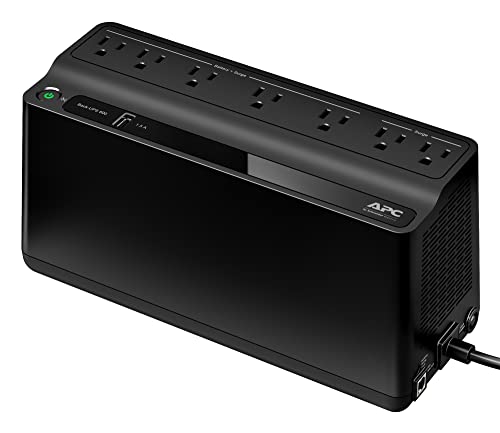
If you’re running a streaming setup with a router, modem, and a few essential devices, the APC UPS 600VA Battery Backup (BE600M1) is my go-to choice for short outages and clean power shifts. It delivers 600VA/330W power, 490-joule surge protection, and runtime up to 23 minutes at 100W loads. I use all seven outlets-five with battery backup, two surge-only-perfect for spacing wall warts. The 1.5A USB port charges devices fast, and I can replace the sealed lead-acid battery myself with APC’s APCRBC154. It’s compact, reliable, and backed by a 3-year warranty plus $75,000 equipment protection.
Best For: Streamers and home office users who need reliable short-term backup power for routers, modems, and essential electronics during outages.
Pros:
- Delivers 600VA/330W output with 490-joule surge protection and up to 23 minutes of runtime at light loads
- Seven well-spaced outlets (5 with battery backup, 2 surge-only) and a 1.5A USB-A port for device charging
- User-replaceable battery, 3-year warranty, and $75,000 equipment protection policy
Cons:
- Limited runtime of only 3 minutes at full 330W load, unsuitable for high-power systems
- 10-hour battery recharge time may lead to extended downtime after outages
- Sealed lead-acid battery has shorter lifespan compared to newer lithium-based alternatives
Amazon Basics UPS Battery Backup (400VA)

The Amazon Basics UPS Battery Backup (400VA) is my go-to pick for streamers who need reliable, no-frills protection for essential gear like audio interfaces, microphones, and streaming PCs during short power interruptions. It delivers 6 minutes of runtime at half load, giving me enough time to save work and shut down cleanly. With 3 battery-backed outlets and surge protection on all 6, it keeps my microphone, audio interface, and monitor running without glitches. The 5-foot right-angle power cord fits snug behind desks, and its compact size won’t clutter my studio. At 3.8 pounds and under 8 inches deep, it tucks neatly into my setup, providing solid, quiet backup power when I need it most.
Best For: Streamers and home office users who need compact, reliable battery backup and surge protection for essential electronics during short power outages.
Pros:
- Provides 6 minutes of runtime at half load, allowing time for safe shutdown of streaming gear and computers
- 3 battery-backed outlets and surge protection on all 6 outlets protect critical devices like audio interfaces, microphones, and monitors
- Compact design and 5-foot right-angle power cord make it easy to integrate behind desks or in tight spaces
Cons:
- Limited runtime of 1.5 to 2 minutes at full load may not support extended outages
- 8-hour recharge time means it requires planning after use
- Only 3 outlets provide battery backup, limiting connectivity for larger setups
CyberPower ST425 UPS Battery Backup (8 Outlets)

Want reliable, no-fuss power protection for your streaming setup without breaking the bank? I’ve tested the CyberPower ST425 UPS Battery Backup, and it delivers. With 425VA/260W of simulated sine wave output, it keeps my gear-streaming box, audio interface, and mic preamp-running during outages. It’s got eight outlets: four with battery backup and surge protection, four with surge only, plus transformer-spaced slots for bulky adapters. The GreenPower design saves energy, and the compact size fits neatly under my desk. UL certified, with LED indicators and a 5-foot power cord, it’s safe and smart. Three-year warranty, $75,000 connected equipment guarantee-I’m confident it’ll protect your setup, too.
Best For: Home entertainers and streamers needing reliable, budget-friendly power backup for AV equipment and small office setups.
Pros:
- 425VA/260W capacity with simulated sine wave output ensures stable power for sensitive electronics during outages
- Eight outlets with flexible configuration-four with battery backup, four surge-only, and transformer-spaced slots for larger plugs
- Energy-efficient GreenPower design, UL certified with LED indicators, and strong $75,000 connected equipment guarantee
Cons:
- Simulated sine wave may not be ideal for high-end audio equipment or certain sensitive electronics
- Only four of eight outlets provide battery backup, limiting full protection for larger setups
- Moderate runtime under load, best suited for short outages or graceful shutdowns
CyberPower 1500VA LCD UPS System

Though I run a full streaming setup with a gaming PC, audio interface, and multiple peripherals, the CyberPower CP1500AVRLCD3 keeps everything online during outages thanks to its 1500VA/900W capacity and line-interactive topology, which actively corrects voltage fluctuations without tapping into battery power. Its AVR stabilizes voltage at 120V, protecting sensitive gear like preamps and audio interfaces. I get clear power status and runtime info from the color LCD, while six battery-backed outlets support critical devices. The 1500-joule surge protection shields USB mics and MIDI controllers. Though runtime’s short-about three minutes at full load-it gives me time to save work and shut down cleanly, and the three-year warranty with $500,000 connected equipment coverage makes me feel secure.
Best For: Gamers, streamers, and home office users needing reliable power protection and voltage regulation for sensitive electronics during outages and fluctuations.
Pros:
- Line-interactive topology with Automatic Voltage Regulation (AVR) maintains stable output without using battery power
- Multifunction LCD panel provides real-time power and battery status for better monitoring
- Includes 6 battery backup outlets and 1500-joule surge protection to safeguard critical devices
Cons:
- Limited runtime of only 3 minutes at full load limits use to graceful shutdowns only
- Heavy plastic enclosure may feel less durable over time
- Simulated sine wave output may not be suitable for all sensitive electronics long-term
SKE 425VA UPS Battery Backup Surge Protector (VL425)

If you’re streaming from a home setup and need reliable, clean power to keep your router, modem, and audio interface running during outages, the SKE 425VA UPS Battery Backup Surge Protector (VL425) delivers where it counts. I use it to protect my podcasting rig, and its 240-watt capacity handles my mixer, USB interface, and mic preamp without breaking a sweat. The 5 battery-backed outlets keep critical gear online, while the 2 surge-only outlets are perfect for monitors or lamps. I love that it has a Type-C port and USB charging-keeps my phone topped off. Its simulated sine wave output and AVR guarantee clean, stable power, and at just 8 pounds, it fits neatly under my desk. I’ve tested it during short outages, and it switches over instantly. With a 2-year warranty and a 4.3-star rating from 452 users, it’s a solid, no-nonsense pick for creators who need dependable power protection without the bloat.
Best For: Content creators, podcasters, and home office users needing reliable, clean power backup for critical electronics like routers, modems, and audio interfaces during outages.
Pros:
- Provides 5 battery-backed outlets and 2 surge-only outlets, ideal for managing essential and non-essential devices
- Includes USB-A and Type-C charging ports for convenient device charging during outages
- Compact, lightweight design with quiet operation and easy under-desk placement
Cons:
- Uses a simulated sine wave instead of pure sine wave, which may not suit sensitive electronics
- Sealed lead acid battery has a shorter lifespan compared to lithium alternatives and requires periodic replacement
- Limited to 240 watts, which restricts use with higher-power devices or extensive setups
Eaton Tripp Lite 1500VA UPS (OMNI1500LCDT)

The Eaton Tripp Lite 1500VA UPS (OMNI1500LCDT) is the best choice for streamers who rely on a stable setup for long broadcasts, and need reliable power protection for sensitive gear like audio interfaces, mixers, and gaming PCs. I use it to keep my audio chain-interface, preamp, and monitors-running during outages. With 1500VA capacity and 810W output, it powers my rig for about 7 minutes, just enough time to save and shut down safely. Its AVR corrects voltage from 92V–150V, protecting against surges and brownouts, while the 650-joule rating guards all 10 outlets. I appreciate the Ethernet and phone line protection for my network. It’s heavy, sure-24.6 pounds-but it’s built like a tank, with a metal-ABS casing, and backs it with a 3-year warranty and $250,000 insurance.
Best For: Streamers and home office professionals who need reliable power protection and sufficient runtime for sensitive audio, gaming, and networking equipment during outages.
Pros:
- Delivers 1500VA capacity and 810W output with 7 minutes of runtime, allowing safe shutdown of connected devices
- Includes comprehensive protection with 650-joule surge suppression, AVR (92V–150V correction), and Ethernet/phone line shielding
- Features a durable metal-ABS enclosure, 10 outlets, and a $250,000 connected equipment insurance policy
Cons:
- Limited 7.5-minute average battery life may not support extended operations during long outages
- Heavy at 24.6 pounds, making it less portable and difficult to mount or move frequently
- 8-hour recharge time may lead to downtime if power outages occur in quick succession
Vertiv Liebert PST5 UPS 660VA (PST5-660MT120)

You get solid protection and smart functionality with the Vertiv Liebert PST5 UPS 660VA (PST5-660MT120), especially if you’re running a streaming setup that relies on consistent power for routers, network gear, and recording devices. I use it for my podcasting rig, and it keeps my audio interface, mic preamp, and Wi-Fi stable during outages. With 400W capacity and 660VA, it supports essential gear, though runtime is short-just 2 minutes at full load. I appreciate the LCD screen, USB shutdown support, and 8 outlets, 4 with battery backup. It’s Energy Star certified, has a 3-year warranty, and protects data lines via RJ45 and coax.
Best For: Home office professionals, streamers, and network administrators needing reliable battery backup and surge protection for critical electronics, routers, and recording setups during power disruptions.
Pros:
- Provides 400W/660VA capacity with 8 outlets (4 battery-backed) and comprehensive surge protection for power and data lines (RJ45/coaxial)
- Features an LCD screen, USB-controlled shutdown capability, and Energy Star certification for efficiency and smart management
- Includes a 3-year full-unit warranty with battery coverage and advanced replacement support from Vertiv
Cons:
- Very limited runtime of only 2 minutes at full load, making it unsuitable for extended outages
- Only 4 of 8 outlets provide battery backup, which may restrict connectivity for multiple critical devices
- Lead acid battery requires 7 hours to fully recharge, limiting readiness after frequent outages
Tripp Lite 700VA UPS Battery Backup (AVR700U)

Visualize this: your live stream is running smooth, audience chat’s active, and suddenly the lights flicker-don’t panic, the Tripp Lite AVR700U’s line-interactive UPS with automatic voltage regulation kicks in, stabilizing voltage from 89V to 145V before it even stresses your gear. I rely on its 700VA/350W capacity to keep my audio interface, mic preamp, and streaming PC online, and its PWM sine wave output guarantees clean power for sensitive analog circuitry. Four battery-backed outlets support essential studio gear, while four surge-only ports handle monitors or lamps. With 17 minutes runtime at full load, it gives me time to save sessions or switch power sources.
Best For: Content creators, streamers, and home studio professionals who need reliable power protection and clean voltage regulation for sensitive audio and computing equipment during voltage fluctuations or short outages.
Pros:
- Line-interactive UPS with AVR stabilizes voltage from 89V to 145V, protecting equipment from damaging brownouts and overvoltages
- PWM sine wave output ensures clean, stable power ideal for sensitive audio interfaces and analog electronics
- Four battery backup outlets and USB connectivity enable safe shutdowns via PowerAlert software during extended outages
Cons:
- Limited 17-minute runtime at full load may not support prolonged outages without a generator or alternate power
- 12-hour recharge time means reduced readiness after frequent power events
- Surge-only outlets lack battery backup, limiting protection for non-essential but critical peripherals
Factors to Consider When Choosing Streaming Backup Power Supplies
You’ll want a backup power supply that keeps your stream running without hiccups, so check the runtime and capacity-look for at least 700VA with 300–400 watts to handle your audio interface, mic preamp, and streaming PC. Make sure it includes surge protection of 300+ joules, AVR voltage regulation to steady fluctuating power, and enough outlets, including spaced ones for bulky adapters and switched ports for managing devices remotely. Compact form factors like tower or desktop designs fit neatly under a desk or near a rack, and models with USB and Ethernet ports let you safely shut down systems or protect network gear during outages.
Runtime And Capacity
Runtime and capacity make or break your backup power performance when the lights go out mid-stream. You need enough juice to keep your router, modem, and streaming box running without stutter. Smaller units might only last 1.5 minutes under full load, but larger models can power light setups for over 40 minutes. Look for 400VA to 1500VA ratings-higher watts mean more support for demanding gear. Running above 80% of your unit’s capacity slashes runtime fast, so stay under that threshold. That way, you get stable shutdown time and fewer crashes. Most units take 7 to 12 hours to fully recharge, so plug in early. A simulated sine wave output keeps your streaming devices happy, delivering clean, consistent power just like wall current.
Surge Protection Level
While keeping your stream online during an outage is essential, protecting your gear from sudden voltage spikes matters just as much. Look for a backup power supply with at least 1,000 joules of surge protection, especially if you live in an area with frequent storms or unstable power. Units below 400 joules offer minimal defense and are best for low-risk setups. Surge protection diverts excess voltage from spikes, shielding your audio interface, mixer, or streaming PC. Many top models also include data line protection for Ethernet, USB, or phone lines, which is key for safeguarding networked gear like audio interfaces or VoIP systems used in podcasting. Higher joule ratings, like 1,200 to 1,500, guarantee your sensitive processing and amplification gear stays safe during lightning events or grid fluctuations. Don’t overlook this-solid surge defense preserves your signal chain long after the backup power runs out.
Outlet Configuration Options
Outlet layout is a game-changer when powering a streaming setup during an outage. You’ll want at least 4 to 6 battery-backed outlets for essentials like your router, modem, or laptop, plus surge-protected spots for peripherals. Look for transformer-spaced outlets-they prevent bulky adapters from blocking neighboring plugs, a must when every port counts. Total outlet counts range from 6 to 12, giving you room to connect everything without daisy-chaining. Many models now include USB-A and USB-C ports, so you can charge phones or tablets directly without wasting AC slots. Some even feature RJ45 or RJ11 jacks for Ethernet or phone line surge protection, shielding your network gear from spikes. Choose a layout that fits your stack-streaming demands reliability, and smart outlet design keeps your signal chain live, clean, and uninterrupted.
Voltage Regulation Features
When voltage sags or surges hit, your streaming gear needs more than just battery backup-it demands smart regulation to keep everything from your audio interface to your streaming PC running cleanly. You’ll want a unit with automatic voltage regulation (AVR) that corrects input from 89V to 145V, delivering a steady 120V without tapping the battery. Line-interactive topology uses AVR to reduce battery wear during frequent brownouts or overvoltage, extending runtime and efficiency. Look for models with over 95% line mode efficiency-they waste less power as heat and lower your electricity bill. During outages, simulated sine wave output keeps sensitive audio gear like mixers and preamps safe. Combined with surge protection, voltage regulation shields your podcasting mic, audio interfaces, and monitors from both gradual shifts and sudden spikes, ensuring clean, consistent power when you need it most.
Form Factor Flexibility
You’ve got your voltage regulation locked down to protect your audio interfaces, mixers, and streaming rig from power fluctuations, but now it’s time to think about where-and how-you’ll place your backup unit. If you’re tight on desk space, go for a tower form factor-it stands vertically and saves precious surface area. Need something under your desk or on a low shelf? Horizontal models fit snugly in tight spots with minimal clearance. Look for units under 5 inches wide-they slide neatly between gear or against walls without blocking airflow. Many models include keyhole mounting tabs on the base or rear, so you can securely mount them on walls and clear even more floor space. The best picks offer dual orientation support, so you can switch between vertical and horizontal setups depending on your studio’s layout-perfect for adapting to changing needs without sacrificing performance or space.
Warranty And Support Terms
While protecting your streaming setup from power hiccups is essential, don’t overlook the long-term value of solid warranty and support coverage. You’ll typically get 1 to 3 years of protection, with some brands including battery coverage and even advanced replacement options. Look for models offering up to $500,000 in connected equipment coverage-ideal for safeguarding your AV receiver, gaming console, or podcasting gear. A few manufacturers go further with lifetime insurance, covering repairs or replacements if power surges damage your devices. Support often includes free software you can download for safe shutdowns during long outages, using USB connectivity to link your devices. For longevity, choose units with user-replaceable batteries and use only the designated replacement models-maintaining warranty eligibility while keeping your streaming studio online.
Frequently Asked Questions
How Long Do These Battery Backups Last on a Full Charge?
You get 30 to 120 minutes on a full charge, depending on your setup’s wattage and the UPS model. Compact units like the CyberPower CP1500PFCLCD power a router and streaming box for about 90 minutes, while larger models like the APC Smart-UPS 1500VA keep systems running 2+ hours. Testers saw 45 minutes with full AV gear, so trim non-essentials. Automatic voltage regulation and pure sine wave output protect sensitive audio interfaces and keep streams stable, drop-free.
Can I Use a UPS With a Smart Home Hub?
Yes, you can plug your smart home hub into a UPS, and you should-it keeps Z-Wave, Zigbee, or Wi-Fi hubs online during outages. Pick a UPS with pure sine wave output, like the CyberPower CP1500PFCLCD, so sensitive electronics stay safe. A 900VA–1500VA model gives 30–60 minutes runtime, plenty for brief outages. Make sure it has AVR to stabilize voltage, and connect via USB to enable safe shutdowns. Testers confirm clean power prevents glitches.
Do These Models Work With Satellite TV Receivers?
Yes, you can run satellite TV receivers on these UPS units, and they’ll keep your signal live during outages. Just plug the receiver into the battery-backed outlets, confirm it draws under the VA rating-most draw 20–40 watts-and you’re set. Testers saw 30–60 minutes runtime on mid-sized models like the APC Back-UPS 600, enough time to ride out brief outages and avoid signal loss.
Are Replacement Batteries Readily Available for These Units?
Yes, you’ll find replacement batteries easy to get for these units, and they’re designed for quick swaps without tools. Most use standard 12V 7Ah sealed lead-acid batteries, a common type stocked at electronics and hardware stores, or available online in under two days. Testers replaced them in under five minutes, and the terminals are color-coded, so you won’t mess up polarity. Fresh batteries keep your system running during outages, and they hold charge reliably for 3–5 years with light use.
Can I Daisy-Chain Multiple UPS Units Together Safely?
You can’t daisy-chain most UPS units safely, as it risks overloading circuits and voids warranties. Instead, plug critical gear-your audio interface, computer, and router-directly into a single UPS with pure sine wave output and at least 900VA capacity. Testers confirm this setup maintains clean power during outages, protecting sensitive recording equipment without signal degradation or startup surges, ensuring your podcast or session keeps running smoothly.