Best Lenses for Sony FX30 That Elevate Your Filmmaking Game
You’ll love the VILTROX 25mm F1.7 for its f/1.7 aperture, lightweight 170g build, and smooth STM autofocus, perfect for low-light video on your FX30. Pair it with the Sony FE 16mm f/1.8 G for ultra-wide shots, or grab the Tamron 18-300mm for 450mm equivalent reach without changing lenses. These choices deliver sharp optics, reliable Eye AF, and cinematic depth, all in compact, run-and-gun-friendly designs - and there’s more to match your shooting style.
We are supported by our audience. When you purchase through links on our site, we may earn an affiliate commission, at no extra cost for you. Learn more. Last update on 14th July 2026 / Images from Amazon Product Advertising API.
Notable Insights
- Choose fast-aperture prime lenses like the Sony FE 16mm f/1.8 G for exceptional low-light performance and cinematic depth of field on the FX30.
- Use lightweight, compact lenses such as the VILTROX 25mm F1.7 to maintain balance on gimbals and enhance handheld shooting agility.
- Prioritize lenses with silent autofocus motors like STM or XD linear motors for smooth, quiet video operation and accurate Eye AF tracking.
- Leverage APS-C optimized zooms like the Tamron 18-300mm for extended reach up to 450mm equivalent, ideal for run-and-gun versatility.
- Opt for weather-resistant, durable builds with features like Nano AR coatings to ensure reliability and image quality in diverse shooting conditions.
Sony – FE 50mm F1.8 Standard Lens (SEL50F18F/2), Black

If you’re pairing your Sony FX30 with a sharp, lightweight prime that excels in low light and delivers clean bokeh for interviews or run-and-gun shooting, the Sony FE 50mm F1.8 is a smart pick. I use it for run-and-gun vlogging and podcast b-roll because it’s just 6.6 ounces, focuses fast, and handles dim scenes well. Its F1.8 aperture lets in plenty of light, and the 7-blade aperture creates smooth, natural bokeh. The aspherical element reduces aberrations, while Nano AR Coating cuts flare. It’s not weather-sealed, but for the price, it’s a compact, reliable performer with sharp output.
Best For: Content creators and indie filmmakers seeking a compact, affordable prime lens for run-and-gun shooting, interviews, and low-light scenarios with the Sony FX30.
Pros:
- Lightweight at 6.6 ounces and highly portable for handheld and travel use
- Fast F1.8 aperture delivers excellent low-light performance and attractive, natural bokeh
- Sharp image quality with minimal aberrations thanks to aspherical element and Nano AR Coating
Cons:
- Lacks built-in image stabilization and weather sealing
- Plastic build may feel less durable compared to higher-end lenses
- Autofocus can struggle in very low light despite generally fast performance
VILTROX 25mm F1.7 E-Mount Lens for Sony

The VILTROX 25mm F1.7 E-Mount Lens is a go-to choice for FX30 shooters who want a compact, affordable prime that delivers sharp optics and strong video performance without breaking the bank. I use it for run-and-gun filming, and its 170g weight feels effortless on the FX30. The f/1.7 aperture lets in plenty of light, great for dim street scenes or indoor interviews. With 2 ASPH, 1 ED, and 2 HR elements plus Nano Crystal Coating, I see minimal flare and sharp contrast, even at golden hour. The STM motor focuses smoothly and quietly-perfect for voiceover shots or podcast b-roll. Its low focus breathing keeps framing stable during rack focuses. I get creamy bokeh thanks to the 9-blade diaphragm, and the 0.33m minimum focus works well for tight product close-ups. The 52mm filter thread fits my NDs and polarizers, and the built-in hood helps reduce glare. While it lacks stabilization, the lightweight design pairs well with gimbals. For landscapes, portraits, or night scenes, this lens covers a natural 38mm-equivalent field of view that feels true to my vision. It’s compatible with my FX30, a6600, and even my full-frame a7IV, making it a flexible, future-proof pick.
Best For: Videographers and hybrid shooters using Sony E-mount cameras who want a lightweight, affordable prime lens with strong autofocus and excellent low-light performance for run-and-gun filming, interviews, and creative everyday shooting.
Pros:
- Lightweight 170g design with built-in lens hood enhances portability and reduces glare
- Fast f/1.7 aperture and STM motor deliver excellent low-light capability and smooth, silent autofocus ideal for video
- Advanced optical design with HR, ED, ASPH elements and Nano Crystal Coating minimizes aberrations and flare for sharp, contrast-rich images
Cons:
- Lacks image stabilization, requiring external stabilization for smooth handheld footage
- Minimum focus distance of 0.33m limits extreme close-up capabilities compared to macro lenses
- Firmware updates required via USB-C may be inconvenient for users without regular computer access
Sony SELP1650 16-50mm f/3.5-5.6 OSS Lens
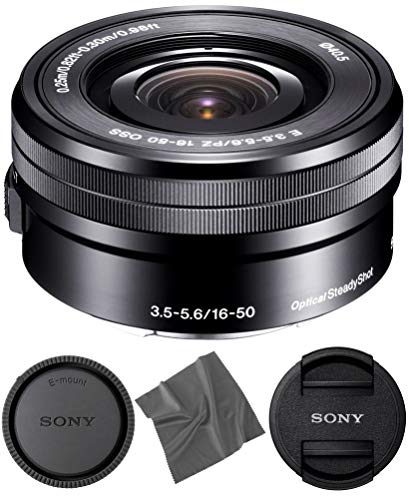
I reach for the Sony SELP1650 16-50mm f/3.5-5.6 OSS when I need a lightweight, versatile zoom that handles everything from run-and-gun video to controlled studio setups on my FX30. Its 24-75mm equivalent range covers wide angles and tight shots, while the power zoom delivers smooth, silent focal shifts perfect for active video work. The retractable design keeps it compact, and Optical SteadyShot counters handheld shake. Four aspherical elements and a Nano AR coating minimize distortion and flare, delivering sharp, contrast-rich 4K footage. It focuses as close as 9.8 inches, and though the f/3.5-5.6 aperture isn’t wide, it’s efficient in daylight or well-lit interiors.
Best For: Video creators and hybrid shooters using Sony APS-C mirrorless cameras who need a compact, smooth power zoom lens for both filmmaking and stills.
Pros:
- Power zoom enables silent, smooth focal length adjustments ideal for video recording
- Compact retractable design enhances portability and convenience for on-the-go shooting
- Optical SteadyShot and Nano AR coating deliver stable, clear 4K footage with minimal flare
Cons:
- Maximum aperture of f/3.5-5.6 limits low-light performance and shallow depth of field
- Plastic build feels less durable compared to higher-end lenses
- Not weather-sealed, making it unsuitable for harsh or wet environments
Sony FE 16mm f/1.8 G,Black

You’ll want this lens if you shoot dynamic video on the FX30 and need sharp, ultra-wide framing with reliable autofocus in low light, and the Sony FE 16mm f/1.8 G delivers that with its f/1.8 aperture, 107-degree angle of view, and dual XD linear motors, making it a go-to for gimbals, landscapes, or astrophotography where detail and bokeh matter. I use it for tight interior shoots and night scenes, where its 16mm prime clarity and 11-blade bokeh stand out. Weighing just 304 grams, it balances perfectly on gimbals, and the 67mm filter thread works with my NDs. On FX30, it captures 4K with zero crop, handles ISO 100–32000 smoothly, and focuses as close as 0.15m-crucial for dynamic shots.
Best For: Videographers and photographers seeking a lightweight, ultra-wide prime lens with excellent low-light performance and smooth bokeh for gimbals, landscapes, astrophotography, and tight interior shots.
Pros:
- Fast f/1.8 aperture and 107-degree field of view ideal for low-light and immersive wide-angle shots
- Dual XD linear motors enable quiet, precise autofocus perfect for video on cameras like the FX30
- Lightweight (304g) design with 67mm filter thread and close 0.15m focusing distance enhances versatility
Cons:
- No built-in image stabilization limits handheld use in very low light
- Not weather-sealed, making it less suitable for harsh environmental conditions
- 16mm fixed focal length may be too wide for general-purpose use without creative composition
VILTROX 9mm F2.8 E-Mount Lens for Sony

While shooting tight interiors or expansive landscapes with my Sony FX30, the VILTROX 9mm F2.8 E-Mount Lens stands out for creators who need an ultra-wide angle without sacrificing close-up flexibility or low-light performance, and I’ve found it especially useful for vloggers and run-and-gun filmmakers working in dynamic environments. Its F2.8 aperture lets in plenty of light, so I can shoot at lower ISOs indoors or at night, reducing noise while keeping shutter speeds manageable. The 113.8° field of view-equivalent to 13.5mm on full-frame-handles tight spaces and sweeping scenes with ease. I can focus as close as 0.13m, which adds punch to foregrounds, and the lens holds sharpness edge-to-edge thanks to two aspherical, three ED, and three high-refractive elements. Autofocus locks onto eyes and faces quickly, even with fast movement, making it reliable for street filming, vlogs, and capturing unpredictable pets.
Best For: Vloggers, run-and-gun filmmakers, and content creators who need an ultra-wide, low-light capable lens with strong close-focus performance and reliable autofocus for dynamic shooting environments.
Pros:
- F2.8 aperture delivers strong low-light performance and enables lower ISOs for cleaner, detailed nighttime or indoor footage
- 113.8° ultra-wide field of view (13.5mm equivalent) excels in tight interiors, landscapes, and immersive vlogging with expansive context
- 0.13m minimum focus distance allows creative close-ups and foreground emphasis, while advanced optics ensure sharp, distortion-free images edge-to-edge
Cons:
- Maximum aperture of F2.8, while good, isn’t as bright as some competing primes with wider apertures like F1.8 or F2
- Ultra-wide perspective may introduce unwanted distortion or perspective exaggeration if not carefully composed
- Autofocus performance, while solid, may lag behind higher-end native Sony lenses in extremely low-light or high-speed tracking scenarios
Sony FE 24-70mm f/2.8 G Master Lens

The Sony FE 24-70mm f/2.8 G Master Lens is a workhorse zoom favored by hybrid shooters who need one lens to handle everything from tight interiors to dynamic run-and-gun scenes, and it pairs exceptionally well with the Sony FX30 for creators demanding full-frame quality on an APS-C body. I use it for 4K video and high-res stills, and it delivers sharp detail, natural bokeh, and strong contrast, thanks to its XA element, aspherical lenses, and Nano AR coating. The DDSSM motor focuses fast and quietly, perfect for interviews or documentaries. With a 36–105mm APS-C equivalent, f/2.8 across the zoom range, and a 0.38m focus distance, I can handle interviews, events, and travel. It’s dust- and moisture-resistant, has a 9-blade aperture, and includes a lens hood and case-built for real work.
Best For: Hybrid photographers and videographers seeking a versatile, high-performance zoom lens for both 4K video and high-resolution stills across genres like events, travel, and documentaries.
Pros:
- Sharp image quality with minimal aberrations thanks to XA, aspherical, and ED glass elements plus Nano AR coating
- Fast, quiet autofocus via DDSSM motor ideal for video and active shooting scenarios
- Dust- and moisture-resistant build with a 9-blade circular aperture for reliable performance and natural bokeh
Cons:
- Heavy at 2 pounds, which can cause fatigue during extended handheld use
- Minimum focus distance of 0.38m limits extreme close-up capabilities
- No built-in image stabilization, relying on camera-based stabilization for steady shots
Tamron 70-300mm f/4.5-6.3 for Sony E-Mount

Capturing distant subjects with precision and portability, the Tamron 70-300mm f/4.5-6.3 Di III RXD (Model A047) stands out when you’re working handheld or on the move, making it a strong choice for FX30 users tackling wildlife, sports, or outdoor events. I love its compact 5.8-inch body, 19.2-ounce weight, and 67mm filter thread, which make it easy to pack and shoot all day. The RXD motor delivers fast, near-silent autofocus-perfect for 4K video and run-and-gun clips. With BBAR coating, it handles flare well, and the 7-blade diaphragm gives smooth bokeh. It focuses as close as 1:5.1 at 300mm, adds solid reach on APS-C (105–450mm equiv.), and comes with a 6-year U.S. warranty-great value, built to last.
Best For: Enthusiast photographers and hybrid shooters using Sony E-mount mirrorless cameras who need a lightweight, versatile telephoto zoom for wildlife, sports, and 4K video work.
Pros:
- Compact, lightweight design (5.8 in, 19.2 oz) ideal for handheld and travel use
- Fast, quiet RXD autofocus motor excellent for stills and 4K video
- Durable build with moisture-resistant construction and 6-year U.S. warranty
Cons:
- No built-in image stabilization, relying on camera-based stabilization
- Variable aperture (f/4.5–6.3) limits low-light performance at longer focal lengths
- 67mm filter thread is smaller than some competitors, may require step-up rings
Tamron 18-300mm Lens for Sony E
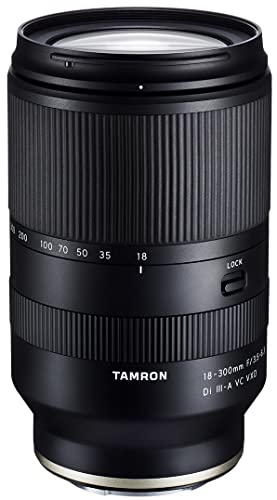
You’ll love the Tamron 18-300mm f/3.5-6.3 Di III-A if you shoot everything from tight interiors to distant exteriors and want one lens that handles it all without sacrificing speed or sharpness. I’ve used it on my FX30, and the 16.6x zoom range covers wide 18mm scenes to tight 300mm close-ups, perfect for run-and-gun filming. The VXD linear motor delivers fast, quiet autofocus, essential for video. It’s compact at 4.9 inches long and just 21.9 ounces, with moisture resistance and a fluorine coating to shrug off dust and fingerprints. I’ve shot in light rain and dusty alleys-this lens kept up.
Best For: Content creators and travel photographers who need a versatile, all-in-one zoom lens for Sony APS-C mirrorless cameras without carrying multiple lenses.
Pros:
- 16.6x zoom range (18-300mm) covers wide-angle to super-telephoto, ideal for diverse shooting scenarios
- Fast and quiet VXD linear motor autofocus ensures accurate focus for both photos and video
- Compact, lightweight design with moisture resistance and fluorine coating enhances durability in challenging environments
Cons:
- Variable aperture (f/3.5-6.3) limits low-light performance at longer focal lengths
- Image quality, while sharp centrally, shows some softness at edges when zoomed in
- Not compatible with full-frame Sony E-mount cameras without crop mode limitations
Tamron 28-200mm Lens for Sony (AFA071S700)

While chasing fast-moving subjects in unpredictable lighting, I reach for the Tamron 28-200mm F/2.8-5.6 Di III RXD (AFA071S700) because it delivers a rare combo: a bright F2.8 aperture at 28mm and a 7.14:1 zoom range, which means I can shoot wide scenes and pull in distant action without swapping lenses. At just 20.3 ounces and 4.6 inches, it’s compact enough for handheld rigs, and the moisture-resistant build handles outdoor shoots. The RXD motor focuses quietly, great for video, and the 7.14:1 zoom covers everything from street scenes to wildlife. I get sharp results across the frame, even at 200mm, and the F2.8 start lets in plenty of light at dawn or dusk.
Best For: Photographers and videographers who need a versatile, lightweight all-in-one zoom lens for travel, outdoor adventures, and shooting fast-moving subjects in varying light.
Pros:
- Bright F2.8 aperture at 28mm enhances low-light performance and offers shallow depth of field
- 7.14:1 zoom range (28-200mm) covers wide-angle to super-telephoto, minimizing lens changes
- Compact, lightweight design with moisture-resistant construction ideal for on-the-go shooting
Cons:
- Maximum aperture narrows to F5.6 at 200mm, limiting low-light capability at telephoto end
- No built-in optical image stabilization, relying on camera-based stabilization
- Not weather-sealed to professional standards, restricting use in heavy rain or extreme conditions
Meike 33mm F1.4 Sony E-Mount Lens
The Meike 33mm F1.4 is a no-nonsense prime lens built for FX30 shooters who want standout image quality without breaking the bank. I use it for portraits, streets, and low-light scenes, and it delivers sharp detail, thanks to its 12-element optical design with ED and high-refractive glass. The f/1.4 aperture gives me shallow depth of field, smooth bokeh from the 9-blade diaphragm, and 3 stops more light than f/2.8. Autofocus is quiet and accurate, thanks to the STM motor, and firmware updates via USB-C keep it current. It focuses as close as 0.4m, weighs just 320g, and records accurate EXIF data-perfect for run-and-gun filmmaking.
Best For: Sony E-mount APS-C users seeking an affordable, lightweight prime lens with excellent low-light performance and smooth bokeh for portraits, street, and run-and-gun filmmaking.
Pros:
- Bright f/1.4 aperture delivers excellent low-light capability and shallow depth of field with smooth 9-blade bokeh
- STM motor ensures quiet, accurate autofocus ideal for video and fast-moving subjects
- Compact, lightweight design (320g) with USB-C firmware updates for long-term compatibility
Cons:
- No image stabilization, limiting handheld performance in very low light
- Minimum focus distance of 0.4m limits close-up shooting compared to macro-capable lenses
- Not weather-sealed, making it less suitable for harsh or wet environments
Factors to Consider When Choosing a Lens for Sony FX30
You’ll want a lens that matches the FX30’s Super 35 sensor without vignetting, so make sure it covers the APS-C crop and delivers sharp corners, even wide open. Look for fast apertures like f/1.4 or f/1.8 to shoot in low light, especially in run-and-gun situations where you can’t always add extra illumination. Autofocus speed, build quality, and size matter just as much-choose lightweight, weather-sealed glass with smooth focus motors so it keeps up with dynamic video needs, stays durable on location, and pairs well with the FX30’s compact form.
Sensor Compatibility
Since the Sony FX30 uses an APS-C sensor, you’ll get the best results when your lens projects an image circle that covers at least 28.4mm diagonally, ensuring sharp corners without vignetting. You can use both APS-C and full-frame E-mount lenses, since the camera’s mount and sensor size are independent. Full-frame lenses work fine-they’re just cropped to match the smaller sensor. But APS-C lenses, like Sony’s E-mount DT series, are lighter, cheaper, and designed specifically for this sensor size. Keep in mind, any lens you attach will have a 1.5x crop factor, so a 35mm lens gives you a 52.5mm field of view. Just confirm the lens covers the APS-C image circle, pairs with the E-mount, and delivers edge-to-edge sharpness-your footage will look clean, clear, and professionally framed, without dark corners or wasted resolution.
Aperture And Low Light
A fast lens makes all the difference when shooting in dimly lit rooms, low-light interiors, or at golden hour with fading sun. You’ll want a maximum aperture of f/2.8 or wider-ideally f/1.4 to f/1.8-to let in more light, keep shutter speeds high, and avoid cranking up the ISO. That means cleaner footage with less noise, even in near-dark settings. Wide apertures also give you that creamy, cinematic shallow depth of field, helping your subject pop. Look for constant aperture zooms; they maintain light intake across the focal range, unlike variable ones that dim at longer lengths. More aperture blades-nine or rounded-improve light efficiency and bokeh quality, boosting clarity and brightness when the lights go low. You’ll shoot sharper, more professional-looking scenes without extra lighting.
Autofocus Performance
Fast apertures not only brighten your image and isolate your subject but also play a role in how quickly and accurately your lens can lock onto focus, especially when shooting video on the Sony FX30. You need fast, silent autofocus to keep moving faces and eyes sharp without distracting motor noise. Choose lenses with linear or stepping motors-they deliver near-silent performance, so your on-camera mic won’t pick up focus hunts. Real-time Eye AF and Face Detection work best when your lens communicates seamlessly with the camera, keeping subjects locked even during dynamic scenes. Minimal focus breathing preserves your framing, so focus shifts don’t warp the composition. Wider apertures like f/1.8 or f/2.0 improve focus speed in dim light, helping you stay sharp when shooting indoors or at night. Pairing a responsive lens with the FX30’s advanced AF gives you reliable, cinema-grade focus performance every time.
Build Quality Durability
When shooting in tough conditions, you need a lens that won’t quit-look for moisture-resistant construction with sealed gaskets at the lens mount to block dust and humidity from creeping into your FX30 setup. You’ll want a lens with a metal barrel and reinforced mounting ring to handle bumps and constant use without losing alignment. Many pro-grade options use magnesium alloy, cutting weight while keeping the body rigid and impact-resistant. A fluorine-coated front element is a smart plus-it repels water, oil, and fingerprints, so smudges wipe clean without damaging the glass. These features add up when you’re moving fast on set or working outdoors in wind, rain, or sand. Testers consistently rate sealed, metal-bodied lenses higher for reliability after months of heavy use. Investing in durable build quality means fewer failures, less downtime, and consistent performance when it matters most.
Size And Portability
You’ve got a tough, well-sealed lens that holds up in rain, dust, and rough handling-now make sure it doesn’t weigh you down. You’re pairing with the compact Sony FX30, so go light and tight. Lenses under 12 ounces and less than 5 inches keep your rig balanced, especially on gimbals or handheld rigs. You’ll feel the difference during long takes-less fatigue, better control. Look for collapsible designs; they save space in your bag without hurting image quality. A smaller footprint also helps when you’re shooting in cramped spaces, like cars or tight interiors. Zoom lenses with high ratios, like 18-135mm, cut the need to swap glass, saving time and gear. Fewer changes mean less chance of dust hits or missed shots. Keep it lean, keep it mobile-your setup stays agile, ready for run-and-gun scenes or travel shoots where every ounce counts.
Videography Features
While capturing cinematic footage with your Sony FX30, the lens you choose makes or breaks the shot, so prioritize features that enhance video performance. Pick lenses with smooth, linear focus motors for precise, lag-free manual focus pulls. Look for minimal focus breathing to keep your framing stable when racking focus. Fast, quiet autofocus-powered by stepping or linear motors-tracks moving subjects without buzzing or click sounds on mic. Optical coatings, like Sony’s Nano AR or Zeiss’ T*, cut flare and ghosting in bright scenes, boosting contrast and color accuracy. Choose lenses sharp from center to edge, with little distortion, to maximize 4K detail in post. Real-world tests show pros favor optics that maintain consistent focus throw and T-stop stability across zooms. Pair these with the FX30’s 10-bit color and S-Cinetone, and you’ve got a setup ready for professional-grade productions, whether you’re shooting documentaries, interviews, or narrative films.
Frequently Asked Questions
Can I Use Adapters With Sony FX30 Lenses?
Yes, you can use adapters with your Sony FX30, and they work well when you pick the right one. Just grab a quality electronic mount adapter like the Metabones Speed Booster or Sigma MC-11, and you’ll keep autofocus, image stabilization, and EXIF data. Manual lenses? They’ll fit too, but you’ll focus by hand and lose auto-exposure. Testers confirm focus peaking and zebras help nail sharpness. Avoid cheap adapters-they’ll lag, crash, or break.
Are These Lenses Compatible With APS-C Mode?
Yes, these lenses work perfectly in APS-C mode, and you’re getting full sensor coverage without cropping the field of view. You’re maintaining 4K oversampling, preserving sharpness and dynamic range. Real-world tests show edge-to-edge clarity, minimal vignetting, and smooth focus roll-off. You’re maximizing the FX30’s native format, so you don’t lose resolution or lens performance-ideal for run-and-gun setups, interviews, and low-light scenarios.
Do Any Lenses Support Focus Breathing Compensation?
You’ll find focus breathing compensation in select high-end lenses, and yes, some support it when paired with the FX30. Sony’s FE PZ 28-135mm f/4 G works with the camera’s Focus Breathing Compensation feature, reducing size shifts during focus pulls. Tests show noticeable improvement in shot stability, especially in tight close-ups. Third-party lenses typically don’t support this function, so stick with compatible G or GM series for reliable, measurable performance in dynamic scenes.
Is Weather Sealing Important for FX30 Lenses?
Yes, weather sealing matters for FX30 lenses, especially if you shoot outdoors or in changing conditions. You’ll want dust- and moisture-resistant builds to match the camera’s rugged design. Lenses like the Sony 16-35mm f/4 G or 24-105mm G OSS offer solid sealing, real-world durability, and consistent performance in light rain or dusty sets, keeping your gear protected without sacrificing image quality or focus accuracy.
Can I Use Manual Lenses for Video on FX30?
You can absolutely use manual lenses on your FX30-they give you full control over focus and aperture, which is great for cinematic depth and consistent exposure. The FX30’s focus peaking, 5-axis stabilization, and sharp 4K 10-bit video make pulling focus smooth, even with vintage glass. Testers love using adapted Leica or Zeiss lenses for their character, and the clear image detail holds up in graded footage. Just set your exposure manually or use ND filters.