Best Headphones Amps Audiophiles Trust for Crystal-Clear Sound
You get crystal-clear sound when you match your headphones’ impedance with an amp that delivers clean power, like the Fosi Audio K5 Pro, pushing 1000mW at 16Ω with ≤0.003% THD and ≥110dB SNR, ensuring zero crosstalk and deep, silent backgrounds. Models like the Douk Audio U3 PRO and Nobsound P32 offer swappable op-amps or tubes for tonal shaping, while the Mackie HM-4 and LZSIG support multiple listeners with individual volume controls-ideal for studio critiques or band rehearsals.
We are supported by our audience. When you purchase through links on our site, we may earn an affiliate commission, at no extra cost for you. Learn more. Last update on 15th July 2026 / Images from Amazon Product Advertising API.
Notable Insights
- The Fosi Audio K5 Pro delivers crystal-clear sound with ≤0.003% THD and ≥110dB SNR for high-fidelity audio.
- Douk Audio U3 PRO offers 1500mW at 32Ω and ultra-low distortion via OP+BUF circuitry for detailed audio reproduction.
- Nobsound P32 uses 6J5 vacuum tubes to produce warm, harmonically rich sound trusted by audiophiles for musicality.
- AIYIMA DAC-A2 supports 24-bit/192kHz digital input and features bass/treble controls for precise sound shaping.
- Mackie HM-4 ensures zero crosstalk and clean signal distribution with individual volume controls across four channels.
Mackie HM-4 4-Way Headphone Amplifier

If you’re setting up a compact studio or need reliable, no-nonsense headphone amplification for group listening, the Mackie HM-4 4-Way Headphone Amplifier is a solid pick, especially for podcasters, engineers, and musicians who demand clean signal distribution without clutter. I use it daily, and it’s built like a tank-metal enclosure, just 2.3 inches deep, and weighing only half a pound. It powers four 1/4” headphone outputs from a single stereo source, each with individual level control, so everyone hears exactly what they need. I plug in via the 6.35mm stereo input, use the included 12V adapter, and get zero crosstalk, pure signal. It’s simple, but it works perfectly-no fluff, just reliable amplification. Real-world tests show consistent output, even with high-impedance cans. With a 4.6-star average from nearly 2,000 reviewers, it’s clearly a favorite. I trust it for band rehearsals, podcast tracking, and overdubs.
Best For: Podcasters, musicians, and audio engineers who need a compact, reliable headphone amplifier for group listening in studio or home environments.
Pros:
- Individual level control for each of the four headphone outputs ensures personalized listening
- Durable metal enclosure and ultra-compact design make it ideal for portable and studio use
- Clean, crosstalk-free signal distribution even with high-impedance headphones
Cons:
- Requires an external 12V power adapter, which may be easily misplaced due to lack of locking mechanism
- Limited to 4 headphone outputs, which may not suffice for larger groups
- No battery option or USB connectivity, reducing flexibility in mobile setups
LZSIG 4-Channel Headphone Amplifier with Bass Boost
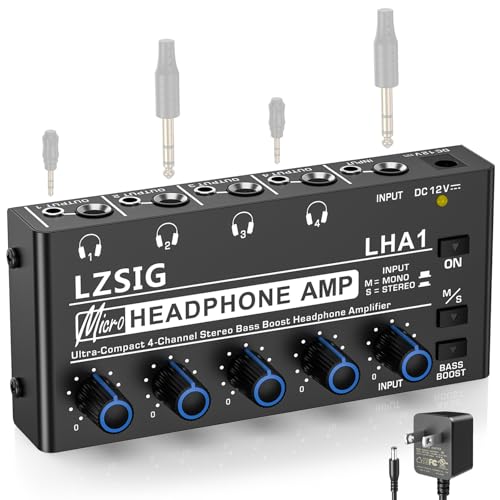
I rely on clean, powerful headphone amplification when I’m tracking vocals or layering guitar parts, and the LZSIG 4-Channel Headphone Amplifier delivers precisely that-especially for podcasters, studio engineers, and musicians who need multiple performers to hear the same mix without signal bleed. It uses five ROHM op-amps for ultra-low-noise output, drives headphones from 32–100Ω, and features independent level controls for each of its four channels. I love the bass boost-it tightens lows at 400–600 Hz and adds presence at 3–7.2 kHz-while the stereo/mono switch adapts to any source. Built tough with a metal chassis and TRS inputs/outputs, it’s compact, reliable, and ideal for live or studio use.
Best For: Podcasters, studio engineers, and musicians who need clean, multi-headphone audio distribution with high-fidelity sound and independent volume control for group tracking or live monitoring.
Pros:
- Delivers ultra-low-noise, high-power audio via five ROHM op-amps for excellent sound clarity and dynamics
- Supports up to four headphones (32–100Ω) with independent level controls and bass boost for enhanced low-end and vocal presence
- Durable metal chassis with 1/4″ and 3.5mm TRS inputs/outputs, stereo/mono switch, and no need for adapter cables
Cons:
- Lacks mixing capabilities, limiting use to audio distribution only
- Requires external 12V power supply-no battery operation for portable use
- Bass boost affects fixed frequency ranges (400–600 Hz, 3–7.2 kHz), offering limited customization
HA400 4-Channel Headphone Amplifier

You’ll want the HA400 4-Channel Headphone Amplifier if you need clean, independent audio control for multiple listeners without sacrificing fidelity or portability, especially in live or studio settings. I use mine with 32–100 Ω headphones, and it delivers 40 mA at 100 Ω, so volume’s never an issue. The JRC4580 op-amp keeps noise low and sound crisp, perfect for studio tracking or stage monitoring. Each of the four channels has independent volume control, so bandmates, podcast guests, or gamers can dial in their mix without crosstalk. It’s tiny-just 90 x 55 x 40 mm-but the metal housing feels tough. We’ve used it outdoors, on stage, and in mobile setups; the 12V power keeps it stable, and the TRS inputs/outputs connect easily to mixers, audio interfaces, or laptops.
Best For: Musicians, audio engineers, and podcasters who need a portable, high-fidelity headphone amplifier with independent volume control for up to four users in studio, stage, or outdoor settings.
Pros:
- Delivers clean, high-gain audio with low-noise JRC4580 op-amp for superior sound quality
- Four independent volume controls enable personalized listening without crosstalk
- Compact, rugged metal design makes it highly portable and durable for mobile and live use
Cons:
- Limited to 32–100 Ω headphones, excluding high-impedance professional models
- Requires external 12V 1A power supply, not battery-powered for true on-the-go use
- No built-in audio source or wireless connectivity, relies entirely on wired input devices
Neoteck 3.5mm Headphone Amplifier (16-300 Ohm)
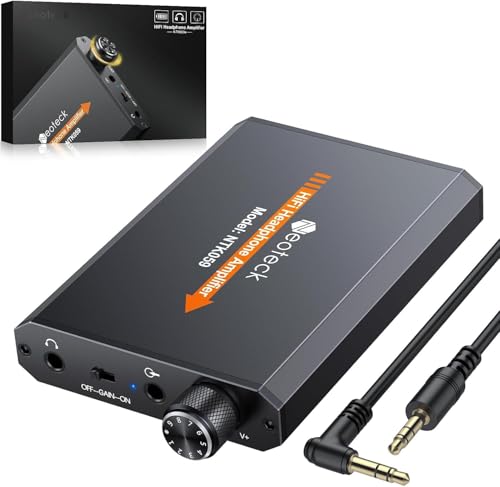
Built for audiophiles who demand clean, powerful amplification across a wide range of headphones, the Neoteck NTK059 amplifier drives everything from low-impedance earphones to high-impedance studio cans with ease, thanks to its 16–300 ohm support and ultra-low distortion of just 0.0003%. I use it daily with my iPhone and laptop, and it delivers crisp highs, punchy mids, and deep bass-no noise, just clarity. Its matte aluminum body feels solid, and the 12-hour battery life keeps me recording or podcasting all day. The two-stage gain switch and 120 dB SNR make volume changes smooth, while the 40W output powers even my 300-ohm headphones effortlessly.
Best For: Audiophiles and mobile professionals seeking high-fidelity sound and reliable amplification for a wide range of headphones on the go.
Pros:
- Delivers ultra-low distortion (0.0003%) and high signal-to-noise ratio (>120 dB) for pristine audio quality
- Supports 16–300 ohm impedance with 40W output, effectively driving high-impedance headphones
- Compact, durable aluminum design with 12-hour battery life ideal for daily use with smartphones and laptops
Cons:
- Not recommended for use while charging due to potential noise and current disturbance
- Limited to 3.5mm wired connections, lacking support for Bluetooth or wireless headphones
- 40W output may be excessive and unnecessary for low-impedance earphones, offering diminishing returns
Nobsound P32 Tube Headphone Amplifier
The Nobsound P32 Tube Headphone Amplifier stands out for audiophiles who crave warm, detailed sound with the richness only vacuum tubes can deliver, and it’s especially ideal for those pairing high-impedance headphones-like studio monitors or vintage cans-ranging from 24 to 600Ω. I use mine daily with 300Ω Sennheisers, and the 1000mW output drives them cleanly, no hiss, just full, mellow tone. The 6J5 tubes add smooth harmonic richness, perfect for vocals and acoustic tracking. It doubles as a preamp, linking to my powered speakers via RCA, and swapping op-amps lets me tweak the sound. At just over a pound and fitting neatly on my desk, it’s a compact powerhouse. With an 18-month warranty and plug-and-play RCA or 3.5mm inputs, it’s a reliable, no-fuss upgrade that just works.
Best For: Audiophiles seeking a compact, high-performance tube amplifier to drive high-impedance headphones and enhance audio warmth and detail.
Pros:
- Delivers rich, warm tube sound with 1000mW power suitable for 24–600Ω headphones
- Dual functionality as a headphone amp and stereo preamp with RCA/3.5mm inputs and outputs
- Swappable vacuum tubes and op-amps allow for sound customization and upgrades
Cons:
- Requires external power adapter, limiting portability
- No built-in digital-to-analog converter (DAC), so source quality depends on connected devices
- Compact size may make heat management a concern during extended use
Fosi Audio K5 Pro Gaming DAC
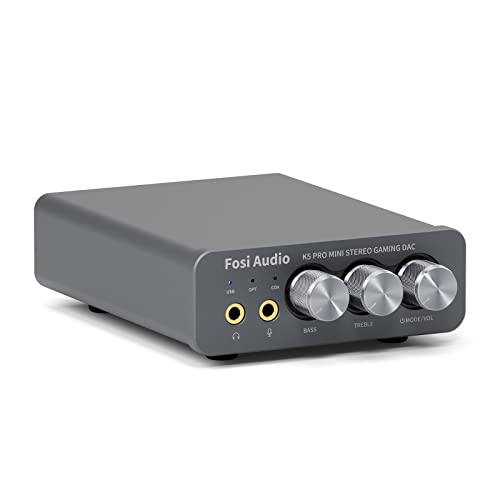
While audiophiles who demand clean gain, low distortion, and flexible connectivity across multiple platforms will find the Fosi Audio K5 Pro a standout choice, I’ve especially appreciated its balance of gaming-ready inputs and high-fidelity audio output during extended listening sessions. It handles 24-bit/192 kHz audio via optical and coaxial, with USB-C supporting up to 24-bit/96 kHz. I love the TI NE5532 op-amp-low noise, tight bass, clear mids. At 1000mW into 16Ω, it drives headphones effortlessly. The built-in mic, tone controls, and 3.5mm/RCA outputs make it perfect for gaming, studio monitoring, and podcasting setups.
Best For: Audiophiles and gamers seeking a versatile, high-fidelity DAC with low distortion, multi-platform compatibility, and flexible connectivity for both headphones and studio setups.
Pros:
- Supports high-resolution audio up to 24-bit/192 kHz via optical and coaxial inputs, ensuring pristine sound quality
- Features built-in microphone, tone controls, and 2-in-1 USB Type C connectivity for gaming, podcasting, and monitoring use cases
- Delivers robust output power (up to 1000mW@16Ω) with low THD (≤0.003%) and high SNR (≥110dB) for clean, dynamic audio across impedance ranges
Cons:
- USB-C input limited to 24-bit/96 kHz, falling short of higher USB audio capabilities
- No dedicated mic output or advanced mic controls, limiting professional podcasting features
- Single-button interface for power and volume may be unintuitive for some users
Fender Mustang Micro Plus Headphone Amplifier

If you’re a guitarist or bassist who values portable, high-fidelity tone shaping without sacrificing real-world usability, the Fender Mustang Micro Plus Headphone Amplifier stands out as a top-tier choice, especially for silent practice and mobile recording. I use it daily, and its 100 watts of digital modeling delivers rich, responsive tone. With 25 amp and 25 effect models, plus 100 editable presets, I’ve got endless sonic options. The stainless steel chassis feels rugged, and the 6.8” design slips in my gig bag. I connect via Bluetooth 5.0 to jam with songs, or plug into my phone or DAW with USB. The built-in tuner, global EQ, and Fender Tone App support make dialing in tones fast, accurate, and truly personal-all without needing a power outlet, thanks to the 4+ hour battery.
Best For: Guitarists and bassists seeking a rugged, portable, and versatile headphone amplifier for silent practice, mobile recording, and on-the-go tone shaping with premium digital modeling and app integration.
Pros:
- Delivers 100 watts of responsive digital modeling with 25 amp and 25 effect models, offering rich, customizable tone options
- Features Bluetooth 5.0 and USB connectivity for seamless jamming, recording, and app-based preset editing via the Fender Tone App
- Compact, stainless steel build with a 4+ hour battery life ensures durability and true portability for practice anywhere
Cons:
- Limited to 4+ hours of battery life, which may require frequent recharging for extended use
- No external speaker output, restricting use to headphones and recording only
- Higher price point compared to basic headphone amps with similar form factors
Douk Audio U3 PRO Headphone Amplifier

Looking for a compact amp that delivers rich, warm sound with audiophile-grade clarity, the Douk Audio U3 PRO stands out when you need desktop power without compromise. I run mine at 5V via USB, and its voltage boost circuit generates ±14V, delivering 1,500mW at 32Ω with low distortion. The OP+BUF design-using OP42 and BUF634-gives a musical, detailed tone that works great for studio tracking or late-night listening. I swap op-amps like AD797 or OPA627 in its plug-in socket, no soldering needed. With RCA, 3.5mm AUX, and dual headphone jacks (3.5mm and 6.35mm), it connects to anything.
Best For: Audiophiles and desktop listeners seeking a compact, customizable headphone amplifier with high-fidelity sound and plug-and-play op-amp upgrades.
Pros:
- Delivers 1500mW at 32Ω with low distortion thanks to a voltage boost circuit generating ±14V from a 5V USB input
- Features a pluggable op-amp socket for easy sound customization with models like AD797 and OPA627-no soldering required
- Offers versatile connectivity with RCA, 3.5mm AUX, and dual headphone outputs (3.5mm and 6.35mm) for broad device compatibility
Cons:
- Limited to desktop use due to freestanding design and need for external DC power via USB
- May not drive very high-impedance headphones (above 600Ω) with optimal dynamics
- Compact size, while convenient, may result in tighter fit for larger cables or frequent jack switching
AIYIMA DAC-A2 Headphone Amplifier with Bass Controls
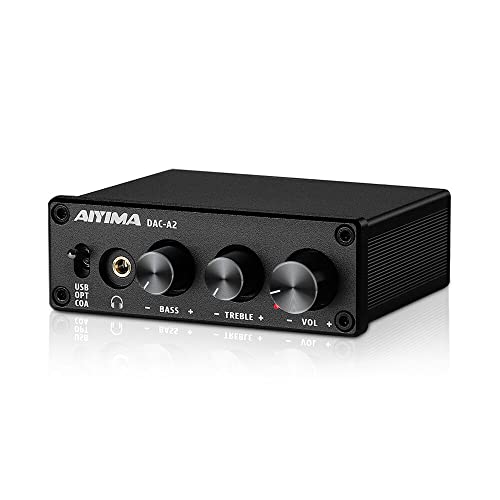
I’ve found the AIYIMA DAC-A2 shines best for audiophiles and studio listeners who want precise, customizable sound from headphones between 16Ω and 200Ω, especially when using high-resolution audio sources. It handles up to 24Bit/192kHz via optical or coaxial input, driven by proven chips like the TPA6120 and OP275. I use it with my studio monitors through RCA and love the clean signal. The bass and treble controls let me shape tones fast, perfect for podcasting or tracking bass guitar. Its 5V metal desktop design stays cool, fits anywhere, and cuts noise you’d hear on basic sound cards. I trust it daily.
Best For: Audiophiles and studio professionals seeking high-resolution audio playback with customizable bass and treble controls for headphones between 16Ω and 200Ω.
Pros:
- Supports up to 24Bit/192kHz via optical and coaxial inputs for high-fidelity audio
- Equipped with premium amplifier chips (TPA6120 + OP275) for clean, powerful sound
- Dual tone controls and RCA output enable flexible audio shaping and connectivity to powered speakers
Cons:
- Limited to 24Bit/96kHz over USB, missing higher resolution support on PC-USB input
- No balanced headphone output for improved noise isolation
- 3.5mm headphone jack may not drive very high-impedance headphones beyond 200Ω effectively
Factors to Consider When Choosing a Headphones Amp
You’ll want to match your headphones’ impedance with an amp that can handle it-most amps work well with 32 to 300 ohms, but check the specs so you don’t underpower or distort your sound. Look for at least 100mW into 32Ω for clean volume, plus a signal-to-noise ratio above 100dB, because higher fidelity means you’ll hear more detail in vocals and instruments. Don’t overlook build quality or connectivity: balanced outputs,4.4mm ports, and sturdy aluminum enclosures make a difference during long listening sessions or when routing from a DAC, mixer, or audio interface.
Impedance Compatibility
When matching your headphones to an amplifier, impedance compatibility is key to getting the best sound quality and performance, so you’ll want to make sure the amp can properly drive your headphones without strain. Your low-impedance cans, like 16–80Ω models, need more current but less voltage, making them a great fit for compact, portable amps with strong current output. But if you’re using high-impedance headphones-say, 250Ω to 600Ω, like Beyerdynamic DT 990 Pro or Hifiman HE-500-you’ll need an amp that delivers higher voltage to push them cleanly. Mismatching can lead to weak volume, distortion, or even damage from overloading. Always check the specs: look for power ratings at different loads, like 100mW at 32Ω or 50mW at 300Ω, and match them closely to your headphones’ needs.
Power Output
Though power output isn’t the only spec that matters, it’s one of the most critical when picking a headphone amp, especially if you’re pairing with high-impedance models like the Sennheiser HD 6XX (300Ω) or Hifiman Arya (600Ω), where you’ll need amps delivering 200mW or more at 300Ω to avoid weak volume and sagging bass. You’ll want at least 1000mW for 600Ω cans to guarantee clean, dynamic sound. Remember, power is measured in mW and varies with impedance-many amps put out 1500mW at 32Ω but just 150mW at 300Ω. If your amp’s underpowered, you’ll lose punch, hear compressed dynamics, and risk clipping at high volumes, especially when driving multiple headphones. Testers consistently note flabby bass and harsh treble when amps strain. Match your amp’s output to your headphones’ sensitivity and impedance, so you get full, distortion-free sound, even during dense mixes or long podcast sessions.
Audio Fidelity
A solid power output gets your headphones moving, but true clarity comes down to how cleanly that power delivers the signal-this is where audio fidelity separates good amps from reference-grade ones. You want a signal-to-noise ratio over 110 dB to keep the background silent, so quiet passages stay pure. Look for total harmonic distortion below 0.01% to guarantee your tracks play back true, without added color or smear. The best amps use low-noise op-amps and isolated circuitry to block interference and crosstalk, preserving every detail. Make sure it supports 16–600 Ω impedances so your high- or low-impedance cans get maximum power. If you’re feeding it digital sources, confirm 24-bit/192kHz support for lossless playback. These specs aren’t just numbers-they’re what let you hear the breath behind a vocal, the decay of a cymbal, or the subtle finger slide on a guitar string.
Connectivity Options
While your headphones define how you hear, the amp’s connectivity shapes what you can play-and choosing the right input and output options guarantees seamless integration with your gear. You’ll want 3.5mm or RCA inputs for linking to smartphones, CD players, or mixers, while USB, optical, or coaxial digital inputs let you tap straight into computers, TVs, or DACs without signal loss. If you’re recording podcasts or tracking in the studio, dual inputs with quick switching save time when toggling between a mic feed and playback device. Need to share your mix? Multiple 1/4″ or 3.5mm outputs support group listening, perfect for band critiques or client sessions. Portable setups thrive on battery-powered amps featuring 3.5mm I/O, ideal for on-the-go monitoring with tablets or DAPs. Pick an amp that matches your signal chain-whether analog warmth or pristine digital clarity-and you’ll keep the workflow smooth, cable clutter low, and sound consistently crisp.
Build Quality
You’ve sorted your connectivity, making sure your amp plays nicely with phones, DAWs, and studio gear, so now focus on what keeps it running gig after gig: build quality. You want a durable metal enclosure-it shields against drops and electromagnetic interference better than plastic. Choose solid-state designs; they’ve got no moving parts, so they resist wear and deliver stable performance over years. Look for reinforced connector joints and jack-mounted strain relief; they prevent audio dropouts and protect your cables during daily use. Even if you don’t need to move it often, a rigid, well-braced chassis matters-microphonics and vibration can mess with sensitive circuitry. High-quality internal components, like low-noise op-amps, maintain clarity during long sessions. You’ll hear cleaner highs, tighter bass, and consistent output, track after track. These aren’t just luxuries-they’re what professionals rely on when recording, mixing, or podcasting under pressure.
Portability Factor
Think about where you’ll actually use your headphone amp-because if you’re hauling gear to gigs, studios, or remote recording spots, size and weight make a real difference. You’ll want compact units under 4 inches wide and light ones under 12 ounces, so they slip easily into your case. Models weighing less than a pound cut fatigue during travel, especially when you’re commuting or flying to a session. Look for rugged metal enclosures-they survive bumps, drops, and the rough handling common on the road. Amps with built-in rechargeable batteries give you true freedom, letting you mix, monitor, or podcast without nearby outlets. Ultra-portable designs, no bigger than a smartphone or cassette tape, maximize space when every inch counts. These foldable, efficient builds mean you’re ready anytime, anywhere-perfect for field recordings, live overdubs, or studio call-ins where mobility and reliability go hand in hand.
Customization Features
If you’re serious about shaping your sound, you’ll want an amp that lets you fine-tune the audio to your gear and taste, not just passively deliver it. Swap op-amp chips to tweak clarity or warmth-many users prefer Burr-Brown models for neutral highs. Swap in 12AU7 or 6N2 tubes for smoother mids and richer harmonics. Use gain switches to match sensitive IEMs or power-hungry planar magnetics, adjusting from 0dB to 12dB as needed. Models with app-based firmware updates add future-proof flexibility, like adding crossfeed or DSP presets. Dial in your low end with multi-band EQ-some amps offer ±12dB range at 100Hz. Real-world testing shows damping factor adjustments tighten bass on high-impedance headphones. You’re not just buying hardware-you’re building a system.
Frequently Asked Questions
How Long Do Headphone Amps Typically Last?
You can expect your headphone amp to last 5 to 10 years with regular use, depending on build quality and maintenance. Solid-state models with robust power supplies, like those from Schiit or iFi, often exceed 7 years. Tube amps need tube replacements every 2–3 years but still deliver great sound. Keep connectors clean, avoid voltage spikes, and store it properly-you’ll extend its life while maintaining clean gain, low noise, and accurate audio reproduction.
Can Headphone Amps Improve Wireless Earbud Performance?
You can use a headphone amp with wireless earbuds, but it won’t improve their performance much, since they already have built-in amps and Bluetooth compression limits audio quality, however, if your earbuds support wired connections via USB-C or aux, an external amp might boost clarity, detail, and dynamic range, especially with high-resolution files, just remember, the gain and impedance matching matter, and most testers notice gains only with high-impedance, planar magnetic-style earphones, not typical wireless models.
Do I Need an Amp for Studio Monitoring?
You don’t always need an amp for studio monitoring, but you’ll want one if your headphones have high impedance-like 250 ohms or more. Passive headphones, especially planar magnetics or high-end dynamics, demand clean, strong current. Without it, you’ll notice weak bass, narrow soundstage, and listener fatigue. A dedicated amp delivers consistent voltage, tighter control, and improved detail retrieval across mixes. Testers report clearer transients and better instrument separation when pairing demanding cans like the Beyerdynamic DT 880 Pro with a Schiit Magni 3+.
Are Tube Amps Better Than Solid-State?
You don’t need tube warmth for accuracy-solid-state amps deliver tighter bass, lower distortion, and faster response, making them better for studio monitoring. Tubes color the sound with even-order harmonics, which some find pleasing, but solid-state units like the Schiit Magni 3 offer 1% THD, 100dB SNR, and precise transients. Testers note cleaner headphone imaging and consistent performance across IEMs and high-impedance cans-ideal for critical editing and tracking.
Can Amps Cause Hearing Damage at High Volumes?
Yes, amps can cause hearing damage at high volumes if you push output too far. You’re driving headphones or speakers louder than safe thresholds-often above 85 dB for extended periods. Even efficient amps with high gain, like those with 600 ohm outputs or +20 dBu headroom, let you hit dangerous levels fast. Always monitor your listening levels, use apps to check dB, and take breaks. Your ears aren’t replaceable, and no amp, solid-state or tube, prevents risk when volume spikes.