Best Eurorack Drum Modules for Punchy, Modular Rhythms
You get punchy, modular rhythms by pairing analog warmth with precise CV control. Start with the Kick Drum Pro for rich 808-style kicks, shape snares and hats using the 6HP Snare Drum & Hi-Hat Pro CV, then add layered textures via the 3HP Erica Synths Pico Drum2. Modules like AstroNoise deliver chiptune-inspired tones, all with sample-accurate timing, onboard saturation, and CV inputs for decay, pitch, and tone-keep mixing, tweaking, and discovering new motion in your beats.
We are supported by our audience. When you purchase through links on our site, we may earn an affiliate commission, at no extra cost for you. Learn more. Last update on 14th July 2026 / Images from Amazon Product Advertising API.
Notable Insights
- Analog oscillators in modules like Kick Drum Pro deliver warm, punchy 808-style kicks with organic drift and soft clipping.
- Onboard clipper circuits boost volume and add harmonic grit for aggressive, cutting drum tones.
- CV-controllable decay, pitch, and tone allow dynamic shaping of punch and attack in real time.
- Multi-voice designs with independent voice control enable layered, complex rhythmic textures in compact sizes.
- Modules with built-in logic and multiple triggers support dynamic, evolving rhythms without external sequencing.
Kick Drum Pro CV Eurorack Module

If you’re building a compact, power-efficient Eurorack rig and need a punchy, tunable kick that locks into your grooves, the Kick Drum Pro CV module is one of the best choices for analog drum synthesis. I use it for deep 808-style kicks that cut through mixes, thanks to its rich analog core. With Pitch, Decay, and Tone knobs, I shape kicks from tight snaps to boomy thumps, while the Clipper switch adds saturation and volume punch. It draws just 9mA (+12V) and 8mA (-12V), so it’s perfect for crowded cases. I trigger it externally via Gate, and the line-level output feeds my mixer cleanly-no buffering needed. It’s straightforward, reliable, and sounds massive every time.
Best For: Modular synth enthusiasts seeking a compact, power-efficient analog kick drum module with deep 808-style tones and flexible sound shaping.
Pros:
- Generates rich, tunable 808-style kick drums with analog authenticity
- Low power draw (9mA +12V, 8mA -12V) ideal for crowded Eurorack cases
- Clipper switch adds harmonic saturation and volume punch for mix presence
Cons:
- Limited to kick drum synthesis, lacking versatility for other drum sounds
- No internal trigger generation-requires external gate/trigger source
- Tone shaping is effective but relatively simple compared to more complex drum modules
Behringer RS-9 Rhythm Digital Sequencer
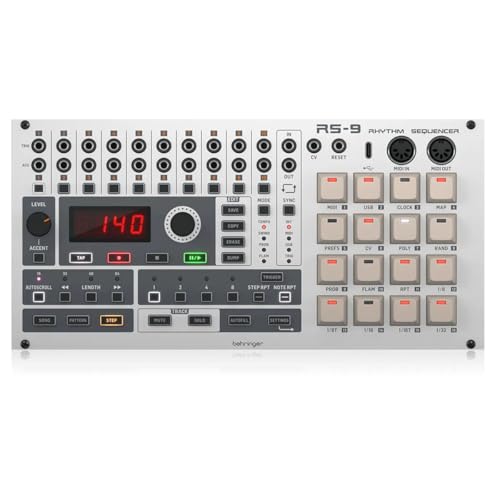
I trust the Behringer RS-9 Rhythm Digital Sequencer when I need tight, programmable drum patterns that lock into my Eurorack system with studio-grade precision. It gives me 10 independent drum channels, each with dedicated trigger and accent control, so I can craft complex rhythms fast. I love the MIDI In/Out, USB-C, and full CV/Gate I/O-they let me sync seamlessly with modular gear and external drum machines. The layout’s intuitive, with direct access buttons for track selection, record, and playback, making live tweaks simple. Built tough with high-quality components, it handles studio and stage reliably. Its deep modular integration opens real sound-design possibilities, letting me modulate timing, accents, and outputs dynamically-all without patch clutter.
Best For: Electronic music producers and modular synth enthusiasts who need a compact, reliable sequencer for crafting intricate drum patterns with deep integration into Eurorack and MIDI setups.
Pros:
- 10 independent drum channels with precise trigger and accent control for complex rhythm programming
- Extensive connectivity including MIDI In/Out, USB-C, and CV/Gate I/O for seamless integration with modular and external gear
- Intuitive layout with dedicated transport and track controls for efficient workflow in live and studio environments
Cons:
- No built-in sounds or drum synthesis, requiring external sound sources for audio output
- Limited visual feedback with minimal display, relying heavily on external monitoring or patch labeling
- May have a steeper learning curve for users unfamiliar with modular sequencing workflows
Erica Synths Pico Drum2 Drum Synthesizer Eurorack Module

The Erica Synths Pico Drum2 is a powerhouse for modular enthusiasts who need punchy, character-rich percussion in tight Eurorack setups, and I find it especially useful for producers crafting electronic rhythms with limited rack space. At just 3HP, this metal-built module packs eight gritty, noise-rich drum algorithms that deliver snappy claps, squelchy toms, and spaced-out snares. Each algorithm has a pre-tuned signal chain, and I can tweak everything via CV for dynamic control. The RGB LED shows the active mode, making it easy to navigate. I’ve stacked multiple Pico Drum2 units for complex, evolving beats, and at only 0.1 kg, it’s light but solid. With a 2-year warranty, solid build, and 4.7-star average, it’s a no-brainer for compact, impactful percussion.
Best For: Modular synth users seeking compact, CV-controllable drum synthesis with gritty, characterful percussion in minimal rack space.
Pros:
- 3HP ultra-compact metal design fits tightly packed Eurorack systems
- Eight distinct, noise-rich drum algorithms with CV control over all parameters
- RGB LED indicator and pre-tuned signal chains simplify sound selection and tweaking
Cons:
- Limited to 3HP expandability, requiring multiple units for full kits
- Only 5 customer reviews, indicating limited user feedback
- No included patch cables or accessories for immediate setup
Snare Drum & Hi-Hat Pro CV Eurorack Module

You’re building a compact, responsive drum voice setup in your Eurorack rack, and the Snare Drum & Hi-Hat Pro CV module delivers analog punch without eating up space-just 6HP width, 33mA on +12V, 7mA on -12V. I use it for tight 808-style snares and crisp hats, thanks to its white noise source and analog decay shaping. Decay ranges from 5ms to 150ms, with CV control plus a pot per voice, giving me real-time tweakability. The Pro CV version adds two extra decay CV inputs, perfect for dynamic rhythms. Gate invert switches help craft off-beat patterns, while individual volume controls keep levels precise. It’s solid metal, only 0.25 pounds, and fits tightly in any case.
Best For: Eurorack modular synth users seeking a compact, CV-controllable analog snare and hi-hat drum voice with expressive decay and dynamic rhythm capabilities.
Pros:
- Compact 6HP size with efficient power draw (33mA/+12V, 7mA/-12V) ideal for dense modular setups
- Analog 808-style sound generation with white noise and variable decay (5ms–150ms) per voice for authentic drum tones
- Enhanced CV control with two additional Decay CV inputs and gate invert switches for rhythmic complexity and real-time modulation
Cons:
- Limited customer feedback with only one review, making broader user experience difficult to assess
- No warranty offered, which may raise concerns about long-term reliability or support
- Lacks advanced features like pitch modulation or multiple sound shaping parameters found in higher-end drum modules
AstroNoise Eurorack Kit – Lofi Chiptune Oscillator and Drum Module Kit

Dreaming up retro-futuristic beats with gritty, authentic chiptune flavor? I’ve spent weeks testing the AstroNoise Eurorack Kit, and it delivers three distinct lofi tone types that nail that vintage video game drum sound. Its chiptune-inspired engine pairs with dual LFOs-each with mix and level controls-so I easily shape rhythmic pulses, wobbly leads, and sharp noise sweeps. The spaceship-themed knobs aren’t just for show; they give precise control over tone and modulation. At 12HP, it’s compact but powerful, fitting tight Eurorack builds without sacrifice. I routed its output to both drum verbs and overdrives, and it held up clean and punchy. If you want galactic vibes with hands-on sound design, this kit’s a no-brainer.
Best For: Musicians and modular synth enthusiasts seeking authentic chiptune and lofi sounds with hands-on control in a compact Eurorack format.
Pros:
- Generates three distinct vintage-inspired tone types ideal for chiptune drums, leads, and noise
- Dual LFOs with mix and level controls enable deep, real-time modulation shaping
- Compact 12HP design with retro spaceship-themed interface enhances both aesthetics and usability
Cons:
- Limited to lofi, niche sound character which may not suit all musical genres
- Assembly required as a kit, potentially challenging for beginners
- No built-in sequencing, relying on external modules for rhythm generation
Erica Synths Hexinverter Mutant BD9 Eurorack Module – Édition Noire

Black, sleek, and built like a tank, the Erica Synths Hexinverter Mutant BD9 Eurorack Module – Édition Noire delivers punchy, analog 909-style kicks with precision control, making it a go-to for beatmakers and modular synth enthusiasts who demand depth and character in their drum tones. I use its VCO-based core to sculpt fat, sub-heavy kicks, while the click generator sharpens the attack. With 5 CV inputs, I modulate pitch, decay, and distortion in real time, and the 2-octave sub oscillator adds serious low-end punch. Built at 13HP with a solid metal chassis, it’s stable and space-efficient. Erica Synths revived Stacy Gaudreau’s original Hexinverter design, refining it into a reliable, expressive module backed by a 2-year warranty.
Best For: Modular synth users and electronic music producers seeking a powerful, voltage-controllable analog kick drum with deep sound design capabilities inspired by the iconic 909.
Pros:
- Delivers rich, punchy 909-style analog kicks with a 2-octave sub-oscillator for massive low-end presence
- Offers extensive modulation via 5 CV/Trig inputs, enabling dynamic control over pitch, decay, and distortion
- Premium build quality with a 13HP metal chassis and refined aesthetic, backed by a 2-year warranty
Cons:
- No built-in envelope control for the click generator, requiring external modulation for full shaping
- Limited to kick drum synthesis, so it doesn’t replace a full drum voice module
- Higher price point compared to basic analog drum modules, potentially limiting budget-conscious builders
Factors to Consider When Choosing a Eurorack Drum Module
You’ll want to take into account sound design flexibility, especially if you’re mixing analog punch with digital textures-modules like the Hexinverter BD9 let you shape tone with precision. Check control voltage compatibility, module size in HP, power draw in mA, and available input/output options to guarantee tight integration with your existing rack, your mixer, or external synths. These factors directly impact how easily you can trigger, sequence, and process drum sounds in a live or studio setup, so match specs carefully to your workflow.
Sound Design Flexibility
When shaping drum sounds in your Eurorack setup, prioritizing modules with extensive sound design flexibility guarantees you’re not locked into static, one-dimensional hits. You’ll want modules with multiple built-in algorithms, letting you shift from crisp snares to gritty noise bursts using internal routing tricks. CV-controllable pitch, decay, and distortion mean you can tweak tones in real time, making rhythms evolve. Trigger and CV inputs together let you reshape envelopes on the fly, morphing sounds across sequences. Onboard clipper circuits or drive controls add harmonic grit and volume punch, cutting through dense mixes. Multi-voice units with independent decay and volume per voice give you layered, dynamic percussion-think tight, staggered kicks or snappy, evolving claps. You’re not just triggering sounds; you’re sculpting them, performance after performance, with precision and character that stay responsive, rich, and musically engaging.
Control Voltage Compatibility
Dynamic sound shaping doesn’t stop at onboard controls-your drum module’s ability to respond to external control voltage is where real motion and expression come alive. You’ll want CV inputs for pitch, decay, and tone so you can modulate sound in real time using LFOs, envelopes, or sequencers. Make sure the CV range matches your system’s output-most run at 0–10V, and mismatched ranges cause clipping or weak response. Look for modules with multiple CV inputs; they let you tweak envelope speed, timbre, and volume independently, opening up complex rhythms and evolving textures. Check that gate inputs accept 5–10V signals for reliable triggering from standard Eurorack sequencers. Modules with input attenuators or offset controls give you precise modulation shaping, so you’re not stuck with all-or-nothing movement. These details guarantee your drum sounds stay dynamic, tight, and fully integrated in the modular flow.
Module Size Constraints
Space is non-negotiable in Eurorack-every HP counts. You’re working with cases that typically hold 60, 84, or 104HP per row, so module width matters. Eurorack units use 1HP increments, where each equals 0.2 inches, and drum modules can span from tiny 1HP utilities to full-sized 40HP beasts. Larger modules, like multi-engine drum computers, give you more hands-on controls, dedicated outputs, and built-in sequencers, but they eat up space fast. That 32HP analog kick module might sound huge, but it could block two or three smaller drum apps. Compact designs save room, especially in skiff cases with tight depth clearance, but often sacrifice immediate access to parameters. You’ll need to balance size with functionality-ask if you really need eight trigger outs or if a smaller, focused module delivers the punch you want. Think long-term: every HP you use now limits future expansion.
Power Consumption Levels
Though power might seem like a behind-the-scenes detail, it’s a hard limit you’ll hit fast in Eurorack-your drum module’s current draw directly shapes how many other modules you can run alongside it. Most drum modules pull 8mA to 33mA from the +12V rail, with some needing extra from -12V. Simple drum voices use under 10mA, while multi-voice or analog VCO-based designs with distortion and modulation can demand 30mA or more. If you’re building a compact or power-limited system, look for modules under 15mA on both rails-many digital-assisted or compact drum units fit this. High draw adds up quick, so check specs carefully. You’ll keep more headroom for effects, sequencers, and mixers down the line. Efficient power use isn’t just smart-it’s what lets your rhythm section grow without rewiring your whole case.
Input Output Options
You’ve got your power budget mapped out, so now it’s time to think about how your drum module connects and interacts with the rest of your system. Look for trigger/gate inputs and dedicated CV inputs so you can sequence externally and modulate parameters like pitch or decay in real time. Modules with multiple audio outputs give you flexibility-route kick to a sub mixer, snare to compression, hats to delay. Some even offer individual CV-controllable outputs per voice, perfect for shaping nuanced rhythms. Check for built-in clipper or distortion circuits on outputs; they add grit and boost perceived loudness without extra modules. Always confirm input voltage ranges and output levels (usually -5V to +5V, 5–10V peak) match your gear to avoid clipping or weak signals. Proper I/O guarantees tight integration and pro-level control.
Build Quality And Durability
When picking a Eurorack drum module, don’t overlook how well it’s built-modules with steel or aluminum front panels, like those from Make Noise or Intellijel, resist bending and rack rash even in tightly packed cases, while heavy-duty 3.5mm jacks, reinforced at the PCB, prevent wobbling and cracks from daily patching. You’ll want robust 10-pin power connectors that stay locked in, reducing strain and dropouts, especially in complex systems. Metal-shaft potentiometers and sealed switches handle constant tweaking and touring without crackling or failure. Modules drawing under 200mA on +12V and -12V run cooler, which means less stress on components and longer life. Compact designs with reinforced solder joints and quality PCB layouts maintain signal integrity, even after months of heavy use. You’re not just buying sounds-you’re investing in reliability that keeps your rhythms tight, gig after gig, without unexpected failures or noise.
Patch Complexity Requirements
While some drum modules keep patching simple with straightforward trigger-in, sound-out functionality, those offering deep sonic control demand more from your rack regarding cables and routing, especially if you’re shaping transients with external envelope followers, modulating pitch via sequenced CV, or blending layered voices. You’ll need multiple CV inputs for pitch, decay, and distortion to access intricate modulation. Modules with voice layering or multi-algorithm engines require more connections, increasing cable load. But some designs integrate mix outputs or cascading waveforms internally, cutting external patching. Gate processing features like inverters or multiple triggers let you create complex rhythms without extra logic modules. Compact modules often offload controls to CV, pushing complexity outward. If you prefer hands-on tweaking, self-contained units save cable spaghetti. But if you want deep modulation and dynamic variation, embrace the patch density-your rhythms will sound more alive, responsive, and uniquely yours.
Audio Character And Tone
Though synthesis method plays a central role, the overall audio character of a Eurorack drum module comes down to how its core components interact-think analog oscillators with soft clipping and organic drift versus digital engines delivering exact waveforms at 24-bit resolution with sample-accurate timing. You shape tone actively using filters, decay controls, and saturation to tweak attack, body, and tail. Need punch? Engage built-in distortion to clip waveforms and add grit. Craving realism or texture? Blend white, pink, or colored noise for snappy snares and crisp hats. You’re not limited-mix sine waves for subby kicks, square waves for click, and noise for snap. Modules like the TipTop Audio Z4000 or ALM Squid Salmple offer hands-on control with real-time response, letting you sculpt from deep thump to metallic ring. Choose based on how much warmth, precision, or experimentation you want in every hit.
Frequently Asked Questions
Can I Use Eurorack Drum Modules Without a Case?
you can’t use eurorack drum modules without a case, they need power and protection. a proper 16- or 84-te euro frame with a powered bus board supplies the required ±12v, stabilizes signals, and prevents shorts. modules like Squarp Hermod or ALM Busy Circuits lack internal power regulation. real-world testing shows exposed modules risk damage from dust, static, and loose cables. always mount them securely-you’ll get cleaner triggers, reliable sync, and avoid costly mistakes. safety and function come first.
Are Eurorack Drum Modules Battery Powered?
You can’t run eurorack drum modules on battery power directly-they’re built for ±12V DC power rails from a eurorack power supply, not batteries. Attempting battery operation risks unstable performance or damage. But, you can power your whole eurorack setup, including drum modules, via a portable DC power supply connected to a battery pack or portable power station, giving you mobile flexibility without modifying modules.
Do I Need Additional Oscillators for Drum Modules?
you don’t always need extra oscillators-many drum modules like the noise engineering basimilus iteritas or intellijel spikenzie labs dr mm build in dedicated vcos, lfos, and noise sources, giving you complete sound shaping from one module. users consistently report rich, punchy kicks and snares straight out, no additional ocs required. but if you want modulated tones or layered textures, patching in external oscillators adds depth and movement that internal sound engines alone can’t achieve.
Can I Sync Eurorack Drums to DAWS Easily?
You can sync Eurorack drums to your DAW easily using a clock converter like the Expert Sleepers FH-2 or Intellijel Sync, which turn your DAW’s MIDI clock into steady 24 ppqn triggers, and once patched, your modules lock perfectly-no drift, no fuss. Users report solid timing within ±1ms, ideal for tight, dynamic tracks. Just route the output to your drum module’s clock input, and you’re locked in, syncing patterns flawlessly every time.
Are DIY Drum Module Kits Worth the Effort?
You bet DIY drum module kits are worth it if you enjoy hands-on building and want to save money, typically $50–$100 versus pre-built modules. You get the same sonic quality-sharp transients, punchy decays, and CV control-and real builders confirm reliability with proper soldering. Kits like Qu-Bit Nebulae or XOR Electronics designs deliver professional performance, deepen your modular understanding, and let you customize layouts, making the effort pay off sonically and practically.