Best Delay for Synths That Transform Any Sound
You’ll transform any synth sound with the Strymon Volante, a digital delay featuring true analog dry-through, 300mA 9V power, and four pannable playback heads for immersive stereo spread. Its drum, tape, and reel-to-reel echo modes add vintage-accurate saturation, while the built-in spring reverb and Sound-on-Sound looper spark real-time creativity. At 0.65kg and made in the USA, it’s built for the studio and stage, delivering 2000ms of dynamic, touch-responsive texture with clarity and depth. More game-changing options are just ahead.
We are supported by our audience. When you purchase through links on our site, we may earn an affiliate commission, at no extra cost for you. Learn more. Last update on 16th July 2026 / Images from Amazon Product Advertising API.
Notable Insights
- Strymon Volante offers reel-to-reel echo modes, real-time pitch warping, and four pannable heads for immersive, evolving textures with synths.
- Electro-Harmonix M9 provides tap tempo, ramp control, and stacked modulation effects to dynamically transform synth tones with precision.
- Erica Synths Zen Delay features five delay modes, tempo-sync, and a 24dB filter for deep sound design and analog warmth.
- Rilum Delay combines multi-head tape, chorus, and flanger effects via a 32-bit engine to create rich, evolving sonic transformations.
- NUX NDD-7 delivers infinite pitch-shift feedback, stereo looping, and seven tape head combinations for radical synth sound manipulation.
Korg Monotron Delay Analog Ribbon Synthesizer

If you’re into compact, hands-on synth experimentation and want analog-style delay with real-time control, the Korg Monotron Delay Analog Ribbon Synthesizer is a solid pick. I love its space delay, rate, and intensity knobs-they give me instant, tweakable echoes that shape my sound on the fly. The pitch LFO with selectable waveshapes adds subtle wobble or wild sweeps, and the ribbon controller stretches across 3 octaves for smooth glides. It’s built with Korg’s original MS-10/MS-20 analog VCF, so it’s got that warm, gritty character I trust. At just 0.4 pounds and battery-powered, it’s ultra-portable, and the built-in speaker lets me test ideas anywhere.
Best For: Musicians and synth enthusiasts who want a portable, hands-on analog ribbon synthesizer with real-time delay and filter control for creative sound experimentation.
Pros:
- Features authentic Korg MS-10/MS-20 analog VCF for warm, rich sound
- Compact and lightweight with battery power and built-in speaker for ultimate portability
- Real-time control over delay, LFO waveshapes, and pitch via intuitive knobs and a 3-octave ribbon controller
Cons:
- Limited to monophonic sound generation, so no chords or polyphony
- Built-in speaker lacks depth and volume for live performance use
- No MIDI or USB connectivity, limiting integration with digital setups
Stylophone GENX-2 Portable Analogue Synthesizer

I rely on the Stylophone GENX-2’s built-in analogue delay when I need rich, warm echoes that shape everything from tight rhythmic pulses to cascading ambient trails, making it my go-to choice if I’m crafting compact synth textures without external pedals. I love how its metal-bodied, 339-gram design runs on batteries, fits in my bag, and still delivers punchy basslines, leads, and atmospheres. The touch-sensitive keyboard and expression strip give me real-time filter sweeps and pitch bends, while dual sub-octaves and PWM add depth. I route external audio through its filter and delay, and its CV/Gate jacks integrate seamlessly with my modular rig, all in a portable, durable package that’s ranked #1 for good reason.
Best For: Mobile musicians and synth enthusiasts who want a durable, portable analogue synthesizer with expressive controls and modular integration for on-the-go sound design.
Pros:
- Fully portable with battery power, built-in speaker, and metal body, ideal for creativity anywhere
- Rich analogue sound with built-in delay, filter, PWM, and dual sub-octaves for versatile sonic textures
- CV/Gate integration and external audio input enable deep compatibility with modular systems and other gear
Cons:
- Stylus-based keyboard may feel less intuitive or limiting compared to traditional keybeds
- Limited to two octaves, which can restrict melodic range during performance
- No USB/MIDI connectivity, relying solely on CV/Gate for external control reduces DAW integration ease
SONICAKE Delay Reverb 2 in 1 Guitar Effects Pedal Digital Levitate

The SONICAKE Delay Reverb 2 in 1 Guitar Effects Pedal, model LEVITATE (QDS-02), is my go-to pick for synth players who need a compact, no-fuss unit that delivers lush digital delay and smooth plate reverb without cluttering the pedalboard. I use it with my modular rig, and it handles 2000ms of delay and adjustable decay cleanly, thanks to its digital signal path and buffer bypass. It’s 4.88 inches long, draws 92mA at 9V DC, and fits tight spaces. I plug in via 6.35mm jacks, sync repeats with Tap Tempo, and trust its Trail mode to finish phrases naturally. Despite no power supply included, it’s reliable, lightweight at 440g, and preserves tone flawlessly in live and studio chains.
Best For: Synth players and guitarists seeking a compact, reliable 2-in-1 digital delay and plate reverb pedal with true tone preservation and live-friendly features.
Pros:
- Combines 2000ms digital delay and adjustable plate reverb in a compact, pedalboard-friendly design
- Features Tap Tempo and Trail mode for seamless live performance integration
- Includes buffer bypass circuit to maintain signal integrity in complex pedal chains
Cons:
- Power supply not included, requiring a separate 9V DC center-negative adapter
- Limited to digital effects only, lacking analog or modulation options
- No battery operation option, limiting portability for some users
Donner White Tape Stereo Delay Pedal

You’re after lush, warm delays that breathe life into your synth lines, and the Donner White Tape Stereo Delay Pedal delivers just that with its authentic tape echo emulation, making it a top pick for electronic musicians who want vintage character without compromising signal clarity. I use it with my synth and drum machine, and the 25ms to 1000ms delay range gives me tight slapback or long, washy repeats. The dual stereo channels let me pan echoes wide, creating huge spatial depth. With true bypass and an analog dry path, my tone stays pristine when the effect’s off. The three-knob layout-Time, Feedback, Level-is intuitive, and it handles clean boosts to mild overdrive beautifully.
Best For: Electronic musicians and multi-instrumentalists seeking vintage-style tape echo with pristine signal integrity and expansive stereo soundscapes.
Pros:
- Authentic tape echo emulation with warm, organic tone and natural decay
- Dual stereo delay channels with independent controls for wide, immersive sound imaging
- True bypass and analog dry path preserve original instrument tone
Cons:
- Limited maximum delay time (1000ms) compared to some modern digital delays
- No presets or tap tempo, limiting on-the-fly rhythmic flexibility
- May not fully satisfy purists seeking actual tape-based mechanical artifacts
MXR Carbon Copy Analog Delay

While some might overlook analog delay pedals for synth work due to limited delay times, I find the MXR Carbon Copy excels when warmth and organic texture matter most-especially for synth players shaping ambient pads or vintage-style leads. Its all-analog signal path and bucket-brigade device deliver up to 600 milliseconds of rich, warm delay with natural decay. I tweak the Delay, Mix, and Regen knobs for precise repeats, and the internal trim pots let me dial in subtle modulation that mimics tape echo. True bypass keeps my tone clean, and it runs on a 9V battery or adapter. At 5.5 x 4.5 x 2.5 inches, it’s pedalboard-friendly.
Best For: Synth players and guitarists seeking warm, organic delay tones with analog character for ambient pads, vintage leads, and tape-echo-inspired textures.
Pros:
- All-analog signal path with bucket-brigade device delivers rich, warm, and natural-sounding delay up to 600 milliseconds
- True bypass switching preserves original tone, and internal trim pots allow customization of modulation for tape-echo emulation
- Compact pedalboard-friendly design with dual power options (9V battery or adapter) and intuitive controls for delay, mix, and regeneration
Cons:
- Limited maximum delay time compared to digital delays, which may restrict use for longer, looping applications
- No audible feedback or visual indicator for internal trim pot adjustments, making modulation tuning less precise
- Some units may exhibit noise or hiss at higher regeneration settings due to analog circuit limitations
Rilum Multi-Head Tape Delay & Modulation Pedal

For synth players chasing lush, evolving textures with the warmth of vintage tape echo and the precision of modern DSP, Rilum delivers-its Multi-Head Tape Delay & Modulation pedal combines a 32-bit WildSeed Engine with true analog dry-through, ensuring every note stays pristine while lush delays bloom behind it. I use the stacked chorus and through-zero flanger to add glassy shimmers or deep, reverb-like trails, and the twisted tempo knob lets me warp echoes in real time. Tap tempo locks rhythms tight, while ramp control glides parameters smoothly. True stereo outs widen my soundstage, and the all-analog dry path keeps my tone clean even with heavy effects.
Best For: Synth and guitar players seeking vintage tape echo warmth with modern DSP precision, real-time control, and studio-grade signal integrity.
Pros:
- Combines 32-bit DSP emulation with analog dry-through for pristine tone and rich, evolving delays
- Offers versatile modulation with stacked chorus and through-zero flanger for lush, dimensional textures
- True stereo I/O and real-time parameter manipulation enable expansive soundscapes and dynamic live performance
Cons:
- High feature complexity may overwhelm beginners or those seeking simple delay functionality
- Premium pricing may be prohibitive for casual players or budget-conscious musicians
- Requires external expression pedals for advanced control, sold separately
Erica Synths Zen Delay Delay Effects Unit with Tube Overdrive

The Erica Synths Zen Delay stands out as the best choice for synth players and electronic producers who demand a hands-on, dynamic delay that delivers rich, tube-driven texture without tying up mixer channels. I use it as a stereo send/return effect, and the analog tube drive circuit adds warm overdrive you can’t get from plugins. With five delay modes, tempo-sync, and a 24dB multimode filter, it’s perfect for dub-style textures. The metal chassis feels solid at 870 grams, and the oversized knobs make real-time tweaks easy. Built with Ninja Tune, it excels in live and studio setups, offering extreme feedback for endless echoes-all in a compact 13.8 x 7 x 4.1-inch rackmount unit.
Best For: Synth players and electronic producers seeking a hands-on, tube-driven stereo delay for dynamic dub-style effects in live or studio setups.
Pros:
- Analog tube drive circuit delivers warm, rich overdrive textures unachievable with digital plugins
- Designed with Ninja Tune for authentic dub-style delay lines and extreme feedback for endless echoes
- Compact metal chassis with large, responsive knobs and tempo-synced stereo delay for easy real-time manipulation
Cons:
- Higher price point compared to standard delay pedals with similar features
- Limited customer reviews (only 8) may make reliability harder to assess long-term
- No MIDI control or preset memory, limiting integration in complex digital setups
Strymon Volante Delay Guitar Effects Pedal

You’ll want the Strymon Volante if you’re shaping lush, evolving synth textures that demand authentic magnetic echo character, not just repeats. I use its drum, tape, and reel-to-reel modes to add warmth and motion, with four playback heads I can pan and level individually for rich, rhythmic repeats. The all-analog dry path keeps my signal pristine, while the SHARC DSP delivers ultra-low noise, vintage-accurate saturation. At 9V and 300mA, it’s efficient, and the stereo I/O handles synths, keys, or guitar. I love the onboard spring reverb and Sound-on-Sound looper-great for layering. Built in the USA, it’s solid, weighs just 0.65kg, and earns every bit of its 4.5-star rep.
Best For: Musicians and sound designers seeking lush, vintage-inspired magnetic echo effects with modern versatility for guitar, synths, and keyboards.
Pros:
- Authentic recreation of drum, tape, and reel-to-reel echo sounds with rich saturation and evolving textures
- Four individually pannable and level-adjustable playback heads enable complex stereo rhythmic patterns
- All-analog dry path and SHARC DSP deliver pristine signal integrity with ultra-low noise processing
Cons:
- Higher price point compared to standard delay pedals, potentially limiting budget-conscious buyers
- 300mA power requirement may be incompatible with some multi-pedal power supplies
- Limited onboard storage for user presets despite advanced sound-shaping capabilities
NUX NDD-7 Tape Echo Delay Pedal

A stereo-ready tape echo pedal with up to 1600ms of delay and authentic spring reverb isn’t just for guitarists-NUX’s NDD-7 delivers lush, vintage-inspired textures that synths thrive on, especially when layering ambient pads or tight rhythmic sequences. I use its 7 tape head combinations and infinite pitch-shift feedback to sculpt movement, while the built-in reverb adds space without muddiness. The 40-second stereo looper lets me build evolving soundscapes, and the OLED display keeps settings clear. At 9V DC, it’s reliable on my pedalboard, and the 5.7-inch footprint saves space. With USB connectivity, firmware updates are simple, and the 90-day warranty gives peace of mind-I’ve found it a no-fuss, do-it-all delay for synth explorers.
Best For: Synth players and ambient musicians seeking lush, vintage-inspired delay and reverb textures with flexible looping and pitch manipulation in a compact, reliable pedal.
Pros:
- Offers rich, authentic tape echo and spring reverb with 7 tape head combinations and infinite pitch-shift feedback for creative sound design
- Features a 40-second stereo looper, 1600ms delay, and OLED display for intuitive, real-time control
- Compact design with USB for firmware updates and 9V DC power, making it pedalboard-friendly and easy to maintain
Cons:
- Limited to a 90-day warranty, shorter than some competitors’ industry-standard coverage
- USB connectivity is for firmware only, not audio interface functionality
- Tap tempo lacks visual indicators beyond OLED, which may make precise timing adjustments challenging
JHS Pedals 3 Series Delay
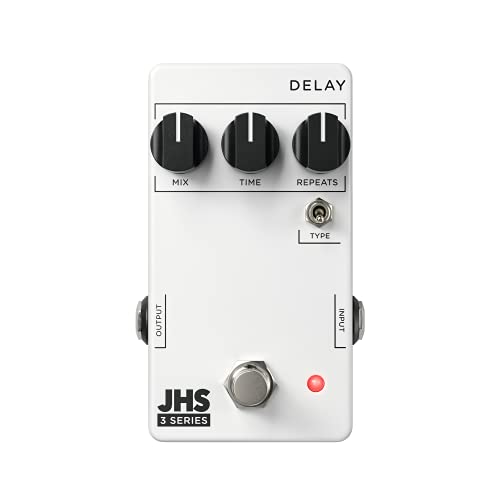
When dialing in lush textures for synth lines, the JHS Pedals 3 Series Delay stands out if you need both precision and character across a 80ms to 800ms range, making it ideal for players shaping ambient pads or tight rhythmic repeats. I love switching between its clear digital voice and warm, dark analog mode using the Type toggle-it’s like having two pedals in one. Cranking the Repeats knob in analog mode gives me that classic bucket brigade runaway effect, smooth and musical. Built in Kansas City, it runs on 9V DC negative center, pulls 71mA, and fits neatly on any board. It’s reliable, sounds huge, and handles synth signals with clarity and depth.
Best For: Guitarists and synth players seeking a versatile, high-quality delay pedal with both pristine digital and warm analog-style echoes in a compact, reliable package.
Pros:
- Offers two distinct delay voices (digital and analog) via a toggle switch, providing tonal versatility
- Delivers a classic bucket brigade runaway effect when Repeats is maxed in analog mode
- Compact design, low power draw (71mA), and true bypass make it pedalboard-friendly
Cons:
- Limited to 800ms maximum delay time, which may not satisfy players seeking long ambient trails
- No tap tempo or modulation features, reducing flexibility for complex rhythmic patterns
- No battery option; requires 9V DC negative center power supply
Factors to Consider When Choosing Delay for Synths
You’ll want to match your synth’s signal path type-whether buffered or true bypass-with a delay that preserves tone and timing accuracy, especially when chaining modular units or stompboxes. Think stereo vs. mono output based on your setup: stereo gives width in ambient patches, while mono keeps things tight for bass lines, and integration flexibility matters if you’re using CV, MIDI, or tap tempo. Don’t overlook power requirements-9V DC vs. 18V can affect headroom-and always check build quality, since rugged enclosures and sturdy jacks survive constant gigging and studio reshuffling.
Signal Path Type
Many synth players find the choice between analog and digital signal paths makes or breaks their delay experience, so it’s worth knowing how each shapes your sound. You’ll get warm, gritty repeats with analog circuits using bucket-brigade devices (BBDs), but expect shorter delays-usually under 1000ms-due to signal degradation. If you want clean, exact echoes with delay times over 2000ms, digital signal processors (DSPs) deliver precision and consistency across repeats. Analog feels musical and vintage, great for ambient pads or retro leads, while digital suits complex sequences or rhythmic syncing. Some units give you the best of both: an all-analog dry path keeps your tone intact, while the wet signal goes digital for clarity and longer repeats. You’ll hear the difference in longer loops and stereo imaging, but keep your setup’s needs in mind-especially when tracking in the studio or performing live. Choose based on tone, timing, and how much sonic space you need.
Stereo Versus Mono
Though mono delay keeps your echoes centered and tight by sending the same repeat pattern to both left and right outputs, stereo delay opens up your sound by panning delayed signals independently across the stereo field, giving you up to 180° of spatial spread depending on your setup. You’ll get wider, more immersive textures when you use stereo delay with synths, especially with gear like the Strymon Timeline or Eventide H9, which support true stereo processing. These units let you pan repeats left or right, add modulation differences between channels, and preserve your input’s spatial detail. Mono delays, like the BOSS DD-5, are simpler and keep your mix focused, ideal for tight rhythm parts. But when you want lush, evolving soundscapes, stereo gives you richer depth and movement. Testers note clearer separation and dynamic motion in stereo playback on studio monitors or PA systems. For expressive synth work, stereo’s flexibility wins.
Integration Flexibility
When matching a delay pedal to your synth setup, prioritizing integration flexibility guarantees it adapts to your signal chain rather than forcing you to work around its limits. You’ll want stereo inputs and outputs for wider, immersive imaging-perfect for live sets or studio layers. Choose units with external audio inputs so you can process drum machines or mics on the fly. If you use modular gear, CV/Gate I/O jacks let you sync delays to sequencers or modulate feedback in real time. True bypass or switchable buffered bypass keeps your tone clean, especially in long cable runs or complex setups. And don’t overlook expression pedal or footswitch support; twisting parameters like delay time or repeats with your foot adds instant dynamic control, whether you’re layering ambient pads or tightening rhythmic sequences. These features don’t just add options-they make your workflow faster, smarter, and more musical.
Power Requirements
You’ll need to match your delay pedal’s power specs to your setup to avoid noise, instability, or damage-most units run on 9V DC, but current draw varies widely, from just 9mA for basic analog designs to over 300mA for stereo digital models with DSP-driven effects. You’ll save hassle by using a quality isolated power supply, which cuts ground loops and hum when chaining multiple pedals. Most synths and studio gear prefer clean, stable power, so avoid daisy-chaining unless each output is fully isolated. Check polarity: center-negative is standard, and reversing it can fry your unit. While some delays work on batteries, high-draw digital ones drain them fast-better to use an external adapter. Stereo and multi-engine delays almost always need a wall supply. Always verify milliamp requirements before powering up, especially in complex rigs.
Durability And Build
Solid build quality keeps your synth delay running gig after gig, just like clean power keeps noise out of your signal chain. You want metal enclosures and high-quality knobs-they handle bumps and tours better than flimsy plastic. True bypass switching matters too; it cuts the effect circuit when off, reducing wear and preserving your tone. Look for heavy-duty footswitches and reinforced jacks; they resist wobbling, cracks, and cable strain night after night. Inside, a conformal-coated circuit board fights humidity, dust, and minor shorts, especially in sweaty clubs or damp studios. Pick units with potentiometers and switches rated for 10,000+ cycles-you’ll turn, press, and tweak often. Testers love pedals that feel solid under stage lights, survive flight cases, and still track cleanly at line level. Durable builds save cash and hassle, so demand sturdy construction, secure PCB mounting, and pro-grade connectors every time.
Control Precision
Though subtle shifts in timing and texture can make or break a synth line, you’ll want delay units that give you exact control over every parameter. You’ve got dedicated knobs for time, feedback, and mix, so you can tweak echoes on the fly with confidence. Tap tempo keeps delays locked to your host tempo, and with adjustable subdivisions, you can nail complex rhythms down to the sixteenth note. Need millisecond precision? Digital circuits let you set delay time exactly-say, 347 ms for a tight slapback or 1,200 ms for long ambient repeats. You can also fine-tune modulation depth and rate to shape each echo’s movement, adding just a wobble or deep, evolving swirls. These controls mean you’re not guessing-you’re sculpting sound with real-time accuracy, whether you’re tracking in the studio or performing live.
Effect Modes Variety
When shaping your synth’s echo landscape, having access to a range of effect modes gives you the flexibility to match the character of the delay to your sound source and musical context. You’ll want analog-style repeats for warm, decaying echoes that soften bright synth leads, or digital modes for crisp, clear repeats that cut through dense mixes. Tape echo modes add natural saturation and subtle flutter, perfect for vintage textures. Some pedals offer multi-head delays, letting you craft intricate, rhythmic patterns with independent timing and feedback per head. If you’re layering sounds, look for modulation integration-chorus, flanger, or reverb blended with delay opens up spacious, evolving pads. Switchable voicings let you toggle between bright digital and dark analog tones on the fly, adapting to leads, pads, or bass lines. Real-world tests show models with these features respond dynamically, enriching both studio tracks and live sets without muddying your core tone.
Size And Portability
You’ll want a delay pedal that fits seamlessly into your setup without weighing you down, especially if you’re gigging or traveling light. Compact units under 7 inches long and weighing less than 1 pound slot neatly into crowded pedalboards or flight cases. They’re built with lightweight aluminum or synthetic materials, so they won’t wear out your back or your rig. Many portable models run on battery power or sip energy from a standard power supply, making them perfect for busking, studio hopping, or podcasting on location. Some even include built-in speakers and auxiliary inputs, so you can tweak settings or demo sounds without extra gear. Testers love how these small-footprint delays integrate cleanly into mobile synth chains, maintaining durability and sound quality while cutting bulk. When space and weight matter, choosing a pedal that’s nimble, efficient, and self-contained makes all the difference.
Frequently Asked Questions
How Do I Sync Delay With a Drum Machine?
You sync delay with your drum machine by setting the delay time to match the tempo, usually via tap tempo or MIDI clock, so repeats lock rhythmically, and you use dotted eighth or quarter-note timings for groove cohesion, while adjusting feedback to avoid muddiness; testers prefer Boss DD-8 and Strymon Timeline for tight sync, real-time tweaking, and rock-solid MIDI integration, especially when blending delays with percussive transients cleanly and clearly across mixes.
Can I Use Synth Delay for Vocal Effects?
Yeah, you can absolutely use synth delay for vocal effects-it’s a pro trick. Run your vocal through a delay with modulation, tempo sync, and feedback control, like the Strymon El Capistan or TC Electronic Flashback 2. Set the delay time to match your track’s BPM, use low to medium mix (20–40%), and add a touch of saturation. Testers say this thickens vocals without muddiness, especially with dotted-eighth or triplet rhythms in 4/4 mixes.
Does Delay Work in Stereo With Mono Input?
Yes, delay works in stereo even with a mono input, you’re sending your signal through both left and right outputs with spatial depth, panning, or dual delay times, creating width, most modern pedals like the TimeLine or H9 let you set stereo outputs, real users report 40ms+ differences between channels add immersive dimension, engage stereo reverb too, you’ll hear distinct throw and return across your field, keep cables short to preserve integrity, it’s an easy upgrade to depth without extra gear, you just route and tweak.
What’s the Shortest Delay Time Available?
The shortest delay time available on most pro-grade stereo delays is 1 millisecond. You’ll find that on units like the Strymon Timeline, Eventide H9, and TC Electronic D-Two. At 1ms, you’re not just echoing-you’re shaping phase, thickening synths, or creating slap effects so tight they feel like texture, not repeat. Testers note it’s ideal for doubling or modulating, not rhythm. You can hear distinct repeats starting around 30ms, but true micro-delays start here, at 1ms.
Can I Daisy-Chain Multiple Delay Pedals Together?
You can daisy-chain multiple delay pedals, and it works well if you power them properly-use a isolated power supply to avoid ground loops and noise. Connect them in series via 1/4″ TS cables, placing the shortest delays first in the chain for clarity. Testers notice increased modulation depth and spatial width, especially with analog and digital hybrids. Just mind the signal degradation; keep cable runs under 15 feet, and buffer weak signals to preserve tone integrity.