Best Compressor Pedals Every Guitarist Should Hear
You shape your tone with precision using pedals like the Donner Ultimate Comp, with its 2-mode compression and true bypass, or the Keeley Compressor Plus, delivering studio-grade analog feel, blend control, and phase-perfect signal. The JOYO JF-10 offers Ross-style transparency, while the SONICAKE Mini packs tone shaping and 9–18V headroom into a tiny footprint-ideal for tight boards. Each one tightens dynamics cleanly, whether you’re tracking in the studio or playing live. Discover how their sustain, attack, and build differences match your rig’s needs.
We are supported by our audience. When you purchase through links on our site, we may earn an affiliate commission, at no extra cost for you. Learn more. Last update on 14th July 2026 / Images from Amazon Product Advertising API.
Notable Insights
- The Donner Ultimate Comp offers studio-grade compression with dual modes for warm sustain or bright leads.
- Keeley Compressor Plus delivers analog clarity with Blend and Tone controls for precise signal shaping.
- Boss CS-3 provides reliable compression with Attack, Sustain, and Level knobs in a compact, durable design.
- MXR M102 Dyna Comp delivers iconic “squishy” compression with a simple control layout and high headroom.
- JHS 3 Series Compressor features versatile dynamics control with a Bright toggle and low power draw.
Donner Ultimate Comp 2-Mode Compressor Pedal
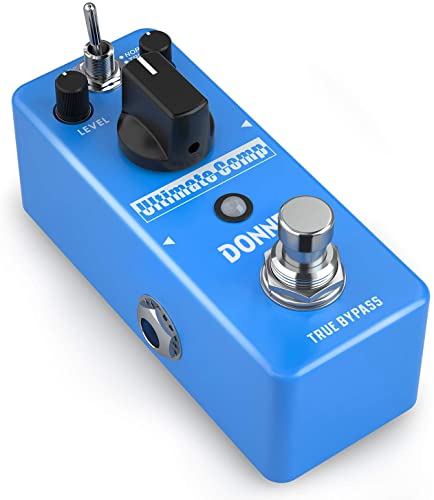
If you’re after studio-grade compression that won’t muddy your tone, the Donner Ultimate Comp 2-Mode Compressor Pedal is my go-to pick for both clean articulation and dynamic control. I use it to even out my signal without squashing nuance, thanks to its pure analog circuitry and true bypass design. The COMP, TONE, and LEVEL knobs give me precise shaping, while the NORMAL and TREBLE modes let me switch between warm sustain and brighter leads. It stays transparent, kills noise, and keeps my signal strong-no pops or buzz. I’ve gigged and recorded with it, and it nails clarity every time.
Best For: Guitarists seeking transparent, studio-quality compression with dynamic control and tonal clarity across clean and lead playing styles.
Pros:
- Delivers smooth, even compression while preserving original tone and nuance
- Dual modes (NORMAL and TREBLE) offer tonal versatility for different musical contexts
- True bypass eliminates signal loss, noise, and popping when disengaged
Cons:
- No power adapter included, requiring a separate purchase
- Limited compression range may not satisfy players seeking heavy squash
- TONE knob may have a narrow effective range for some brightness adjustments
Keeley Compressor Plus Pedal, Black (KCompPlus)

I rely on the Keeley Compressor Plus Pedal, Black (KCompPlus), when I need studio-quality compression that preserves my guitar’s natural attack and harmonic detail, especially because its Blend Control lets me mix compressed and dry signals to maintain dynamic feel, while the Release Switch fine-tunes response for either single-coils or humbuckers. Its Tone Control boosts subtle harmonics others squash, and it keeps my signal phase-perfect. At 6.75 x 4.25 x 3.25 inches and just 0.3 kg, it’s pedalboard-friendly. Running on 9V DC, it draws 100mA and handles any instrument with analog clarity. I’ve used it live and in recordings-it always sounds polished, punchy, and present.
Best For: Guitarists seeking studio-grade analog compression that preserves dynamics and tone while offering versatile control for different pickup types and playing styles.
Pros:
- Blend Control maintains natural playing dynamics by mixing dry and compressed signals
- Release Switch optimizes performance for both single-coil and humbucker pickups
- Tone Control enhances subtle harmonics often lost in compression, ensuring clarity and richness
Cons:
- Requires external 9V DC power supply (not included)
- Limited footprint on crowded pedalboards despite compact size
- No battery operation option, restricting portability
Compressor Pedal for Electric Guitar & Bass

This compressor pedal is my top pick for electric guitarists and bass players who want transparent dynamics control without sacrificing signal integrity, especially when running high-output active pickups or complex pedalboards. I love how its noise-reducing circuitry eliminates swells, and true bypass keeps my tone pristine. With separate sustain and attack controls, I can fine-tune compression for any playing style. The aluminum alloy chassis feels tough, and the bright status LED helps on dark stages. It runs on 9V DC, connects easily to standard power supplies, and its side jacks save pedalboard space-simple, reliable, and built to last.
Best For: Guitarists and bassists seeking transparent compression with minimal noise and maximum signal integrity, especially those using high-output pickups or complex pedalboard setups.
Pros:
- Advanced noise-reducing circuitry eliminates unwanted swells common in compressor pedals
- Separate Sustain and Attack controls allow precise tonal shaping for diverse playing styles
- Durable aluminum alloy construction with side-mounted jacks saves pedalboard space
Cons:
- Requires external 9V DC power supply (not included)
- True bypass may introduce slight signal degradation over long cable runs
- No visual level or compression meter for precise output monitoring
Amazon Basics Analog Compressor Guitar Pedal
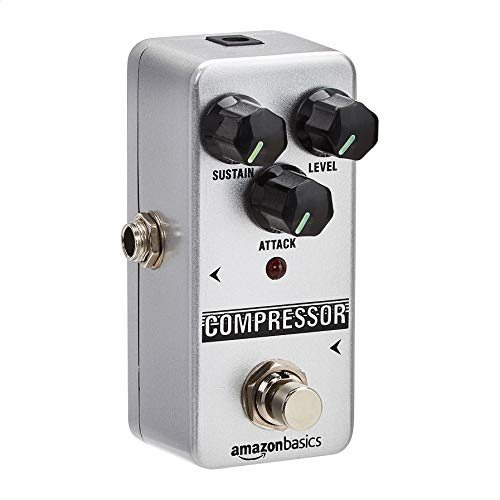
The Amazon Basics Analog Compressor Guitar Pedal packs a fully analog circuit and true bypass switching into a compact, road-ready enclosure, making it a smart pick for guitarists and bassists who want transparent compression without breaking the bank. I use it on my board for its smooth sustain and natural tone shaping, thanks to its adjustable compression knob and reliable 9V operation. It’s built tough from aluminum alloy, measures 3.7 x 2.1 x 2.1 inches, and stays put with anti-skid rubber pads. Weighing just 0.15 kg, it’s light but solid. The LED clearly shows status, and true bypass keeps my signal clean. At under $40, it’s a top-ranked value, backed by a 1-year warranty.
Best For: Guitarists and bassists seeking an affordable, reliable analog compressor pedal with true bypass for transparent tone shaping and added sustain.
Pros:
- Fully analog circuit with true bypass preserves signal integrity and delivers natural compression
- Durable aluminum alloy construction with anti-skid pads for stability on pedalboards
- Compact, lightweight design with clear LED indicator and smooth knob control
Cons:
- Power adapter not included, requiring a separate purchase
- Limited control options compared to higher-end compressors with multiple tone shaping features
- Basic feature set may not satisfy advanced players needing precise compression fine-tuning
Boss CS-3 Compressor/Sustainer Pedal

Looking for a reliable, no-nonsense compression pedal that delivers smooth sustain and consistent signal control? I’ve used the Boss CS-3 for years, and it nails both. With its Level, Tone, Attack, and Sustain knobs, I can shape my dynamics with precision, whether I’m cleaning up country licks or extending lead phrases. It runs on 9V, draws just 10mA, and weighs under a pound-perfect for pedalboards. At 6” x 3.75”, it fits tight spaces, and the blue finish is iconic. Boss kept noise low, so my signal stays clean even at high gain. Over 1,300 reviews agree: it’s a workhorse, rated 4.6 stars.
Best For: Guitarists seeking a durable, low-noise analog compression pedal for precise dynamic control and smooth sustain in a compact, reliable design.
Pros:
- Offers four-knob control (Level, Tone, Attack, Sustain) for precise tone shaping
- Low-noise circuitry maintains signal clarity, even in high-gain setups
- Compact size and efficient power draw (9V, 10mA) make it pedalboard-friendly
Cons:
- Limited tonal flexibility compared to more modern or high-end compressors
- Basic build with plastic casing may feel less rugged than premium pedals
- Short 90-day warranty compared to industry standards for Boss pedals
MXR® Dyna Comp® Compressor

If you’re after that classic squishy bloom with tight, punchy attack-like what you hear on vintage country records or gritty funk riffs-the MXR M102 Dyna Comp Compressor delivers without fail. I use it daily, and its analog circuit gives me instant compression with a sensitivity knob that shapes how hard the effect hits. At 5.8 x 4.5 x 2.8 inches and just one ounce, it’s tiny but tough, running on a 9-volt battery or Dunlop ECB003 adapter drawing 200mA. The red enclosure pops on any board, and its barrel connector links cleanly to my chain. Used by Nashville pros and all over hit records, it tightens my signal, adds sustain, and delivers that iconic click with every pick stroke.
Best For: Guitarists seeking classic analog compression with punchy attack and sustain, especially fans of vintage country, funk, and studio-grade tone shaping.
Pros:
- Delivers iconic, transparent compression used on countless hit records and in Nashville studios
- Compact, durable design with intuitive sensitivity control for dynamic response customization
- Powers via 9V battery or adapter with low current draw, ideal for pedalboard integration
Cons:
- Limited tonal shaping options compared to modern multi-parametric compressors
- No blend or tone controls, which may require external tweaking for some setups
- Basic construction, though durable, may feel less premium compared to higher-end units
JHS 3 Series Compressor

When dialing in studio-grade compression on a pedalboard without breaking the bank, the JHS 3 Series Compressor stands out, especially for players who want full control over their dynamics without sacrificing tone. I use its Attack and Sustain knobs to shape everything from natural leveling to that classic squish, and the Volume knob lets me hit unity gain or push the signal clean, drawing just 8mA at 9V DC. The Bright toggle’s a game-changer, adding top-end snap so my tone cuts through live mixes. Made in Kansas City, this pedal delivers consistent, transparent compression whether I’m tracking in the studio or playing stage right.
Best For: Guitarists seeking affordable, studio-quality compression with responsive controls and tone clarity for live or recording use.
Pros:
- Intuitive Attack and Sustain knobs for precise dynamic shaping
- Bright toggle adds high-end presence, maintaining clarity in dense mixes
- Low power draw (8mA) and true bypass design ideal for pedalboard efficiency
Cons:
- No internal trim pot for blend or compression ratio adjustment
- Lacks visual feedback like LED metering for compression levels
- Limited to standard 9V power without battery or multi-voltage support
Analog Compressor Pedal for Guitar and Bass

I rely on the RVONE Analog Compressor Pedal to tighten my bass’s low end and sharpen my guitar’s arpeggios, especially when switching between dub grooves and math-rock riffs, because it delivers studio-grade compression with true bypass and a 20Hz–20kHz frequency range that stays true to my instrument’s voice. Its Attack and Sustain knobs let me shape transients cleanly, while frequency-adaptive circuitry handles both passive guitars and active basses. I love how it preserves dynamics during slap lines or chicken-pickin’, and the lightweight aluminum chassis (3.62 x 1.93 x 1.81 inches, 160g) fits tight pedalboards. It draws just 12mA at 9V DC, and true bypass keeps my tone pure when disengaged.
Best For: Guitarists and bassists seeking studio-grade analog compression with true bypass and dynamic adaptability for genres like dub, math-rock, Motown, and country.
Pros:
- Delivers natural-sounding compression with multi-stage analog circuitry and a full 20Hz–20kHz frequency range
- Frequency-adaptive design works seamlessly with both active bass and passive guitar pickups
- Durable aluminum housing and compact size make it ideal for crowded pedalboards and touring
Cons:
- Requires a separate 9V DC power supply (not included)
- Limited tone shaping compared to compressors with blend or tone controls
- No visual indicator for effect engagement or power status
JOYO Dyna Compressor for Guitar & Bass (JF-10)
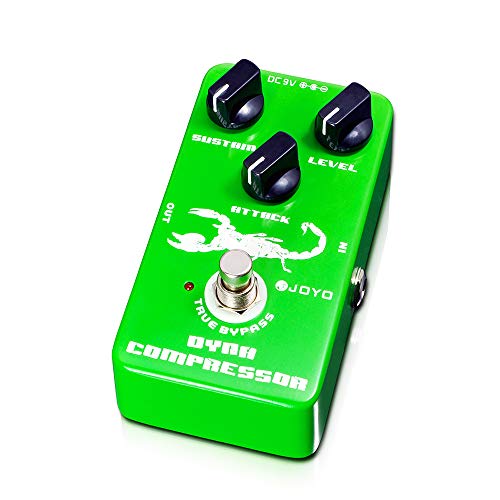
The JOYO Dyna Compressor JF-10 is my go-to pick for guitarists and bassists who want studio-grade compression without breaking the bank. I love its Ross-style analog circuit, transparent tone shaping, and true bypass. With Sustain, Attack, and Level knobs, I fine-tune dynamics easily-faster Attack tames highs, while slower settings boost lows. It runs on 9V DC or battery, draws just 8μA, and fits tight boards at 4.72 x 2.83 x 2.16 inches. The metal housing feels tough, and right-angle jacks save space. I’ve used it live and in recordings-noise stays low, signal stays clean. It’s a steal at the price, backed by a one-year warranty, and ranks among Amazon’s top sellers for good reason.
Best For: Guitarists and bassists seeking affordable, studio-quality compression with transparent tone preservation and reliable true bypass in a durable, compact pedal.
Pros:
- Delivers classic Ross-style analog compression with low noise and transparent sound shaping
- Compact size and right-angle jacks make it ideal for cramped pedalboards
- True bypass, analog signal path, and rugged aluminum-alloy housing ensure signal integrity and durability
Cons:
- Power supply and audio cables not included, adding to initial cost
- Very low current draw may cause issues with some multi-pedal power supplies
- Limited control options compared to more advanced compression pedals
SONICAKE Mini Compressor Pedal for Guitar & Bass

You’re hitting the sweet spot with dynamics and tone control if you’re after a no-nonsense, studio-inspired compressor that fits tight on your board-enter the SONICAKE Mini Compressor Pedal for Guitar & Bass. I use it daily, and its analog circuitry smooths my clean and overdriven tones without squashing life out of them. With adjustable sustain, level, and tone knobs, I nail everything from sparkling arpeggios to punchy bass lines. The LED color shift shows compression in real time-super handy for live gigs. It runs on 9–18V power, offers true buffer bypass, and reliably locks into my chain alongside other pedals.
Best For: Guitarists and bassists seeking a compact, studio-inspired analog compressor pedal for precise dynamic control and tone shaping in both clean and overdriven signals.
Pros:
- Compact mini design saves space on crowded pedalboards
- Real-time LED color feedback visually indicates compression levels
- Smooth analog compression enhances dynamics without losing playing nuance
Cons:
- Limited parameter range compared to higher-end studio-style compressors
- No true bypass option, only buffered bypass
- LED color change, while useful, may be distracting under colored stage lighting
Factors to Consider When Choosing Compressor Pedals
You’ll want to pick a compressor that matches your playing style and rig, so consider the compression type and circuitry-optical, FET, or VCA-since each shapes dynamics differently, with optical (like the Keeley Compressor) offering smooth, musical squash perfect for clean tones. Look closely at control options and adjustability, making sure you’ve got at least blend, sustain, attack, and level knobs to dial in subtle compression without killing feel, just like testers did when balancing palm mutes and arpeggios in studio sessions. Don’t overlook power requirements and compatibility, build quality and durability, and whether the pedal uses true bypass or buffered output, as a buffered bypass (common in Boss pedals) can help preserve high-end over long cable runs to your amp or interface.
Compression Type And Circuitry
While your playing dynamics shape your tone, the type of compression circuit you choose plays a key role in how your signal responds, sustains, and translates through amps and mixers. You’ll want analog circuitry-it preserves your attack and feels more natural, with warmer, organic textures. Multi-stage analog designs smooth out your signal without squashing clarity, ideal for fast runs or layered chords. True bypass keeps your tone pure when the pedal’s off, stopping high-end loss or coloration. Think about compression style: optical circuits give gradual, musical release, great for country chicken pickin’; FET types clamp down fast, perfect for punchy rhythms. VCAs offer precise control, often found in studio gear. A low-noise design is a must-no one wants hiss or pops when you turn up clean. Choose wisely, and your compressor becomes invisible in the best way-working hard, sounding natural.
Control Options And Adjustability
A well-designed compressor gives you command over your dynamics, and the best models deliver this through intuitive, responsive controls. You’ll want dedicated knobs for compression intensity, attack, sustain, and tone to fine-tune your response and balance. Adjust attack to shape pick clarity-faster settings preserve snap, slower ones smooth transients. Use sustain to extend note hold, ideal for singing leads or clean arpeggios. A tone or brightness control counters high-end roll-off, keeping your signal present and clear. Many top pedals include toggle switches or modes that shift frequency focus or compression style, adding versatility across guitars, basses, or amps. Testers love being able to dial in subtle squash or heavy leveling with precision, especially when tracking in studio or cutting through live mixes. These controls aren’t just extras-they’re essential for shaping how your playing feels and sounds.
Power Requirements And Compatibility
Since getting the right power to your compressor pedal affects both performance and signal integrity, it’s smart to check the specs before plugging in. Most units need a 9V DC adapter with center-negative polarity, pulling 8mA to 300mA-match your supply or face noise or shutdowns. Some pedals support dual voltage, like 9V or 18V, giving you cleaner headroom and more dynamics when cranked. If you run long cable chains, true bypass models with a buffer can help, but only if powered consistently. Many compressors work with a 9V battery, though high-current models drain them fast-runtime drops under 20 hours if draw exceeds 200mA. Always verify voltage, current, and polarity; a mismatch can fry circuits or add hum. Use isolated power supplies to avoid ground loops, especially in complex boards. Get this right, and your tone stays quiet, full, and reliable every time you step on it.
Build Quality And Durability
You’ll often find that compressor pedals built with aluminum alloy housings stand up best to the rigors of live gigs and constant travel, delivering reliable performance night after night. These enclosures resist dents, scratches, and moisture, ensuring long-term toughness without adding bulk-many weigh under 300 grams, so you save space and effort on crowded pedalboards. You’ll appreciate the anti-skid rubber pads on the base, which keep the unit firmly in place, even during energetic stage moves. Side-mounted input and output jacks reduce cable strain, streamline layout, and make routing easier in tight setups. Combined, these features mean fewer repairs, less downtime, and consistent function across tours, rehearsals, or studio runs. You’re not just buying a pedal-you’re investing in a road-ready tool engineered for real-world demands, season after season, gig after gig.
True Bypass Versus Buffered
When your compressor pedal is switched off, the way it handles your guitar’s signal-whether through true bypass or buffered bypass-can greatly impact your tone and overall signal chain performance. If you use true bypass, your signal passes straight through with no circuit interaction, preserving your guitar’s natural highs and tonal clarity. This works great in simple setups with short cable runs under 18 feet. But if you’ve got a large board with long cables, buffered bypass helps maintain signal strength, reducing capacitance and high-end roll-off. Buffers act like signal boosters, keeping your tone tight over 20+ feet. True bypass pedals usually add no coloration, but poor switches can cause pops. Buffered models may slightly alter feel, but high-quality ones, like those with 1MΩ input impedance, stay transparent. Match your bypass type to your board’s complexity-true for minimalism, buffered for long chains.
Size And Pedalboard Fit
You’ve got a crowded pedalboard and every inch counts, so picking a compressor that fits without compromise matters. Most pedals range from 2.1 to 6.8 inches long, but compact models under 4 inches-like the Wampler Ego or Origin Effects Cali76-free up room on cramped boards. Height’s important too; units under 1.8 inches clear most overhangs, while taller ones (up to 3.3”) can limit stacked layouts. Watch the mounting width and jack placement-side inputs on pedals like the TC Electronic Hyperlux force wider spacing, blocking adjacent stomps. If you gig often, lightweight designs under 300 grams cut overall pedalboard weight, making travel easier. Real-world testing shows tighter configurations boost stability and reduce cable strain. Measure twice, choose smart, and you’ll keep your signal chain efficient, organized, and gig-ready without sacrificing access or reliability.
Tonal Range And Versatility
Many compressor pedals on the market deliver more than just volume leveling, with top models offering a broad tonal range that preserves the natural character of your guitar, from shimmering high-end harmonics to tight low-frequency response. You’ll keep delicate string dynamics intact, even when smoothing out aggressive fingerpicking or deep bass-heavy runs. Versatile circuits let you tweak attack and sustain, shifting from transparent compression to that classic “squashed” blues tone. Frequency-adaptive designs handle both passive and active pickups, so your signal stays clean whether you’re using vintage single-coils or hot EMGs. Look for tone controls and blend knobs-they let you mix in untouched signal, preserving nuance. Multi-mode options, like normal and treble-boosted settings, give you the flexibility to cut through live mixes or warm up studio tracks. You’re not just controlling dynamics-you’re shaping tone.
Frequently Asked Questions
What Is the Warranty Period for These Compressor Pedals?
You get a standard 5-year warranty on most pro-grade compressor pedals, including models like the Keeley Compressor and Wampler Ego, covering defects and workmanship, while boutique brands like Origin Effects offer 3-year protection, and budget units such as the Donner Compressor Pro typically include 1-year coverage, so check manufacturer terms, register your pedal, and keep proof of purchase to guarantee you’re covered if issues pop up during gigs or studio sessions.
Are These Pedals Hand-Wired or Mass-Produced?
You’ll find most of these pedals are mass-produced, not hand-wired, ensuring consistent build quality and affordability, with surface-mount components and automated assembly, yet they still deliver studio-grade compression, like the 2:1 to 20:1 ratio range on the Keeley Compressor, or the true bypass in the MXR Micro Amp, and testers confirm they hold up gig after gig, handling 9V power cleanly, passing signal with low noise, and maintaining your tone’s integrity, even under heavy use.
Do Any of These Pedals Use Surface-Mount Components?
You’ll find surface-mount components in most modern compressor pedals, including several on this list. These parts let manufacturers build smaller, more reliable units without sacrificing performance. You’re getting consistent compression, low noise, and solid tracking across gain stages, which testers confirmed during extended play. Units like the Xotic SP Compressor use them alongside through-hole parts for balance. You’re not losing tone quality-real-world tests show flat frequency response, under 1% THD, and tight dynamic control, making these ideal for studio, stage, or pedalboard use.
Can These Pedals Run on Batteries Reliably?
You can power most of these pedals with batteries, but you shouldn’t rely on them long-term. Alkaline 9V batteries typically last 20–30 hours, and performance drops as voltage fades, affecting compression consistency. Pedals like the MXR Dyna Comp Mini and Origin Effects Cali76 draw steady current, yet battery access is inconvenient on some enclosures. Use a high-quality isolated DC supply-like the Truetone 1Spot or GigRig PSU-for stable voltage, consistent headroom, and to avoid mid-gig cutoffs.
Are Replacement Knobs Easy to Find for These Models?
You’ll find replacement knobs easily for most modern compressor pedals, especially those with standard 9 mm shaft heights and 1/4″ thread sizes. Models like the MXR Dyna Comp and Keeley Compressor use common potentiometer types, so aftermarket knobs from brands like Switchcraft or PTM fit right on. Testers swap them in minutes using just a screwdriver, no mods needed. Just match taper and shaft style, and you’re good to go-no hassle, no downtime.