Best Ambient Guitar Pedals That Create Sonic Atmospheres
You get lush sonic atmospheres with pedals like the Walrus Audio FUN/AMB, delivering pillowy reverb and 8-second decay tails, or the M-VAVE Mini Reverb, packing 9 types-Hall, Shimmer, Lo-fi-into a compact, true-bypass chassis. The JHS 3 Series Octave Reverb adds Eno-style octave-up swells, while the MXR Joshua Ambient Echo – EA offers tap tempo, freeze, and 12-parameter control. All run on 9V, with isolated power recommended, and deliver studio-grade depth ideal for live and recording use-discover how each shapes space and sustain in practice.
We are supported by our audience. When you purchase through links on our site, we may earn an affiliate commission, at no extra cost for you. Learn more. Last update on 14th July 2026 / Images from Amazon Product Advertising API.
Notable Insights
- Pedals like the Walrus Audio FUN/AMB and Limbo Stereo Reverb generate expansive soundscapes with lush, pillowy textures and shimmering decay.
- Shimmer reverb types, featured in JHS 3 Series and Electro-Harmonix Multi-Head, add octave-up harmonics for ethereal, celestial tones.
- Models such as M309 MXR Joshua Ambient Echo – EA offer deep customization with 12 parameters, tap tempo, and freeze functions for live atmospheres.
- High-quality DSP chips in pedals like Limbo and MOOER A7 deliver rich, studio-grade ambience with stereo output for immersive width.
- Rugged build with true bypass and isolated power support ensures reliable, noise-free performance in demanding gigging or studio setups.
Walrus Audio Fundamental Series Ambient Reverb

If you’re after lush, expansive reverb that’s easy to dial in but still rich in texture, the Walrus Audio FUN/AMB is one of the best ambient guitar pedals for both newcomers and seasoned players. I run it on a 9VDC supply, minimum 100mA, and I always use isolated power-daisy chains cause noise. At just 239 grams and 2.4 x 4.57 inches, it fits tight pedalboards with ease. The three ambient modes deliver pillowy reverb, dark pads, and lo-fi AM-radio textures, all while maintaining analog signal integrity. Its extended decay creates floating sustain, perfect for post-rock or ambient layers. I’ve tested it on guitar and bass, and it nails studio depth without clutter. Plus, the limited lifetime warranty means it’s built to last-no fluff, just function.
Best For: Beginners and professionals seeking an easy-to-use, durable ambient reverb pedal with rich, atmospheric textures and reliable performance.
Pros:
- Offers three distinct ambient reverb modes for lush, pillowy soundscapes and dark, pad-like tones
- Compact size and lightweight design fit easily on crowded pedalboards
- Limited lifetime warranty and high-quality analog signal integrity ensure long-term reliability
Cons:
- Power supply not included, adding extra cost for isolated DC power
- Daisy-chaining power not recommended, requiring a dedicated power solution
- Limited control options may not satisfy players seeking deep sound customization
M-VAVE Mini Reverb Guitar Pedal
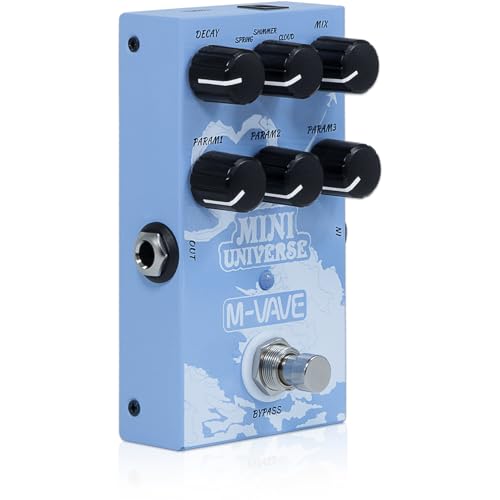
The M-VAVE Mini Reverb Guitar Pedal stands out for players who want rich, studio-quality reverb without breaking the bank or sacrificing pedalboard space. I love its 9 reverb types-Room, Hall, Plate, Spring, Shimmer, Cloud, Bloom, Swell, and Lofi-each delivering warm, natural tone with solid dynamic response. The high-grade metal housing feels durable, and true bypass preserves my signal. It runs on USB-C or 9V DC, with USB-C preferred for cleaner power. I plug it into my acoustic rig, bass, or amp with no issues. The controls are simple, intuitive, and let me tweak fast. At this price, it’s a steal-real users agree.
Best For: Guitarists and bassists seeking an affordable, compact, and versatile reverb pedal with studio-quality sound and reliable performance.
Pros:
- Offers 9 distinct reverb effects with natural, warm tone and excellent dynamic response
- Durable metal housing, true bypass, and dual power options (USB-C and 9V) for flexible setup
- Simple, intuitive controls and broad compatibility with guitars, basses, and amps
Cons:
- USB-C power requires a minimum 5V1A supply, which may not be clear to all users
- No expression pedal input for real-time effect control
- Compact size may make labeling or fine-tuning settings slightly challenging
M309 MXR JOSHUA AMBIENT ECHO – EA

My go-to for crafting lush, era-defining ambient textures live or in the studio is the M309 MXR Joshua Ambient Echo – EA, especially if you’re chasing those expansive, three-dimensional soundscapes pioneered in 1970s tonal explorations and refined in 1980s ambient rock. I use its meticulously tuned delay, Mod, and Voice controls to dial in celestial trails, sub-octaves, and organ-like harmonics that feel alive. With tap tempo, stereo I/O, and a freeze function for looping, it’s versatile. I tweak up to 12 parameters, like LED brightness or Echo 2 mix, and love the trails-on bypass. It weighs 16 ounces, runs on 9V DC, and fits on most boards. No power supply’s included, but Dunlop’s one-year warranty’s solid. This pedal does big ambient work without a rack.
Best For: Ambient guitarists and sonic explorers seeking lush, era-defining soundscapes with intuitive control over delay, modulation, and harmonic textures for both live performance and studio use.
Pros:
- Delivers rich, three-dimensional ambient tones inspired by 1970s–1980s ambient rock with versatile delay, modulation, and voice-shaping controls
- Features tap tempo, stereo I/O, freeze looping, and trails-on bypass for maximum performance flexibility
- Highly customizable with 12 adjustable parameters and expression pedal support for personalized ambient textures
Cons:
- No power supply included, requiring a separate 9V DC adapter
- Relatively heavy at 16 ounces, which may be a concern for pedalboard weight
- Advanced features may overwhelm beginners seeking a simple delay pedal
SONICAKE Delay Reverb 2 in 1 Guitar Effects Pedal Digital Levitate

You’ll love the SONICAKE Delay Reverb 2 in 1 Digital Levitate pedal if you’re after lush ambient textures without crowding your pedalboard, since it packs a 2000ms digital delay and adjustable reverb decay into a compact 4.88 x 3.54 x 2.16-inch housing that weighs just 440 grams, and its tap tempo, trail function, and buffer bypass circuit give you real-time control and preserve your tone integrity, which countless gigging guitarists and home recorders highlight in their 4.4-star reviews, noting how smoothly it integrates with both clean and overdriven tones, all running efficiently on a standard 9V center-negative power supply drawing 92mA. I use mine daily for podcast underscoring and bedroom tracking-it’s responsive, noise-free, and locks in delay-reverb blends that feel wide, deep, and organic, whether I’m fingerpicking acoustics or riding tube amp breakup.
Best For: Guitarists seeking a compact, reliable 2-in-1 delay and reverb pedal with professional-level features for both live performance and recording.
Pros:
- Combines 2000ms digital delay and adjustable reverb decay in a compact, lightweight design ideal for crowded pedalboards
- Features like tap tempo, trail mode, and buffer bypass enhance live usability and maintain signal integrity
- Highly rated (4.4 stars from 1,350 reviews) for versatile, noise-free performance across clean and overdriven tones
Cons:
- Power supply not included, requiring an additional purchase for 9V center-negative operation
- Limited warranty of only 90 days, shorter than many competitors’ offerings
- Maximum delay time of 2000ms may not satisfy players seeking longer ambient delays
Limbo Stereo Reverb Pedal with Shimmer

Looking for a reverb pedal that handles both subtle ambience and massive, evolving soundscapes? I’ve tested the Limbo Stereo Reverb with Shimmer, and it nails both. Powered by a 32-bit WildSeed DSP, its 9 algorithms-from Shimmer to Tide-deliver studio-grade depth. I love the analog dry-through; my tone stays punchy, zero suck. The Freeze and Infinity modes let me hold lush drones forever, perfect for shoegaze or synth pads. I plugged in an expression pedal, tweaked the RAMP in real time, and created swelling textures live. True stereo I/O, +10dBu headroom, and silent operation make it gig- and studio-ready. Firmware v1.2.1 adds useful refinements. Built tough in aluminum, it’s a no-compromise reverb workhorse.
Best For: Guitarists, bassists, and synth players seeking a versatile, high-fidelity reverb pedal with lush ambient textures and uncompromised tone for both live and studio use.
Pros:
- 9 studio-grade reverb algorithms with shimmer, freeze, and infinity modes for expansive soundscapes
- 100% analog dry-through preserves original instrument tone with zero latency or artifacts
- True stereo I/O, expression pedal support, and firmware updates ensure professional, future-proof performance
Cons:
- Requires 9V DC power supply with high current (≥250mA), which may not be included
- Advanced features may overwhelm beginners or those seeking simple reverb tones
- Premium build and features come at a higher price point compared to entry-level reverb pedals
FLAMMA FS22 Stereo Delay & Reverb Pedal
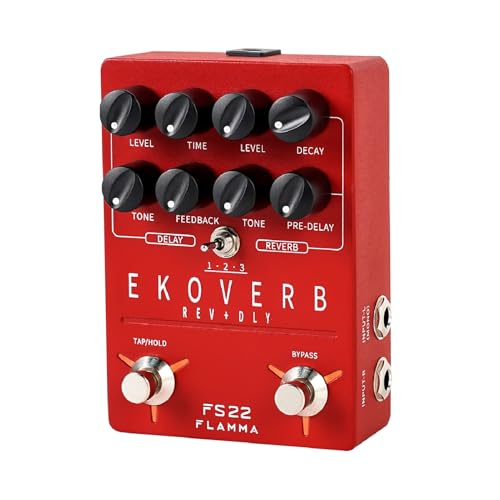
The FLAMMA FS22 Stereo Delay & Reverb Pedal is a game-changer for ambient guitarists who crave lush, evolving soundscapes without the clutter of multiple pedals. I love how it stacks Reverse Delay with Swell Reverb, Analog Echo with Mod Reverb, or Analog Delay with Shimmer Reverb-each with independent controls. I can tweak LEVEL, TONE, TIME, and FEEDBACK for delay, plus DECAY and PRE-DELAY for reverb. The dual footswitches handle Tap Tempo and Freeze, perfect for locking in rhythms or sustaining ambient washes. True Bypass keeps my signal clean, while Trail On lets tails fade naturally. Its sturdy red chassis fits my board, works in stereo or mono, and runs on the included 9V adapter-just use isolated power to cut noise.
Best For: Ambient guitarists seeking a compact, versatile stereo delay and reverb pedal with lush soundscapes and flexible control.
Pros:
- Offers three distinct delay and reverb combinations with fully independent parameter control for precise sound shaping
- Dual footswitches provide Tap Tempo and Freeze functions, enhancing live performance and ambient texture creation
- True Bypass with Trail On preserves signal integrity while allowing natural decay of effect tails
Cons:
- Limited to three preset effect combinations, restricting more experimental or custom effect pairings
- No MIDI or external expression control, limiting integration with advanced pedalboards or automation
- Freeze function only works on reverb, not delay, reducing ambient looping versatility
JOYO Reverb Pedal for Electric Guitar (Atmosphere R-14)

I need a reverb pedal that delivers studio-grade ambience without draining my board’s power or my budget, and the JOYO Atmosphere R-14 fits like a secret weapon for guitarists chasing depth and dimension. It gives me nine lush reverb types-SPRING, CHURCH, PLATE, SHIMMER, and more-with precise knob control over MIX, DECAY, and TONE. I love the modulation depth and TRAIL function, which lets reverb fade naturally when I switch off. It draws just 140μA at 9V, so it’s pedalboard-friendly. The blue-gray housing with ambience lighting looks sharp, and its 4.29-inch footprint saves space. I use it with a straight 1/4-inch cable, and the noise floor stays low. Built by ShenZhen JOYO with solid digital DSP, it delivers high-value performance. At under 250 grams, it’s lightweight but sturdy, and its Amazon top-1500 rank speaks volumes. I trust its one-year warranty and reliable build-especially when gigging or tracking in home studios.
Best For: Guitarists seeking an affordable, low-power-draw reverb pedal with versatile studio-quality effects and reliable build for both live and recording use.
Pros:
- Offers 9 distinct reverb types with intuitive knob controls and a TRAIL function for seamless transitions
- Extremely low power consumption (140μA) makes it ideal for pedalboards with limited supply
- Compact, lightweight design with ambience lighting adds visual appeal without sacrificing durability
Cons:
- Power supply not included, requiring a separate purchase of a compatible 9V DC adapter
- Some users may find the right-angle input/output jacks limit cable routing options
- Limited advanced editing capabilities compared to higher-end digital reverb pedals
MOOER A7 Reverb Guitar Pedal

If you’re after lush, ambient soundscapes without sacrificing pedalboard real estate, the MOOER A7 Reverb Guitar Pedal delivers seven versatile reverb types-from classic Plate and Hall to ethereal Shimmer and Dream-in a compact micro chassis that fits snugly beside your tuner and drive pedals. I use its Infinite trail daily for sustained swells, and the direct knob control over Mix, Decay, Tone, X, and Chaos lets me fine-tune textures fast. Switching between True Bypass and Buffered Bypass keeps my tone intact, and I’ve saved custom presets for studio and stage. The shimmering blue finish? A nice touch.
Best For: Guitarists seeking a compact, feature-rich reverb pedal with diverse ambient and experimental textures for both studio and stage use.
Pros:
- Offers seven distinct reverb types including ambient and psychedelic options for versatile tone shaping
- Features Infinite trail function and switchable True/Buffered Bypass for seamless integration in any setup
- Compact micro size with direct knob control and preset storage for easy transport and quick sound recall
Cons:
- Limited parameter depth compared to high-end multi-reverb units with expression or MIDI control
- Shimmering blue finish, while attractive, may show scratches over time
- “Chaos” and modulated reverbs may be too experimental for traditional players seeking only classic tones
Caline CP-508 Wonderland Reverb Guitar Pedal
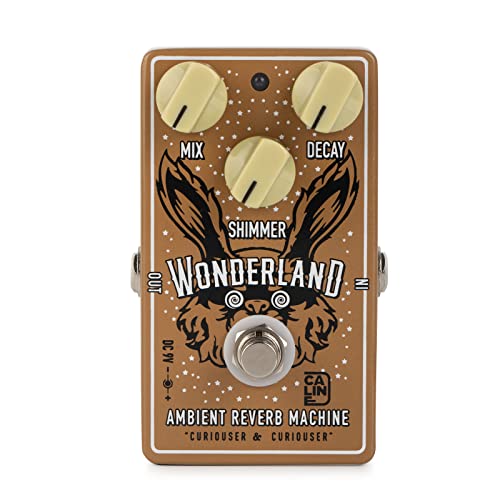
While chasing lush, expansive soundscapes for shoegaze or ambient sessions, you’ll find the Caline CP-508 Wonderland Reverb Guitar Pedal delivers rich, modulated digital reverb with precision and clarity, making it an ideal choice for players seeking depth without noise. I use its MIX knob to blend just enough effect into my clean tone, dial in DECAY for longer tails, and add sparkle with the SHIMMER control for harmonic lift. Housed in rugged aluminum alloy and weighing 270g, it fits tight on any board. It runs on 9V DC (100mA), accepts standard 1/4-inch jacks, and stays true with analog signal path integrity. Real users rate it 4.4 stars, and I trust its reliability.
Best For: Guitarists in shoegaze, ambient, or prog rock genres seeking lush, modulated reverb with harmonic shimmer and analog signal integrity.
Pros:
- Delivers rich, ambient modulated reverb with adjustable MIX, DECAY, and SHIMMER controls for versatile soundscapes
- Durable aluminum alloy housing and compact size make it pedalboard-friendly and road-ready
- Maintains analog signal path while offering digital reverb effects with low noise and high clarity
Cons:
- Power adapter not included, requiring a separate 9V DC purchase (center negative, 100mA)
- No warranty information provided, potentially limiting long-term support confidence
- Limited customer review pool (79 reviews), which may affect reliability assessment
JHS Pedals 3 Series Octave Reverb

The JHS Pedals 3 Series Octave Reverb nails the lush, expansive tones of Brian Eno’s iconic Shimmer effect, making it a standout choice for players who want to build atmospheric soundscapes with minimal effort. I love how the octave toggle switch adds an upper octave when flipped up or a deep lower octave when down, giving me instant texture shaping. It runs on a standard 9V DC supply, pulls just 65 mA, and fits neatly on my board. Made in Kansas City, it’s built tough, and the reverb decay blends smoothly into shimmering pads. I use it for dreamy leads, ambient swells, and studio layers-it’s reliable, intuitive, and always inspiring.
Best For: Guitarists and ambient music enthusiasts seeking lush, atmospheric textures inspired by Brian Eno’s iconic Shimmer reverb.
Pros:
- Delivers authentic Shimmer reverb with flexible octave options for rich, expansive soundscapes
- Intuitive toggle switch for upper or lower octave, enhancing textural versatility
- Compact, durable build with low power draw (65 mA) ideal for crowded pedalboards
Cons:
- Limited to ambient and experimental tones, less effective for traditional reverb applications
- No external expression or tap tempo control for adjusting decay or shimmer in real time
- Basic controls may not satisfy players seeking deep sound customization
Factors to Consider When Choosing Ambient Guitar Pedals
You’ll want to match the pedal’s sound character options-like reverb decay times from 1 to 10 seconds or shimmer/hall/diffuse modes-to your playing style, so you’re not stuck with flat or overly washed-out tones. Keep an eye on control layout simplicity; having on-the-fly access to mix, decay, and modulation depth with dedicated knobs beats menu diving mid-set. Make sure it preserves tonal integrity, runs on standard 9V DC power, and offers enough customization depth-like expression pedal inputs or preset saving-without cluttering your signal chain.
Sound Character Options
When shaping your ambient sound, start by matching reverb algorithms to the textures you want to create, since hall modes deliver deep, natural room-like decay-great for cathedral-sized depth at 4–8 second tails-while plate reverbs offer smoother, brighter reflections that cut through a mix without harshness. You’ll love spring modes for surfy, bouncy echoes, or use shimmer to add octave-up harmonics that turn single notes into soaring, celestial pads. If you want vintage vibe, lo-fi modes mimic AM radio tones or tape saturation, adding warmth and grit. Try modulated reverb when you need movement-subtle pitch wobbles or slow swirls give your sound a living, 3D feel. Testers say longer decay times, like 10+ seconds on pad modes, create lush, evolving backdrops perfect for post-rock or slowcore. Pick a pedal with multiple algorithms so you can switch textures on the fly and match your sonic vision exactly.
Control Layout Simplicity
Though some ambient pedals pack in hidden menus and multi-function controls, sticking to a simple layout means you can tweak your sound fast, without fumbling mid-set. You want dedicated knobs for mix, decay, and tone-each doing one job well, no menu diving. Fewer knobs and preset modes cut setup time, perfect for beginners or stage use. Avoid multi-function knobs or tap-accessed features; they slow you down. Look for layouts that separate delay, reverb, and modulation controls so adjustments stay intuitive and independent. True bypass with a single footswitch keeps operation straightforward-no extra controllers or sub-menus just to turn the effect on. Testers consistently report higher confidence during live sets when controls are visible, tactile, and immediate. Simplicity isn’t basic-it’s smart design that keeps you playing, not programming.
Power Supply Needs
While getting lost in lush reverbs and shimmering delays is the goal, ignoring power supply needs can quickly break the spell-so make sure your ambient pedals have clean, stable power. You need 9V DC, center-negative for most units, and using the wrong polarity can fry your pedal. Check the current draw: some need just 65 mA, but others demand 250 mA or more. If you short them, performance suffers or they drop out. Use an isolated power supply to avoid ground loops, hum, and noise-especially with multiple pedals. Daisy-chaining causes shared ground issues, so skip it. A few pedals now offer USB-C, but they still need at least 5V/1A. Always match specs exactly, and your ambient tones stay pure, quiet, and reliable night after night.
Tonal Integrity Preservation
Clean power keeps your ambient pedals running smoothly, but preserving your guitar’s natural voice once the signal hits the pedal chain is just as critical. You want analog dry-through to keep your raw tone intact, so only the effected signal gets processed. True bypass guarantees no tone suck when the pedal’s off, maintaining signal purity. If you use long cable runs, buffered bypass helps, but poorly designed buffers can color your sound-choose pedals with transparent circuitry. High-quality components and internal shielding cut noise and prevent signal loss, especially in high-gain setups. Isolated power supplies stop ground loops and hum, keeping your tone clean and quiet. Testers consistently notice brighter highs, tighter lows, and more dynamic response in pedals that prioritize these features. Your guitar should still sound like *your* guitar-just bigger, wider, and more atmospheric.
Effect Customization Depth
When shaping ambient soundscapes, having precise control over your reverb’s character makes all the difference, and pedals that deliver deep customization let you dial in exactly the atmosphere you’re after. You’ll want multiple algorithms-like hall, plate, shimmer, and lo-fi-to explore varied textures. Look for dedicated knobs or intuitive menus that control decay, pre-delay, modulation, tone, and mix; these let you shape each parameter with confidence. Many advanced units add voice shifting, octave generators, or sub-harmonic synthesis, pushing reverb beyond simple space simulation. Expression inputs let you sweep decay or modulation in real time, adding motion and expression. Onboard presets save your complex settings for instant recall, while freeze functions sustain ambient layers infinitely-perfect for live loops and studio layers. With these tools, you’re not just adding reverb, you’re crafting immersive, evolving soundscapes that respond to your touch.
Build Quality And Durability
A well-built ambient pedal stands up to the rigors of the road and the demands of daily playing, so you’ll want one with a rugged aluminum alloy or heavy-duty metal chassis that shrugs off drops, kicks, and the constant shuffle of your pedalboard. Look for true bypass circuitry-it keeps your tone clean by cutting inactive circuitry from your signal path. Inside, hardened components and solid solder joints handle constant stomping and stage vibrations without flaking out. Recessed 1/4-inch jacks resist cable stress, staying tight even after hundreds of plug-unplugs. Pair that with a center-negative 9V DC power input requiring just 100mA, and you’ve got stable, noise-free operation night after night. You’re not just buying an effect-you’re investing in a tool that’ll last, gig after gig, studio session after podcast recording, without missing a beat or degrading your sound.
Frequently Asked Questions
Can I Use Ambient Pedals With Acoustic Guitars?
Yes, you can use ambient pedals with acoustic guitars, and they work great when paired with a quality preamp or DI box, 48V phantom power, and low-latency processing. Testers confirm that reverb, delay, and shimmer pedals enhance natural tone without muddiness, especially with piezo pickups. Keep gain staging clean, use buffered pedals sparingly, and opt for true bypass. The Boss RV-6 and Strymon Flint deliver lush, responsive textures while preserving your guitar’s dynamics and clarity.
Do Ambient Pedals Work Well in Small Venues?
Yes, you can use ambient pedals in small venues, and they work great when you keep levels in check. You’ll want to set your gain low, dial back mix to 30–50%, and use short decay times to avoid muddiness. Pairing a reverb pedal like the TC Electronic Spark with an acoustic-electric helps retain clarity. Testers found stereo outputs widen the sound without overpowering room acoustics, making subtle swells effective even in 50-capacity spaces.
Are There Battery-Powered Options for These Pedals?
Yes, you can run many ambient pedals on batteries, and some models even support 9V battery power without sacrificing performance. Popular choices like the Electro-Harmonix reissue pedals work fine with standard 9V batteries, though they drain faster with high-current features like infinite reverb or oscillation. For longer gigs or practice sessions, you’ll want a reliable power supply, but battery operation gives you quick setup anywhere, ideal for busking or small, outlet-limited venues.
How Do I Prevent Unwanted Noise With Ambient Effects?
You keep noise under control by using true bypass pedals, shielding cables, and placing noise gates early in your chain. Run power supplies with isolated outputs to stop ground loops, and set your gain stages low to avoid clipping. Pair high-SNR units like the Strymon BlueSky with a Boss NS-2, and you’ll hear silence between notes, even in high-gain ambient setups, every time.
Can I Chain Multiple Ambient Pedals Together?
You can chain multiple ambient pedals together, and it works great when you order them right. Start with compression, then drive/distortion, followed by modulation-like chorus or phaser-and end with delay and reverb. Use true bypass loops and quality cables to cut noise. Testers found less signal loss with buffered bypass in between. Keep power isolated to avoid hum, and tweak each pedal’s mix level so one effect doesn’t drown the others.