Best Acoustic Travel Guitars for Every Wandering Musician
You want a tough, packable acoustic that sounds big despite its size, and models like the Enya NOVA GO SP1 deliver with a 35-inch carbon fiber body, USB-C recording, and built-in effects. The Traveler Guitar Ultra-Light, at just 2 lbs 14 oz, fits overhead and offers a full 24.75-inch scale. For warmth, the Cordoba Mini II MH-CE gives rich tone from its deep body and mahogany build, while the Journey Instruments collapsible design assembles in 20 seconds and fits under seats in a sub-18-inch pack - there’s a perfect match no matter your journey.
We are supported by our audience. When you purchase through links on our site, we may earn an affiliate commission, at no extra cost for you. Learn more. Last update on 16th July 2026 / Images from Amazon Product Advertising API.
Notable Insights
- Carbon fiber travel guitars like the Enya NOVA GO SP1 resist warping and extreme temperatures, ideal for outdoor or variable climates.
- Compact designs such as the Traveler Guitar Ultra-Light (28 inches) fit in overhead bins and are carry-on compliant.
- Foldable models like the Journey Instruments guitar assemble in seconds and pack into TSA-friendly backpack cases.
- Lightweight builds under 4 pounds, like the Cordoba Mini II, ensure comfort during long journeys and easy portability.
- Built-in electronics and pickups in guitars like the SONICAKE kit enable silent practice and direct amp connectivity.
Enya NOVA GO SP1 Travel Guitar
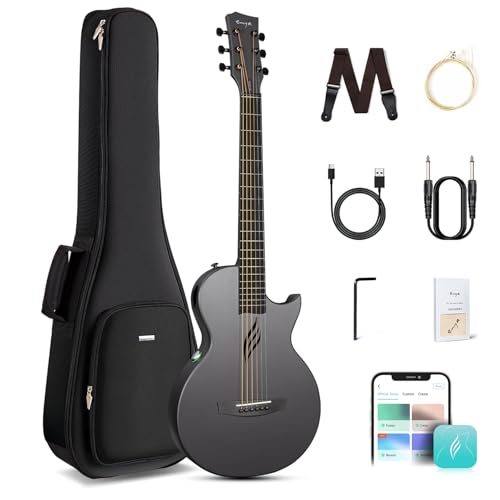
If you’re after a travel guitar that won’t quit on you in tough conditions, the Enya NOVA GO SP1 is the one. Made from carbon fiber composite, it shrugs off humidity, heat, and cold-no warping on sunny beaches or mountain treks. Its Smart AcousticPlus SP1 pickup gives me reverb, delay, and fusion effects straight from the guitar, no pedals needed. I stream music or play through the built-in speaker via Bluetooth. The USB-C port lets me record straight to my phone, update firmware, or charge the system. At 35 inches, the half-size body’s durable, one-piece design feels solid, and the zero fret with truss rod keeps tuning smooth. It comes with a gig bag, wrench, and cables-ready to go.
Best For: Travelers and outdoor enthusiasts who need a durable, portable guitar that performs reliably in extreme environments without sacrificing sound quality or modern features.
Pros:
- Built with carbon fiber composite that resists warping, cracking, and environmental changes, ideal for outdoor and travel use
- Smart AcousticPlus SP1 pickup with built-in effects and Bluetooth-enabled speaker eliminates the need for external pedals or amplifiers
- USB-C connectivity allows direct recording to devices, system updates, and charging, enhancing versatility and convenience
Cons:
- Half-size 35-inch body may feel less comfortable for players accustomed to full-size guitars
- Built-in speaker sound quality may not match dedicated external amplification systems
- Premium materials and technology come at a higher price point compared to traditional travel guitars
Traveler Guitar Ultra-Light Acoustic-Electric (Antique Brown)

The Traveler Guitar Ultra-Light Acoustic-Electric in Antique Brown is built for the mobile musician who refuses to sacrifice playability for portability, and I’ve found it’s ideal for travelers, buskers, and recording artists constantly on the move. At just 2 lbs 14 oz and 28 inches long, it fits easily in carry-on luggage, yet its 24 3/4-inch scale and 22 frets feel surprisingly natural. The headstock-less design uses an In-Body Tuning System for durability and tuning stability, while solid American Hard Maple in a neck-through build guarantees rich resonance. It includes a built-in piezo pickup, 1/4-inch output, and a detachable lap rest-perfect for quiet practice or live gigs. I plug mine straight into my audio interface for podcast sessions or small amps on the road, and the tone always holds up. It’s a pro-grade tool, not just a travel toy.
Best For: Traveling musicians, buskers, and recording artists who need a durable, portable guitar without sacrificing playability or sound quality.
Pros:
- Extremely lightweight and compact design makes it ideal for travel and carry-on luggage
- Full-scale neck with 22 frets provides a playing experience comparable to full-sized guitars
- Built-in piezo pickup and output jack enable easy amplification and recording on the go
Cons:
- Headstock-less design may feel unfamiliar to traditional guitar players
- Limited sound projection compared to standard acoustic guitars due to smaller body size
- Higher price point than other travel guitars with similar features
Fender FA-25N 3/4 Size Nylon Guitar

I reach for the Fender FA-25N 3/4 Size Nylon Guitar when I need a compact, easy-to-play instrument that doesn’t sacrifice tone or build quality-especially ideal for younger players, beginners, or anyone with smaller hands. Its C-shaped neck and soft nylon strings make fretting comfortable, while open-gear tuners keep it in tune reliably. The walnut bridge delivers warm, balanced tone, and the 3/4-scale body fits snugly in tight spaces-perfect for travel. Built on 75+ years of Fender craftsmanship, it includes a 2-year warranty and 3 months of free Fender Play, so you learn faster with real songs. It’s light, durable, and ready wherever music calls.
Best For: Beginners, children, and players with smaller hands seeking a compact, comfortable, and high-quality starter nylon-string acoustic guitar.
Pros:
- Comfortable C-shaped neck and soft nylon strings ideal for easy playability and learning
- Compact 3/4-size body and lightweight design make it portable and travel-friendly
- Includes 2-year warranty and 3 months of free Fender Play for added value and support
Cons:
- 3/4-size scale may not suit players looking for full-size guitar feel or tone projection
- Nylon strings produce a softer sound, less ideal for rock or brighter musical styles
- Open-gear tuners, while functional, are less durable than sealed tuners on higher-end models
Journey Instruments Solid Sitka Travel Guitar

You’ll want the Journey Instruments Solid Sitka Travel Guitar if you need a no-compromise acoustic that fits under an airplane seat but still delivers full-bodied tone, thanks to its solid Sitka spruce top and layered African mahogany back and sides producing clear highs, warm mids, and strong projection. I love how its patented collapsible neck attaches in 20 seconds, stays stable, and doesn’t sacrifice sound. Weighing just 3.7 lbs, it’s durable yet light, with a carbon-reinforced neck and lifetime-guaranteed stainless steel hardware. The 23-inch scale and satin neck feel comfortable, while the included TSA-friendly backpack carries my guitar, laptop, and tools-all under 18 inches.
Best For: Travelers, musicians on the go, and outdoor enthusiasts who need a compact, durable acoustic guitar that delivers full-size sound without sacrificing portability.
Pros:
- Delivers rich, full-bodied acoustic tone with solid Sitka spruce top and layered African mahogany construction
- Patented collapsible neck assembles in 20 seconds and maintains tuning stability and structural integrity
- Lightweight at 3.7 lbs with a TSA-compliant backpack case that fits under airline seats and carries tech and accessories
Cons:
- Smaller 23-inch scale length may feel unfamiliar to players used to full-scale guitars
- Compact body may lack the low-end resonance of a full-size dreadnought
- Premium price point may be higher than other travel guitars with similar size
Donner HUSH I Travel Guitar with Bag

Pros:
- Ultra-compact and lightweight design fits in airplane overhead bins and weighs about the same as a laptop
- Silent 30–45dB pizzicato mode with 50 hours of headphone playtime enables discreet, undisturbed practice
- Built-in 2-stage EQ, anti-phase button, and ergonomic neck enhance sound control and comfort during extended playing
Cons:
- Headless design may feel unfamiliar to traditional acoustic guitar players
- Battery-powered operation required for amplified sound, with no built-in USB charging
- Compact size may limit resonance and volume compared to full-sized acoustic guitars
SONICAKE Travel Acoustic Electric Guitar Kit
The SONICAKE Travel Acoustic Electric Guitar Kit stands out for players who need a reliable, full-featured instrument that packs down for the road without sacrificing tone or playability. I love its solid mahogany body and rosewood fingerboard-they deliver warm, rich acoustics you’d expect from a full-sized guitar. The built-in digital preamp gives me multiple body simulations, Reverb, Chorus, and Resonance Enhancement, plus a 2-band EQ for precise tone shaping. Its 2000mAh battery lasts up to 10 hours, perfect for long gigs or travel. At just 1.7kg and with a detachable wooden frame, it’s easy to carry, and the included gig bag and accessories make it ready to play right out of the box.
Best For: Traveling musicians and on-the-go performers seeking a portable, full-featured acoustic electric guitar with rich tone and built-in effects.
Pros:
- High-quality digital preamp with versatile sound shaping, effects, and body simulations for enhanced tonal variety
- Solid mahogany body and rosewood fingerboard deliver warm, authentic acoustic tone in a compact, travel-friendly design
- Long-lasting 2000mAh battery and lightweight 1.7kg build make it ideal for extended play and mobile use
Cons:
- Detachable frame may feel less stable than a traditional one-piece guitar body during vigorous playing
- Smaller body size could limit bass resonance compared to full-sized acoustic guitars
- Effects and preamp rely on battery power, requiring regular charging for consistent performance
Donner 38″ Acoustic Guitar Kit (RISING-G1)

A durable, travel-ready acoustic that stays in tune no matter the climate is exactly what beginners and intermediate players need when hitting the road, and the Donner 38″ Acoustic Guitar Kit (RISING-G1) delivers just that, thanks to its 3K carbon fiber top, which resists warping from humidity, heat, or cold-something I’ve noticed makes all the difference during camping trips or outdoor gigs where wooden tops would normally struggle. Its mahogany back and sides give it warm, rich tone, while the HPL fretboard and rounded frets make playing smooth and comfortable. At just 3.5 pounds, it’s lightweight, portable, and perfect for on-the-go practice or performance, and the included case, strap, picks, and strings mean you’re ready to play right out of the box.
Best For: Beginners and intermediate players seeking a durable, portable acoustic guitar that maintains tuning stability in diverse climates.
Pros:
- Features a 3K carbon fiber top for exceptional durability and resistance to warping from humidity, heat, and cold
- Lightweight at 3.5 pounds with a compact 38-inch design, ideal for travel, camping, and on-the-go performances
- Comes fully accessorized with a case, strap, picks, and strings for immediate playability
Cons:
- Smaller 38-inch scale may feel less authentic compared to full-sized 41-inch acoustic guitars
- HPL fretboard, while durable, may not offer the same premium feel as real wood
- Limited sound projection compared to larger-bodied traditional acoustic guitars
Natasha 38-inch Carbon Fiber Acoustic Guitar
You’ll find the Natasha 38-inch Carbon Fiber Acoustic Guitar hits the sweet spot if you’re a traveling musician, student, or commuter needing a rugged, lightweight instrument that won’t sacrifice tone for size-this 38-inch steel-string model weighs in at just under 4 pounds, thanks to its full carbon fiber composite build, and slips easily into overhead bins or backpacks. I’ve played it on planes, in hostels, and under trees, and it stays in tune despite humidity swings. Its tortoise back design boosts resonance, while the phosphor bronze strings deliver bright, full projection. The abalone-inlaid fretboard and planetary art add flair, but it’s the dent-proof, warp-resistant build that truly shines. Perfect for gigging folks who value durability, tone, and compact ease-all without a full-sized footprint.
Best For: Traveling musicians, students, and commuters seeking a durable, lightweight, and compact acoustic guitar that maintains rich sound quality and resists environmental changes.
Pros:
- Ultra-lightweight carbon fiber construction enhances portability and resists warping from humidity and temperature shifts
- Compact 38-inch design with ergonomic tortoise back delivers impressive resonance and volume comparable to full-sized guitars
- Eye-catching craftsmanship with abalone inlays and planetary fretboard art adds unique aesthetic appeal
Cons:
- Smaller body and 1.69-inch nut width may feel cramped for players with larger hands or those preferring standard neck spacing
- Carbon fiber tone, while bright and punchy, lacks the natural wood warmth favored by traditionalists
- Limited size options may not suit taller players or those needing a standard-scale instrument
38in Acoustic Travel Guitar Starter Kit

While I’m just starting out or helping a young learner get into the habit of daily practice, the BESYOU 38-inch Acoustic Travel Guitar Starter Kit stands out with its beginner-friendly sizing and complete bundle, making it ideal for kids, teens, and adults alike. I love that it includes a digital tuner, capo, string winder, gig bag, strap, picks, extra steel strings, and even pickguards. Its laminated basswood body, catalpa neck, and alloy steel strings deliver bright tone, solid projection, and smooth playability. At 38 inches with 18 frets, it’s compact yet full-scale. I find it durable, lightweight, and ready for daily use-no setup hassles, just tune and play.
Best For: Beginners, including kids, teens, and adults, seeking an affordable, portable, and complete 38-inch acoustic guitar starter kit for learning and daily practice.
Pros:
- Complete starter bundle with essential accessories including tuner, capo, string winder, gig bag, strap, picks, and extra strings
- Lightweight and compact 38-inch full-scale design made from durable laminated basswood and catalpa wood for comfortable playability
- Ready to play out of the box with bright sound, solid projection, and no required setup
Cons:
- Made with laminated wood and basic components, which may limit tonal depth compared to higher-end models
- Fretboard finish and build quality may require minor adjustments for optimal playability
- Limited color options and aesthetic customization, with only brown finish available
Cordoba Mini II MH-CE Acoustic Electric Guitar

The Cordoba Mini II MH-CE stands out as the best choice for travelers and compact rig musicians who need a nylon-string sound with reliable amplification. I love its 22.875-inch scale and deep body-they give it a rich, balanced tone close to a full-size guitar. Weighing just 2.4 pounds and measuring 34.38 inches long, it packs easily. The layered mahogany construction offers warmth and mellow response, while the pau ferro fretboard guarantees smooth playability. Its built-in 1/4-inch output lets me plug straight into amps or audio interfaces, ideal for live gigs or podcasting. It’s lightweight, road-ready, and sounds bigger than it looks.
Best For: Travelers, small-space musicians, and performers seeking a portable nylon-string acoustic-electric guitar with full-size tone and reliable amplification.
Pros:
- Lightweight and compact design (2.4 lbs, 34.38 inches) ideal for travel and easy transport
- Deep body and 22.875-inch scale length deliver a rich, balanced sound close to a full-size nylon-string guitar
- Built-in 1/4-inch output enables direct amplification for live performance, recording, or podcasting
Cons:
- No accessories included, such as a case, strap, or tuner, increasing initial setup cost
- Layered mahogany construction, while durable, may offer less resonance than solid wood models
- Natural wood grain variation may result in appearance differences from product images
Factors to Consider When Choosing an Acoustic Travel Guitar
You’ll want to focus on size and portability first-most travel guitars range from 23 to 26 inches in scale length, with compact bodies that fit in overhead bins. Consider the materials: sitka spruce tops offer bright tone and solid durability, while mahogany or sapele backs add warmth, and laminates handle travel wear better than solid wood. Playability, sound projection, comfort, and included accessories like gig bags, built-in tuners, or pickup systems all shape your experience, especially if you’re recording, busking, or podcasting on the go.
Size And Portability
A compact travel guitar usually measures between 28 and 38 inches long, weighs as little as 2.4 pounds, and packs a shorter scale length-typically 22.8 to 24.75 inches-so it fits more comfortably in tight spaces and feels easier to play on the go. You’ll find these lightweight builds, often under 3.7 pounds, slip easily into crowded planes, fitting neatly under seats or in overhead bins without checking in. Some models feature foldable or detachable necks, cutting packed length by up to 50% while keeping a full fretboard when assembled. With slimmer bodies and contoured frames, they slide into backpacks or snug cases without bulk. You stay mobile, whether hiking to a campsite or commuting across cities. Testers love how the reduced size doesn’t sacrifice playability, especially with scaled-down necks that still feel natural. When portability matters, these dimensions make all the difference-saving space, reducing strain, and keeping your playing seamless wherever you land.
Material And Durability
While your travel guitar must withstand the rigors of constant movement, choosing the right materials makes all the difference in longevity and performance. You’ll want carbon fiber composite if you’re crossing deserts, mountains, or humid coasts-it won’t warp or crack, handles temperature swings like -20°F to 120°F, and shrugs off humidity changes. Solid wood tops, like spruce or mahogany, deliver richer tone but need careful climate control to avoid cracks. For hassle-free durability, laminated wood bodies resist moisture and dings, perfect for unpredictable weather. A neck-through-body design or reinforced neck joint keeps the neck stable, even after bumpy bus rides or plane cargo holds. Opt for stainless steel tuners or carbon-reinforced hardware-they won’t corrode on salty beach tours or wear down after years of tuning. These smart builds mean fewer repairs, less downtime, and more playing, no matter where the road takes you.
Sound Quality And Projection
Sound quality and projection define how your music connects with listeners, especially in intimate campfire settings or bustling transit hubs. You want a solid wood top-spruce or mahogany-for richer resonance and better projection over laminates. A deeper body boosts bass response and volume, even in compact frames, giving you stronger acoustic presence. Choose a longer scale length if you prefer brighter tones and more projection, though it increases string tension. Consider carbon fiber soundboards when traveling through varying climates-they stay stable and keep tone consistent. F-holes or sound ports improve dispersion by releasing internal air pressure efficiently, so your sound projects forward with clarity. These features guarantee your voice and guitar cut through ambient noise without a mic, delivering live, dynamic performance anywhere. Testers consistently notice clearer highs, fuller lows, and improved projection in well-designed travel guitars.
Playability And Comfort
Comfort starts where your hand meets the neck. You’ll want a C-shaped profile with a satin finish-it feels smooth and lets your hand glide effortlessly across the fretboard. A shorter scale length, between 22 and 25 inches, reduces string tension, so your fingers don’t tire fast, especially if you’ve got smaller hands. Pair that with rounded fret edges and a polished fretboard, and bending notes or chording stays comfortable, even after hours of playing. Look for a nut width between 1.6 and 1.9 inches: wider means more room for precise fingerpicking, but demands a bigger stretch. At under 4 pounds, lightweight builds cut down on fatigue, keep the guitar balanced on your leg or strap, and make hikes to mountaintop jams way easier. You stay loose, relaxed, and ready to play anytime, anywhere.
Included Accessories
A solid travel guitar package doesn’t stop at the instrument-many models come loaded with essentials that keep you playing smoothly on the road. You’ll often get a padded gig bag or backpack that fits airline carry-on limits, so you’re airport-ready. Inside, expect useful extras: a digital tuner, capo, string winder, picks, strap, cleaning cloth, and sometimes even a hex wrench for quick action tweaks. Extra strings mean you won’t get stranded mid-jam, and a few sets include a multi-tool for minor truss rod adjustments. Beginners benefit from quick-start guides or free online lesson access. Some bundles go further-adding instrument cables, headphones, or rechargeable batteries for silent practice or busking with a small amp. These thoughtful inclusions cut down on extra purchases and gear clutter. You’ll land, unpack, and play fast, no hassle.
Tuning Stability And Maintenance
While most acoustic guitars struggle to hold tune after being stuffed in an overhead bin or exposed to shifting climates, travel models built with carbon fiber composites stand up to temperature swings and humidity drops without warping or expanding, so you’re not constantly re-tuning between cities, especially since these materials absorb less moisture than traditional tonewoods, preserving intonation across environments from desert festivals to coastal campfires. You’ll also benefit from sealed tuning machines and a zero fret design, which reduce string slippage and sharpen pitch accuracy. A dual-action truss rod lets you fine-tune neck relief on long trips, maintaining ideal string tension. Fixed bridges with secure anchor points keep strings stable during bumpy bus rides or frequent packings. And if you choose nylon strings, you’ll get lower tension on the neck and tuners, cutting mechanical stress and boosting tuning longevity. These features together mean fewer tweaks and more playing, no matter where the road takes you.
Frequently Asked Questions
Can I Fly With a Travel Guitar as Carry-On?
Yes, you can fly with a travel guitar as carry-on, provided it fits in the overhead bin or under the seat, typically under 36 inches long and 12 inches wide. Airlines like Southwest, Delta, and United allow compact guitars if they meet size limits. Use a hardshell case for protection, like theGig Gear Transit Case, and always confirm with your carrier before boarding.
Do Travel Guitars Have Good Sustain and Tone?
You get decent sustain and tone from travel guitars, especially models with solid tops like the Martin LX1 or Taylor GS Mini, which use sitka spruce and deliver surprisingly rich resonance. Shorter scale lengths around 23–24 inches tighten your fretting hand reach but slightly reduce harmonic complexity. You’ll notice lower volume than full-sizes, yet modern bracing and materials keep tone balanced, clear, and stage-ready.
Are Nylon Strings Better for Travel Guitars?
Yes, nylon strings are better for travel guitars if you prioritize comfort and tuning stability. They exert less tension-about 30–40 lbs versus 70+ for steel-reducing neck stress and helping the guitar stay in tune during temperature shifts. You’ll find smoother playability, especially for fingerstyle, and less finger fatigue on long trips. Top models like the Cordoba C10 Parlor or Pepe Romero Jr. thrive with nylon, offering warm, classical tone without sacrifice.
How Do I Protect My Guitar During Travel?
You protect your guitar during travel by using a hardshell case with foam padding, like the Gator GK-55, which handles impacts and pressure changes. Always loosen strings slightly to reduce neck stress, maintain 40–50% humidity with a soundhole humidifier, and never leave it in a hot car. A TSA-approved lock adds security, and a padded gig bag works for short trips, but a flight case is best for airlines.
Can I Upgrade the Electronics on a Travel Guitar?
You can upgrade the electronics on most travel guitars, and you should if you want better tone and reliability. Many compact models ship with basic piezo pickups, but swapping in a Fishman Matrix Infinity or LR Baggs Element keeps output clean at 9V, reduces feedback, and captures more natural string response. Install a preamp with built-in tuner and EQ, and you’ll get pro-level sound in small venues, parks, or podcast sessions-no bulk, full clarity.