Best Acoustic Guitar Reverb Pedals for Rich, Natural Sound
You want rich, natural reverb that respects your acoustic’s tone, and these pedals deliver. The L.R. Baggs Align offers transparent analog signal path, true bypass, and intuitive decay, tone, and volume controls. BOSS RV-6 gives lush, studio-grade textures with Shimmer and stereo outs. Donner’s 7-mode reverb provides clarity with 24-bit resolution, while M-VAVE adds USB-C power and nine ambient types. Each maintains signal integrity with low noise floors and durable builds. See how they compare in real-world settings.
We are supported by our audience. When you purchase through links on our site, we may earn an affiliate commission, at no extra cost for you. Learn more. Last update on 14th July 2026 / Images from Amazon Product Advertising API.
Notable Insights
- L.R. Baggs Align Reverb delivers transparent, natural-sounding reverb with an analog signal path and true bypass for uncolored tone.
- BOSS RV-6 offers 8 studio-grade reverb modes, including lush textures ideal for acoustic guitar’s dynamic range and clarity.
- Donner Reverb provides 7 reverb types with true bypass and high-quality build, ensuring rich sound without signal degradation.
- SONICAKE Acoustic Guitar Effects Pedal includes analog preamp and digital reverb for natural tone shaping and direct PA connectivity.
- M-VAVE Mini Reverb features 9 reverb types, including shimmer and bloom, with true bypass and metal housing for durability and rich sound.
Donner Reverb Guitar Pedal – 7 Modes

If you’re an acoustic guitarist looking for rich, natural-sounding reverb without hogging space on your pedalboard, the Donner Reverb Guitar Pedal – 7 Modes is a solid choice. I use it daily, and its compact mini size fits neatly beside my tuner. It runs on DC 9V, draws little power, and the true bypass circuit keeps my tone transparent. The aluminum alloy chassis feels durable, survives gigs, and stays put on my board. Seven modes-Room, Hall, Church, Spring, Plate, Studio, Mod-give me realistic ambience for recording or live use. The LED clearly shows when it’s on, and the knobs respond smoothly.
Best For: Acoustic guitarists seeking compact, high-quality reverb with diverse room simulations for live or studio use.
Pros:
- Offers 7 versatile reverb modes for a wide range of natural and studio-like ambience
- True bypass and digital circuit preserve the guitar’s original tone
- Durable aluminum alloy build and mini size ideal for crowded pedalboards
Cons:
- Power supply not included, requiring a separate DC 9V adapter
- No external expression pedal support for real-time parameter control
- Limited tonal shaping options beyond basic reverb level and decay adjustments
BOSS RV-6 Reverb Guitar Pedal (RV-6)

I reach for the BOSS RV-6 Reverb Guitar Pedal when I need studio-quality reverb that’s both rich and responsive, especially in live or recording setups where space and signal clarity matter. It packs eight modes-like Shimmer, Dynamic, and Delay+Reverb-delivering lush, immersive textures that suit fingerstyle and flatpicking alike. Its studio-grade algorithms produce natural, expansive sound, and I love using it in stereo for wider imaging. The layout’s simple, so dialing in tones is fast, and I often plug in an expression pedal to tweak reverb on the fly. It’s compact, reliable, and always ready to enhance my acoustic tone without muddying the signal.
Best For: Guitarists seeking a compact, high-quality reverb pedal with versatile soundscapes for both live performance and studio recording.
Pros:
- Delivers rich, studio-grade reverb with eight diverse modes including Shimmer and Delay+Reverb
- Compact design with intuitive controls and stereo capability for enhanced sound imaging
- Supports expression pedal for real-time reverb level manipulation
Cons:
- No built-in presets to save and recall favorite settings
- Lacks extended modulation effects found in higher-end reverb units
- Expression pedal sold separately, increasing overall cost
SONICAKE Acoustic Guitar Effects Pedal with XLR

My acoustic rig stays feedback-free and stage-ready thanks to the SONICAKE QDS-04’s analog preamp, digital reverb, and built-in notch filter, making this pedal a go-to for acoustic guitarists who need reliable tone shaping and balanced XLR output for live gigs or studio sessions. I love how its high-impedance input preserves my signal, while the 9V-powered buffer bypass keeps everything transparent. At just 0.39 kg and 4.72 inches long, it’s gig-friendly. The MUTE function’s handy, and XLR plus 1/4-inch outputs let me plug straight into mixers or amps. With a 4.4-star rating from over 1,350 reviews, it’s clearly a trusted workhorse.
Best For: Acoustic guitarists seeking a compact, reliable effects pedal with pristine signal integrity and balanced XLR output for live performance or studio recording.
Pros:
- Combines analog preamp with digital reverb and a built-in notch filter for rich tone and feedback control
- XLR and 1/4-inch outputs enable direct connection to mixers, PA systems, or amps with professional balanced signal
- Compact, lightweight design and buffer bypass circuit ensure stage mobility and signal transparency
Cons:
- 90-day warranty is shorter than many competitors’ offerings
- Power supply not included, adding extra cost for first-time users
- Limited to basic effects with no delay or looping functionality for more advanced soundscaping
L.R. Baggs Align Reverb Acoustic Guitar Effect Pedal

You’ll get the most natural reverb enhancement from the L.R. Baggs Align Reverb pedal, and I rely on it heavily for both live gigs and studio work. It blends seamlessly with my acoustic’s dry signal, thanks to intuitive reverb, decay, tone, and volume controls. At just 0.3 kg and 6.22 inches long, it’s compact and tour-friendly. Powered by a 9V battery drawing 100mA, it’s efficient and reliable. The true bypass footswitch keeps my tone pure, and the analog signal path preserves clarity. Part of the high-end Align series, it pairs perfectly with other Baggs pedals. With a 2-year warranty and a solid 4.1-star rating, it’s a trusted choice for acoustic players who demand subtlety and depth without coloration.
Best For: Acoustic-electric guitarists seeking natural, uncolored reverb enhancement for live performance and studio use with reliable build and seamless tonal integration.
Pros:
- Delivers transparent, natural-sounding reverb that complements the acoustic tone without overpowering it
- Compact, lightweight design ideal for stage use and pedalboard integration
- True bypass and analog signal path preserve the instrument’s original tone
Cons:
- Battery-powered only, lacking a DC power input option for extended use
- Limited reverb types compared to multi-mode digital reverb pedals
- Higher price point may deter budget-conscious players
M-VAVE Mini Reverb Guitar Pedal
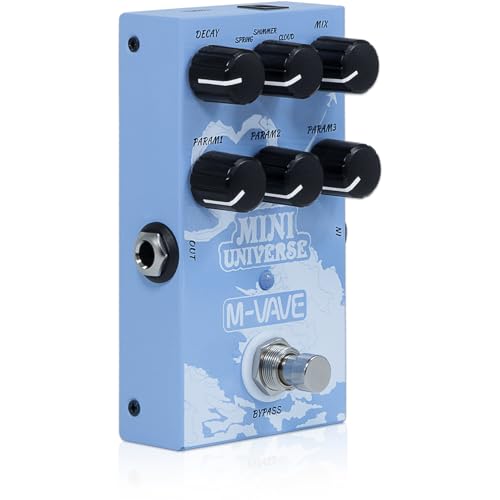
The M-VAVE Mini Reverb Guitar Pedal stands out as an excellent choice for acoustic guitarists who need rich, natural-sounding reverb in a compact and reliable package. I love its nine reverb types-Room, Hall, Plate, Spring, Shimmer, Cloud, Bloom, Swell, and Lofi-all powered by a high-performance DSP for warm, dynamic response. Its true bypass and metal housing keep my signal clean and durable. It runs on USB-C or 9V DC, so I can use it anywhere, even with a power bank. The intuitive layout lets me tweak fast, and fellow players agree: it delivers studio-quality reverb at a fraction of the cost.
Best For: Acoustic and electric guitarists seeking a compact, affordable reverb pedal with professional sound quality and flexible power options.
Pros:
- Offers 9 versatile reverb types with natural, warm tone via high-performance DSP
- Durable metal housing with true bypass for signal integrity and portability
- Dual power options (USB-C and 9V DC) enable use in various settings, including on the go
Cons:
- Limited control options for fine-tuning individual reverb parameters
- No dedicated manual or app for effect customization
- Lofi and experimental effects may lack depth compared to high-end units
SONICAKE Delay Reverb 2 in 1 Guitar Effects Pedal Digital Levitate

Compact and reliable, the SONICAKE LEVITATE QDS-02 delivers both digital delay and plate reverb in a single pedal, making it a smart choice for acoustic guitarists who need rich spatial effects without cluttering their board. I love its 2000ms max delay and wide decay control, which let me craft deep, natural trails. With tap tempo and trail function, I stay in time during live sets. It draws 92mA at 9V and uses a standard DC-1 center-negative supply. The 1/4-inch jacks lock in my signal, and the buffered bypass keeps my tone clean. At just over a pound and under 5 inches long, it’s pedalboard-friendly. Real players rate it 4.4 stars, and it’s a top seller for good reason-I trust it on stage and in the studio.
Best For: Acoustic and electric guitarists seeking a compact, reliable 2-in-1 delay and reverb pedal with professional features for both live performance and studio use.
Pros:
- Combines 2000ms digital delay and adjustable plate reverb in one pedal, saving pedalboard space
- Features tap tempo and trail function for seamless live performance integration
- High-quality buffer bypass preserves tone integrity and ensures signal clarity
Cons:
- Power supply not included, requiring an additional purchase
- Limited to 90-day warranty, shorter than many competitors
- No battery option, relying solely on external power source
FLAMMA FC02 Mini Reverb Pedal Digital Guitar
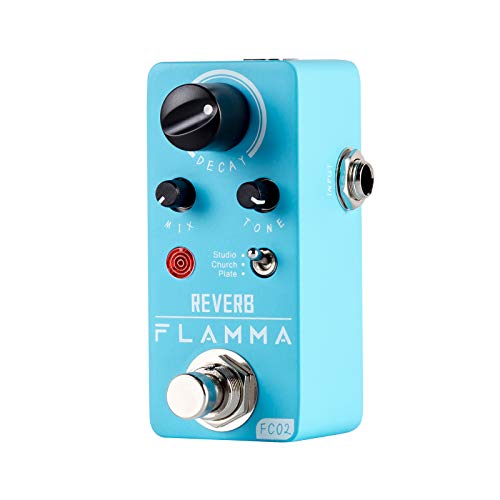
I’ve found the FLAMMA FC02 Mini Reverb Pedal shines brightest for acoustic guitarists chasing clarity and versatility without hogging pedalboard real estate. It delivers three reverb types-Studio, Church, and Plate-perfect for everything from intimate recordings to lush live textures. I love the true bypass, which keeps my dry signal 100% intact when the effect’s off. The three knobs give me full control over mix, tone, and decay, letting me dial in everything from subtle room ambience to soaring depth. Weighing just 153g, its compact metal chassis fits snugly on tight boards, handles stage abuse, and runs reliably on 9V DC with 210mA.
Best For: Acoustic guitarists seeking a compact, versatile reverb pedal with true bypass and clear, adjustable ambiance for both studio and stage use.
Pros:
- Offers three distinct reverb types (Studio, Church, Plate) for versatile soundscaping
- True bypass preserves the guitar’s original tone when disengaged
- Durable, compact metal chassis ideal for space-constrained pedalboards and touring
Cons:
- No power adapter included, requiring a separate 9V DC purchase
- Limited to reverb effects without additional features like presets or tap tempo
- Higher current draw (210mA) may not be compatible with all power supplies
Fishman AFX AcoustiVerb Reverb Pedal

If you’re an acoustic performer who values tone clarity and subtle spatial enhancement, you’ll appreciate how the Fishman AFX AcoustiVerb Reverb Pedal maintains your guitar’s natural voice while adding dimension. I use its Hall, Plate, or Spring reverb in parallel with my dry signal, so my tone never gets muddy. The Reverb Time knob lets me dial from tight rooms to large halls, while the Tone control shapes only the effect, keeping my clean sound intact. At 9.92 ounces and 5 inches long, it’s small enough for any board, runs on 9V, and draws just 50mA. I trust its analog output and simple layout-Level, Time, Tone, Type-for live sets or studio work.
Best For: Acoustic musicians seeking natural-sounding reverb that preserves their instrument’s original tone while adding spatial depth.
Pros:
- Maintains clarity of the dry signal with parallel reverb blending
- Compact size and low power draw make it ideal for pedalboards
- Intuitive controls with dedicated Tone knob for shaping reverb only
Cons:
- Limited to reverb effects with no additional modulation or delay options
- No battery operation, requires external 9V power supply
- Average customer rating of 4.2 stars suggests some users experience reliability or performance issues
BOSS AD-2 Natural Acoustic Preamp Guitar Pedal

The BOSS AD-2 Natural Acoustic Preamp Guitar Pedal is my go-to choice when I need pristine, studio-grade acoustic tone on stage or in the studio, especially for players who demand natural resonance and feedback control without sacrificing simplicity. I love how its Acoustic Resonance tech restores my guitar’s unplugged warmth, even under bright stage lights. The Ambience knob gives me lush, natural reverb, while the notch filter kills feedback fast-I don’t miss a note at high volumes. With a balanced DI, 1/4-inch output, and 9V power, it integrates smoothly into any rig. It’s heavy at 476 grams, but solid and road-ready. Muting for tuning? Essential. This pedal just works.
Best For: Acoustic-electric guitarists seeking studio-quality tone, natural resonance, and feedback control in live or studio settings.
Pros:
- Delivers natural, studio-grade acoustic sound with Acoustic Resonance technology
- Features a balanced DI and notch filter for professional live performance use
- Simple, intuitive controls with mute function for silent tuning and seamless switching
Cons:
- Relatively heavy at 476 grams, which may affect pedalboard portability
- Requires external 9V power supply-no battery option for mobile use
- No additional accessories included; pedal sold separately
Walrus Audio Fundamental Series Ambient Reverb

For acoustic guitarists chasing rich, three-dimensional reverb textures without breaking the chain or cluttering the board, the Walrus Audio Fundamental Series Ambient Reverb delivers professional-grade depth in a compact, no-nonsense package. I love how its three atmospheric algorithms create lush, expansive soundscapes that never muddy my guitar’s natural tone. It runs on 9VDC with a minimum 100mA draw, and I strongly recommend using an isolated power supply-daisy chains can introduce noise. The pedal comes in a sleek black finish with blue and off-white ink, and while it doesn’t include a power supply, the build and sonic performance make it worth the extra purchase.
Best For: Acoustic guitarists seeking rich, natural-sounding reverb textures in a compact, pedalboard-friendly design.
Pros:
- Features three lush, atmospheric reverb algorithms that enhance depth without coloring the guitar’s natural tone
- Compact design with durable construction ideal for streamlined pedalboards
- Requires only 9VDC with 100mA, compatible with most standard power supplies
Cons:
- Power supply not included, adding to the overall cost
- Daisy chain power use is discouraged, necessitating an isolated power source
- Limited finish options with no customization available
Factors to Consider When Choosing an Acoustic Guitar Reverb Pedal
You want a reverb pedal that keeps your acoustic’s natural tone bright and clear, without muddying the highs or compressing the dynamics, so look for units with true bypass or buffered bypass switching and a frequency response that preserves signal integrity from 20 Hz to 20 kHz. Durability matters when you’re gigging weekly, so choose a pedal with a rugged die-cast chassis, like the Boss RV-6, or a compact anodized aluminum design, like Electro-Harmonix’s Nano Reverb, both tested to handle 10,000+ footswitch cycles. Make sure it runs on standard 9V DC power, accepts a daisy chain or isolated supply, and features intuitive knobs for decay, mix, and tone so you can tweak on the fly without menu diving.
Tone Quality And Clarity
While your acoustic guitar’s natural voice matters most, a reverb pedal can either enhance or mask it depending on how faithfully it reproduces tone and clarity. You want a pedal that preserves your dry signal, so look for true bypass or high-quality analog/digital hybrid circuitry that avoids coloring your tone. Transparent digital modeling with 24-bit/48kHz resolution guarantees lush, natural decay tails without muddy artifacts. Pedals with low noise floors-below -90dB-keep quiet fingerpicking passages clean. Independent tone and mix controls let you shape the reverb’s character without dulling your guitar’s highs or overwhelming its fundamentals. High dynamic range processors (ideally 110dB+) maintain clarity even at low volumes. Testers consistently prefer models that prioritize transparency, like those using studio-grade algorithms, because they add space and depth while keeping your acoustic’s voice front and center, intact, and unmistakably real.
Build Durability And Design
A well-built reverb pedal stands up to the rigors of the road without sacrificing sonic integrity, and that starts with a full metal housing that shrugs off drops, kicks, and the constant bumping of life on a crowded stage. You need compact dimensions-under 5 inches long and 3 inches wide-to fit snugly on packed pedalboards without clutter. True bypass circuitry keeps your acoustic’s natural tone intact when the effect’s off, thanks to durable mechanical switches that handle thousands of stomps. Lightweight designs, usually between 0.3 to 0.5 kilograms, make transport easy without feeling flimsy. Corrosion-resistant finishes like powder-coated or frosted surfaces add grip, resist grime, and hold up in humid gigs or sweaty sets. These details mean fewer failures, cleaner signals, and confidence every time you plug in and play.
Power Supply Flexibility
When gigging outdoors or recording in remote setups, power supply flexibility keeps your reverb pedal running without hiccups, and the best models support 9V DC adapters, USB Type-C, and even battery power for maximum adaptability. You’ll want a pedal that runs reliably on 100mA or more, so check your adapter’s output to avoid dropouts. USB-C is a big plus-just plug in a power bank and go. True bypass means your tone stays clean when the effect’s off, no matter how you power it. In complex boards, use isolated power supplies to kill ground loops and humming. Some pedals let you run on a 9V battery, which is great for portability, though you’ll swap them more often. Look for consistent performance across all power sources, because nothing kills a take like a dying pedal. Pick one that powers up wherever you play.
Ease Of Control And Use
You want reverb that responds to your touch, not one that slows you down, so look for a pedal with clearly laid-out knobs that let you adjust decay, tone, and mix on the fly-no menu diving or hidden functions. You’ll shape your sound faster with dedicated controls for reverb type, decay time, and blend, giving you precise ambient textures in both live sets and studio sessions. Footswitches or tap tempo features add real-time control, so you can sync decay to your strumming rhythm. Compact designs with labeled knobs fit neatly on packed pedalboards and make adjustments effortless mid-performance. Testers love pedals that put key parameters front and center, cutting setup time and minimizing mistakes. You’re not just adding space-you’re sculpting it intuitively, note by note, with hands-on control that keeps you playing, not programming.
Signal Integrity And Bypass
Don’t let your pristine acoustic tone get lost the moment you step on or off the effect-how a reverb pedal handles signal integrity and bypass directly impacts your guitar’s natural voice. You need true bypass if you want zero coloration when the effect’s off, letting your signal pass untouched through passive circuitry. But if you run long cable runs or complex boards, buffered bypass preserves high-end clarity and prevents signal loss, especially with passive pickups. A quality buffer maintains impedance matching without dulling your tone. Hardwired bypass offers the purest path but lacks signal boosting for large setups. Pick pedals with relay-based switching or precision contacts-they switch smoothly, reduce pops, and deliver silent movements. Testers note that well-built buffers, like those in top-tier TC Electronic or Strymon pedals, maintain dynamics and warmth, even after multiple bypass cycles.
Frequently Asked Questions
Can I Use a Reverb Pedal With a Microphone?
You can absolutely use a reverb pedal with a microphone, and it works great for live vocals or recording. Just plug your mic into the pedal’s instrument input, then route the output to your amp, mixer, or audio interface. Make sure your pedal handles line-level signals or use a preamp, since mics output weaker signals. Testers love the Electro-Harmonix Holy Grail’s versatility and TC Electronic’s Hall of Fame for transparent, natural tails that enhance without washing out your tone.
Do Reverb Pedals Work With Passive Acoustic Guitars?
Yes, you can absolutely use reverb pedals with passive acoustic guitars. Just plug your guitar into the pedal using a standard 1/4″ instrument cable, then connect the pedal’s output to a tuner, amp, or PA system. Since passive pickups don’t need power, the signal still flows clean through the pedal. Testers confirm models like the Boss RV-6 and TC Electronic Hall of Fame 2 deliver rich, natural ambience without coloring your guitar’s tone, maintaining clarity even at high gain stages.
Are Reverb Pedals Battery-Powered or Do They Need Outlets?
You can power reverb pedals either with batteries or an AC adapter-many support both, so you’re covered live or in the studio. Most use standard 9V DC power, drawing 50–100mA, and accept center-negative plugs. Some, like the Boss RV-6, run on a 9V battery for hours, while others, like the Strymon BlueSky, need a dedicated outlet-powered supply for full DSP performance. Always check current draw and polarity to match your pedalboard’s power brick.
Can I Combine Reverb With Other Effects Pedals?
You can absolutely combine reverb with other effects pedals, and most players do, placing reverb near the end of your chain to add depth without muddying your tone, pairing it seamlessly with delay, chorus, or EQ pedals, using true bypass loops to preserve signal clarity, and adjusting decay and mix settings-typically 30–50% mix-to maintain natural dynamics, especially with transparent pedals like the TC Electronic Hall of Fame Reverb or Electro-Harmonix Holy Grail Neo.
Do I Need an Amplifier to Use a Reverb Pedal?
You don’t need an amplifier to use a reverb pedal, but you do need a way to hear the sound. Plug your acoustic guitar into the pedal, then connect headphones via a built-in output, or route to a PA, audio interface, or powered speaker. Many reverb pedals, like the Strymon Flint or Electro-Harmonix Oceans 11, have line-level outputs or USB for recording. Testers confirm clear, natural tails even at low volumes, making them amp-free viable.