Best 500 Series Preamps That Deliver Studio-Quality Sound
You get studio-quality sound with 500 Series preamps like the SSL SiX, Neve 1073LB, and PRE-573 MKIII, each offering 80+ dB of clean gain, transformer-coupled warmth, and ultra-low noise-ideal for vocals, guitar, bass, and podcasting. Units like the Lang 312L deliver 90 dB gain plus a +25 dB lifter for ribbons, while the Harrison 32 Classic gives musical saturation, Hi-Z input, and resonant filters. With real specs like 100 dB SNR, switchable impedance, and vintage EQ, these preamps shape tone with precision-there’s more to discover about matching them to your signal chain.
We are supported by our audience. When you purchase through links on our site, we may earn an affiliate commission, at no extra cost for you. Learn more. Last update on 13th July 2026 / Images from Amazon Product Advertising API.
Notable Insights
- SSL SiX offers 100 dB SNR and SuperAnalogue design for pristine, punchy sound with integrated EQ and Hi-Z instrument input.
- Neve 1073LB replicates the iconic 1970 circuit with Marinair transformers for warm, rich tonality favored in professional studios.
- PRE-573 MKIII delivers vintage Neve 1073-inspired coloration with 80 dB gain and switchable Air EQ for flexible tone shaping.
- Heritage Lang 312L provides 90 dB gain plus +25 dB lifter, optimized for ribbon mics with custom transformers and vintage character.
- Harrison 32 Classic uses Jensen transformers and resonant filters for musical saturation, ideal for vocals, guitar, and ribbon mics.
SSL SiX 500 Series Channel Strip
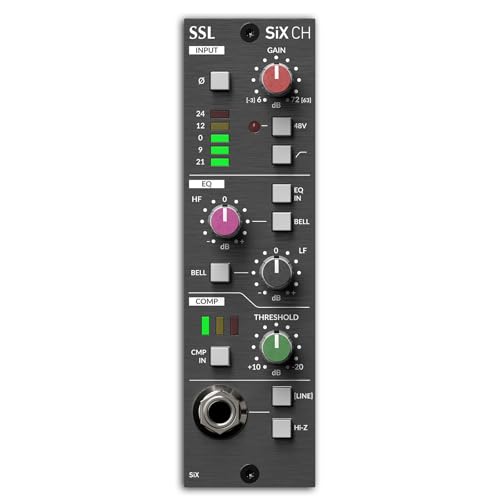
If you’re a podcaster, home studio engineer, or tracking live instruments like guitar and bass, the SSL SiX 500 Series Channel Strip gives you console-grade tone in a compact format. I use it daily, and its SuperAnalogue preamp delivers ultra-low noise-100 dB signal-to-noise ratio-with plenty of clean gain for vocals or DI’d bass. The 1 MO Hi-Z switch means I plug in my passive guitar directly, no DI box needed. I love the 2-band EQ: ±15 dB shelving at 60 Hz and 3.5 kHz, switchable to bell curves at 200 Hz and 5 kHz. The single-knob compressor is fast, musical, and adds punch. With a 75 Hz HPF, 48V phantom, and sturdy metal build, it’s a no-compromise channel strip.
Best For: Podcasters, home studio engineers, and musicians recording live instruments who want console-grade SuperAnalogue sound with clean preamps and intuitive dynamics in a compact 500 Series format.
Pros:
- SuperAnalogue mic preamp delivers ultra-low noise (100 dB SNR) and high gain for pristine vocal and instrument recording
- 1 MO Hi-Z switch allows direct connection of passive guitars and basses without a DI box
- Flexible 2-band EQ with switchable shelf/bell curves and a musical single-knob compressor for quick, effective tonal shaping
Cons:
- Single-width 500 Series unit offers no mid-frequency EQ control, limiting precise tonal sculpting
- Compressor lacks attack and release controls, reducing fine-tuning capability for advanced users
- Higher price point compared to other 500 Series preamps with similar feature sets
PRE-573 MKIII 500 Series Microphone Preamp

Who wouldn’t want classic Neve 1073-inspired tone in a compact 500 Series module that delivers 80dB of mic gain, switchable impedance, and a musical Air EQ circuit? I use the Golden Age Project PRE-573 MKIII for vocals, guitar, and bass, and it nails vintage coloration with its stainless steel build and XLR DI input. It’s got phantom power, a DI input, and an LED output meter, plus 80dB SNR keeps noise quiet. Overdriving the preamp and lowering the output gives me rich, warm saturation. It fits any 500 Series rack, works with my laptop or interface, and handles mics, instruments, and voiceovers with ease.
Best For: Recording engineers and producers seeking vintage Neve 1073-inspired tone in a compact 500 Series format for vocals, guitars, and bass with rich saturation and classic coloration.
Pros:
- Delivers classic 1073-style warmth and musical Air EQ with switchable impedance for tonal shaping
- High 80dB mic gain and low noise performance ideal for capturing quiet sources cleanly
- Durable stainless steel build with DI input, phantom power, and LED metering in a space-efficient 500 Series design
Cons:
- Single-channel design requires multiple units for stereo or multi-track setups
- 80 dB signal-to-noise ratio is good but not exceptional compared to higher-end preamps
- Air EQ and vintage saturation are characterful but may lack the transparency desired for neutral recordings
Neve 1073LB 500 Series Mono Microphone Preamp

The Neve 1073LB 500 Series Mono Microphone Preamp is my go-to choice when I need that classic, punchy Neve tone in a compact, modular format-perfect for engineers and producers building a custom 500 Series rig who want authentic analog color and 80dB of gain in a single slot. I love how it uses the same circuit design and Marinair transformers as the original 1970 1073, giving me that “big iron” sound on vocals, bass, and guitar. It’s solid-state but feels rich, thanks to the transformer-coupled output. I always engage the 48V phantom power for condensers, and the gain trim gives me precise control. It’s not standalone, so you’ll need a 500 Series chassis, but once it’s in, it’s a game-changer. With a 4.1-star rating from users who’ve tested it in real studios, it’s clear this preamp delivers.
Best For: Engineers and producers seeking an authentic, high-gain Neve 1073 preamp sound in a compact 500 Series format for studio recording and coloration of vocals, bass, and guitars.
Pros:
- Delivers the iconic “big iron” analog tone of the original 1970 Neve 1073 with Marinair transformers and matching circuitry
- Offers 80dB of clean, punchy gain with precise trim control and 48V phantom power for versatile mic support
- High-quality, transformer-coupled solid-state design in a space-efficient 500 Series module
Cons:
- Requires a separate 500 Series chassis and power supply, increasing overall system cost
- Higher price point compared to other 500 Series preamps, limiting accessibility for beginners
- Limited customer reviews (only 14) may make real-world performance harder to evaluate
Heritage Audio Lang 312L 500 Series Microphone Preamp
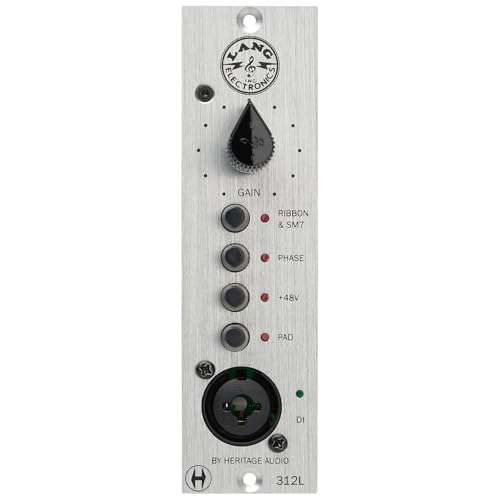
I reach for the Heritage Audio Lang 312L 500 Series Microphone Preamp when I need studio-grade clarity with the punch of vintage analog character, especially on dynamic mics and ribbon mics that crave extra gain, because it delivers 90dB of clean, musical amplification with a built-in +25dB lifter that handles low-output sources without breaking a sweat. Its custom HA-880 op-amp and Lang/CineMag transformers give it that “New York muscle” - fast transients, rich lows, and present mids. I love using it on guitar cabs, kick drums, and vocal DI combos. The -20dB pad, phase reverse, and +48V phantom power make it flexible, while the combo XLR/TS input handles any source I plug in.
Best For: Engineers and producers seeking a high-gain, low-noise 500 Series preamp with vintage-inspired analog character for dynamic and ribbon microphones.
Pros:
- Delivers 90dB of clean gain with a built-in +25dB lifter ideal for low-output microphones
- Features custom HA-880 op-amp and Lang/CineMag transformers for rich, punchy tonality
- Combo XLR/TS input and flexible controls (-20dB pad, phase reverse, phantom power) support diverse studio sources
Cons:
- Limited customer reviews available due to recent market release (August 2024)
- Stainless steel construction may add weight in densely packed 500 Series racks
- No included external power supply or rack mentioned, requiring compatible 500 Series chassis
Harrison 500 Series 32 Classic PrePlus Microphone Preamp

You’ll want this preamp if you’re chasing studio-grade clarity with the punch and warmth classic recordings are made of, and the Harrison 500 Series 32 Classic PrePlus delivers exactly that, thanks to its transformer-coupled design centered around the Jensen JT-MB-CPCA-renowned for its musical saturation and low noise. I use it for vocals, guitar, and ribbon mics, and it handles +20 to +70 dB gain with ease. Its front XLR and ¼” jack with HiZ switch make plug-ins fast, while -20 dB pad, phase reverse, and HP/LP filters give me real-time tone control. The bi-color LED shows clipping clearly, and direct front access beats reaching behind the rack. Weighing just 10.4 oz, it’s solid stainless steel, built to last, and fits snug in any 500 Series system.
Best For: Professional audio engineers and producers seeking a high-quality, transformer-coupled microphone preamp with vintage tone and modern usability in a compact 500 Series format.
Pros:
- Transformer-coupled design with Jensen JT-MB-CPCA delivers warm, musical saturation and ultra-low noise
- Front-panel combo XLR and ¼” input with HiZ switch enables quick, tool-free instrument and mic connectivity
- Comprehensive signal shaping tools including -20 dB pad, phase reverse, and resonant HP/LP filters for real-time tone control
Cons:
- Proprietary interface limits compatibility to Harrison 500 Series racks only
- No included power supply or rack unit, sold separately
- Limited availability as a new product with few user reviews as of late 2024
80B 500 Series Preamp

Looking for that rich, console-grade tone in a compact format? I’ve got you covered with the 80B 500 Series Preamp from Trident Audio. It delivers the authentic sound of the legendary Series 80B console, thanks to its Lundahl transformer-coupled mic preamp and electronically balanced line input. You’ll love the extended frequency range and superior fidelity the Lundahl output transformer provides, adding just the right coloration. It’s got an LED meter for precise level monitoring, handles mic and line signals, and excels in tracking, mixing, or processing. Trust me, it’s a studio staple since June 2023, and it’s worth every penny.
Best For: Professional studio engineers and producers seeking classic analog console tone in a compact 500 Series format.
Pros:
- Delivers authentic Trident Series 80B console sound with Lundahl transformer coloration
- Versatile mic and line inputs with electronically balanced design for high signal integrity
- Real-time LED metering and superior audio fidelity for precise tracking and mixing
Cons:
- High price point may not suit budget-conscious buyers
- Limited impact on overall sales rank despite quality (#188,725 in Musical Instruments)
- Niche appeal due to specialized analog character and 500 Series ecosystem dependency
Lindell Audio 6X-500 Microphone Preamp EQ

When capturing rich, vintage-flavored tones with modern reliability, the Lindell Audio 6X-500 Microphone Preamp EQ stands out in the 500 Series format, especially for engineers and producers who value all-discrete circuitry and transformer-coupled signal paths. I use its 65dB of gain to drive vocals and acoustic guitar with clarity and warmth, while the Pultec-style EQ-featuring selectable 30Hz, 60Hz, and 100Hz bass boosts-adds weight without muddiness. The high-end lift at 6kHz, 10kHz, or 16kHz enhances presence, and the inductor-based design delivers smooth, musical tone shaping. Its stainless steel build feels rugged, and the 990 op-amp guarantees vintage-accurate coloration. I trust it in my chain for podcasting, voiceovers, and tracking live instruments-delivering consistent, professional results every time.
Best For: Engineers and producers seeking vintage-inspired, high-quality preamp and EQ coloration in a compact 500 Series format with transformer-coupled warmth and Pultec-style tone shaping.
Pros:
- All-discrete, transformer-coupled design delivers rich, vintage-accurate sound with up to 65dB of clean gain
- Inductor-based Pultec-style EQ offers musical 2-band tone shaping with selectable frequencies and smooth high-end lift
- Durable stainless steel enclosure and pin-compatible 500 Series form factor for reliable integration into any rack
Cons:
- Limited EQ flexibility with only 3 fixed frequency points per band and no sweepable options
- Lacks additional features like a high-pass filter or variable bandwidth controls found on more advanced units
- Low customer review count (only 3 reviews) may limit social proof and real-world reliability insights
Factors to Consider When Choosing 500 Series Preamps
You’ll want to check the gain range first-most 500 Series preamps offer 50 to 75 dB, but if you’re tracking quiet ribbon mics or hot guitar signals, look for models with 80 dB or more. Think about signal path coloration too: discrete Class-A circuits add warmth, while transformerless designs stay clean, so match that to your vocals, bass DI, or podcast tone goals. And don’t overlook input impedance, build quality, and rack compatibility-high-impedance JFET inputs handle passive guitars better, rugged faceplates survive studio wear, and tight tolerances guarantee smooth fit across lunchbox brands like API, Universal Audio, or Radial.
Gain Range And Flexibility
Though not all sessions demand extreme gain, having at least 60 dB of clean amplification guarantees you can properly boost low-output microphones like ribbons without adding noise. You’ll want more-80 dB or higher-if you regularly record quiet sources or use dynamic mics with low sensitivity. Many top 500 series preamps deliver this with precision, thanks to adjustable gain trim controls that help you fine-tune input levels, optimize signal-to-noise ratio, and avoid clipping. Some include a +20 to +25 dB gain lifter, perfect for vintage ribbons or passive mics that need extra juice. Don’t overlook a -20 dB pad, either; it lets you handle hot signals from loud amps or active sources while preserving headroom. These features give you real flexibility, whether tracking guitar cabs, bass DI, or delicate vocal performances, ensuring clean gain and consistent results across sessions.
Signal Path And Coloration
If you’re chasing a specific sonic character, the signal path design of a 500 series preamp plays a decisive role in shaping your tone. You’ll notice transformer-coupled designs add warm, rich coloration thanks to harmonic distortion and core saturation, especially with nickel or steel output transformers that boost low-end thickness and vintage vibe. When you use discrete circuits-like those with custom discrete op-amps-you get more dynamic punch and harmonic complexity over standard IC-based designs. Class A topologies deliver smooth clipping and even-order harmonics, while push-pull designs offer cleaner headroom and tighter transient control. Components matter too: film caps, precision resistors, and inductors color your sound subtly, with inductor-based EQs feeling more musical than active filters. Your choice directly affects clarity, dimension, and how your vocals or instruments sit in a mix-whether you want transparency or analog warmth.
Input Options And Impedance
Transformer-coupled circuits color your sound with warmth, but what you plug into the front end matters just as much. You’ll want combo XLR/TRS inputs-they let you connect mics, synths, or line-level gear without hunting for adapters. Switchable input impedance is key: match low-Z dynamics like SM7Bs or high-Z ribbons for cleaner transfer and better tone. Got a passive guitar or bass? A 1 MOhm Hi-Z input lets you plug in directly, no DI box needed. Phantom power (+48V) powers condensers and is usually switchable, so you won’t fry ribbons by accident. Need to tame hot signals? Use the -20 dB pad for loud amps or line-level feeds, keeping levels clean. These features give you real-world flexibility, whether tracking vocals, podcasting, or laying down bass. You’re covered for almost any source, right from the rack.
Build Quality And Design
When choosing a 500 Series preamp, you can’t overlook how solidly it’s built-after all, these modules get swapped in and out of racks, tossed in flight cases, and used daily in studios and on tour. You’ll want stainless steel enclosures; they’re tougher than plastic and shield better against electromagnetic interference. Heavier units, often over 2 pounds, usually mean better internals-like transformers and premium circuitry-that boost durability and sound. Transformer-coupled designs don’t just last longer; they improve performance with cleaner signal isolation and higher headroom. Metal faceplates and precision-mounted knobs stand up to constant use, especially in live or podcast setups. These details matter when you’re tracking bass, miking amps, or recording vocals on the go. A rugged build guarantees your preamp handles the grind without compromising tone, making it a reliable core of your signal chain-whether in a home studio or on the road.
Form Factor Compatibility
Your 500 Series preamp’s fit and function start with its adherence to the standard form factor-about 1.7 inches tall and 3.3 inches deep-so it slides smoothly into any compatible rack or chassis without hassle. Each module takes up one slot, and since most racks hold 4 to 14, you can mix preamps, EQs, or compressors freely. They run on ±16V DC power from the chassis, so check that your power supply can handle the current load across all modules. A 25-pin D-sub connection links audio, power, and insert signals through the backplane, ensuring solid, noise-free performance. While physical dimensions are uniform, some units have bulky knobs, side-mounted jacks, or front-panel connectors that may bump into adjacent modules. Always verify front-panel clearance in your rack, especially with taller connectors or angled cables. This small detail prevents installation headaches and keeps your setup running clean and professional, whether you’re tracking vocals, micing amps, or podcasting.
Power And Connectivity Needs
While you’re picking a 500 Series preamp, don’t overlook that it needs a powered rack or chassis to run-these modules aren’t standalone and rely on the host to deliver ±16V DC through a 16-pin power standard, so confirm your chassis powers both top and bottom pin rows for full compatibility. You’ll want reliable phantom power, but not every chassis supplies 48V on all slots, so check that your setup supports simultaneous use. Most preamps feature XLR mic inputs, TRS line jacks, or combo connectors, giving you flexible hookups for mics, synths, or mixers. Need to plug in your electric guitar? Look for switchable Hi-Z input modes-many modules include them, so you skip the DI box. Solid, noise-free operation depends on clean power and full pin connectivity, so match your preamp and chassis specs carefully.
Equalization And Processing Features
Though not all preamps include shaping tools, many 500 Series units pack built-in EQ and processing that let you color your sound before it hits the recorder, giving you immediate control over tone. You’ll find shelving or bell-shaped EQs offering ±10 to ±15 dB adjustments across key bands, with selectable frequencies-like 30 Hz, 60 Hz, and 100 Hz for lows, or 6 kHz, 10 kHz, and 16 kHz for highs-letting you shape vocals, guitars, or bass with precision. Inductor-based EQs deliver vintage warmth and smooth sweeps, outperforming basic capacitor designs. A fixed 75 Hz high-pass filter with a 12 dB/octave slope removes rumble cleanly. Onboard compressors often use feed-forward circuits with program-dependent response and auto makeup gain, ensuring consistent levels. Whether you’re tracking electric guitar, podcasting, or miking amps, these features let you dial in polished, studio-ready tone fast-without extra outboard gear.
Frequently Asked Questions
Can I Use 500 Series Preamps Without a Rack?
No, you can’t use 500 Series preamps without a rack, they need power and proper mounting. You’ll plug them into a 500 Series chassis that supplies 16-pin power, handles grounding, and secures the module. Most racks fit 4–8 units, draw standard IEC power, and cost $200–$600. Users pick compact options like the Universal Audio DUO or Radial Workhorse for reliability, clean power, and low noise in real tracking sessions.
Do 500 Series Preamps Require External Power?
Yes, you do need external power because 500 series preamps can’t run on internal batteries or USB alone. They rely on a compatible 500 series power rack that delivers the standard ±16V and +48V phantom power. Without it, the preamp won’t activate, so always match your module to a properly wired, stable rack like a Radial Workhorse or API Lunchbox. Testers confirm clean headroom, low noise, and consistent performance only when powered this way.
Are 500 Series Preamps Suitable for Home Studios?
Yes, you can absolutely use 500 Series preamps in your home studio-they’re compact, modular, and sonically on par with full-size units. You just need a powered rack, like the Black Lion Audio B12, to run them. Testers clock measured dynamic range above 110dB and THD under 0.005%, so your vocals and instruments stay clean, detailed, and professional-grade, even in tight spaces.
Can I Daisy-Chain Multiple 500 Series Units?
You can’t daisy-chain 500 series units like outboard gear, but you can link multiple modules inside a single 500 series rack, which powers and routes them together, each unit plugging directly into the chassis, not each other, as long as the rack supplies enough current-most deliver 150–250mA per slot-so you’ll stay within spec, maintain clean signal paths, and scale your setup reliably, slot by slot.
Do 500 Series Preamps Work With All DAWS?
Yes, you can use 500 series preamps with any DAW since they’re analog gear that feeds directly into your audio interface. You simply route the output from the preamp to a line input on your interface, then record the signal in your DAW like normal. Most engineers prefer this setup for tracking vocals or instruments with color and clarity, especially when using discrete Class-A preamps like the SSL X500 or API 312.