Understanding Class A vs Class AB Amplification in Guitar Amps
You get warm, even-order harmonics and soft compression in Class A amps like the Fender Champ, where tubes conduct 360 degrees, run hot, and wear faster at 25% efficiency. Class AB, like your Marshall Plexi or Fender Twin, uses push-pull design, hits 60% efficiency, delivers tighter bass, more headroom, and cleaner tone at volume. It runs cooler, splits the signal with a phase inverter, and handles high wattage better. You’re likely playing Class AB more than you think. Find out which amps really fall into each camp.
We are supported by our audience. When you purchase through links on our site, we may earn an affiliate commission, at no extra cost for you. Learn more. Last update on 19th July 2026 / Images from Amazon Product Advertising API.
Notable Insights
- Class A amplifiers conduct the full waveform cycle, keeping tubes constantly on for warm, even-order harmonic distortion.
- Class AB uses push-pull design with tubes conducting over 180 but less than 360 degrees for greater efficiency.
- Class A runs at 25% efficiency with high heat and shorter tube life due to constant current flow.
- Class AB reaches up to 60% efficiency, delivering tighter bass, higher headroom, and cleaner output at high volumes.
- True Class A amps include single-ended designs like the Fender Champ; many “Class A” labeled amps are actually Class AB.
What “Class A” and “Class AB” Really Mean
While you might’ve heard “Class A” thrown around like a badge of tonal honor, it actually refers to a specific way tubes handle the signal, and it’s not just marketing speak. In amplifier classes, Class A means the output tubes conduct the full 360 degrees of the waveform, staying on constantly-eliminating crossover distortion but running hot and inefficient (just 25%). In contrast, Class AB uses a push-pull design where tubes alternate, each conducting over 180 but less than 360 degrees, boosting efficiency to 60% and enabling higher wattage. Class AB amps need a phase inverter to split the signal; true Class A designs, like the Vox AC4, don’t. While Class A delivers smooth, even-order harmonics, Class AB-found in Marshalls and Twins-offers tighter bass, more headroom, and longer tube life, making it the go-to for 50+ watt rigs.
How Class A Amps Work: Constant Tube Conduction
You’re already familiar with the basic distinction between Class A and Class AB operation, so let’s take a closer look at how Class A amps actually function-starting with their most defining trait: constant tube conduction. In a Class A amplifier, the output stage keeps current flowing through the tube 100% of the time, meaning the tube never cuts off, even with no input signal. This constant operation guarantees smooth waveform reproduction and eliminates crossover distortion. Class A amps, like the Fender Champ or Vox AC4, typically use cathode biasing and often run a single tube or parallel single-ended designs. Because the tube is always conducting at maximum, heat builds quickly-efficiency is only around 25%. That constant thermal stress also means shorter tube life compared to other types. Still, many players love Class A for its warm, natural compression and consistent harmonic response straight from the output stage.
How Class AB Amps Work: Push-Pull Efficiency
When you need more volume and headroom without draining your tubes or overheating your cabinet, Class AB amps deliver by pairing a push-pull output stage with smart efficiency. In a Class AB amplifier, the phase inverter splits the signal into two antiphase waves, driving each output tube in turn. One tube handles the positive half, the other the negative, with a slight overlap in the conduction cycle to prevent crossover distortion. This push-pull design means each tube conducts more than 50% but less than 100% of the cycle, boosting power efficiency up to 60%-far better than Class A’s 25%. You get higher output, like a 100-watt Marshall using four EL34s with two active at once, plus cooler operation, longer tube life, and less stress on the power transformer.
How Each Class Shapes Your Tone
Class A and Class AB amplifiers don’t just differ in efficiency-they shape your tone in fundamentally different ways, and once you’ve played both, the distinction hits you fast. In a Class A amp like the Vox AC30, both output tubes conduct the full waveform, delivering rich, even-order harmonic distortion and a warm, singing tone. Single-ended Class A designs, such as the Fender Champ, use just one tube, giving you soft compression, minimal negative feedback, and a grainy, open overdrive. Class AB amps, like the Marshall JTM45, run in push-pull mode-each tube handles more than half the cycle-yielding tighter bass, higher headroom, and a punchier tone. They use fixed bias and negative feedback for increased clarity and cleaner output at volume. You’ll get less harmonic distortion but sharper attack and focus. So if you want lush, vintage color, go Class A; for definition and cut, Class AB delivers.
The Playing Feel of Class A vs. Class AB
Though they deliver power in different ways, the real magic of Class A and Class AB amps reveals itself under your fingers the moment you pick a note. You’ll notice Class A amps feel more alive, thanks to continuous tube conduction and single-ended designs that boost touch sensitivity. The playing feel is immediate, with zero lag and smooth compression that responds to volume knob tweaks and picking dynamics. Think Fender Champ-every nuance transfers effortlessly. In contrast, Class AB amps like the Marshall JTM45 have a tighter, punchier response due to push-pull efficiency and higher headroom, but exhibit slight crossover delay. This makes their playing feel less organic, though more precise for high-gain rhythms. You’ll feel the difference in your right hand-Class A breathes with you, while Class AB demands control.
Debunking Class A Marketing Myths
What if the “Class A” tag on your favorite amp isn’t telling the whole story? You’ve probably heard Class A praised as tonally superior, but that’s one of the biggest marketing myths in tube amp design. Class A vs Class AB isn’t about quality-it’s how amps function. True Class A Tube Amps, like the Fender Champ or Vox AC4, run output tubes at full power, conducting 100% of the waveform. But many amps labeled “Class A,” including the Marshall JTM45, Fender Twin Reverb, and Dumble Overdrive Special, actually run in Class AB. They’re more efficient and can deliver cleaner headroom. Don’t let associations with “Grade-A” fool you-Class AB isn’t inferior. In fact, some of the most sought-after tones come from Class AB. Your ears don’t lie; play before you judge.
Class A or AB? The Truth Behind Famous Amps
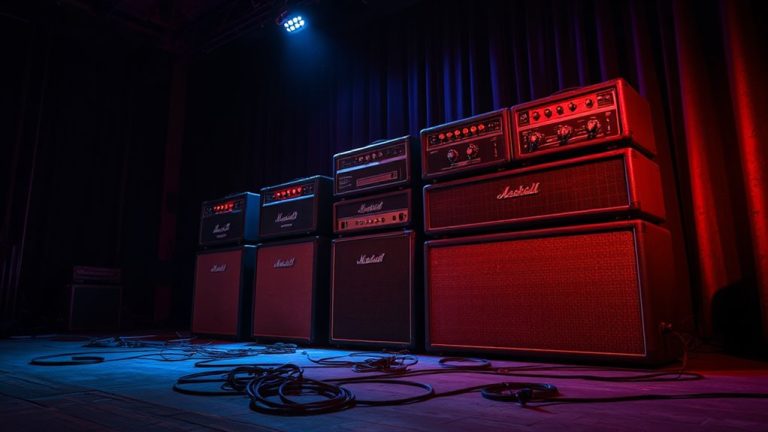
You might think your favorite legendary amp runs in Class A, but the truth is, most don’t-icons like the Fender Tweed Bassman, Blackface Twin Reverb, and Marshall Plexi all operate in Class AB, using push-pull output stages with two or more tubes sharing the waveform in alternating phases, typically biased to conduct just over 180 degrees with slight overlap to eliminate crossover distortion, resulting in tighter bass response, higher efficiency, and more headroom than true Class A designs can deliver, especially at higher wattages like the Marshall’s 100-watt configuration. Real Class A amps like the Vox AC4 and Fender Champ use single-ended output tube designs with cathode biasing, creating warm, rich harmonics but less power. Even the Dumble, Mesa/Boogie Mark I, and Soldano SLO are Class AB, favoring precision and punch. Don’t trust the marketing-check the circuit.
On a final note
You’re choosing feel as much as tone when picking between Class A and Class AB amps. Class A, like the Vox AC30, runs hotter, with smooth, even harmonics and 15–30 watts of rich, compressed response. Class AB, like the Fender Twin Reverb, delivers tighter lows, faster transient response, and 85–100 watts of clean headroom. Real players notice how Class A breaks up earlier and sustains longer, while Class AB handles pedals and dynamics with precision.