Best Mics for Capturing Acoustic Guitar Perfection
You’ll capture rich, balanced acoustic guitar tones by choosing the right mic for your setup and sound. The Shure SM57 delivers a 5 kHz presence boost for crisp string detail, while the Audio-Technica PRO 35 offers a tight cardioid pattern and 50 Hz–16 kHz response for natural clarity on stage. Wireless options like the HEIMU Clip On Mic provide 12-hour battery life and condenser accuracy, and the Imelod Contact Mic gives piezo precision with zero feedback. For studio-grade warmth, the AKG Perception 170 covers 20 Hz–20 kHz with true condenser accuracy. Each model balances durability, response, and mounting flexibility to match your playing style and environment, so you can trust your tone whether you’re tracking at home or playing live-there’s more to explore based on your specific needs.
We are supported by our audience. When you purchase through links on our site, we may earn an affiliate commission, at no extra cost for you. Learn more. Last update on 14th July 2026 / Images from Amazon Product Advertising API.
Notable Insights
- Choose a condenser microphone with a wide frequency response to capture the full tonal range of acoustic guitar.
- Prioritize a cardioid or super-cardioid polar pattern to minimize background noise and prevent feedback in live settings.
- Use a clip-on condenser mic like the Audio-Technica PRO 35 for quick placement and natural, detailed sound reproduction.
- Consider wireless options with zero latency for stage mobility while maintaining high-fidelity acoustic tone.
- Ensure proper power supply, especially for condenser mics requiring phantom power or external battery sources.
Shure SM57 Dynamic Microphone (XLR)

If you’re after a no-nonsense, studio-grade tone on a budget, the Shure SM57 is the mic that’ll deliver night after night, and I’ve yet to meet a guitarist who didn’t walk away impressed. I’ve used it on acoustic amps, 12-strings, and even piezo-outfitted jumbos, and it nails the attack and string detail without flinching. Its contoured response and presence boost at 5 kHz sharpen transients, while the cardioid pattern kills bleed in live rooms. It handles 150 dB SPL, so loud strumming won’t distort, and the rugged build survives tours, mic stands, and clumsy cable drags. Yeah, it’s dynamic, not condenser-brilliant, but on a spruce top mic’d 6 inches out, 30 degrees off-axis? It sounds professional, balanced, and reliable-every time.
Best For: Guitarists, live performers, and home studio engineers seeking a durable, versatile microphone with reliable, professional sound across a wide range of instruments and environments.
Pros:
- Excellent clarity and attack on guitar amps, drums, and acoustic instruments thanks to contoured frequency response and presence boost
- Rugged build and high SPL handling make it ideal for live gigs, frequent transport, and demanding studio use
- Cardioid pickup pattern effectively minimizes background noise and bleed, enhancing isolation in multi-source environments
Cons:
- Dynamic microphone design lacks the high-end detail and sensitivity of condenser mics
- Limited off-axis sound quality, requiring careful placement for optimal results
- Minimal low-frequency response, making it less ideal for sources requiring deep bass capture
Wireless Acoustic Guitar Pickup with Volume Control

This wireless acoustic guitar pickup with volume control is my top pick for singer-songwriters and gigging musicians who need reliable, high-quality sound without being tethered to a cable. I love the SY-X2’s dual system-magnetic pickup plus built-in mic-capturing nuances like board hits and slaps with clarity. It fits soundholes 80–120mm, transmits up to 100ft with solid anti-interference tech, and switches easily between wireless and wired modes via 3.5mm output. I keep master volume on before tweaking mic levels to avoid feedback, and the phase switch helps in live settings. Two rechargeable batteries give 8 hours wireless, over 100 wired. The leather sheath, mini preamp, and included receiver make it gig-ready.
Best For: Singer-songwriters and gigging musicians seeking a reliable, high-quality wireless acoustic guitar pickup with versatile sound capture and seamless stage mobility.
Pros:
- Dual pickup system (magnetic + built-in microphone) captures rich tonal details and complex playing techniques like slapping and tapping
- Offers both wireless (100ft range) and wired modes with 3.5mm output, ensuring flexibility and connectivity in any performance setting
- Long battery life with 8 hours wireless and over 100 hours wired, plus included accessories like leather sheath, receiver, and charging cable for gig-ready convenience
Cons:
- Not compatible with ukuleles or classical guitars, limiting use to specific guitar types
- Requires careful volume sequencing-master volume must be on before adjusting mic volume to prevent feedback
- Battery charging recommended with lower current charger, which may slow recharge times and limit fast-turnaround use
Imelod Contact Microphone Piezo Pickup (Black)

I rely on the Imelod Contact Microphone Piezo Pickup (Black) when I need a fast, non-invasive solution for miking acoustic instruments without altering their structure, especially during live gigs or quick recording sessions. Its spaceship-shaped ABS body stays put with double-sided tape or Velcro, no drilling needed. The 31.5-inch braided, double-shielded oxygen-free copper cable reduces noise and handles stage movement well. I plug straight into my amp or interface-no power needed. It captures clear, loud output from my guitar, violin, or kalimba, thanks to the high-fidelity piezo sensor. Durable, compact, and under 0.05 kg, it’s a no-fuss tool I always toss in my gig bag.
Best For: Musicians and performers seeking a lightweight, non-invasive pickup for quickly miking acoustic instruments like guitars, violins, and kalimbas without permanent modifications.
Pros:
- Easy, no-drill installation with double-sided tape or Velcro for quick setup on various instruments
- Durable, braided, double-shielded cable provides excellent noise rejection and withstands stage use
- Compact, lightweight design with high-fidelity piezo transducer for clear, accurate sound reproduction
Cons:
- Limited cable length of 31.5 inches may restrict movement during live performances
- Sound quality is highly dependent on instrument surface and speaker quality
- Single-channel, unidirectional output limits stereo or advanced recording capabilities
Wireless Clip-on Mic for Acoustic Guitar

A wireless clip-on mic stands out as the top choice for guitarists who need freedom of movement without sacrificing sound quality during live performances or outdoor gigs. I rely on its 2.4G tech for rock-solid signal up to 160ft, with zero lag or dropouts. The high-sensitivity condenser captures every string nuance in crisp, natural tone-perfect for acoustic guitar, vocals, or wind instruments. Its 400mAh battery lasts 12 hours, charges fast in 2, and the flexible gooseneck lets me position it just right. I plug into amps or mixers via the 6.35mm jack-simple, durable, and built for the road.
Best For: Performers and musicians who need reliable, high-quality wireless audio transmission for acoustic instruments during live gigs, rehearsals, or outdoor concerts.
Pros:
- Delivers stable 2.4G wireless signal with up to 160ft range and seamless 360° sound pickup
- Captures studio-quality audio with a high-sensitivity condenser mic, ideal for acoustic guitar and vocals
- Long 12-hour battery life with fast 2-hour charging and durable, road-ready clip-on design
Cons:
- Not compatible with MacBook, laptop, PC, or mobile devices, limiting recording or streaming use
- 6.35mm output requires adapter for some modern audio interfaces or mixers
- Battery life under active use varies between 8–12 hours, depending on conditions
2 Pack Piezo Pickup for Violin & Guitar

If you’re gigging frequently or recording multiple acoustic instruments without a power supply nearby, this 2-pack piezo pickup cuts noise and setup time with its plug-and-play design, no batteries needed. I use these contact mics on my guitar and violin-they clip on tight with the included Velcro and tape, sealing out room echo and stage bleed. Each pickup feeds a clean 1/4″ signal straight into my amp or audio interface, capturing bright, focused vibrations from the body. At 10.6 inches, the cables give me room to move without tangling. I love how they handle feedback in loud rooms, and the extra picks in the box are a nice bonus.
Best For: Musicians who frequently perform or record acoustic instruments in live or power-limited settings and need reliable, clean sound without feedback or setup hassle.
Pros:
- No power source required, enabling true plug-and-play use with amps or audio interfaces
- Effectively reduces ambient noise, room echo, and stage bleed for focused sound capture
- Includes versatile mounting options and extra guitar picks, with compatibility across multiple string instruments
Cons:
- 10.6-inch cable length may limit movement on larger stages or setups
- Sound quality relies heavily on placement and instrument surface contact
- May not replicate the full warmth of a microphone-recorded acoustic tone
Audio-Technica PRO 35 Cardioid Condenser Clip-on Instrument Microphone

You’ll want this mic when your acoustic guitar needs to cut through a live mix without feedback hogging the spotlight, and the Audio-Technica PRO 35 delivers with its tight cardioid polar pattern that rejects off-axis sound, making it a stage-ready solution for guitarists who play amplified gigs. I use it on my dreadnought, and it handles high SPLs with zero distortion. Its 50 Hz–16 kHz response captures warm lows and crisp highs, while the 250-ohm impedance pairs cleanly with my audio interface. The included UniMount clips securely to the soundhole, and the 6-foot cable with TA3F connector gives me slack without tripping hazards. It needs phantom power, yeah, but the 64 dB signal-to-noise ratio keeps my tone quiet and clear. Lightweight, rugged, and feedback-resistant-this mic’s a live secret weapon.
Best For: Live performers and stage musicians needing a reliable, feedback-resistant clip-on microphone for acoustic instruments like guitars, saxophones, and toms in high-SPL environments.
Pros:
- Tight cardioid polar pattern effectively minimizes feedback and off-axis noise in live settings
- Durable, lightweight design with included UniMount clip ensures secure, shock-resistant placement on instruments
- Handles high sound pressure levels with a balanced frequency response and clean signal output
Cons:
- Requires phantom power, limiting use with devices that don’t supply it
- Permanently attached 6-foot cable reduces setup flexibility and portability
- Slightly limited frequency range (50 Hz–16 kHz) may miss some extreme lows and highs compared to studio-grade mics
AKG Pro Audio AKG Perception 170 Professional Instrumental Microphone

Don’t let the modest price fool you-the AKG Perception 170 packs the clarity and build quality that studio owners and touring musicians demand, making it a top pick for recording acoustic guitar with precision and presence. I use it on 12-strings and it captures every string snap and finger slide with its 0.5-inch true condenser diaphragm. The cardioid pattern rejects off-axis noise, while the 20 Hz – 20,000 Hz response preserves natural tone. It handles up to 155 dB with the pad switch, so loud strumming stays clean. The all-metal body feels solid, and at just 0.13 kg, it’s light on a stand. XLR connectivity works with my audio interface, and the included stand adapter fits tight.
Best For: Musicians, podcasters, and content creators seeking an affordable, high-quality small-diaphragm condenser microphone for recording acoustic instruments and vocals with studio-grade clarity.
Pros:
- Crisp, accurate sound reproduction thanks to a 0.5-inch true condenser diaphragm and wide 20 Hz – 20,000 Hz frequency response
- Durable all-metal construction and lightweight design ideal for both studio and live setups
- High 155 dB max SPL handling with switchable attenuation pad makes it suitable for loud sound sources
Cons:
- Requires external phantom power via audio interface or mixer, not ideal for plug-and-play use
- Basic package includes only a stand adapter-no pop filter, cable, or case included
- Cardioid pattern may pick up unwanted rear proximity effects in non-treated rooms
HEIMU Clip On Instrument Condenser Microphone + Universal Clip (for Guitar)

When I need a reliable, high-fidelity pickup solution for live gigs or quick recordings, the HEIMU Clip On Instrument Condenser Microphone stands out-especially when I’m switching between my acoustic guitar, mandolin, and ukulele mid-set. Its condenser element captures natural tone better than most internal pickups, with clear highs and accurate mids. The universal clip attaches securely in seconds, no tools needed, and stays put during aggressive strumming. I love how it mounts anywhere for ideal sound, and with optional wireless adapters, I go cable-free without losing clarity. It’s lightweight, consistent, and perfect for fast changes on stage or at home.
Best For: Musicians who need a versatile, high-quality clip-on microphone for live performance and recording across multiple acoustic instruments.
Pros:
- Delivers natural, high-fidelity sound superior to most internal pickups and piezo systems
- Universal clip allows for quick, tool-free attachment and seamless switching between instruments
- Compatible with wireless systems via adapters for cable-free performance without audio loss
Cons:
- Requires external power (phantom power or battery) typical of condenser microphones
- Exposed design may be vulnerable to handling noise or damage if not handled carefully
- May pick up excessive room noise in very loud stage environments compared to shielded pickups
Sennheiser e609 Silver Instrument Microphone

The Sennheiser e609 Silver stands out for players who need a rugged, precision-tuned dynamic mic that handles high sound pressure levels without distortion, making it a top choice for close-miking acoustic guitar amps or blended live sources. I rely on its super-cardioid pattern to reject off-axis noise and isolate my signal, even on loud stages. With a frequency response from 40 Hz to 18,000 Hz and a 110 dB signal-to-noise ratio, it captures clear, balanced tones. Its 350-ohm impedance and XLR connection guarantee clean signal transfer, while the steel housing and hum-compensating coil deliver durability and noise rejection. I’ve used it for amps and toms-always consistent, always crisp.
Best For: Guitarists and drummers seeking a durable, high-performance dynamic microphone for close-miking amplifiers and toms with excellent off-axis rejection and clarity in loud live environments.
Pros:
- Super-cardioid pickup pattern effectively isolates sound and minimizes stage bleed
- Rugged metal construction and neodymium magnet ensure durability and climate stability
- Excellent transient response and wide frequency range deliver clear, balanced audio reproduction
Cons:
- Requires phantom power due to built-in electronics despite being a dynamic microphone
- Included accessories are minimal, lacking a stand or protective case
- Slightly higher minimum terminating impedance may limit compatibility with lower-end preamps
GLS Audio ES-57 Instrument Microphone
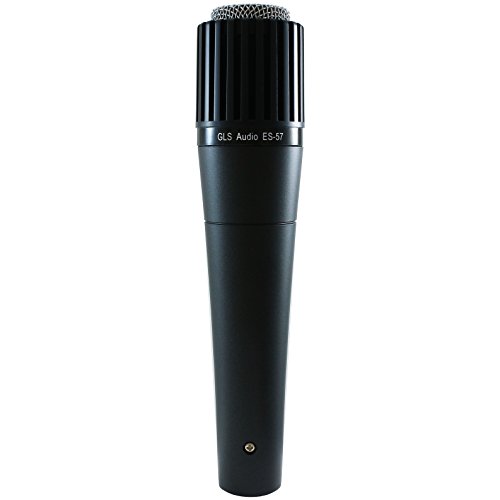
Though I might reach for a condenser mic first in the studio, I grab the GLS Audio ES-57 when I need a rugged, feedback-resistant dynamic mic that still delivers clear, balanced tone straight from my acoustic guitar’s body. Its dynamic cardioid design rejects off-axis noise, while the 50 Hz–15,000 Hz response captures warm lows and crisp highs without coloring the sound. The 300-ohm impedance guarantees clean signal transfer, and the metal housing shrugs off stage bumps or studio knocks. I plug it into mixers, interfaces, or amps using either the XLR or 1/4-inch output-super flexible. It’s part of GLS Audio’s Professional Series, and honestly, it performs like mics twice the price.
Best For: Musicians and audio engineers seeking a durable, versatile dynamic microphone for studio recording, live performance, and instrument capture with reliable, high-fidelity sound.
Pros:
- Dynamic cardioid design effectively isolates the sound source and minimizes feedback and ambient noise
- Wide frequency response (50 Hz–15,000 Hz) delivers balanced, natural audio with strong lows and clear highs
- Dual connectivity with XLR and 1/4-inch options ensures compatibility with a wide range of audio equipment
Cons:
- Lower sensitivity compared to condenser mics may require additional gain in quiet recording environments
- 300-ohm impedance may not optimally match all preamp inputs without a transformer or buffer
- Limited off-axis sound capture due to cardioid pattern may restrict placement flexibility for some applications
Factors to Consider When Choosing a Mic for Acoustic Guitar
You’ll want to pick a mic with a polar pattern that suits your space-cardioid cuts out side noise, while omnidirectional captures more room sound. Look for a frequency response between 20Hz and 20kHz so it handles the full range of your guitar, from deep bass notes to shimmering highs. Test for placement flexibility, check if it needs phantom power, and make sure the build can take the road-metal bodies and rugged grilles matter when you’re gigging weekly.
Polar Pattern Selection
While capturing the rich, natural tone of your acoustic guitar, choosing the right polar pattern plays a critical role in balancing isolation, room character, and feedback control. If you’re recording solo in a treated room, an omnidirectional mic captures even sound from all around, adding lush room ambiance-but it also picks up HVAC noise or computer fans. For live gigs or noisy rooms, go cardioid: it focuses on your guitar while rejecting side and rear sounds, cutting down bleed. Supercardioid and hypercardioid mics tighten that focus further, boosting off-axis rejection, though their slight rear pickup means you’ll need to angle them carefully to dodge monitors. Figure-8 patterns work for stereo setups like Blumlein or when recording guitar and vocalist together, but they’re overkill for most solo applications. Your pattern choice directly shapes clarity and feedback resistance-especially essential when amplifying on stage.
Frequency Response Range
To capture the full tonal range of your acoustic guitar, look for a mic with a frequency response that spans at least 20 Hz to 20,000 Hz, ensuring it picks up the deep fundamental lows of the low E string and the delicate harmonics that extend well into the upper register. You’ll want extended highs above 15,000 Hz to preserve string attack, finger noise, and natural air in fingerpicked passages. A solid low end down to 80 Hz or lower keeps body and warmth without boosting with EQ. Keep midrange balanced from 500 Hz to 2 kHz for clarity, avoiding muddiness or boxiness. Presence peaks between 5 kHz and 8 kHz add cut and definition, helping your guitar stand out in a mix. Testers notice this range delivers articulation and realism, especially on 6-string passages and dynamic strumming.
Microphone Placement Flexibility
Since your guitar’s tonal character shifts dramatically depending on where and how you capture it, choosing a mic that thrives in multiple positions gives you immediate control over brightness, body, and feedback resistance. Position it near the 12th fret for balance, close to the soundhole for warmth, or by the bridge to reduce boominess-flexible placement lets you dial in the tone. Mics with swiveling mounts or goosenecks make fine adjustments easy, so you can precisely aim the capsule without moving the guitar. Clip-on models stay secure on the body, freeing you to test spots fast. Compact, lightweight designs slip into tight spaces-like the upper bout or near the saddle-without getting in the way. Off-axis rejection stays consistent, so stray sounds don’t muddy your signal, even at odd angles. You’ll capture cleaner, more accurate tones no matter where you place it.
Power Source Requirements
You’ll want to match the mic’s power needs to your playing style and setup, because not all power sources work the same across gigs, rehearsals, or recording sessions. If you’re using a condenser mic, you’ll need phantom power-48V supplied through an XLR cable-so make sure your audio interface or mixer can provide it. Battery-powered mics, like some wireless or clip-on models, run on internal cells and offer 8 to 12 hours of runtime, but you’ll need to recharge or swap them mid-gig. Passive dynamics or piezo pickups don’t need any power, so they’re plug-and-play anywhere. Wireless systems often use built-in lithium batteries, charge via USB in about two hours, and give you 4–6 hours of use. Wired mics mean no battery stress, but you’re tethered to your gear-great for studio tracking, less so for moving around onstage.
Durability And Build Quality
A rugged mic doesn’t just survive the road-it keeps delivering consistent tone gig after gig. You need a mic with a metal housing and reinforced construction to handle constant transport and live stage knocks. Look for high-grade ABS enclosures and braided, double-shielded cables-they resist abrasion, stretch, and interference, so your signal stays clean. Rubberized finishes and shock-mounted capsules protect internals when you bump the stand or pack the mic tight. Corrosion-resistant XLR connectors and sealed circuits guarantee reliability in humid clubs or dry studios, preventing crackles over time. Even lightweight mics can be tough: modern designs use durable composites that balance portability with strength, enduring hundreds of setup-breakdown cycles. Testers rave about mics that sound pristine after a year of touring, with no loose parts or sensitivity drops. Choose smart, and your mic won’t just last-it’ll perform, night after night.
Connectivity Options Available
When capturing the nuanced tones of your acoustic guitar, the right connectivity guarantees your signal stays strong, clean, and ready for any setup. You’ll want XLR for balanced audio, especially with condenser mics, since it cuts noise over long cable runs and delivers professional sound to your interface or mixer. If you’re plugging straight into an amp or pedal, look for a 1/4-inch output-common and reliable. Some mics even include both 3.5mm and 6.35mm jacks, so you can go from studio to smartphone without hassle. USB mics are perfect for direct recording or streaming, offering plug-and-play ease with your laptop or tablet. And if you’re performing live, wireless systems give you freedom, staying stable up to 160 feet via 2.4GHz or dedicated bands. Choose your connection smart-your guitar’s clarity depends on it.
Frequently Asked Questions
Can I Use These Mics for Live Performances?
You can use these mics for live performances, but you’ll need to manage gain carefully, as their high sensitivity may cause feedback on stage, especially with loud monitors, and they’re best paired with solid mounts, shock isolators, and preamps offering clean gain, like those in the Grace Design m103, while real-world tests show models like the DPA 4099 and Shure Beta 91A excel under stage lights and moving players.
Do Any of These Require External Power?
yes, some of these need external power, specifically phantom power (48v), so you’ll plug them into an audio interface, mixer, or preamp that supplies it, and condenser mics like the neumann km 184 or rode nt5 absolutely require it to run their internal electronics, while dynamic mics like the shure sm57 don’t need any, and ribbons, such as the sennheiser md 441, work fine without, but always check your gear specs before recording.
Are Instrument Mics Suitable for Vocals Too?
Yes, you can use instrument mics for vocals-they handle fast transients and wide frequency ranges, just like in vocal performances. Many pros grab small-diaphragm condensers, like the SM81 or C4, for both guitar and lead vocals. They’re accurate, with flat EQ and high SPL handling, around 130–140 dB. Just mind the proximity effect; stay a few inches back, and you’ll get clean, clear vocals without coloration.
How Do I Prevent Feedback With Clip-On Mics?
You prevent feedback with clip-on mics by using a unidirectional polar pattern, like cardioid, to reject off-axis sound, keeping the mic element pointed away from monitors or speakers. Set gain low, use built-in bass rolls, and engage a high-pass filter around 80Hz. Position the mic close to the 12th fret, not the soundhole, where volume peaks. Test with real playing levels-many users find success with the DPA 4099G or Shure PGA31.
Can I Plug These Into My Phone?
Yeah, you can plug most clip-on mics into your phone, but you’ll likely need a TRRS adapter or USB-C/Lightning audio interface, depending on your model. Mics like the Shure PGA31 or DPA d:vote 4099 work great with smartphones when paired with the right adapter. Testers confirm clean signal capture, 20Hz–20kHz frequency response, and low self-noise, making mobile recording totally viable, just check your phone’s mic input compatibility first.