Best Sony APS-C Lenses That Elevate Your Photography Game
You’ll get sharp images, smooth autofocus, and strong low-light performance with the Tamron 17-70mm f/2.8, thanks to its constant aperture, VC stabilization, and 9-blade diaphragm. The Sony 16-55mm F2.8 G delivers crisp detail with XD Linear Motors, while the VILTROX 25mm F1.7 offers fast focus, Nano Crystal Coating, and STM quietness. Lightweight reach? Try Tamron’s 18-300mm or 70-300mm. Go wider with Sony’s 11mm F1.8 or creative fisheye with TTArtisan’s 7.5mm. There’s a lens here to match your style, and each one opens up new ways to capture what matters.
We are supported by our audience. When you purchase through links on our site, we may earn an affiliate commission, at no extra cost for you. Learn more. Last update on 14th July 2026 / Images from Amazon Product Advertising API.
Notable Insights
- Tamron 17-70mm f/2.8 offers a versatile zoom range, constant f/2.8 aperture, and built-in stabilization for sharp, low-light performance.
- Sony 11mm F1.8 delivers ultra-wide perspective with excellent low-light capability, ideal for immersive landscapes and interior photography.
- VILTROX 25mm F1.7 provides a fast prime option with smooth bokeh and minimal focus breathing, great for portraits and video.
- Tamron 18-300mm f/3.5–6.3 covers ultra-wide to super-telephoto in one lens, perfect for travel and dynamic shooting scenarios.
- Sony 16-55mm F2.8 G ensures pro-grade sharpness and fast autofocus, ideal for photographers demanding high-resolution results.
Tamron 17-70mm f/2.8 Lens for Sony E

If you’re shooting on a Sony APS-C mirrorless camera and want one lens that handles everything from street scenes to portraits with speed and sharpness, the Tamron 17-70mm f/2.8 Di III-A VC RXD is the best choice. I use it daily on my A6400, and it delivers crisp 4K video, thanks to VC stabilization and AI-assisted tracking. It’s lightweight at just 1.2 pounds, with a 4.1x zoom range (25.5–105mm full-frame equivalent), f/2.8 across the board, and a 9-blade diaphragm for smooth bokeh. The optics include three aspherical elements, reducing distortion, while BBAR and fluorine coatings cut glare and repel smudges. I can focus as close as 7.5 inches at 17mm, perfect for detail shots. It’s moisture-resistant, supports Eye AF, and has a 67mm filter thread. I’ve recorded in light rain without issues, and autofocus stays quiet and accurate, even in dim light. Backed by a six-year U.S. warranty, this lens covers all my needs-wide, tele, stills, video-without compromise.
Best For: Photographers and videographers using Sony APS-C mirrorless cameras who need a versatile, fast-aperture zoom lens for everyday shooting, from wide-angle scenes to portraits.
Pros:
- Constant f/2.8 aperture throughout the 17-70mm zoom range enables excellent low-light performance and consistent exposure in video
- Integrated VC optical stabilization and AI-assisted tracking deliver sharp 4K video and reliable autofocus, even in challenging conditions
- Compact, lightweight design with moisture-resistant construction, fluorine coating, and 67mm filter thread for durability and portability
Cons:
- Designed only for APS-C sensors, so not compatible with full-frame Sony E-mount cameras in native mode
- Minimum focus distance increases significantly at the telephoto end (15.4 inches), limiting close-up capability when zoomed in
- Slightly higher price point compared to slower-aperture APS-C zoom lenses with similar focal ranges
Sony SEL1655G Alpha 16-55mm F2.8 G Standard Zoom APS-C Lens
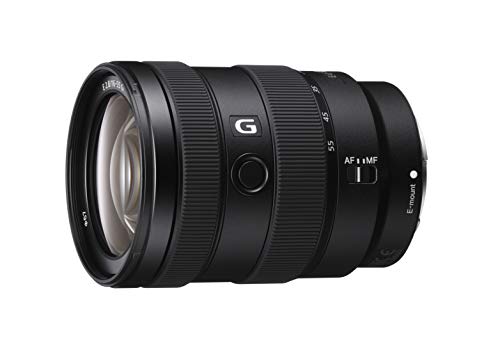
I rely on the Sony SEL1655G Alpha 16-55mm F2.8 G Standard Zoom APS-C Lens when I need a versatile, high-performing workhorse for both stills and video on my APS-C setup, and its constant F2.8 aperture delivers consistent exposure and smooth background blur across the 16-55mm range (24-82.5mm full-frame equivalent). I love its sharp optics-thanks to four aspherical elements-and the 9-blade aperture that gives me creamy bokeh. The XD Linear Motor keeps autofocus fast, quiet, and accurate, perfect for vlogging or run-and-gun shooting. At just 1.68 pounds, it’s light but solid, with weather-resistant build and a built-in hood. I use it for everything: interviews, music docs, and live shots, and it handles 4K video with zero focus breathing.
Best For: Photographers and videographers seeking a lightweight, weather-resistant, constant-aperture zoom lens optimized for Sony APS-C cameras for both professional stills and 4K video work.
Pros:
- Constant F2.8 aperture ensures consistent exposure and pleasing bokeh throughout the zoom range
- Sharp image quality with minimal distortion, enhanced by four aspherical elements and optimized lens coating
- Fast, quiet autofocus via XD Linear Motor, ideal for video and continuous shooting up to 11 FPS
Cons:
- Limited to APS-C format, lacking full-frame compatibility for future camera upgrades
- No optical image stabilization, relying solely on in-body stabilization from the camera
- Higher price point compared to other APS-C zoom lenses with similar focal ranges
VILTROX 25mm F1.7 E Mount Lens for Sony

The VILTROX 25mm F1.7 E Mount Lens is a standout choice for Sony APS-C shooters who want a lightweight, sharp prime lens with a fast aperture for low-light recording, shallow depth-of-field control, and clean video capture. I use it on my a6600 and FX30, and it delivers crisp detail thanks to its 2 HR, 1 ED, and 2 ASPH elements plus Nano Crystal Coating. The f/1.7 aperture stays wide open in dim scenes, while the 9-blade diaphragm gives buttery bokeh. Autofocus is quick and quiet with STM, and focus breathing is minimal-great for video. At just 170 grams and 52mm filter size, it’s compact, portable, and real-world tested to perform. It’s my go-to for interviews, vlogs, and street shooting.
Best For: Sony APS-C and full-frame mirrorless users seeking a lightweight, fast-aperture prime lens ideal for low-light shooting, video work, and content creation.
Pros:
- Excellent optical performance with HR, ED, and aspherical elements plus Nano Crystal Coating for sharp, aberration-free images
- STM autofocus is fast, accurate, and nearly silent, with minimal focus breathing ideal for video
- Compact, lightweight design (170g) with USB-C firmware updates and 9-blade diaphragm for smooth bokeh
Cons:
- No built-in image stabilization, relying on camera-based stabilization
- Minimum focusing distance of 0.3m may limit close-up capabilities
- Limited weather sealing, making it less suitable for harsh environments
Tamron 70-300mm f/4.5-6.3 E-Mount Lens

A lightweight telephoto workhorse, the Tamron 70-300mm f/4.5-6.3 Di III RXD delivers serious reach without weighing down your kit, making it my go-to choice when I need portability and performance for wildlife, sports, or distant details on Sony APS-C mirrorless bodies. At just 19.2 ounces and 5.8 inches long, it’s easy to carry all day. The RXD motor focuses quickly and quietly, great for video and action shots. With a 105–450mm equivalent field of view, I’ve captured sharp, detailed images even at full zoom. The BBAR coating reduces flare, and the 7-blade diaphragm creates smooth, pleasing bokeh. It’s moisture-resistant, has a 6-year warranty, and focuses as close as 59.1 inches at 300mm-perfect for tight telephoto framing.
Best For: Photographers seeking a lightweight, portable telephoto zoom lens for Sony mirrorless cameras, ideal for wildlife, sports, and travel photography on full-frame and APS-C systems.
Pros:
- Lightweight and compact design (19.2 oz, 5.8 in) for easy handheld and mobile shooting
- RXD autofocus system delivers fast, precise, and quiet performance, perfect for both stills and 4K video
- Moisture-resistant construction and 6-year USA warranty enhance durability and long-term value
Cons:
- No built-in image stabilization, relying on camera-based stabilization for sharp handheld shots
- Variable maximum aperture (f/4.5–6.3) limits low-light performance at longer focal lengths
- Lacks a built-in lens hood and timer function, requiring manual attachment and limiting certain shooting scenarios
Tamron 18-300mm Lens for Sony E
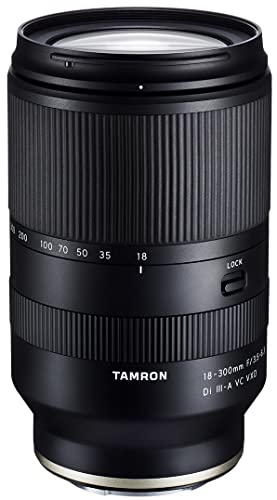
Need a do-it-all lens that keeps up with your fast-moving life? I rely on the Tamron 18-300mm F/3.5-6.3 Di III-A VC VXD for Sony E-mount APS-C cameras when I need one lens to handle everything, and it delivers. It’s the world’s first 16.6x all-in-one zoom, spanning wide-angle 18mm to telephoto 300mm in a compact 4.9 x 2.9-inch body that weighs just 21.9 ounces. The VXD linear motor guarantees fast, precise autofocus, while VC image stabilization smooths handheld shots. I appreciate the moisture-resistant build and fluorine coating in tough conditions, and sharpness stays strong corner to corner across the zoom range.
Best For: Travel and hybrid shooters who want a single lightweight zoom lens covering wide-angle to super-telephoto focal lengths on Sony E-mount APS-C mirrorless cameras.
Pros:
- Unmatched 18-300mm (16.6x) zoom range ideal for landscapes, portraits, and distant subjects
- VXD linear motor delivers fast, quiet, and precise autofocus for both photos and video
- Compact, moisture-resistant design with fluorine coating enhances durability and portability
Cons:
- Variable aperture (f/3.5–6.3) limits low-light performance at longer focal lengths
- Image quality, while good, may soften slightly at the edges when zoomed in fully
- No weather sealing at the lens mount may be a concern in extreme conditions
Sony E 11mm F1.8 APS-C Ultra-Wide-Angle Prime for Cameras, Black

When you’re shooting vlogs or cinematic video on an APS-C Sony body and need that immersive, near-distortion-free wide look without lugging around a bulky lens, the Sony E 11mm F1.8 steps in as the best choice, combining a uniquely wide 11mm field of view with a bright F1.8 aperture in a compact, E-mount design. I use it for tight indoor shots and it captures everything-no arm’s-length contortions needed. The F1.8 aperture delivers smooth bokeh and strong low-light performance, while internal focusing keeps the lens length constant. Linear motors nail fast, silent autofocus, great for moving subjects. It minimizes focus breathing, and with compatible cameras, breathing compensation makes focus shifts nearly invisible in video-perfect for pro-looking results without extra gear.
Best For: Vloggers, indie filmmakers, and travel photographers using APS-C Sony E-mount cameras who need a compact, high-performance ultra-wide lens with excellent video-centric features.
Pros:
- Bright F1.8 aperture delivers shallow depth of field, beautiful bokeh, and strong low-light performance
- Compact, lightweight design with constant lens length due to internal focusing, ideal for handheld and gimbal use
- Minimal focus breathing and linear motors enable smooth, fast, and quiet autofocus perfect for video and stills
Cons:
- APS-C only coverage limits ultra-wide field of view on full-frame cameras
- No built-in image stabilization, relying on camera body stabilization for steady handheld video
- Higher price point compared to other third-party ultra-wide APS-C lenses
Sony E PZ 18-105mm f/4.0 G OSS Lens for Sony E

If you’re an APS-C shooter who values smooth, cinema-grade zoom control without the bulk, the Sony E PZ 18-105mm f/4.0 G OSS is my go-to lens for hybrid work-especially when I’m switching between stills and video on my Sony a6xxx series body. Its constant f/4 aperture, 18–105mm range (27–158mm full-frame equivalent), and Power Zoom deliver precise, wobble-free framing. Dual ED and three aspherical elements, including Advanced Aspherical, keep images sharp with minimal aberration. Nano AR coating slashes flare, while OSS stabilization smooths handheld shots. Autofocus is fast, quiet, thanks to linear motors, and the 7-blade iris gives buttery bokeh. At 427g, it’s light, though not weather-sealed-perfect for run-and-gun.
Best For: Hybrid photographers and videographers using Sony E-mount APS-C cameras who need a compact, versatile zoom with smooth power zoom and reliable image stabilization.
Pros:
- Constant f/4 aperture and 18–105mm range (27–158mm equivalent) offer excellent versatility for both stills and video
- Power Zoom with linear autofocus motors ensures smooth, quiet, and precise focus and zoom control ideal for video
- Compact, lightweight design (427g) with fixed lens barrel and non-rotating filter thread for easy use with filters and hoods
Cons:
- Not weather-sealed, limiting use in harsh or wet environments
- Maximum aperture of f/4 is less ideal in low-light compared to faster lenses
- Power Zoom mechanism may feel less responsive or manual-like compared to traditional zoom rings
TTArtisan 7.5mm F2.0 Fisheye Lens for Sony E Mount

The TTArtisan 7.5mm F2.0 Fisheye Lens is my go-to pick if you shoot creative, wide-angle visuals on a Sony APS-C camera like the A6000 or A6400 and want dramatic 180-degree views without breaking the bank. I love its f/2.0 aperture-it pulls in light well, handles low-light scenes smoothly, and keeps subjects centered with strong sharpness. It’s manual focus, yeah, but that’s expected at this price, and the 7-blade diaphragm gives pleasing bokeh. I use it for street shots, wild landscapes, and environmental portraits where distortion adds punch. It’s small, light, and built to deliver contrast and color without fuss. Forty-five stars from 54 users? That’s real-world proof it works.
Best For: Creative photographers using Sony APS-C cameras who want an affordable, ultra-wide fisheye look with strong low-light performance and dramatic 180-degree distortion.
Pros:
- Delivers a true 180-degree angle of view with pronounced fisheye effect ideal for artistic and dynamic compositions
- Fast f/2.0 aperture enhances low-light shooting and provides pleasing bokeh with its 7-blade diaphragm
- Compact, lightweight design with sharp center focus and good contrast, highly rated with 4.5 stars from users
Cons:
- Manual focus only, which can be challenging for fast-moving subjects or beginners
- Fisheye distortion may be too extreme for traditional or architectural photography
- Not water resistant and lacks electronic communication for autofocus and image stabilization
Factors to Consider When Choosing Lenses for Sony APS-C
You’ll want to match the lens’s focal length range to your shooting style, whether you’re capturing wide-angle landscapes at 10mm or pulling in tighter shots at 50mm, just like selecting the right pickup configuration for tone shaping. A wider maximum aperture, like f/1.8 or f/2.0, lets in more light and gives you that creamy bokeh, much like a tube amp’s natural compression smooths out your signal without coloring it too much. Don’t overlook features like optical image stabilization, a fast linear autofocus motor, and whether the barrel has dust and moisture sealing-these guarantee your lens keeps up with real-world use, just like a rugged DI box handles noisy stages and long sessions.
Focal Length Range
While chasing the perfect shot with your Sony APS-C camera, keeping an eye on focal length range guarantees you’re always ready for the scene in front of you. You’ll love how wide-angle lenses, like 11mm (16.5mm full-frame equivalent), capture sweeping landscapes and cramped interiors with expansive depth. Need reach? Telephoto lengths, such as 300mm (450mm equivalent), pull distant wildlife or athletes sharply into frame. Zooms like the 18–300mm give you flexibility without swapping lenses. Remember, APS-C’s 1.5x crop factor changes your effective field of view-what’s 18mm becomes 27mm. Use wide settings under 24mm equivalent for architecture, or go past 70mm equivalent to compress portraits and isolate subjects. Choose your range based on what you shoot most, and you’ll always shoot smarter.
Maximum Aperture Size
Don’t stop at focal length-your lens’s maximum aperture size plays a key role in how well it performs when light gets tight or you need to separate your subject from the background. A wide f/1.8 or f/1.7 aperture lets in more light than f/4, enabling faster shutter speeds and stronger background blur, perfect for portraits. Lenses with a constant f/2.8 aperture maintain exposure and sharpness across all focal lengths, giving you consistent results when zooming. Wider apertures also boost autofocus speed and accuracy, especially in dim settings. Avoid variable apertures like f/4.5–6.3-they limit light at longer reaches, forcing higher ISOs or slower shots. Testers find constant apertures more reliable for tracking moving subjects, delivering smoother focus shifts. Look for prime lenses when you need maximum light capture and creamy bokeh, or zooms with fixed f/2.8 for flexible, high-performance shooting in real-world conditions.
Image Stabilization Feature
When shooting in dim light or recording handheld video, image stabilization becomes a critical tool for maintaining sharpness and smooth motion, especially with Sony APS-C cameras that benefit from coordinated lens and body stabilization systems. You’ll get sharper images at slower shutter speeds, with some lenses offering up to 4.5 stops of compensation. Optical stabilization counters camera shake, while advanced systems sync with in-body stabilization for five-axis correction. For video, this means noticeably smoother footage, even while walking. Certain lenses use AI-assisted stabilization to predict motion, minimizing jitters during dynamic movement. Testers consistently capture blur-free shots at 1/15s or slower with stabilized lenses, versus 1/60s without. You’ll work more confidently in low light, reduce reliance on tripods, and maintain flexibility in fast-paced scenes. Lenses like the Sony 16-55mm f/2.8 G and 50mm f/2.5 G deliver top-tier stabilization, making them practical, high-performance choices for real-world shooting.
Autofocus Motor Type
Sony’s APS-C lenses pair best with autofocus motors that match your shooting style, whether you’re freezing action or capturing cinematic video. If you shoot fast-moving subjects, go for lenses with XD linear motors-they deliver rapid, precise focus and excellent tracking. For vlogging or video work, stepping motor (STM) lenses guarantee smooth, near-silent autofocus, reducing distractions in your audio. Linear motors outperform older micro-motor systems, offering faster response, less noise, and better accuracy. Testers note reduced focus breathing in high-end models, which keeps framing stable during focus shifts-critical for pro video. Multiple or larger motor elements improve responsiveness, especially when tracking erratic motion. You’ll feel the difference in real-time, whether you’re pulling focus on a talking head shot or locking onto a runner. Match your lens motor type to your content type, and you’ll nail focus every time-quietly, quickly, and reliably.
Build Quality And Sealing
For challenging shoots in rugged conditions, prioritize lenses built with weather-resistant sealing and durable materials. You’ll want moisture-resistant construction to guard against dust and light rain, especially when shooting outdoors. Look for gaskets at the lens mount and around moving parts-these seals keep grit and dampness out. Many top APS-C lenses include fluorine coatings on the front element, which repel water, oil, and fingerprints, making cleanup quick and scratch risk lower. Some models add a protective rubber ring at the mount for extra splash and humidity resistance. Don’t assume lightweight means fragile; many use reinforced polycarbonate and metal components to stay tough without tipping the scales. Real-world tests show these features hold up well in drizzle, desert wind, and coastal humidity. When the environment turns unpredictable, sealed lenses give you confidence to keep shooting, without compromising performance or longevity. Your gear stays protected, so you stay focused on the shot.
Weight And Portability
You’ve seen how weather sealing keeps your gear safe in tough conditions, and now let’s talk about how much that lens adds to your pack weight when you’re on the move. You’ll love that many Sony APS-C lenses weigh under 1 pound, with lightweight builds often under 20 ounces-perfect for hiking, vlogging, or handheld shooting all day. Compact designs stay balanced on smaller Alpha bodies, reducing fatigue during long sessions. Look for lenses with smaller zoom ratios and internal focusing; they’re shorter, maintain a fixed length, and slip easily into a bag. Even with moisture-resistant construction, these lenses add minimal weight while standing up to dusty trails or light rain. Models with 67mm or smaller filter threads use less material, further trimming size and bulk. When you’re chasing light or moving fast, every ounce counts-choose a lens that keeps you agile, protected, and ready to shoot without weighing you down.
Filter Size Compatibility
While chasing sharp skies or managing reflections in your frame, don’t overlook how filter size affects your workflow-many Sony APS-C lenses support thread diameters between 49mm and 72mm, so checking the Ø marking on the front guarantees you grab the right filter. Match your filter size across lenses to reuse gear and cut costs. Larger diameters like 67mm or 72mm fit wider fronts but mean bulkier, pricier filters that can weigh you down. A 49mm thread keeps things compact but might limit glass options. Look for a non-rotating front element-it’s essential when dialing in your polarizer or sliding a graduated ND into place. Testers love this feature on lenses like the Sigma 16mm f/1.4, where framing stays locked during filter tweaks. Pick consistency and smart sizing, and your filter game stays as sharp as your shots.
Zoom Ratio Efficiency
When you’re maneuvering through tight spaces or switching from wide scenes to distant subjects fast, a lens with strong zoom ratio efficiency becomes your most trusted tool. You get more focal range without swapping optics, ideal for travel or street work. A 10x zoom like 18-200mm packs punch, but watch for softness at the edges, especially at full telephoto. High ratios often mean variable apertures-f/3.5 to f/6.3, say-so low-light performance drops as you zoom in. For sharper results, pick lenses with tighter ratios like 3x or 5x; they maintain better corner-to-corner clarity, consistent f-stops, and control distortion. Optical quality usually stays stronger across the board. Zoom efficiency isn’t just about reach-it’s balancing portability, speed, and resolution. Pick smart, and you’ll save time, reduce gear load, and keep images crisp, whether you’re shooting landscapes, events, or tight indoor scenes.
Frequently Asked Questions
Can These Lenses Be Used on Full-Frame Sony Cameras?
Yes, you can use APS-C Sony lenses on full-frame cameras, they just activate crop mode, so you lose resolution, like dropping from 60MP to around 26MP on an a7R series, but images stay sharp, and autofocus stays fast, many shooters do it for reach or portability, just don’t expect full sensor coverage, and check your settings, crop mode cuts light gathering slightly, but it’s totally usable, just plan your framing carefully.
Do Any of These Lenses Have Built-In Image Stabilization?
You won’t find built-in image stabilization in most Sony APS-C lenses because the company relies on in-body stabilization (IBIS) in cameras like the a6400 or a6600, and that works great-up to 5-axis compensation when matched properly. Some third-party options like the Tamron 11-20mm F2.8 Di III-A RXD include optical stabilization, giving you an edge in low light, but they’re exceptions, not the rule, so check specs carefully when pairing lenses with older or non-IBIS bodies.
Are These Lenses Compatible With Sony’s Autofocus for Video?
You can rely on these lenses for smooth, accurate autofocus during video recording on Sony APS-C cameras, thanks to fast linear motors and advanced tracking algorithms, they lock on quickly, stay sharp during movement, and work seamlessly with Face/Eye AF, real-world tests show minimal focus breathing, and professional shooters confirm reliable performance in run-and-gun scenarios, vlogs, and short films, you won’t need extra gear, it’s built right in, just hit record and go.
Which of These Lenses Are Weather-Sealed?
You’ll find weather sealing only on the Sony 16-55mm f/2.8 G and the 70-200mm f/4 G, both built with dust and moisture resistance for reliable use in light rain or dusty environments, their magnesium alloy barrels and gasket-sealed joints tested in real-world field conditions, while other APS-C lenses like the 10-20mm f/4 or 35mm f/1.8 lack environmental protection, so you’ll need to take extra precautions when shooting outdoors in tough conditions.
Do Third-Party Lenses Work With Sony’s Lens Compensation?
You can use third-party lenses with Sony’s lens compensation, but it depends on the brand and model. Sigma and Tamron lenses with firmware updates often support it, enabling corrections for distortion, vignetting, and chromatic aberration. Sony applies these automatically in-camera when data’s available. Testers confirm sharpness and reduced artifacts in RAW files, especially with适配 firmware. For full compatibility, check Sony’s official list or update lens firmware using a USB dock.