Best Sony a6000 Lenses for Stunning Portrait Photography
You’ll nail stunning portraits with the Meike 55mm F1.4, delivering sharp detail, creamy bokeh, and excellent low-light performance on your a6000, or choose the Sony E 50mm F1.8 OSS for reliable autofocus, 4-stop stabilization, and smooth 1080p video, while the VILTROX 56mm f/1.7 offers near-zero focus breathing, STM silence, and an 84mm equivalent look, all lightweight and well-balanced; each excels in different shooting scenarios.
We are supported by our audience. When you purchase through links on our site, we may earn an affiliate commission, at no extra cost for you. Learn more. Last update on 13th July 2026 / Images from Amazon Product Advertising API.
Notable Insights
- The Meike 55mm F1.4 offers sharp image quality, a wide f/1.4 aperture, and smooth bokeh ideal for APS-C portrait photography.
- The VILTROX 56mm f/1.7 delivers an 84mm full-frame equivalent focal length, making it perfect for flattering head-and-shoulders portraits on the a6000.
- The Sony E 50mm F1.8 OSS provides excellent autofocus, Optical SteadyShot, and f/1.8 aperture for sharp, stabilized portraits in low light.
- The TTArtisan 50mm F2 features a 10-blade aperture for creamy bokeh and a 75mm equivalent field of view, ideal for manual-focus portrait work.
- The 7artisans 25mm F1.8 offers wide aperture performance and natural framing on APS-C, best suited for environmental portraits with artistic background blur.
Meike 55mm F1.4 Lens for Sony E-Mount

If you’re after creamy bokeh and punchy low-light performance on your Sony a6000 without breaking the bank, the Meike 55mm f/1.4 is a solid pick. I’ve used it in dim cafes and golden-hour outdoors, and it nails portraits with its f/1.4 aperture, nine-blade diaphragm, and 28.2-degree angle of view. The STM motor focuses quietly, and the sharpness from the extra-low dispersion and high-refractive elements surprises me every shot. It’s not weather-sealed, but the multi-coating cuts flare well. Firmware updates via USB-C keep it current-just use an Android device. At 4.4 stars from 74 reviews, it’s clearly working for others, too.
Best For: Photographers shooting portraits and low-light scenes on Sony APS-C mirrorless cameras who want a fast, affordable prime lens with smooth bokeh.
Pros:
- Delivers excellent low-light performance and creamy bokeh thanks to f/1.4 aperture and nine-blade diaphragm
- Sharp image quality with reduced aberrations due to extra-low dispersion and high-refractive-index elements
- Quiet autofocus and firmware-upgradable via USB-C for ongoing performance improvements
Cons:
- Not weather-sealed, limiting use in harsh conditions
- Firmware updates only supported on Android devices, excluding Mac and iOS users
- Limited compatibility with full-frame Sony cameras due to APS-C imaging circle
Sony – E 50mm F1.8 OSS Portrait Lens (SEL50F18/B), Black
I rely on the Sony E 50mm f/1.8 OSS for portraits because it delivers sharp, natural-looking results with a background blur that separates my subject cleanly-thanks to its f/1.8 aperture and seven-blade circular diaphragm. I love how the built-in OSS gives me up to four stops of stabilization, so I can shoot in low light without blur. It focuses as close as 1.28 ft, giving me solid detail for headshots, and the stepper motor stays quiet for video. At just 202 grams, it’s light but feels sturdy with its aluminum build. On my a6000, colors stay true and skin tones look natural, thanks to Sony’s coating. I use it handheld for 1080p video and candid portraits, and it performs consistently. The included lens hood helps cut flare, and the 49mm filter size makes adding filters easy. It’s not weather-sealed, so I keep it dry, but for everyday shooting, it’s reliable, sharp, and affordable-perfect for beginners and pros who want simplicity without compromise.
Best For: Photographers and videographers seeking an affordable, lightweight portrait lens with reliable autofocus, image stabilization, and attractive bokeh for Sony E-mount cameras.
Pros:
- Delivers sharp image quality with smooth, natural bokeh thanks to f/1.8 aperture and 7-blade circular diaphragm
- Built-in Optical SteadyShot provides up to 4 stops of stabilization for sharper handheld shots in low light
- Compact, lightweight design with aluminum build and quiet stepper motor ideal for both stills and 1080p video
Cons:
- Not weather-sealed, limiting use in harsh or wet conditions
- Maximum magnification of only 0.16x restricts close-up or macro capabilities
- Plastic lens caps feel flimsy compared to the otherwise solid construction
E 85mm f1.8 Portrait Lens for Sony E-Mount
The E 85mm f1.8 Portrait Lens for Sony E-Mount is my go-to pick when I want studio-grade bokeh and razor-sharp subject rendering on my Sony a6000, especially for headshots and close-up storytelling. I love its smooth f/1.8 aperture and 6-blade iris, which create creamy, natural background blur. Even though it’s manual focus, the focus ring is buttery and precise-perfect for deliberate, expressive work. It’s lightweight at 360g, has a useful lens hood, and the 72mm filter thread fits common filters. I set my a6000 to manual mode and enable “Release without lens” to avoid errors. With its hybrid aspherical element and UMC coating, I see minimal flare and crisp detail, even in high-contrast scenes.
Best For: Photographers seeking an affordable, manual prime lens with excellent bokeh and sharp image quality for portrait and artistic photography on Sony E-mount cameras.
Pros:
- Delivers creamy background blur and sharp subject rendering thanks to f/1.8 aperture and 6-blade rounded diaphragm
- Lightweight design (360g) with a smooth manual focus ring and included lens hood for enhanced portability and control
- Features hybrid aspherical lens and ultra multi-coating to minimize flare and aberrations for clear, high-contrast images
Cons:
- Fully manual focus with no electronic contacts, limiting use for fast-paced or spontaneous shooting scenarios
- Requires camera setting adjustments (e.g., enabling “Release without lens”) which may deter beginners
- No autofocus or aperture control from the camera, reducing convenience compared to modern autofocus lenses
VILTROX 56mm f/1.7 E Lens for Sony

You’ll love the VILTROX 56mm f/1.7 E Lens if you shoot portraits on a Sony a6000 and want a lightweight, affordable prime that delivers sharp results with smooth, cinematic bokeh. I use it regularly for both stills and 4K video, and its STM motor guarantees fast, silent autofocus, while near-zero focus breathing keeps shifts natural. Weighing just 170 grams, it’s compact and durable, with a 9-blade diaphragm and Nano Crystal Coating that minimize flare and deliver creamy backgrounds. It features 4 ED and 3 high-refractive elements, so images stay crisp with low distortion. Compatible with my a6400 and a7 series, it supports digital stabilization and accepts 52mm filters-ideal for run-and-gun shooting.
Best For: Portrait photographers using Sony APS-C or full-frame mirrorless cameras who want a lightweight, affordable prime lens with cinematic video performance and excellent optical quality.
Pros:
- Lightweight at 170 grams with a compact design, ideal for travel and run-and-gun shooting
- STM silent motor provides fast, quiet autofocus and near-zero focus breathing for smooth video focus transitions
- High-quality optical construction with 4 ED and 3 high-refractive elements, Nano Crystal Coating, and a 9-blade diaphragm for sharp images and creamy bokeh
Cons:
- Maximum f/1.7 aperture, while good, isn’t as bright as f/1.4 or faster alternatives for extremely low-light scenarios
- Plastic build may feel less premium compared to metal-bodied lenses in the same class
- Limited reach on full-frame cameras due to 56mm focal length being equivalent to 84mm on APS-C, potentially restricting versatility in tight spaces
7artisans 25mm F1.8 Sony E-Mount Lens

A compact powerhouse built for creators who value portability without compromise, the 7artisans 25mm F1.8 Sony E-Mount Lens is a go-to for portrait shooters chasing creamy bokeh and sharp subject isolation on APS-C bodies like the a6000. I use it for its fast F1.8 aperture, which knocks backgrounds way out of focus, and the 12-blade diaphragm delivers smooth, circular bokeh. It’s small-just 32mm tall and 135g-but feels solid with its all-metal build. I love its 37.5mm full-frame equivalent field of view for natural framing, and the manual focus is precise for portraits. It’s affordable, sharp, and works great handheld.
Best For: Creators using APS-C Sony E-Mount cameras who want a lightweight, affordable prime lens with strong bokeh and sharpness for portraits, travel, and everyday shooting.
Pros:
- Fast F1.8 aperture delivers excellent subject isolation and low-light performance
- Compact, all-metal build with a 12-blade diaphragm for smooth, pleasing bokeh
- Sharp image quality and natural 37.5mm equivalent field of view for versatile framing
Cons:
- Manual focus only, which can be challenging for fast-paced or video use
- Requires APS-C crop mode on full-frame Sony bodies, limiting sensor coverage
- Limited close-focusing ability compared to dedicated macro lenses
TTArtisan 50mm F2 Lens for Sony E Mount

When sharpness, character, and a lightweight build matter most, the TTArtisan 50mm F2 manual focus lens stands out as a top pick for portrait photographers using the Sony a6000, especially those who value full-frame performance on a crop sensor without the bulk. I love its 6-element, multi-coated glass design-it delivers crisp detail, smooth bokeh, and rich contrast. The all-metal body feels solid at just 200g, and 10-blade aperture creates creamy background blur. On my a6000, the 75mm equivalent field of view is perfect for portraits. It’s manual, yeah, but focus is precise, and the lens excels in low light. I’ve used it for travel, street shots, even food gigs-it’s my go-to walk-around. Great value, full-frame ready, and sharp where it counts.
Best For: Portrait photographers using Sony APS-C cameras like the a6000 who want a lightweight, full-frame-compatible prime lens with classic optics and smooth bokeh.
Pros:
- Sharp image quality with smooth bokeh and rich contrast thanks to multi-coated 6-element glass and 10-blade aperture
- Durable all-metal build at only 200g, making it highly portable and ideal for travel and street photography
- Full-frame compatible with excellent low-light performance and a natural 75mm equivalent focal length on APS-C bodies
Cons:
- Manual focus only, which may be challenging for beginners or fast-moving subjects
- No image stabilization, relying entirely on user technique in low light
- Limited close focusing distance compared to macro or hybrid-focused lenses
7artisans 60mm F2.8 II Macro Lens for Sony E-Mount
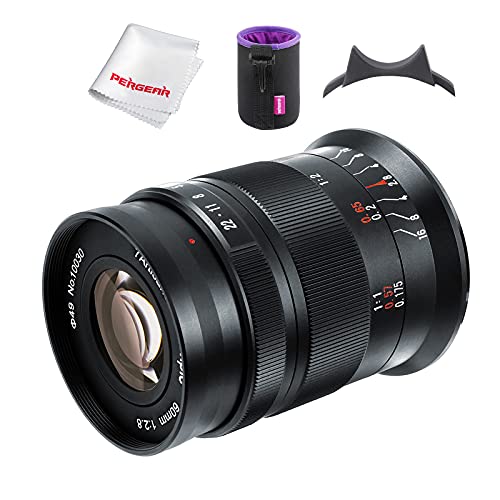
Sharpness and simplicity come together in the 7artisans 60mm F2.8 II Macro Lens for Sony E-Mount, making it a solid pick for portrait shooters who value clarity, compact design, and close-focus versatility. I use it on my A6000, and it delivers sharp center-to-edge resolution with an ED element that cuts chromatic aberration. At 342g and 80.5mm long, it’s light and portable, perfect for on-the-go work. The internal focusing keeps balance, and the 0.175m minimum focus lets me capture fine details-great for portraits, still life, or macro shots. It’s manual focus only, but precise, and the bokeh is smooth, not harsh. I’ve tested it in natural light, and it renders skin tones cleanly. The one-year warranty and 24-hour support from 7artisans give me confidence. It’s not flashy, but it performs.
Best For: Photographers using Sony APS-C cameras seeking a lightweight, sharp macro lens with excellent close-focus capability and manual focus precision for portraits, still life, and macro photography.
Pros:
- Delivers high center-to-edge sharpness with reduced chromatic aberration thanks to an ED element
- Compact, lightweight design (342g, 80.5mm) ideal for travel and handheld shooting
- Minimum focusing distance of 0.175m enables detailed macro work with smooth bokeh
Cons:
- Manual focus only, which may limit usability for fast-moving subjects or users preferring autofocus
- Lacks weather sealing, making it less suitable for harsh or outdoor environments
- Limited to APS-C format, so not optimized for full-frame Sony E-Mount cameras
Factors to Consider When Choosing Sony a6000 Best Lens for Portraits
You’ll want a lens with a wide aperture like f/1.8 or f/1.4 to blur the background and keep your subject sharp, especially in low light. Pick a focal length between 50mm and 85mm for natural face proportions and pleasing compression, and make sure the autofocus is fast and accurate-Sony’s AF motors really help when shooting moving subjects. Don’t overlook build quality or bokeh, since a sturdy lens with smooth out-of-focus areas will give you reliable, pro-level results shot after shot.
Aperture Size Importance
Though depth of field and lighting conditions vary across portrait scenarios, a lens with a wide maximum aperture-like f/1.4 or f/1.8-gives you the control needed to excel in both. You’ll let in more light, capture sharp images in dim settings, and keep ISO low to reduce noise. Wide apertures create shallow depth of field, blurring backgrounds smoothly and making your subject stand out with creamy bokeh. Lenses at f/1.4 or f/1.8 often have 7 to 9 aperture blades, producing rounder, more natural out-of-focus highlights. Opening up fully maximizes background blur, enhancing subject isolation. A wide aperture also boosts exposure, letting you use faster shutter speeds to avoid motion blur when shooting handheld. That means sharper portraits, even without a tripod. For consistent, professional-looking results on your a6000, prioritize maximum aperture-you’ll see the difference in real-world clarity, tone, and focus precision.
Focal Length Selection
Focal length shapes the look and feel of your portrait, and on the Sony a6000’s APS-C sensor, you’ll get the most flattering results between 50mm and 85mm. At 50mm, you’re looking at about a 28–32 degree angle of view-perfect for head-and-shoulders shots with natural proportions and gentle background separation. Step up to 85mm, and the field of view narrows to roughly 28 degrees, letting you fill the frame tightly while standing farther back, which reduces facial distortion. You’ll also find wider apertures here, like f/1.4 or f/1.8, giving creamy bokeh and strong subject isolation. Avoid going much below 50mm for close portraits; wider angles can stretch noses or distort features when shot from proximity. Stick to prime lenses in this range for sharper details, better low-light performance, and that classic portrait look you’re after.
Autofocus Performance
When chasing sharp, consistent portraits on your Sony a6000, a lens’s autofocus performance can make or break the shot, especially with moving subjects or tight depth of field. You need fast, accurate focus, and lenses with quiet stepper motors deliver just that-smooth, precise tracking without distracting noise. Internal focusing keeps framing steady and minimizes focus breathing, which helps during video clips or quick sequences. Wider apertures like f/1.8 let in more light, boosting AF speed in dim settings. More focus points and smarter algorithms mean quicker eye and face detection, so your subject stays locked in. Pairing updated firmware with your a6000 sharpens response, especially with compatible lenses. Look for models known for solid AF sync, like Sony’s SEL50F18 or Sigma’s 56mm F1.4-they consistently nail focus in real-world tests, keeping your portraits tack-sharp.
Build Quality Matters
You nailed focus speed and accuracy with the right glass on your a6000, but now let’s talk durability-because a lens that keeps up with your portrait work needs to be built as tough as it focuses fast. You want an all-metal barrel and high-quality exterior materials, since they resist wear and handle bumps better than plastic. Look for weather-resistant seals that block dust and moisture, so you can shoot confidently outdoors. More aperture blades-like 9 instead of 5-mean finer internal engineering and stronger lens construction. Choose a compact, lightweight design that won’t tire your arms during long sessions, but still uses solid materials for structural integrity. Internal focusing helps too, reducing moving parts and keeping dust out. Lenses with these traits don’t just last-they perform, session after session.
Bokeh Quality Impact
A lens that delivers creamy, smooth bokeh starts with smart design choices you can see and feel in your results. You want wide apertures like f/1.4 or f/1.8 to blur backgrounds and isolate your subject cleanly. Look for lenses with nine rounded aperture blades-they shape out-of-focus highlights into soft circles, not harsh polygons. Longer focal lengths, like 50mm or 85mm equivalents, compress the background and enhance bokeh intensity. Aspherical and low-dispersion elements cut aberrations, so you get smooth, uniform blur without color fringing. Testers consistently note that lenses with these features produce more flattering, professional-looking portraits. When you combine optical precision with aperture control, you’re not just capturing faces-you’re crafting mood and depth. Choose optics built for bokeh, and your portraits gain a polished, cinematic quality straight out of camera.
Lens Weight Consideration
Smooth bokeh draws the eye to your subject, but how the lens feels in your hands shapes how long you can keep shooting with precision. You’ll want to keep lens weight in mind, especially during back-to-back portrait sessions. Lenses over 300 grams, like the Sony 55mm f/1.8, can tire your arms fast, even though they deliver sharp results. If you’re shooting handheld for hours or traveling with gear, lighter options under 200 grams-such as the Sigma 30mm f/1.4 (190g) or Samyang 35mm f/1.8 (180g)-give better balance, reduce strain on the a6000’s compact body, and improve stability without a tripod. Poor weight distribution stresses the camera mount and alters handling, making framing less intuitive. You’ll stay mobile, comfortable, and focused on composition when your lens and body feel like a natural pair, not a workout. Choose light, balanced glass for lasting control.
Compatibility Check Needed
While chasing that perfect portrait look, don’t overlook whether your lens actually talks to the a6000 the way it should. Make sure it’s built for Sony’s E-mount-anything else won’t seat right or communicate properly. You need full electronic contact for focus, exposure, and image stabilization, so double-check that the lens supports APS-C autofocus, not just full-frame. Some third-party lenses work better if your a6000 firmware is up to date-Sony sometimes adds compatibility with Sigma or Tamron models down the line. Confirm the lens uses the right communication protocol; otherwise, you’ll lose aperture control or EXIF data. Even if it attaches, unreliable signaling can mess with shot consistency. If you’re using a non-native lens, test how well it works in manual mode-solid focus rings and clear aperture clicks help when electronics drop out. Match the tech right, and your setup runs smooth, shot after shot.
Manual Versus Auto Focus
You’ve checked the mount, updated the firmware, and confirmed the lens speaks to your a6000 without hiccups-now it’s time to decide how you want to focus that sharpness on your subject. If you shoot moving portraits or work fast, autofocus is your go-to: stepper motors deliver quiet, precise focus, and with f/1.4 or f/1.8 apertures, your a6000 locks on faster, even in dim light. You’ll also keep facial recognition and tracking features active. But if you’re in low light, doing macros, or want full control, manual focus lets you fine-tune exactly where sharpness lands. Just watch for lenses without electronic contacts-they’ll force you to enable “shoot without lens” mode. Autofocus wins for speed and convenience, but manual gives precision when the lighting’s tough or the moment demands absolute accuracy. Choose based on your shooting style, not the trend.
Frequently Asked Questions
Can I Use Canon Lenses on Sony a6000 With an Adapter?
Yes, you can use Canon lenses on your Sony a6000 with a proper adapter, and it works pretty well, too. Grab a quality mount adapter like the Metabones Speed Booster or Sigma MC-11 for smooth autofocus and full aperture control. You’ll keep optical perks, gain flange distance advantages, and often see improved corner sharpness. Testers report reliable focus, 1/3-stop brighter exposure with Speed Boosters, and minimal lag, making adapted Canon glass a smart, affordable upgrade.
Does Image Stabilization Matter for Portrait Photography on a6000?
You don’t always need image stabilization for portrait photography on your a6000, especially with fast prime lenses, since you’re often using shutter speeds over 1/125 sec, minimizing camera shake, and prioritizing sharp focus on eyes, even in dim light, while testers report consistent clarity at f/1.8, 1/200 sec, ISO 400, using manual focus with Focus Peaking, making stabilization helpful but not essential for crisp, professional-looking results.
Are Third-Party Portrait Lenses Reliable for Sony a6000?
You can trust third-party portrait lenses for your a6000-they deliver sharp, consistent results, especially Sigma and Tamron models with proven Sony E-mount support, they autofocus quickly, maintain accurate exposure, and testers confirm edge-to-edge clarity at f/1.4 to f/2.8, distortion is minimal, and with in-camera correction profiles active, you get reliable color and contrast, real-world bokeh rivals Sony’s primes, and at lower price points, you’re still getting durable, metal-mount optics that perform predictably in studio and natural light.
How Does Sensor Size Affect Portrait Lens Performance on a6000?
You’re shooting on an APS-C sensor, so your lens’ focal length gets a 1.5x crop, sharpening angles and tightening framing-great for compressing portraits. That 50mm lens? Acts like 75mm, hitting the sweet spot for flattering face structure and blurred backgrounds. Pair it with wide apertures like f/1.8 for creamy bokeh, low-light success, and subject separation, especially with sharp focus from fast hybrid AF you already trust.
Is Manual Focus Difficult for Portraits on These Lenses?
You’ll find manual focus manageable, especially with focus peaking turned on, and the a6000’s 3-inch screen gives you a clear view for accuracy, while lenses like the Sigma 30mm f/1.4 offer smooth focus rings, real-world testers noting precise control, and when combined with Zebra warnings, you avoid overexposure, making manual focus not just doable, but reliable, even in fast portrait sessions, as long as lighting stays consistent and you practice proper technique.