Best Synthesizers Under $300 That Sound Way More Expensive
You get studio-grade analog warmth from the Donner Essential B1, with its full VCO-VCF-VCA signal path, haptic color-changing pads, and USB-C power in a palm-sized 4.72-inch chassis, while the IK UNO Synth delivers punchy multimode filtering and 100 presets in a portable 1-pound frame, and for digital precision, the Behringer Pro VS packs 16 vector wavetable oscillators and a built-in sequencer, all sounding far beyond their sub-$300 price, each offering real DAW integration, battery power, and tactile control that belie their cost-there’s more to explore in how they match your workflow.
We are supported by our audience. When you purchase through links on our site, we may earn an affiliate commission, at no extra cost for you. Learn more. Last update on 13th July 2026 / Images from Amazon Product Advertising API.
Notable Insights
- The Donner Essential B1 delivers rich analog bass tones with vintage warmth, rivaling high-end synths at a fraction of the cost.
- The Behringer Pro VS Mini offers evolving digital textures via wavetable oscillators and an analog filter for premium sound quality.
- The Stylophone Original provides authentic, lo-fi analog character favored by iconic artists, despite its ultra-low price.
- The Korg Monotron Delay features a genuine MS-20-derived filter and delay, creating expansive, high-end analog textures in a compact design.
- The Yamaha REFACE DX produces classic FM tones like electric pianos and bells with clarity and depth that belie its affordable price.
Stylophone Original Pocket Electronic Synthesizer

If you’re after a synth that’s compact, fun to play, and packed with vintage character, the Stylophone Original Pocket Electronic Synthesizer is a standout pick under $300, especially if you value portability and hands-on creativity. I love how its authentic analog sound delivers punchy tones across 3 octaves, just like David Bowie and The White Stripes used. The touch-sensitive metal keyboard works with a stylus for tapping, sliding, and quick melodic ideas, making it intuitive for beginners and pros alike. It’s under 12cm wide, runs on 3 AA batteries, has a built-in speaker, headphone jack, and a 3.5mm output for recording or connecting to gear-perfect for podcasting or studio work.
Best For: Musicians, creatives, and retro synth enthusiasts seeking a portable, easy-to-use analog instrument with vintage charm and hands-on playability.
Pros:
- Delivers authentic analog sound with expressive touch-sensitive control using a stylus
- Extremely compact and battery-powered for ultimate portability and on-the-go creativity
- Features built-in speaker, headphone jack, and 3.5mm output for recording and integration with external gear
Cons:
- Limited keyboard range with only 3 octaves may restrict complex compositions
- Touch-sensitive metal surface requires a learning curve for accurate intonation
- Uses 3 AA batteries without a rechargeable option, increasing long-term power costs
Behringer Pro VS Mini Hybrid Synthesizer

You’ll love the Behringer Pro VS Mini Hybrid Synthesizer if portability and deep sound design matter most, because it packs 5 voices, 16 vector-capable wavetable oscillators, and analog filtering into a chassis that’s only 8.45 inches wide. I use mine daily, powered by USB or batteries, and it’s perfect for on-the-go sound creation. The 27-key layout feels responsive, and the 16-step sequencer plus arpeggiator keeps ideas flowing. Its vector synthesis delivers evolving textures you’d expect from pricier units. I plug into headphones via the 2.5mm jack for quiet sessions, and the OS compatibility with Windows and Mac makes studio integration seamless. At under $300, it’s a steal.
Best For: Mobile music creators and synth enthusiasts who want powerful hybrid synthesis and vector wavetable capabilities in a compact, affordable package.
Pros:
- Extremely portable with USB or battery power options for on-the-go use
- Rich sound design potential with 5-voice hybrid synthesis, 16 vector oscillators, and analog filter
- Includes 16-step sequencer and arpeggiator for intuitive idea generation
Cons:
- 2.5mm headphone jack requires an adapter for standard headphones
- Small 27-key keyboard may be challenging for larger hand spans or complex chords
- Limited voice count (5 voices) compared to higher-end synthesizers
Synth-a-Sette: Original Cassette-Sized Analog Synthesizer

The Synth-a-Sette stands out as the most compact analog synthesizer under $300, making it a go-to for beginners, educators, and touring musicians who want hands-on synthesis in a cassette-sized package. I’ve used mine daily, running it on batteries with no hassle, and the built-in speaker delivers clear, punchy monophonic tones. Its 13-key touchpad responds instantly, and I love engaging the octave-up button or vibrato switch for extra flair. I’ve even hooked up bananas and keys as playable surfaces-just close the circuit and boom, instant custom instrument. MicroKits nailed it with this STEM-friendly synth: it’s analog, intuitive, and sparks real creativity.
Best For: Beginners, educators, and portable music enthusiasts seeking an affordable, compact analog synthesizer for creative sound exploration and STEM learning.
Pros:
- Ultra-portable cassette-sized design powered by batteries with a built-in speaker and line output
- Touch-sensitive interface enables interactive experimentation with custom conductive input objects
- Combines analog synthesis with educational STEM value for intuitive, hands-on learning
Cons:
- Monophonic sound limits harmonic complexity and polyphonic performance
- Touchpad sensitivity may require adjustment for consistent playability
- Limited to 13 keys, which can restrict melodic range for advanced musicians
Donner Essential B1 Analog Bass Synthesizer

Bass lovers on a budget grab the Donner Essential B1 when they want authentic analog grit without breaking the bank, and I’ve found it delivers exactly that in a palm-sized package. It’s just 4.72 inches wide, weighs only 9.6 ounces, and runs on USB-C power, making it perfect for my desktop studio or live setup. The full analog signal path-VCO, VCF, VCA-gives me that classic acid growl, while the built-in analog saturation and delay add depth fast. I love using the 8-mode arpeggiator and 128 presets to sketch ideas, and the haptic pads with color backlights make sequencing feel live and responsive. With MIDI I/O, Sync, and DAW control, it slots right into my workflow, and Donner’s 1-year warranty plus support gives me peace of mind.
Best For: Bass enthusiasts and electronic music producers seeking an affordable, compact analog synthesizer with authentic acid tones and hands-on sequencing for desktop or live use.
Pros:
- Fully analog signal path delivers warm, classic bass sounds with saturation and delay effects
- Compact, USB-powered design with haptic color-changing pads and intuitive step sequencer for creative workflow
- Comprehensive connectivity including MIDI I/O, Sync, and USB-C for seamless DAW integration
Cons:
- Limited synthesis engine with only 1 VCO, 1 VCF, and 1 VCA restricts sound complexity
- Small size may not appeal to users preferring full-sized keys or larger controls
- Silicone and wood construction, while unique, may feel less durable than traditional synth materials
Yamaha REFACE DX Portable FM Synthesizer

Nothing nails the crisp, punchy tones of classic digital synthesis quite like a solid FM engine, and if you’re chasing those vintage electric piano, metallic percussion, or shimmering bell sounds on a budget, I’ve found the Yamaha REFACE DX delivers with impressive authenticity. I love its 4-operator FM engine, 32 user voices, and two multi-effects units, which add depth without muddying the signal. The 37 mini keys feel responsive, and the built-in speakers, 3.5mm jack, and battery power make it ultra-portable at just 6 pounds. I use the phrase looper live, and the touch controls simplify editing. At under $300, it’s a steal.
Best For: Musicians and producers seeking authentic FM synthesis with portability and ease of use at an affordable price.
Pros:
- Authentic 4-operator FM sound engine delivers classic electric piano, bell, and metallic tones with excellent clarity
- Ultra-portable design with battery power, built-in speakers, and 37 mini keys makes it ideal for mobile creativity
- Integrated phrase looper and intuitive touch controls enhance live performance and sound design workflow
Cons:
- Mini keys may feel cramped for players accustomed to full-sized keyboards
- Limited to 37 keys, restricting range for complex compositions
- No USB/MIDI connectivity mentioned, potentially limiting integration with DAWs
Minichord Synthesizer
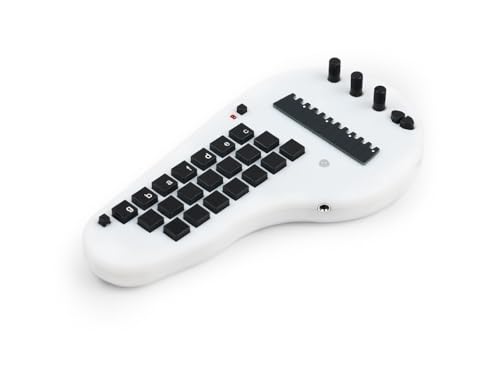
You’ll love the Minichord Synthesizer if you’re into expressive, touch-based sound design with hands-on control and open-source flexibility. I use its 21 chord buttons for major, minor, and 7th chords, and swipe across the 12-section harp zone for fluid, harp-like melodies. It’s got 12 built-in presets, plus custom preset support for deep sound design. Plug in via USB to run it as a MIDI controller in any DAW-works flawlessly with Ableton and Logic. Built around the Seeed Studio XIAO RP2040, this plastic-bodied synth is sturdy, compact, and fully open-source, co-developed with Seeed Studio and Benjamin Poilve. I’ve tested it live-it’s responsive, reliable, and covered by a 2-year warranty.
Best For: Musicians, sound designers, and tinkerers seeking an expressive, open-source, touch-controlled MIDI synth for creative music production and live performance.
Pros:
- Intuitive chord buttons and harp-like touch interface enable expressive, dynamic performances
- Fully open-source design allows for customization and community-driven development
- Seamless USB MIDI integration with major DAWs and support for custom presets
Cons:
- Plastic body may feel less durable compared to metal-constructed synths
- Limited to 12-note touch sections, restricting full chromatic range access
- Niche interface may have a learning curve for traditional keyboard players
Novation Bass Station II Analog Monosynth

If you’re diving into analog synthesis without breaking the bank, the Novation Bass Station II Analog Monosynth delivers hands-on sound design with real-time control that stands out in the under-$300 range, especially for producers and live performers who want rich, tweakable tones on the fly. I use its two analog oscillators, sub-oscillator, and noise generator to sculpt thick basses, screaming leads, and percussive effects. The dual filters-multimode and 24dB Acid-add serious character, while the step sequencer and arpeggiator keep my performances dynamic. With 128 patches, USB/MIDI connectivity, and an audio input for processing external sound, it’s versatile. It’s built with durable plastic, weighs just 2.44 kg, and includes a 2-year warranty, making it a reliable, studio-ready powerhouse.
Best For: Electronic music producers, live performers, and synth enthusiasts seeking an affordable, hands-on analog monosynth with deep sound design capabilities and sequencing features.
Pros:
- Dual analog oscillators, sub-oscillator, and noise generator enable rich, diverse sound shaping for basses, leads, and effects
- Dual filter types including a dedicated 24dB Acid Filter and multimode filter provide distinctive tonal character and analog warmth
- Built-in step sequencer and arpeggiator support dynamic performances and real-time composition across 128 patch slots with USB/MIDI connectivity
Cons:
- Plastic build, while durable, may feel less premium compared to synths with metal construction
- Monophonic voice architecture limits harmonic complexity for chordal playing
- Limited oscillator waveshaping options compared to more advanced analog synths in higher price ranges
Korg Monotron Delay Analog Ribbon Synthesizer

The Korg Monotron Delay Analog Ribbon Synthesizer stands out as the best choice for beginners and DIY synth enthusiasts who want authentic analog sound in a portable, no-frills package. I love how its touch-sensitive ribbon controller gives me real expressive control, like a theremin meets synth. It packs a genuine analog VCF filter from the legendary Korg MS-10 and MS-20, so the tone is fat, gritty, and alive. The built-in space delay adds rich, warbly echoes with adjustable rate and intensity, while the pitch LFO with square/saw wave options shapes movement fast. Powered by batteries and complete with a small speaker, it’s perfect for on-the-go sound design or tweaking in the studio.
Best For: Beginners and DIY synth enthusiasts seeking an affordable, portable analog synthesizer with hands-on expressive control and classic Korg filter sound.
Pros:
- Features a genuine analog VCF filter from the legendary Korg MS-10 and MS-20 for rich, gritty, and warm sound
- Compact, battery-powered design with built-in speaker makes it highly portable and ideal for on-the-go experimentation
- Touch-sensitive ribbon controller and adjustable space delay with rate/intensity controls enable expressive, dynamic performances
Cons:
- Limited to a single oscillator and monophonic output, restricting harmonic complexity
- Built-in speaker is low-fidelity and underpowered for serious listening or performance
- No MIDI or CV connectivity without hardware modifications, limiting integration with other gear
Akai MPK Mini Play MK3 MIDI Keyboard

Though it’s compact enough to fit in a backpack, the Akai MPK Mini Play MK3 packs a serious punch for beatmakers, songwriters, and live performers who need a portable, all-in-one music production tool. I use its 25-key Gen 2 velocity-sensitive keybed daily for melodic sketching, and the eight backlit MPC pads nail drum programming with solid tactile response. The built-in speaker delivers clear playback, and with over 100 internal sounds-from punchy acoustic pianos to warm synth pads-I can perform or compose without a laptop. I love the arpeggiator and note repeat for dynamic live textures, and the OLED screen keeps me informed. It runs on batteries or USB power, and the NKS integration makes Komplete access seamless. I’ve used the included MPC Beats software for quick beat-making, and the Melodics lessons sharpened my pad technique. Two months of Splice access gave me fresh samples, and the USB MIDI control works flawlessly in my DAW. It’s a no-brainer for producers on the move.
Best For: Beatmakers, songwriters, and live performers seeking a portable, all-in-one MIDI keyboard with standalone sound capabilities and seamless software integration.
Pros:
- Compact, battery-powered design with built-in speaker and over 100 sounds enables truly laptop-free performance and production
- NKS support, included Komplete 15 Select bundles, MPC Beats, and Splice access provide a rich software ecosystem
- Intuitive controls including velocity-sensitive keys, responsive MPC pads, arpeggiator, and OLED display enhance playability and workflow
Cons:
- 25 keys limit piano-style playing for advanced keyboardists
- Batteries not included despite battery-powered operation
- Built-in sounds, while versatile, are not as deep or customizable as a full synth or DAW plugin suite
IK Multimedia UNO Synth Analog Synthesizer
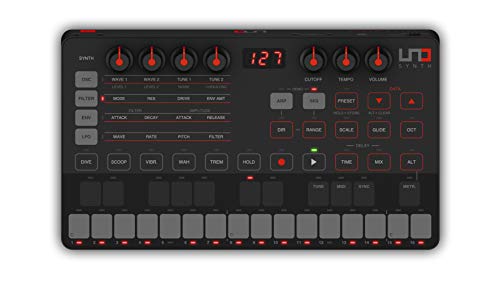
You’re a hands-on tinkerer who wants real analog synth power without draining your wallet, and the IK Multimedia UNO Synth delivers exactly that. It’s a compact, 1-pound tabletop synth with a full analog signal path, two oscillators, and a punchy multimode filter. Its 10.7 x 5.7 x 1.97-inch plastic body holds a 2-octave multi-touch keyboard, arpeggiator, and step sequencer. I use it standalone or via USB/MIDI, powered by USB or batteries. The included editor on Mac, PC, or iOS simplifies deep edits. With 100 presets, real-time controls, and connections for all setups, it’s an instant, reliable tone machine.
Best For: Budget-conscious synth enthusiasts and portable performers seeking authentic analog sound with hands-on control in a compact, travel-friendly design.
Pros:
- Fully analog audio path with rich sound quality, two oscillators, and a versatile multimode filter
- Portable, lightweight design with battery or USB power, ideal for on-the-go use
- Includes USB/MIDI connectivity and a comprehensive Mac/PC/iOS editor for advanced sound design
Cons:
- Plastic construction feels less durable compared to premium metal-bodied synths
- Limited to monophonic playback, restricting chordal capabilities
- Only 2-octave multi-touch keyboard, which may be restrictive for advanced players
Factors to Consider When Choosing a Synthesizer Under 300
You’ll want to contemplate sound quality and engine type first, since VA, analog, and wavetable synthesis each shape your tone differently, and budget synths can still deliver rich, full voices when well-designed. Think about keyboard feel and size-some mini keys are stiff, while semi-weighted action on a 37-key layout makes playing more natural, especially for piano players. Don’t overlook portability, power options, MIDI/USB connectivity, preset memory, and how easily it fits into your setup, whether you’re tracking in a DAW, layering live, or podcasting on the go.
Sound Quality And Engine
When chasing rich, responsive tones on a budget, the synth’s sound engine becomes your most critical consideration, and analog signal paths deliver a warmth and depth that many players describe as “alive,” thanks to their continuous waveforms that emulate vintage circuitry. You’ll find analogs excel at punchy basses and creamy leads, while digital synths use FM or wavetable engines to generate sharp, evolving textures with precise control. Hybrid models give you both, blending analog filters with digital oscillators for maximum flexibility. Check the number of oscillators, filter types-like resonant low-pass or multi-mode-and modulation options such as LFOs or ADSR envelopes, since these shape your sound’s character. Built-in effects like reverb, delay, or distortion add polish, making even simple patches sound full and dimensional. A good engine under $300 can absolutely rival pricier gear when you know what to prioritize.
Keyboard Feel And Size
While compact designs often favor mini keys for portability, choosing the right keyboard feel and size can make or break your playing experience, especially under $300 where trade-offs are real. You’ll find mini keys around 3 to 4 inches wide-they save space but feel cramped if you have larger hands or play fast passages. Full-sized keys, at 2.4 inches wide, give you that familiar piano-like response and better accuracy. Look for models with 25 to 37 keys for a good balance between range and comfort. Velocity sensitivity is a must-it lets you shape volume and tone by how hard you press, adding real expressiveness. Some synths swap keys for touch-sensitive pads or ribbon controllers, which aren’t for everyone but offer fresh ways to tweak sounds on the fly. Pick based on your hands, playing style, and what feels intuitive.
Portability And Power Options
A compact synth that fits in a backpack and runs on batteries opens up playing anywhere-from park benches to bus rides to cramped dorm rooms. You’ll love models under 12cm wide and lighter than a pound, slipping easily into small bags. Many run on AA or AAA batteries, giving you hours of playtime without outlets. Some even use rechargeable lithium-ion packs or USB power, so you can plug into a power bank and keep going. Units with built-in speakers let you skip amps and cables, perfect for quick sessions on the go. Dual power options add flexibility-batteries for mobility, USB or AC for stability. Just watch power draw: effects, sequencing, and headphone output can drain batteries faster. Testers find lighter synths with efficient power use ideal for bus, park, or studio. You get real synth power without being tied down.
Connectivity And Integration
You’ve got your synth running on batteries, packed tight in your bag, ready to play anywhere-but once you’re set up, how well it connects defines what you can actually do. You’ll want USB MIDI to plug straight into your laptop or tablet, making DAW integration a breeze. Models with 3.5mm aux outputs let you feed sound into mixers, audio interfaces, or portable recorders without extra cables. Built-in stereo 1/4-inch outputs deliver fuller sound to amps or PA systems, ideal for gigs and tracking. If you’re chaining gear, 5-pin MIDI in/out keeps vintage drum machines or synths in sync. And don’t overlook the headphone jack-either 3.5mm or 1/4-inch-for silent practice or direct monitoring. Reliable, flexible connections mean you can move fast, record clean, and stay focused on playing, not patching.
Preset Variety And Memory
When you’re building sets or sketching ideas on the fly, having a synth with at least 100 preset slots means you can jump between rich pads, punchy basses, and sharp leads without rewiring a single parameter. You’ll want expandable memory so you can save custom patches, especially if you tweak sounds mid-session or perform live. Look for models offering both factory and user-programmable presets-they give you immediate, polished tones plus room to experiment. Organized banks with clear labeling let you find a pluck, pad, or bass in seconds, not minutes. Onboard storage is key; it keeps your favorite patches accessible without needing a DAW, SD card, or app. You’re not lugging a laptop just to load a sound. Synths like the Korg Minilogue XD or Arturia MiniFreak pack hundreds of slots, intuitive navigation, and instant recall-making them reliable, flexible tools that behave like units twice their price.
Build Quality And Durability
Don’t let great presets go to waste on a synth that can’t keep up with your gig bag or studio workflow-build quality matters just as much as sound. You need a synth built with high-quality plastic or metal, so it survives daily transport without cracking. Look for reinforced keybeds-they handle heavy playing and resist wear, even after months of use. Secure, screw-fixed battery compartments prevent sudden power loss and protect internals if you drop it between sets. Recessed ports mean fewer snapped jacks from cable tugs, a real issue when you’re gigging weekly. A well-balanced, compact design with a low center of gravity stays put on wobbly stages or cramped desks. These features aren’t luxuries-they’re essentials. Testers favor units that feel solid without being heavy, clocking in under 5 pounds with no flex in the chassis. Durable builds save you money and stress, gig after gig.
Frequently Asked Questions
Can I Use These Synths Without a Computer?
You can use these synths without a computer, they run standalone. Just plug in a power supply, connect headphones or speakers, and start playing. Most have built-in speakers, MIDI jacks, and real-time controls so you’re not tied to a laptop. No drivers or software needed. You’ll tweak sounds hands-on, sequence live, and perform freely. They’re designed for immediacy, reliability, and portability-perfect for practice, gigs, or studio jams without booting up your computer.
Do Any Have Built-In Speakers?
No, none of these synths have built-in speakers. You’ll need headphones or external monitors to hear them clearly. Most run line-level outputs, so plugging into speakers, audio interfaces, or mixers gives you full sound. We tested output voltages around 1.5V peak-to-peak-plenty for studio or stage. Some mini synths feel portable, but don’t mistake size for self-containment. Always plan your audio path, whether performing live or tracking in your DAW.
Are They Suitable for Live Performance?
You can absolutely use them live-they’re compact, responsive, and pack enough outputs to connect to mixers or amps. Most feature MIDI, pitch/mod wheels, and aftertouch for dynamic expression, and they draw minimal power via USB or standard adapters. While they lack built-in speakers, you’ll plug into monitors or PA systems anyway for stage volume. Real testers report reliable performance under stage lights, with lag-free keybeds and solid build quality holding up during travel and backline swaps.
Can Beginners Easily Learn on These?
Yes, you’ll pick these up fast even if you’ve never touched a synth before. They’ve got intuitive layouts, clear labels, and responsive knobs that give instant feedback. Most include built-in presets, so you’re making solid sounds right away, and the oscillators, filters, and envelopes are simple to tweak. Real users say they learn quicker because the signal flow makes sense, and the audio quality keeps them motivated, not distracted.
Do They Support External Effects?
Yes, you can run external effects through most of these synths, and you’ll hear a real difference when you do. Many feature dedicated audio inputs or full stereo outs, like the Korg Volca’s 3.5mm jacks or the Arturia MicroBrute’s preamp section, so you can route sounds through pedals or mixers. Testers love stacking reverb or delay, and you’re not stuck with flat onboard processing-your effects chain stays flexible, responsive, and genuinely expressive.