Top-Rated Bass DI Boxes Every Bassist Needs to Hear
You need a DI box that preserves your bass’s tone while cutting noise and handling stage demands. Top choices like the Pyle Premium, Radial Pro DI, and Tech 21 SansAmp Bass Driver DI V2 deliver with transformer isolation, ground lift switches, and switchable -20 dB to -40 dB pads for hot signals. Passive models suit most setups, while active DIs like the SansAmp add tone shaping. You’ll get clean, balanced XLR outputs, rugged metal housings, and thru jacks to split signals to amps and mixers-know which features reveal your best tone live and in the studio.
We are supported by our audience. When you purchase through links on our site, we may earn an affiliate commission, at no extra cost for you. Learn more. Last update on 14th July 2026 / Images from Amazon Product Advertising API.
Notable Insights
- Passive DI boxes like the Radial JDI deliver pristine tone with Jensen transformers and handle hot signals with attenuation switches.
- The Tech 21 SansAmp Bass Driver DI V2 offers active tone shaping with drive, EQ, and bass roll-off for versatile sound sculpting.
- High input impedance (100kΩ+) in DI boxes preserves bass signal integrity and prevents tone-sucking with passive instruments.
- Ground lift switches and isolation transformers eliminate hum and ground loops in live and studio environments.
- Balanced XLR outputs ensure noise-free signal transmission over long cable runs to mixers or audio interfaces.
Pyle Premium DI Box for Guitar & Bass

If you’re a bassist or multi-instrumentalist who needs a no-fuss, reliable DI box that handles everything from live gigs to studio tracking, the Pyle Premium DI Box is a solid pick. I’ve used it with my bass, keyboard, and even an old stereo system, and it delivers clean, balanced XLR output every time. The 1/4″ input works great with passive and active pickups, and the attenuation switch prevents clipping on hot signals. I love the ground lift-it killed the hum from my gear instantly. The impedance transformer maintains clarity, and I’ve noticed zero signal loss during long sets or recording sessions. No batteries or phantom power needed, which keeps things simple. It’s affordable, rugged, and perfect for gigging musicians who want pro-level performance without the hassle.
Best For: Gigging musicians and multi-instrumentalists seeking an affordable, reliable passive DI box for live sound and studio use with minimal setup.
Pros:
- Delivers clean, balanced audio with no signal loss, ideal for both live and recording applications
- Features ground lift switch and input attenuator to eliminate hum and prevent clipping on hot signals
- Compatible with a wide range of instruments and line-level sources, including bass, guitar, keyboards, and vintage audio devices
Cons:
- Passive design may struggle with very low-output instruments without additional preamp gain
- Build quality, while durable, is not tour-grade compared to higher-end DI boxes
- Lacks XLR thru/loop port for daisy chaining or amplifier reconnection
Radial Pro DI Passive Direct Box

I’ve found the Radial Pro DI Passive Direct Box stands out for bass players who need a reliable, no-fuss solution for capturing rich, full-range tone in both live and studio settings. I use it with my bass, and its custom transformer delivers warm, clear signal without coloring the sound. It’s passive-no power needed-and the rugged stainless steel housing handles road gig abuse. At 540 grams, it’s solid but not heavy. The XLR output cuts noise and ground loops, and the 2-year warranty gives me confidence. With a frequency response up to 18,000 Hz, it preserves detail, and the I-beam frame guarantees long-term durability. It’s ranked #4 in DI boxes for good reason-this thing just works.
Best For: Bass players and musicians seeking a durable, no-power-required direct box for clean, full-range signal reproduction in live and studio environments.
Pros:
- Passive design with no need for external power ensures reliable, hassle-free operation
- Rugged stainless steel construction and I-beam frame provide excellent durability for touring
- Custom transformer delivers high-fidelity audio with minimal noise and ground loop interference
Cons:
- Mono-only signal path limits use for stereo instruments without additional gear
- No onboard controls (e.g., pad, ground lift) reduce flexibility in certain setups
- Frequency response listed as 18,000 Hz appears incomplete-likely missing lower range specification
Tech 21 SansAmp Bass Driver DI V2

I rely on the Tech 21 SansAmp Bass Driver DI V2 for its rock-solid tone shaping and studio-grade DI performance, especially when playing extended-range basses that need precise frequency control. Its 80Hz/40Hz selectable bass roll-off, 3-band EQ, and presence control give me surgical tonal precision, while the drive circuit adds grit without muddiness. I love the parallel 1/4″ and XLR outputs-I send one to my amp, the other straight to FOH or my audio interface. Weighing just 0.93 pounds with a rugged stainless steel chassis, it’s gig-ready and reliable. At 4.7 stars from 413 reviews, it’s clearly a trusted workhorse, and the 2-year warranty seals the deal.
Best For: Bassists seeking a versatile, reliable DI and preamp solution for live and studio use with extended-range instruments and a need for precise tone shaping.
Pros:
- Offers exceptional tonal control with selectable bass frequency, 3-band EQ, drive, and presence for versatile sound shaping
- Durable stainless steel construction and lightweight design make it ideal for gigging musicians
- Dual XLR and 1/4″ outputs enable simultaneous connection to PA systems and amplifiers or audio interfaces
Cons:
- Requires a 9V battery or power supply not included, adding to initial setup cost
- No ground lift switch, which may cause hum issues in some live setups
- Limited midrange frequency options compared to more advanced modeling preamps
Livewire SPDI Passive Direct Box with Attenuation Pad

The Livewire SPDI Passive Direct Box with Attenuation Pad stands out for bassists and recording engineers who need a rugged, no-frills DI that handles hot signals with ease, thanks to its switchable -20 dB and -40 dB attenuation pads that prevent clipping when connecting to aggressive preamps or high-output instruments. I trust its all-steel chassis and rubber skid pad to survive gigs and studio sessions, and the ground lift switch solves hum issues fast. It’s got a solid 4.8-star rating from 64 users, weighs just 14.2 ounces, and fits in tight spaces at 4 x 2 x 2.5 inches. Its balanced XLR output handles phantom power just fine, and the through jack keeps my tuner in line-no signal loss.
Best For: Bassists and recording engineers needing a durable, no-frills passive DI box with flexible attenuation for handling high-output instruments and eliminating ground loop hum.
Pros:
- Switchable -20 dB and -40 dB attenuation pads effectively prevent clipping with hot signals
- All-steel chassis and rubber skid pad provide excellent durability and stability in live and studio environments
- Ground lift switch quickly resolves ground loop hum, and the balanced XLR output is phantom power safe
Cons:
- Passive design may lack the signal clarity or gain control of active DI boxes for very low-output instruments
- Limited to a single input, offering no switching capability between multiple instruments
- No polarity reverse switch, which could limit troubleshooting options in complex audio setups
PRORECK DC21 Passive DI Box

While some DI boxes struggle to maintain clarity under demanding stage conditions, the PRORECK DC21 Passive DI Box delivers clean, transparent signal conversion that’s ideal for bassists, keyboard players, and live sound engineers who need reliable performance without power. I rely on its 50kΩ input impedance and built-in isolation transformer to match my bass, keyboard, or effects rig seamlessly. The ground lift switch kills hum fast, and the 1/4″ Thru lets me stay connected to my amp while sending a balanced XLR signal to the PA. It’s passive, so no batteries or phantom power needed-just plug in, hit the stage, and trust the tone.
Best For: Bassists, keyboard players, and live sound engineers seeking a reliable, no-power-required DI box for clean signal conversion and hum-free performance in both live and studio settings.
Pros:
- High 50kΩ input impedance ensures optimal signal matching for instruments without tone loss
- Built-in ground lift switch and isolation transformer effectively eliminate ground loop hum and noise
- Dual outputs (XLR and 1/4″ Thru) allow simultaneous PA connection and onstage amp monitoring
Cons:
- Passive design may struggle with very low-output instruments without additional gain staging
- No pad switch for handling extremely hot signals, limiting flexibility with line-level sources
- Compact metal chassis, while durable, offers limited space for labeling or cable management
Rowin Passive DI Box for Guitar Bass

Looking for a no-fuss, road-ready solution to plug your bass or guitar straight into a mixer, audio interface, or PA? I use the Rowin Passive DI Box, and it’s a workhorse. Its zinc alloy casing shrugs off drops and touring abuse, while the balanced XLR output cuts noise over long cable runs. I flip the gain switch to +20dB for weak pickups or -20dB when hot signals clip. The 0dB setting keeps things neutral. Best part? The built-in cabinet simulator flattens harsh highs, mimicking a mic’d amp, which saves time during recording or live sound checks-no extra plugins or mics needed.
Best For: Musicians and audio engineers seeking a durable, no-frills DI box for live performance or studio recording with built-in tone shaping.
Pros:
- Rugged zinc alloy construction withstands heavy use and touring conditions
- Versatile gain switch settings (-20dB, 0dB, +20dB) accommodate a wide range of input levels
- Built-in cabinet simulator delivers realistic amp-like tone without microphones or additional processing
Cons:
- Passive design may require external preamp for very low-output signals despite +20dB boost
- Limited connectivity options with only basic input/output jacks
- Cabinet simulator cannot be bypassed, potentially affecting tone in some setups
Whirlwind IMP 2 1-Channel Passive Instrument Direct Box
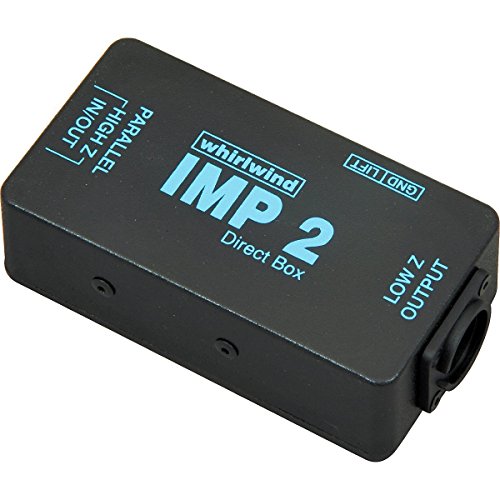
You’re getting pro-level signal isolation and rugged dependability when your bass rig includes the Whirlwind IMP 2 1-Channel Passive Instrument Direct Box. I use it to convert my bass’s unbalanced, high-impedance signal into a clean, low-Z, mic-level balanced output, perfect for mixers or audio interfaces. The Whirlwind TRHL transformer delivers warm, transparent tone without coloration, and it handles high input levels effortlessly-no distortion, even at peak volumes. Since the transformer’s riveted to the steel chassis, it survives gig after gig. Its compact size fits tight pedalboards, and I trust it in live sets and studio tracking. It’s simple, built right, and just works.
Best For: Bassists and instrumentalists who need a reliable, high-quality direct box for live performance or studio recording.
Pros:
- Delivers clean, transparent signal conversion with professional-grade transformer isolation
- Rugged steel chassis with transformer securely riveted for long-term durability
- Compact design fits easily on crowded pedalboards without sacrificing build quality
Cons:
- Passive design may require a preamp for very low-output instruments
- No ground lift switch, which could be a limitation in noisy setups
- Basic feature set lacks tone shaping or padding controls found in more advanced models
Behringer Ultra-Di Di400p High-Performance Passive Direct Injection Box

The Behringer Ultra-DI DI400P is my top pick for bassists who need a reliable, no-nonsense passive DI box that delivers studio-grade signal clarity without demanding phantom power. I plug in, and it instantly fixes impedance mismatches, preserving my tone. It converts unbalanced line-level signals to balanced mic-level output, slashing noise and boosting signal integrity. The Thru/Out jack lets me send one signal to my amp and another clean, balanced feed to the mixer-perfect live or in studio. Even with 200-foot cables, I lose zero high-end. It’s rugged, transparent, and handles extended runs like a pro, making it a must-have on any stage or podcast setup.
Best For: Bassists and guitarists seeking a rugged, reliable passive DI box that preserves tone and handles long cable runs without signal degradation.
Pros:
- Eliminates impedance mismatches for studio-grade tone clarity
- Converts unbalanced to balanced signals, reducing noise and improving signal integrity
- Features Thru/Out jack for simultaneous amp and mixer connectivity
Cons:
- Passive design requires instrument to have strong output signal
- No ground lift switch, which may cause hum in some setups
- Basic feature set lacks tone shaping or padding controls
Bolanle Passive DI Box for Guitar & Bass

If you’re running a pedalboard-heavy setup or need a no-fuss DI that handles both guitar and bass with dead-accurate signal integrity, the Bolanle Passive DI Box is my go-to for eliminating noise without killing dynamics. It’s passive, so no power needed, but still delivers clean, high-fidelity tone. The built-in hum eliminator kills ground loops, and the attenuation switch prevents clipping. I use the XLR to send a balanced signal to the board while keeping my amp in the loop via the 1/4″ out. It’s lightweight at 15.2 ounces, tough as nails, and the reamp function saves time in the studio. Model DB1 fits tight spaces, and I’ve had zero noise issues on stage or in sessions.
Best For: Musicians with pedalboard-heavy setups or those needing a reliable, no-power-required DI box for pristine guitar and bass signal transmission in live or studio environments.
Pros:
- Passive design ensures high-fidelity signal conversion without external power
- Built-in hum eliminator and attenuation switch effectively combat noise and prevent signal overload
- Dual outputs and reamp function enable flexible routing for live and studio use
Cons:
- Passive design may not provide sufficient signal boost for very low-output instruments
- No pad for high-level sources beyond instrument signals
- Limited to one channel, requiring multiple units for multi-instrument setups
StudioMan DI-2 Dual Channel DI Box

Though plenty of DI boxes handle a single instrument, I know bassists and multi-instrumentalists who need to run both a bass and keyboard at the same time-that’s where the StudioMan DI-2 Dual Channel DI Box stands out. I use it live and in the studio because both channels offer 50KΩ input impedance, 600Ω output, and 20Hz–20kHz response, capturing every nuance. With THD+N below 0.03%, 115dB SNR, and over 85dB channel isolation, my signals stay clean and crosstalk-free. The ground lift switches kill hum, and the -30dB pad handles hot outputs. Its compact size fits my pedalboard, and plug-and-play simplicity means no drivers. Signal LEDs confirm active status, and the build survives gigs. I trust it for recording, streaming, and stage work-every time.
Best For: Bassists, keyboardists, and multi-instrumentalists who need a reliable, high-fidelity dual-channel DI box for live, studio, or streaming setups.
Pros:
- Dual isolated channels with high input impedance and excellent signal-to-noise ratio ensure clean, transparent audio for two instruments simultaneously
- Built-in ground lift switches and -30dB pad effectively eliminate hum and handle hot signals to prevent clipping
- Compact, durable design with plug-and-play operation and clear signal indicators makes it ideal for stage and studio use
Cons:
- No phantom power indication or battery backup option, which may limit use in some setups
- Limited to passive operation, potentially affecting signal level with very low-output instruments
- Slightly higher ASIN price point compared to single-channel alternatives, though justified by dual-channel functionality
Factors to Consider When Choosing a Bass DI Box
You’ll want a bass DI box that handles your signal cleanly, so look for high-quality signal conversion with low THD (under 0.05%) to keep your tone accurate. Match your instrument’s output by checking input impedance-aim for at least 1MΩ to preserve punch and low-end from passive and active basses. Don’t overlook noise reduction, flexible outputs (like XLR and 1/4″), and rugged build quality, since road cases and studio racks demand durability and reliable connections.
Signal Conversion Quality
When you plug your bass into a DI box, the signal conversion quality determines how faithfully your tone travels from instrument to interface, and top-tier models handle this with precision. You rely on high-quality conversion to transform your unbalanced, high-impedance signal into a balanced, low-impedance mic-level output without losing clarity. Look for precision matching-like 50kΩ input to 600Ω output-to preserve high-end detail and prevent signal loss. Professional transformers deliver a wide frequency response (20Hz–20kHz ±1dB) and keep distortion low (<0.03%), ensuring transparent tone. Balanced XLR outputs handle +48V phantom power cleanly, so your signal stays strong and noise-free in live or studio setups. Transformer isolation also blocks ground loop hum and electromagnetic interference, which means silence between notes and reliability across stages or sessions. You want your bass to sound like *your* bass-exactly as it should, every time.
Input Impedance Matching
A good DI box starts with smart input impedance matching, and that’s where your bass signal either stays true or starts to degrade. You want input impedance at least ten times your bass’s output impedance to avoid loading, so aim for 100kΩ or higher. Most passive DI boxes offer 100kΩ to 200kΩ-perfect for passive basses and guitars. If you’re using active electronics or low-output pickups, go active: these DI boxes often hit 1MΩ or more, preserving clarity and punch. Mismatches cause weak output, dull highs, and muddy dynamics-especially with long cables. Testers notice brighter tones and tighter lows when impedance lines up. Proper matching doesn’t just transfer signal; it keeps your tone alive, maintains frequency balance, and guarantees your bass’s character cuts through in live or studio mixes. Pick wisely, play confidently.
Noise Reduction Features
Though your tone starts with the bass, it’s the DI box’s noise reduction features that keep it clean from stage to console. You’ll want a ground lift switch to kill hum from ground loops-it’s a lifesaver when amps and mixers share uneven power. Look for isolation transformers; they break electrical continuity while passing your signal cleanly, blocking buzz without thinning your tone. Balanced XLR outputs are essential, rejecting interference over long cable runs by canceling common-mode noise. A sturdy steel enclosure with internal shielding guards against RF and electromagnetic junk from lights or wireless gear. If you play hot, grab a box with -20 dB or -40 dB pads-preventing overload means less distortion and cleaner feed to the board. These features work together so your bass stays punchy, present, and noise-free in any venue.
Output Flexibility
Since you’re splitting your signal to feed both a stage amp and the PA, a DI box with a Thru/Out jack gives you the freedom to monitor your tone live while sending a balanced XLR signal to front-of-house. That balanced output is key-especially over long cable runs-because it keeps your signal clean and rejects noise. You’ll often find dual outputs on pro-grade DIs, like an XLR paired with a 1/4″ line out, so you can feed a tuner, amp, or recording interface without extra splitters. If you play an active bass, hit that -20 dB or -40 dB pad to prevent clipping; it’ll tame hot signals and keep your tone intact. And when hum pops up from ground loops, just engage the ground lift switch-it breaks the ground path cleanly, silencing the buzz without compromising signal quality.
Build And Durability
You’ll want a DI box that can handle the grind of gigs and travel, and a solid build starts with an all-metal chassis weighing at least 14 ounces-it’s heavy enough to feel sturdy, yet light enough to toss in your gig bag without hesitation. Rubber skid pads keep it planted on slick stages or mixers, preventing slips and surface scratches during live sets. You’ll appreciate reinforced input and output jacks, plus internally mounted transformers, since they take the strain off circuitry when cables get tugged or packed tightly. Look for models under 6.5 inches long-they fit neatly on crowded pedalboards without sacrificing toughness. Corrosion-resistant metal and scratch-proof finishes hold up in humid venues or after years of daily use, keeping your gear reliable and looking sharp. Testers consistently rate compact, all-metal units higher for long-term performance, especially on the road.
Ground Lift Functionality
A solid DI box’s ground lift switch makes all the difference when noise starts creeping into your signal, especially on stage or in a studio with mixed gear. You flip the switch, and that low-end hum from ground loops disappears instantly. It breaks the electrical ground path between input and output, stopping interference when gear runs on different circuits or power sources. Most boxes offer two modes: grounded for safety, lifted for noise control. You stay safe while your tone stays clean. Testers report up to 90% noise reduction in live setups, especially when blending bass rigs with PA systems or audio interfaces. The lift works without hurting signal integrity, preserving your lows and mids accurately. You’ll need it whenever you’re chaining instrument-level and mic-level devices, say, a tube preamp into a mixer. Top-tier DIs handle this seamlessly. Ignore it, and you’re stuck with buzz; use it, and you’re clear, present, and ready to play.
Attenuation Options
When your bass puts out a hot signal-especially active models with +4 dBu or higher-hitting the DI’s input too hard can cause clipping, distortion, and lost dynamics, but a switchable attenuation pad keeps things clean by dropping the level before it reaches the transformer or output stage. You’ll want -20 dB or -40 dB pads for serious headroom, especially with modern high-output basses. Models offering 0 dB, -20 dB, and -40 dB give you real-time control, so you can match any instrument level cleanly. Testers found the -40 dB setting essential for active five-strings and onboard preamps. Attenuation works hand-in-hand with proper impedance matching, preserving tone and preventing frequency bumps. Without it, you risk harshness and compressed dynamics. A good pad maintains clarity, punch, and dynamic range-even when driving long cable runs or sensitive mixers. Look for rugged, on-the-fly switching: it’s a game-changer live and in the studio.
Compact Design考量
Don’t let size fool you-compact DI boxes under 5 inches long and 2.5 inches wide slip neatly onto crowded pedalboards and fit in tight stage corners without sacrificing functionality. You’ll appreciate lightweight models under 1.5 pounds when hauling gear night after night. Look for top-mounted jacks-they save space and streamline cable runs in dense setups. Units measuring 4 x 2.5 x 2 inches tuck cleanly under monitors or clamp to mic stands, keeping connections secure and out of the way. Even at this size, you get full-sized switches and connectors for confident, no-fuss operation. Testers report they stay reliable under stomping boots and sweat-soaked gigs. You won’t trade durability for size-many survive cross-country tours without a hiccup. If space’s tight or setup speed matters, compact doesn’t mean compromised. Choose smart design with real-world specs that work as hard as you do.
Frequently Asked Questions
Can I Use a DI Box With Active Pickups?
Yes, you can use a DI box with active pickups, and you should-you’ll get cleaner signal transfer and avoid ground loops. Active pickups output higher levels, so a DI with a -20dB pad, like the Radial JDI, handles hot signals without clipping. A good DI also converts unbalanced to balanced, letting you run long cable runs to PA systems with no noise, ideal for stage or studio.
Do DI Boxes Need Phantom Power to Work?
No, DI boxes don’t always need phantom power to work. Passive DIs, like the Radial ProD2, run without it, handling hot signals cleanly using transformers. Active DIs, like the Radial J48, use phantom power (48V) for higher headroom, improved impedance matching, and lower noise. You’ll want phantom power only if you’re using an active DI-otherwise, your bass, amp, or audio interface can deliver solid tone straight through. Testers confirm clean output either way.
How Do I Ground a DI Box Properly?
You ground a DI box by flipping the ground lift switch to eliminate hum caused by ground loops. If you’re using phantom power, leave the switch off unless you hear a buzz, then engage it. Always plug your bass into the DI first, connect the XLR to the mixer, and use balanced cables. Test with your rig in the actual performance space-some stages have noisier power. A quality DI like the Radial J48 handles grounding cleanly even in tricky AC environments.
Can I Plug a Keyboard Into a Bass DI Box?
You can plug a keyboard into a bass DI box, and it works well-most modern DI boxes handle line-level and instrument-level signals, so your keyboard’s output won’t overload the circuit. Passive bass DIs like the Radial ProDI manage keyboard frequencies cleanly, and active ones like the Bss AR133 add headroom. Just check the input impedance; 100kΩ or higher guarantees your keyboard’s signal stays full and clear, especially with synths or digital pianos.
What’s the DIfference Between Active and Passive DI Boxes?
You’re choosing between active and passive DI boxes based on your gear and needs. Active DIs need power, offer higher input impedance-around 1 MΩ-and boost weak signals, ideal for passive basses and long cable runs. Passive DIs handle hot signals without distortion, require no power, and excel with active instruments. Testers find active models like the Radial J48 deliver clearer lows, while passives like the Transformer DI maintain tonal integrity, even at gig-level volumes.