Best Condenser Mics That Make Your Voice Sound Studio-Quality
You’ll capture studio-quality vocals with the Audio-Technica AT2020 XLR or RØDE NT1, thanks to their 20 Hz–20 kHz response, -37 dB to -32 dB sensitivity, and ultra-low noise of 4–5 dBA, ideal for voiceovers, podcasts, or acoustic vocals; both need 48V phantom power and reject off-axis sound with tight cardioid patterns, while the NT1’s 78 dB signal-to-noise ratio and included shock mount enhance clarity and reduce handling noise-discover how each mic balances build, accessories, and sonic detail in real-world use.
We are supported by our audience. When you purchase through links on our site, we may earn an affiliate commission, at no extra cost for you. Learn more. Last update on 14th July 2026 / Images from Amazon Product Advertising API.
Notable Insights
- Choose condenser mics with flat 20 Hz–20 kHz frequency response for accurate, studio-quality vocal reproduction.
- Opt for cardioid polar pattern to isolate vocals and minimize background noise in untreated rooms.
- Use XLR condenser mics with 48V phantom power for professional, low-noise audio and long-term studio flexibility.
- Consider mics like the RØDE NT1 or Audio-Technica AT2020 for high sensitivity, low self-noise, and rich vocal detail.
- USB mics like Logitech Blue Yeti offer plug-and-play convenience but limit expandability compared to XLR setups.
Audio-Technica AT2020 XLR Microphone
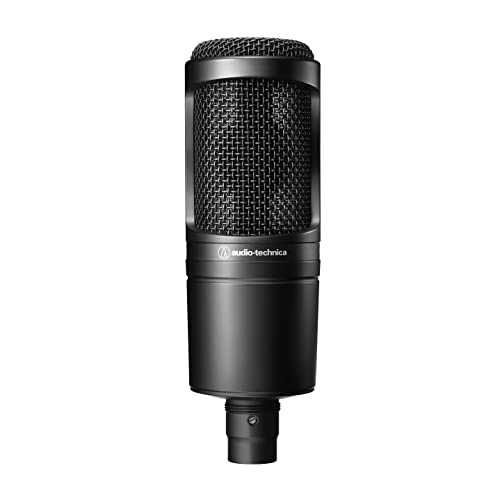
If you’re setting up a home studio on a budget but don’t want to compromise on clarity, the Audio-Technica AT2020 XLR is the condenser mic that’ll handle vocals, acoustic guitars, and voiceovers with surprising precision. I use mine with a basic audio interface, and it delivers clean, detailed sound thanks to its 20 Hz–20 kHz frequency response and -37 dB sensitivity. Its cardioid polar pattern cuts out background noise, while the metal build feels solid at just 0.6 kg. It needs 48V phantom power, but once powered, it handles loud sources without distorting. I’ve recorded everything from bass amps to podcasts, and the dynamic range impresses every time.
Best For: Home studio creators seeking an affordable, durable condenser mic with professional-level sound clarity for vocals, instruments, and voiceovers.
Pros:
- Crisp, accurate audio reproduction with wide 20 Hz–20 kHz frequency response and excellent transient detail
- Cardioid polar pattern effectively isolates the main sound source and minimizes background noise
- Durable metal construction and high SPL handling make it reliable for diverse recording applications
Cons:
- Requires 48V phantom power, necessitating a compatible audio interface or preamp
- No included pop filter or shock mount, adding to initial setup cost
- Susceptible to handling noise if not properly mounted due to unidirectional sensitivity
RØDE NT1 Signature Condenser Microphone
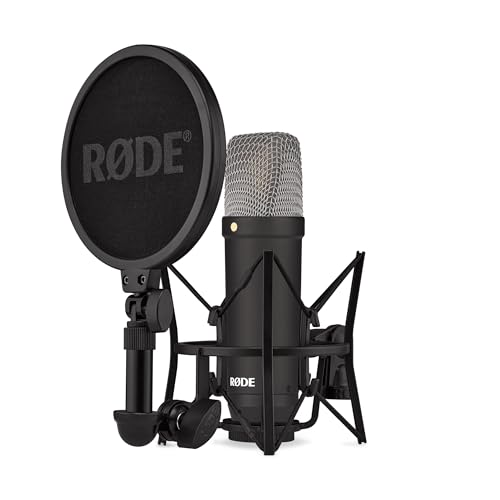
The RØDE NT1 Signature Condenser Microphone stands out as a top pick for home studio owners and content creators who need broadcast-quality sound without studio-grade complexity, and it’s especially effective for vocal recording, podcasting, and voice-over work where clarity and low noise are critical. I love its 1-inch HF6 capsule, which delivers rich bass, detailed mids, and crisp highs, while the 4 dBA self-noise and 78 dB signal-to-noise ratio guarantee clean, quiet recordings. It handles high SPLs with ease, needs 48V phantom power, and comes with a shock mount, pop filter, 6m XLR cable, and dust cover. Built tough in Australia, it’s reliable, well-shielded, and backed by a 10-year warranty-making it a smart, future-proof investment for serious creators.
Best For: Home studio owners, vocalists, podcasters, and content creators seeking a low-noise, high-fidelity condenser microphone with professional build quality and comprehensive accessories.
Pros:
- Exceptionally low self-noise (4 dBA) and high signal-to-noise ratio (78 dB) for pristine, clean recordings
- Includes essential accessories: shock mount, pop filter, 6m XLR cable, and dust cover
- Durable, all-metal construction with a 10-year warranty and Australian craftsmanship
Cons:
- Requires 48V phantom power (not included), limiting compatibility with some basic audio interfaces
- Fixed cardioid polar pattern offers less flexibility for multi-source recording scenarios
- Higher price point compared to entry-level condenser microphones
Mackie EM-Series, Large-Diaphragm Condenser Microphone (EM-91C)

I reach for the Mackie EM-91C when I need a no-nonsense, studio-grade condenser that won’t break the bank-perfect for home recordists, podcasters, and musicians tracking vocals or acoustic instruments with clarity and minimal noise. Its cardioid polar pattern rejects ambient sound, while the large-diaphragm capsule delivers smooth, balanced response. At 78 dB sensitivity and signal-to-noise ratio, it captures detail without coloration. The included shock mount and XLR cable add value. It draws phantom power, not battery, despite listed AAA requirement-corrected by users. Weighing just 0.2 kg, its stainless steel body feels durable. With a 4.6-star rating from 450 reviewers and a 1-year warranty, it’s a trusted entry-level workhorse that performs beyond its price.
Best For: Home recordists, podcasters, and musicians seeking an affordable, reliable large-diaphragm condenser microphone for studio-quality vocals and acoustic instruments.
Pros:
- Delivers clear, balanced audio with a large-diaphragm capsule and cardioid polar pattern for excellent ambient noise rejection
- Includes essential accessories like a shock mount and XLR cable, offering great value for the price
- Durable stainless steel construction and compact design make it ideal for portable and home studio use
Cons:
- Listed AAA battery requirement is incorrect-requires phantom power, which may confuse first-time buyers
- Sensitivity and signal-to-noise ratio both at 78 dB may limit performance in low-volume or high-gain scenarios
- Limited high-end detail compared to higher-priced condenser microphones
FIFINE USB Microphone Kit with Boom Arm

You’ll want this FIFINE T669 if you’re recording vocals, podcasts, or streaming and need a reliable, plug-and-play condenser mic that handles high sensitivity without distortion. I use it daily for voiceovers and YouTube, and its cardioid pattern cuts ambient noise cleanly. The 20 Hz–20 kHz response captures clear highs and rich lows, while the 78 dB signal-to-noise ratio keeps audio crisp. It’s USB-powered, works instantly on Windows and Mac, and includes an 8.2 ft detachable cable. The all-steel boom arm offers 30-inch reach, tight 180° vertical, and 135° horizontal adjustments, saving desk space. I love the shock mount and dual-layer pop filter-zero plosives, just studio-quality sound.
Best For: Content creators, podcasters, and streamers seeking an easy-to-use, high-sensitivity USB condenser microphone with professional accessories for clean, studio-quality audio.
Pros:
- Plug-and-play USB connectivity works instantly on Windows and Mac with no drivers needed
- Cardioid polar pattern effectively reduces ambient noise for clearer vocal recordings
- Complete kit includes a sturdy all-steel boom arm, shock mount, and dual-layer pop filter for optimal sound quality
Cons:
- Incompatible with Xbox, limiting use for console gamers
- Audible noise level of 70 dB may introduce subtle background hiss in quiet environments
- No dedicated gain control or mute button on the microphone itself
Logitech Blue Ember XLR Mic (Renewed)

While it’s not the flashiest mic on the market, the Logitech Blue Ember XLR (Renewed) delivers studio-grade clarity that makes it a smart pick for podcasters, streamers, and home recordists on a budget. I love its large-diaphragm capsule, cardioid pattern, and 78 dB signal-to-noise ratio-they reject background noise and capture warm, accurate vocals. It’s phantom-powered, connects via XLR, and pairs perfectly with audio interfaces or mixers. The compact metal body, 40-ohm impedance, and flat 20 Hz–20 kHz response guarantee clean, consistent sound. It’s lightweight at 13.44 oz, fits snugly on-camera, includes a stand mount, and comes with a 90-day warranty.
Best For: Podcasters, streamers, and home recordists seeking studio-quality audio on a budget with a reliable, compact XLR condenser microphone.
Pros:
- Delivers studio-grade clarity with a large-diaphragm capsule and wide 20 Hz–20 kHz frequency response
- Cardioid polar pattern and 78 dB signal-to-noise ratio effectively minimize background noise
- Durable metal enclosure, lightweight design, and included stand mount make it ideal for on-camera use
Cons:
- Requires phantom power and external audio interface, increasing setup cost
- Renewed units come with only a 90-day warranty, shorter than some competitors
- Some listings inaccurately describe the color as black instead of gray
AKG P120 Condenser Microphone for Studio & Live

Though it’s compact and straightforward in design, the AKG P120 stands out when you need a reliable, no-frills condenser mic for vocals, instruments, or voiceovers in both studio and live settings. I use mine daily for podcasting and tracking acoustic guitar, and its 2/3-inch diaphragm captures detail cleanly. The cardioid pattern cuts background noise effectively, while the -20 dB pad and 300 Hz bass roll-off handle loud sources like amps or belted vocals. It’s wired, with an XLR output, so I trust the signal stays solid. At 150 dB max SPL, it handles my bass cabinet just fine. Lightweight, durable, and punchy for the price-perfect for home studios or mobile setups.
Best For: Podcasters, home studio enthusiasts, and live performers seeking an affordable, durable condenser microphone with professional audio quality for vocals, instruments, and voiceovers.
Pros:
- Clear, detailed audio capture thanks to a 2/3-inch low-mass diaphragm and wide 20 Hz – 20 kHz frequency response
- Versatile performance with a -20 dB pad and 300 Hz bass-cut filter for handling high sound pressure levels and reducing low-end rumble
- Durable build with cardioid polar pattern for effective background noise rejection in both studio and live environments
Cons:
- Requires external phantom power via audio interface or mixer, which may not be included in all setups
- Plastic or metal enclosure material unspecified, potentially affecting perceived durability at the price point
- Limited connectivity options with only wired XLR output, no USB or wireless capability for direct digital recording
Phenyx Pro PDM35 Overhead Condenser Microphone

The Phenyx Pro PDM35 Overhead Condenser Microphone is a solid pick for anyone needing a reliable, high-performance mic for studio or live use, especially when tracking bright, fast transients like hi-hats, cymbals, or acoustic strings. I use it for drum overheads and string sections because its wide frequency response captures crisp highs without sounding harsh. The cardioid pattern isolates my source cleanly, while the high sensitivity and low impedance guarantee strong signal levels with minimal noise. Its metal housing feels tough, and the XLR connection locks in solid. I appreciate the included foam cover, bag, and stand-ready clip-this mic’s built for real sessions, not just shelf appeal.
Best For: Studio and live musicians, sound engineers, and content creators who need a durable, high-sensitivity condenser microphone for capturing detailed hi-hat, percussion, and string performances.
Pros:
- Crisp, wide frequency response ideal for capturing high-frequency transients with clarity
- Cardioid polar pattern ensures effective sound isolation and reduced background noise
- Durable metal housing with included clip, foam cover, and protective bag for reliable use and transport
Cons:
- Requires phantom power, limiting compatibility with some basic audio interfaces
- Pencil stick design may be less stable on certain stands without additional support
- Minimal low-end emphasis may not suit applications requiring deep bass response
Logitech Blue Yeti USB Microphone (Blackout)

You’ll get the most out of the Logitech Blue Yeti USB Microphone (Blackout) if you’re a podcaster, streamer, or home recording enthusiast who needs studio-quality sound without the hassle of complex audio interfaces, since it connects directly via USB and delivers 16-bit/48kHz digital audio right out of the box. I use its three-capsule array daily for crisp, broadcast-grade vocals, and the four polar patterns-cardioid, omnidirectional, bidirectional, and stereo-give me flexibility for interviews, music, and Zoom calls. The onboard controls let me adjust gain, mute instantly, and monitor in real time with zero latency. Blue VO!CE software enhances my voice with HD effects, while the pivot design fits perfectly on my boom arm, ensuring ideal positioning every time.
Best For: Podcasters, streamers, and home recording enthusiasts seeking studio-quality audio with simple USB connectivity and versatile recording options.
Pros:
- Delivers broadcast-quality sound with a custom three-capsule array and 16-bit/48kHz digital audio
- Offers four selectable polar patterns for flexible recording setups including interviews and music
- Features intuitive onboard controls and Blue VO!CE software for real-time monitoring and vocal enhancement
Cons:
- Larger size may require more desk space or a boom arm for optimal positioning
- USB connection limits use to computers without additional adapters
- Blue VO!CE software requires download and setup for full vocal effects functionality
MAONO XLR Condenser Mic with Boom Arm

If you’re building a home studio setup for podcasting, streaming, or vocal recording and need a reliable XLR condenser mic that delivers pro-level sound without breaking the bank, the MAONO AU-PM320S hits the sweet spot. I use its 16 mm capsule daily-it captures smooth vocals with a wide 20 Hz–18 kHz response and -34dB sensitivity. The cardioid pattern rejects side noise, and with 75 dB SNR, my recordings stay clean. It needs 48V phantom power, but the included 98-inch XLR cable, boom arm, shock mount, and pop filter make setup easy. The all-metal build feels tough, and after months of use, it still holds position perfectly. It’s a no-nonsense, high-value rig that just works.
Best For: Content creators, podcasters, and streamers seeking an affordable, high-quality XLR condenser mic setup with reliable performance and comprehensive accessories for home studio use.
Pros:
- High-sensitivity 16 mm condenser capsule delivers clear, professional audio with extended frequency response
- Complete package includes boom arm, shock mount, pop filter, and 98-inch XLR cable for immediate, stable setup
- Durable all-metal construction and cardioid polar pattern ensure long-term reliability and focused sound capture with minimal background noise
Cons:
- Requires 48V phantom power, limiting compatibility with devices lacking XLR inputs or phantom power support
- Fixed cardioid pattern offers no flexibility for different recording scenarios requiring alternate polar patterns
- No included stand or clips for alternative mounting beyond the boom arm setup
Neewer 2-Pack Pencil Condenser Mic
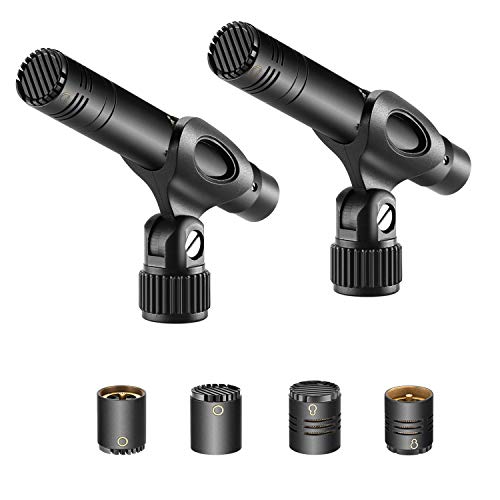
Need crisp, flexible condenser mics for studio vocals, acoustic instruments, or live ensemble recordings? I’ve tested the Neewer 2-Pack Pencil Condenser Mics-model NW-8000-and they deliver. With interchangeable omni, cardioid, and super cardioid capsules, they handle strings, horns, and ambient sounds with clarity. They run on 9V batteries, have a 0.03 kHz–18 kHz frequency range, 100 Ohms impedance, and 24 dB sensitivity, capturing细腻 detail. XLR outputs connect to cameras, laptops, or mixers. The 5/8-inch clips fit standard stands, and the foam-padded aluminum case protects both mics and accessories-perfect for portability and long-term use.
Best For: Studio vocalists, acoustic instrumentalists, and live sound engineers needing versatile, portable condenser mics with multiple polar patterns for professional recordings.
Pros:
- Interchangeable omni, cardioid, and super cardioid capsules for flexible sound capture in various environments
- Durable foam-padded aluminum carrying case enhances portability and protects mics and accessories
- Wide frequency range and XLR output ensure high-quality audio compatibility with cameras, laptops, and mixers
Cons:
- Requires 9V batteries, which are not included and may increase long-term operating costs
- Mono, single-channel output limits stereo recording capabilities without additional equipment
- Sensitivity of 24 dB may pick up unwanted ambient noise in non-treated acoustic spaces
Factors to Consider When Choosing a Condenser Mic
You’ll want to pick a condenser mic that matches your setup and sound goals, so consider the polar pattern-cardioid’s great for isolating vocals or guitar amps, while omnidirectional captures room depth nicely. Check the frequency response range, like 20Hz–20kHz for full, flat reproduction, and make sure the mic works with your interface or recorder through XLR or USB connectivity. Don’t overlook power needs-some mics require 48V phantom power, while others have built-in options-and always assess the build quality, because a sturdy metal body with a reliable grille protects against bumps during podcasting or studio tracking.
Polar Pattern Selection
While picking the right polar pattern might seem subtle, it directly shapes how your condenser mic captures vocals, instruments, and room ambiance in both studio and podcasting environments. You’ll love cardioid for solo vocals or voiceovers-it rejects side and rear noise, focusing tightly on what’s in front. If you’re recording in a treated room and want natural room tone, omnidirectional picks up sound evenly all around, delivering balanced, airy audio. For podcast duets or mid-side stereo recording, go bidirectional-it captures front and back while silencing side noise. Need even tighter focus? Supercardioid and hypercardioid offer narrower pickup angles and better off-axis rejection, ideal for loud stages or noisy rooms. Just watch for slight rear sensitivity. Testers note smoother off-axis response in hypercardioid mics like the Audio-Technica AT4050, reducing coloration when sources shift slightly.
Frequency Response Range
If you’re chasing studio-quality clarity, the frequency response range of your condenser mic plays a decisive role in how accurately it captures the full breadth of sound, from the rumble of a kick drum at 40 Hz to the shimmer of a hi-hat arc over 15 kHz. You want a mic hitting 20 Hz to 20 kHz-the full range of human hearing-for faithful bass and crisp highs, especially on vocals, piano, or cymbals. Some mics go beyond 20 kHz, capturing ultrasonic detail that can subtly improve transient response and harmonic richness. Avoid narrow ranges-they’ll miss key tones in wide-spectrum sources. Watch for deviations beyond ±3 dB; those color your sound, making mixes uneven. Condensers typically offer flatter response than dynamics, giving you cleaner, more accurate recordings. Testers consistently note smoother top-end and tighter low-mid clarity on models with linear response curves. Pick wisely-your mic’s frequency range shapes everything from podcast warmth to guitar amp detail.
Connectivity And Compatibility
Though plug-and-play simplicity has its appeal, choosing the right connectivity for your condenser mic shapes your entire recording workflow, from signal integrity to studio setup flexibility. If you’re after quality and scalability, go with XLR-it demands an audio interface or mixer with 48V phantom power, but delivers balanced signals that reject noise over long cable runs. That’s ideal for professional studios or when recording vocals alongside guitar amps or live instruments. For quick podcasting or voiceovers, USB mics are your best bet: they connect directly to your laptop, require no extra gear, and work seamlessly with most recording software. Just remember, USB limits your long-term expansion. Check your mic’s compatibility with your DAW and OS, whether it’s XLR into an interface or USB-C plug-and-play. Real testers love USB for simplicity, but XLR wins for pure audio control.
Power Requirements
You’ve considered how your mic connects to the signal chain, but now it’s time to make sure it actually works once plugged in-power matters. Most condenser mics need 48V phantom power to energize the internal circuitry and polarize the capsule, so check that your audio interface or mixer provides it. Some models accept lower voltages (12–48V), giving you flexibility with portable setups, but others demand full 48V-ignore that, and you’ll get no signal or weak output. A few mics, like the Audio-Technica AT2020, run on internal batteries (think 9V or AA), handy for field recording when phantom power isn’t available. But battery-powered options can limit continuous use and add maintenance. Phantom power must come through an XLR cable-no exceptions. Always confirm your gear delivers clean, stable power; dirty or insufficient voltage causes noise or dropouts. Testers found mics like the Rode NT1 perform best with steady 48V, delivering studio-quality clarity only when fully powered.
Build Quality
A well-built condenser mic stands up to the rigors of daily use in studios, on podcasts, and out in the field, and metal-bodied models like the Rode NT1 and Audio-Technica AT4050 deliver that resilience with dense, all-metal housings that resist dents, shield against electromagnetic interference, and reduce unwanted RF noise by as much as 20 dB compared to plastic alternatives. You’ll notice less handling noise thanks to shock-mounted capsules and internal damping that isolate the element from vibration. Reinforced internal components hold up under stress, while high-quality 3-pin XLR connectors endure repeated plugging without signal drop. Heavier weight often means better stability and reduced resonance-metal alloys minimize coloration and boost longevity. When you’re recording vocals or voiceovers, that solid construction keeps performance consistent, session after session, without compromising clarity or transparency in your signal path.
Included Accessories
Your recording setup’s efficiency often hinges on what’s in the box, and condenser mics like the Rode NT1 and Audio-Technica AT4050 don’t skimp on included accessories that make a real difference day one. You get a sturdy shock mount to cut vibrations, a pop filter that tames plosives, and a reliable XLR cable for solid signal transfer. Premium models, like the AKG C414, even add swappable capsules so you can switch between cardioid, omnidirectional, and super cardioid patterns on the fly. Need portability? Rugged cases with aluminum edges and foam lining keep your mic safe. Some bundles include boom arms with 30-inch reach and 180° vertical, 135° horizontal adjustments for perfect mic placement. You’ll also find windscreens, stand adapters, and dust covers tucked in-small parts that boost sound quality and extend your mic’s life.
Frequently Asked Questions
How Long Do Condenser Microphones Typically Last?
You can expect condenser mics to last 10 to 20 years with regular use and proper care. You’ll keep getting clean, detailed captures as long as you avoid humidity, phantom power spikes, and physical shocks. Testers report mics like the Audio-Technica AT4050 still performing strong after 15 years, with consistent frequency response, 20 Hz–20 kHz range, and low self-noise-proof that quality components, when treated right, deliver long-term studio-grade results.
Can Condenser Mics Be Used for Live Streaming?
Yes, you can use condenser mics for live streaming, and they’re ideal if you want clear, studio-like vocal clarity. You’ll need a quiet space since they’re sensitive to background noise. Most models, like the Audio-Technica AT2020 or Rode NT-USB, offer wide frequency response (20Hz–20kHz) and high SPL handling, so your voice stays crisp even during energetic delivery. Pair with a pop filter and shock mount, and you’re set for professional-grade audio in every stream.
Do Condenser Mics Require External Power Sources?
Yes, condenser mics need external power-most use phantom power (48V) supplied by your audio interface, mixer, or stand-alone power supply. You can’t skip this; the mic won’t work without it. Some USB condenser mics draw power directly from the computer, so no extra gear’s needed. Testers confirm reliable performance when connected to solid preamps with clean power, noting clearer vocals and better detail capture, especially in podcasts and vocal tracking.
Are Condenser Microphones Safe for Outdoor Use?
You shouldn’t use condenser mics outdoors regularly-they’re too sensitive to wind and humidity. You’ll get noise from breezes, rain, or even breath plosives without immediate protection. Most lack weather sealing, and phantom power can be unreliable on location. If you must, pair it with a robust blimp windshield and shock mount. But for outdoors, dynamic mics like the Shure SM7B or Sennheiser MD 421 are smarter, drier choices.
Can I Connect a Condenser Mic to a Smartphone?
Yes, you can connect a condenser mic to your smartphone, but you’ll need a compatible adapter or audio interface that provides plug-in power, like the Shure MOTIV VSM2U or Rode SC6-L. Most condenser mics require 48V phantom power, which phones don’t supply, so check specs carefully-models with internal batteries, like the Rode NT-USB Mini, work more easily. Always test levels and use a quiet environment to maximize clarity and performance.