Best Bass Effects That Elevate Your Sound Game
You get studio-grade tone shaping with 24-bit processing, custom IR loading, and Bluetooth 5.0 on the LEKATO and BOSS GX-1B, both delivering 6–8 hours of battery life, USB recording, and amp-in-a-box versatility; the Zoom B1X FOUR packs 71 effects and a looper in a 6.2 x 8.5-inch chassis, while the MXR Bass D.I.+ gives transparent DI clarity, blend control, and rugged reliability-perfect for live and studio use. Find out which model matches your gigging or recording workflow.
We are supported by our audience. When you purchase through links on our site, we may earn an affiliate commission, at no extra cost for you. Learn more. Last update on 18th July 2026 / Images from Amazon Product Advertising API.
Notable Insights
- Choose multi-effects pedals with amp modeling, IR support, and editable effects for studio-quality tone shaping.
- Prioritize units with Bluetooth and USB audio for seamless backing track integration and direct recording.
- Use built-in compressors and noise gates to tighten dynamics and reduce unwanted signal noise.
- Select pedals with expression controls, looper functions, and preset storage for live performance flexibility.
- Opt for models with DI outputs and dry thru for direct PA use and re-amping in studio setups.
LEKATO Bass Multi Effects Pedal with Bluetooth

If you’re a bassist who gigs often or records at home without a full amp setup, the LEKATO Bass Multi Effects Pedal with Bluetooth is the best choice because it gives you full control over your tone without needing external gear. I use its 9 amp preamp modes and 8 IR cabinet sims daily, and I can load custom IRs via USB using LEKATO’s Cube-Suite software. The built-in effects-Compression, Chorus, Reverb, Distortion, and more-are editable, with three default presets I tweak for Live Mode. Bluetooth 5.0 streams backing tracks, while the 3.5mm output lets me practice silently. It runs 6–8 hours on a 2-hour charge, works while charging, and records straight to my PC through USB.
Best For: Bassists who perform live or record at home and need a portable, all-in-one tone solution with amp modeling, effects, and direct recording capability.
Pros:
- Offers 9 amp preamp modes and 8 IR cabinet simulations with support for custom IR loading via USB
- Built-in rechargeable battery provides 6–8 hours of use and allows operation while charging
- Enables Bluetooth audio streaming, silent practice via headphone output, and direct USB recording to PC or mobile
Cons:
- Touch-based controls may be less durable or responsive compared to physical knobs and switches
- Limited to 3 default presets in Live Mode, requiring software access for deeper customization
- High amperage (9A) may raise concerns about power efficiency or compatibility with some adapters
Zoom B1X FOUR Bass Multi-Effects Processor
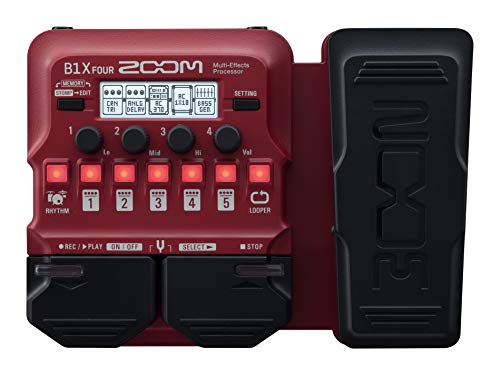
I rely on the Zoom B1X FOUR Bass Multi-Effects Processor when I need a rugged, all-in-one solution that handles everything from tone shaping to performance tools without weighing down my pedalboard. It’s compact-just 6.2 x 8.5 x 2 inches and under 2 pounds-yet packs 71 effects, 9 amp models, a 30-second looper, and 68 rhythm patterns. I use the built-in tuner, expression pedal, and auxiliary input daily, and love connecting via USB to update firmware or edit presets in Zoom Guitar Lab. Running on 9V batteries or a power supply, it’s reliable, stage-ready, and sounds great through amps or headphones.
Best For: Bassists seeking a compact, battery-powered multi-effects processor with versatile tone-shaping tools, a looper, rhythm patterns, and computer-editable presets for both live performance and practice.
Pros:
- Comprehensive feature set with 71 effects, 9 amp models, looper, tuner, and rhythm patterns in a lightweight, portable design
- Includes expression pedal and USB connectivity for firmware updates and deep editing via Zoom Guitar Lab software
- Dual power options (battery or adapter) and auxiliary input make it ideal for mobile use and jamming with external audio
Cons:
- Limited looper duration of 30 seconds may not suffice for longer performances or complex layering
- No built-in display screen makes navigating presets and settings less intuitive
- Expression pedal is included but not assignable to all parameters, limiting real-time control flexibility
FLAMMA FB200 Bass Effects Pedal
The FLAMMA FB200 stands out with its 10 bass-specific amp models and 12 modulation effects, making it a top choice for gigging bassists who need versatile tones in a compact, portable unit. I use its 5 reverb types, noise gate, and three-band EQ to shape my sound fast, and the 40 presets save me time on stage. The built-in drum machine, tuner, and IR loading via USB-C help me practice, record, or podcast anywhere. I charge it in 2.5 hours, and the 2000mAh battery lasts up to 6 hours-perfect for backline use. At just 0.25 kg and with live/preset modes, it’s light, smart, and ready.
Best For: Bassists seeking a lightweight, battery-powered multi-effects pedal with extensive tone-shaping options and mobile connectivity for live, studio, or practice use.
Pros:
- Compact, portable design with 6-hour battery life and fast 2.5-hour charging via USB-C
- Comprehensive effects suite including 10 AMP models, 12 MOD effects, 5 reverb types, and IR loading capability
- Built-in tools like drum machine, tuner, and 40 presets enhance practice, recording, and stage performance
Cons:
- Battery-powered operation may limit extended stage use without access to charging
- USB-C to USB-A cable requirement for PC connectivity may necessitate additional adapters
- Limited to 9 IR slots, which may restrict advanced cabinet simulation flexibility compared to higher-end units
JOYO Bass Overdrive Pedal (DOUBLE THRUSTER R-28)

When you’re shaping heavy low-end tone with precision and want grit without muddiness, the JOYO DOUBLE THRUSTER R-28 stands out as a top pick for bass players chasing aggressive, studio-ready overdrive. I use its GAIN and BLEND knobs to dial in just enough growl while keeping my lows tight, and the TONE control keeps things from getting harsh. Its mid boost switch adds cut for slapping or punching through a dense mix. At 2.83 x 1.89 x 4.29 inches and 250 grams, it’s compact, rugged, and built to last with a metal alloy case. It draws 80mA at 9V, runs analog, and includes noise reduction I actually trust. I’ve gigged it without hum issues, and the LED adds flair without distracting. It works fine with guitars too, but it’s tuned for bass-aggressive, articulate, and under $80. I recommend pairing it with a quality 9V DC supply to avoid noise, since the pedal doesn’t include one. After six months of weekly use, it still performs like day one-proof of JOYO’s decade-plus reputation.
Best For: Bass players seeking a high-gain, articulate overdrive pedal that delivers punchy lows and sharp mids without muddiness, ideal for aggressive tones in live and studio settings.
Pros:
- Delivers clear, punchy bass overdrive with adjustable mid and gain boost for enhanced tonal shaping
- Durable metal alloy housing with compact size and integrated noise reduction for reliable gigging
- Analog signal path with blend control allows seamless integration of drive and clean tone
Cons:
- Power supply not included, and improper adapters may introduce noise or cause damage
- Limited appeal for players seeking subtle or vintage-style overdrive tones
- LED lighting, while aesthetic, offers no functional benefit and may distract on dark stages
Line 6 POD Express Bass

You’ll find the Line 6 POD Express Bass ideal if you’re a gigging bassist or practice-on-the-go player who demands quality tone without the bulk. I use it daily, and its ultra-portable design fits in any gig bag. It packs 7 amp models, 7 cabs, and 17 HX-quality effects that feel responsive and rich. The built-in looper helps me sketch ideas fast, and the intuitive knobs let me tweak tone instantly-no menu diving. It runs on 3 AAs or a 9V adapter, giving me hours of play. Whether I’m warming up or laying down podcast bass lines, it delivers studio-grade sound with zero fuss.
Best For: Gigging bassists and mobile musicians who need a compact, high-quality tone solution for practice or performance on the go.
Pros:
- Ultra-portable design with durable, lightweight form factor ideal for easy transport
- HX-quality amp, cab, and effects modeling delivers studio-grade, responsive tone
- Built-in looper and intuitive controls enable quick sound shaping and creative experimentation
Cons:
- Limited to 7 amp and 7 cab models, which may restrict tonal variety for some users
- Battery life with 3 AA cells may be short during extended sessions
- No USB or digital audio interface functionality for direct recording to computer
SONICAKE Bass Multi Effects Pedal with FX Loop
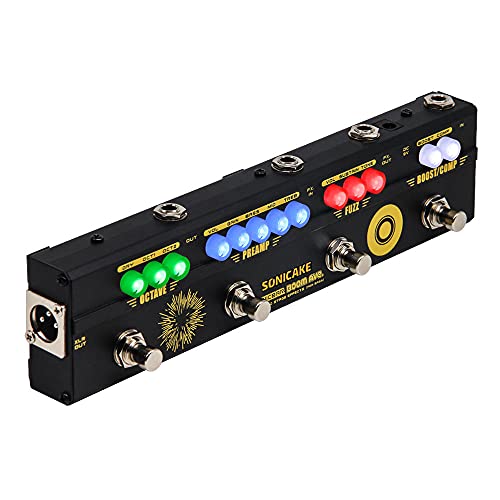
I’ve found the SONICAKE Bass Multi Effects Pedal with FX Loop to be a top pick for gigging bassists who need a compact, all-in-one tone solution that doesn’t sacrifice signal quality or versatility. It nails Ampeg-style warmth with its analog preamp and 3-band EQ, giving me tight control over my clean, rock, or overdriven tones. The built-in compressor, boost, and fuzz are gig-ready, while the octave effect adds weight with notes one or two octaves lower. I love the XLR output for PA hookups and the FX loop for my external pedals. My tone stays rich and intact, though octave tracking wavers slightly above the 15th fret.
Best For: Gigging bassists seeking a compact, all-in-one tone solution with analog warmth, essential effects, and direct connectivity to PA systems.
Pros:
- Combines analog preamp, 3-band EQ, and multiple effects (compressor, boost, fuzz, octave) for versatile tone shaping
- XLR output enables direct connection to mixers and PA systems, ideal for live performance
- Includes FX loop for seamless integration with external effects pedals
Cons:
- Octave effect may have inconsistent tracking on higher frets (above 15th)
- Limited advanced digital effects compared to larger multi-effects units
- No built-in tuner or additional preset storage options
VALETON Dapper Bass DI Preamp Pedal

The VALETON Dapper Bass DI Preamp Pedal, model VES-2, stands out as a top choice for bassists who want studio-grade tone shaping and multi-effects in a single compact unit, especially those balancing live performance with direct recording needs. I use its 3-band EQ, analog compressor, and octave effects daily for warm, punchy tones, and the dry signal thru lets me re-amp or blend with amp tone. With a built-in tuner, FX loop, and 9V adapter included, it’s gig-ready. At 13 inches and 0.65 kg, it’s pedalboard-friendly, and its 4.2-star rating from 418 reviewers confirms its reliability.
Best For: Bassists seeking a versatile, compact analog DI and preamp with multi-effects for live performance, studio recording, and pedalboard integration.
Pros:
- Combines analog DI, 3-band EQ, compressor, and multiple effects (octave, chorus, auto wah) for rich tone shaping
- Features dry signal output and FX loop for flexible signal routing and re-amping options
- Includes power adapter, built-in tuner, and robust construction in a pedalboard-friendly design
Cons:
- Limited to 9V DC power with no battery option for portable use
- FX loop is not true bypass, potentially affecting signal integrity
- Some users may find the control layout dense for quick on-the-fly adjustments
Multi Effects Bass Pedal with 8 AMP Models

Though bassists often prioritize simplicity, I need versatility and tone control when shaping my sound across gigs, rehearsals, and bedroom practice-and that’s where a multi-effects pedal with 8 amp models stands out as the best choice for players who want studio-grade flexibility in a portable unit. I run through overdrive, chorus, phaser, delay, and reverb, while tweaking tone with 9 amp preamp models and 8 IR cabinet sims-I can even load or delete IRs. Three user presets save my go-to sounds, and the rechargeable battery gives me 6 hours of play after a 2-hour charge. I use the headphone jack for silent practice, and wireless pairing-activated by holding footswitches A and B-streams backing tracks on the fly.
Best For: Bassists seeking versatile tone shaping and portable performance with studio-quality effects and wireless capabilities for gigs, rehearsals, and silent practice.
Pros:
- Offers extensive sound customization with 9 amp models, 8 IR cabinet simulations, and support for user-loaded IRs
- Features 3 user presets and intuitive interface for quick, on-the-fly sound recall and editing
- Includes rechargeable battery with 6 hours of runtime and headphone jack for silent, cord-free practice and monitoring
Cons:
- Limited to 3 user presets, which may not suffice for players needing more scene variations
- No mention of external power supply support, potentially limiting long-term continuous use
- Wireless functionality appears limited to accompaniment playback, not audio streaming from the pedal itself
BOSS GX-1B Bass Effects Processor

You’ll find the BOSS GX-1B hits hardest for bassists who need pro-level tone on the move, whether you’re playing small gigs, tracking at home, or practicing late at night. I use its AIRD sound engine daily-it delivers tube-like warmth and dynamic response that feels natural. With 24-bit AD/DA, 32-bit floating-point processing, and 48 kHz resolution, the signal stays clean, even when I stack distortion and reverb. I power it via USB-C from my laptop or a mobile battery, and the Bluetooth lets me stream backing tracks easily. The three footswitches and assignable expression pedal give me hands-on control, while the color screen and Gear Suite knob make editing fast. I store my go-to tones across the 99 user presets, and loading custom speaker IRs tightens my cabinet sims for recording. I plug straight into the PA or audio interface-no amp needed. Using BOSS Tone Studio on my tablet, I tweak tones, organize Livesets, and share patches online. It’s become my go-to for reliable, full-bodied bass anywhere.
Best For: Bassists from beginner to professional levels seeking a compact, high-quality effects processor for practice, recording, and live performance with full tone and extensive connectivity.
Pros:
- Premium AIRD sound engine delivers authentic tube-like warmth and responsive dynamics ideal for bass
- Ultra-portable design with multiple power options (USB-C, batteries, AC) and Bluetooth audio streaming for flexible use anywhere
- Comprehensive editing via color display, assignable controls, and BOSS Tone Studio app with 99 user presets and IR support
Cons:
- No built-in rechargeable battery, relying on AA batteries or external power for portability
- Limited to USB-C for computer connectivity without additional adapters for some setups
- Bluetooth supports audio streaming but not wireless editing or firmware updates
MXR® Bass D.I.+

MXR’s Bass D.I.+ stands out when I need studio-grade tone without the hassle of complex gear, especially for bassists who demand both clean direct signals and gritty overdrive in one compact unit. I love how it delivers transparent DI clarity, warm tube-like distortion, and 3-band EQ shaping-all analog, no menus. The blend control lets me mix clean and overdriven tones smoothly, while the color switch dials in preset voicings fast. With XLR and dual 1/4” outputs, I can send a balanced signal to the board while hitting my amp, and the noise gate cuts hum without killing sustain. It runs on 9V, weighs just 8 ounces, and fits tight pedalboards. At 4.6 stars from 344 reviews, it’s proven.
Best For: Bassists seeking a compact, all-analog solution for blending pristine DI tones with rich, high-gain distortion in live and studio settings.
Pros:
- Combines studio-quality D.I. clarity, 3-band EQ, and versatile analog distortion in one pedal
- Blend control and color switch allow seamless integration of clean and overdriven tones
- XLR output with phantom power support and dual 1/4” outputs for flexible routing to mixers and amps
Cons:
- Requires a 9V power supply (not included in all packages) which may be easily overlooked
- Limited EQ flexibility compared to premium standalone preamps or graphic EQs
- Noise gate, while helpful, may require careful adjustment to avoid cutting off natural decay
Factors to Consider When Choosing Bass Effects
You’ll want to match your bass effects with gear that handles both passive and active signal types, since impedance levels around 1MΩ work best for clean input, and many top pedals-like the Darkglass B7K-support both. Power them right: most require a 9V DC supply, but some, like the Aguilar Tone Hammer, need 18V or even 24V for headroom and low-end clarity. Look for effects with flexible tone shaping, solid connectivity options like XLR outs or tuner ports, and proven performance-testers consistently rate units with dedicated preamp sections and true bypass switching for studio and stage reliability.
Signal Type Compatibility
While your bass’s output signal might seem like a minor detail, it plays a major role in how effects respond and shape your tone. You need to match your pedal’s input impedance with your bass type-passive pickups output lower signal levels, so they work best with high-impedance inputs (1 megaohm or higher) to prevent tone loss. Active basses, with hotter outputs, drive pedals more easily but can overload sensitive circuits. Choose analog pedals for warm, natural tone and dynamic response, or go digital for advanced modeling, like 48 kHz sampling that captures nuance. Some units blend dry and effected signals in parallel, keeping your low-end punch intact. Always check if the pedal’s signal path-whether analog or digital-pairs cleanly with your amp, interface, or DAW to avoid noise and impedance mismatches that dull your sound.
Power Source Options
If you’re gigging regularly or tracking long sessions, power reliability becomes just as important as tone quality. You can rely on AC adapters for stable 9V DC power, minimizing noise and preventing tone degradation during studio or stage use. For portability, some pedals pack built-in rechargeable batteries, giving you 6 to 8 hours of runtime on a 2–2.5 hour charge. If you prefer quick swaps, models running on three AA alkaline batteries let you keep playing fast, though you’ll replace them more often. USB-C or USB-A charging adds convenience, especially when you’re powering up via mobile banks or laptops. A few units even support phantom power through XLR, letting you plug directly into PA systems without extra cables or supplies. Choose the source that matches your gig schedule, runtime needs, and setup simplicity-because no one wants their tone cutting out mid-song.
Effect Variety And Quality
Reliable power keeps your signal chain alive, but it’s the quality and variety of effects that truly define your sound. You’ve got access to built-in compression, EQ, distortion, modulation, delay, and reverb-perfect for dialing in punchy slap, warm vintage, or modern dark tones. High-resolution 24-bit AD/DA conversion and 32-bit floating-point DSP guarantee your signal stays clean, dynamic, and free of artifacts, even under heavy processing. Amp and cabinet modeling, with user-loaded impulse response (IR) support, accurately mimics real gear, from 8x10s to studio mics in live rooms. You can build custom effect chains, save them as presets, and recall them instantly, so your stage or studio setup stays efficient. Onboard tools like noise gates, tuners, and loopers work seamlessly without coloration or latency, keeping your tone pure and your workflow smooth.
Tone Shaping Capabilities
When you’re shaping your bass tone, having precise control over your sound means dialing in the right blend of preamp models, EQ settings, and cabinet responses, and pedals with multiple amp and cab simulations give you instant access to everything from vintage tube warmth to modern solid-state clarity. You can tweak your three-band EQ to boost low-end punch for funk or cut mids for a cleaner slap tone. Onboard compression tightens your attack, while overdrive adds gritty growl when needed. Load custom impulse responses to match your favorite cabs exactly, not just generic emulations. With editable effect chains, you set the order-say, compression before overdrive-and save presets so your go-to rock or jazz tones switch instantly. Testers report smoother highs and tighter lows using IRs, and pros love having 120+ presets across gigs and studio sessions. You stay flexible, accurate, and ready for any mix.
Connectivity Features
You’ve dialed in your tone with precision using amp models, EQ, and impulse responses, but now it’s time to get your signal where it needs to go-your interface, your PA, or even your ears, without a tangle of extra gear. You’ll want USB-C or USB-B ports for direct digital recording to your laptop or tablet, skipping extra interfaces. Bluetooth 5.0 lets you stream metronomes or backing tracks wirelessly from your phone. Hit the stage with confidence using XLR outputs-they deliver balanced signals to mixers or PA systems, rejecting noise over long cable runs. For quiet practice, plug headphones into the 3.5mm jack and play along with your favorite tracks via stereo input. Need more effects? Use the FX loop to add external pedals like reverb or delay into your chain. These connections keep your setup flexible, clean, and pro-grade, whether you’re tracking, live, or just jamming at home.
Portability And Design
Though space and durability often take a backseat in the hunt for tone, choosing a bass effect with portability and smart design means you’ll spend less time managing gear and more time playing. You want compact pedals under 7 x 5 inches-they fit tight pedalboards and shrink your stage footprint. Pick units under 2 pounds to cut strain when touring. Metal enclosures stand up to bumps, drops, and damp stages, so your gear lasts. Need to play unplugged? Go for battery-powered models with rechargeable cells good for 6–8 hours. Onstage tweaks are smoother with low-profile knobs and footswitches that let you adjust on the fly, no hands needed. Testers love how these features add up-less hassle, quicker setup, and gear that keeps up with real gigs. Smart design isn’t just looks; it’s freedom to move and perform.
Frequently Asked Questions
Can I Use Bass Effects With an Acoustic Bass Guitar?
Yes, you can use bass effects with an acoustic bass guitar, and you should if you want to shape your tone effectively. Just plug into a preamp or DI box with EQ, compression, and reverb-Strymon OB1 and Tech 21 SansAmp RBI are top picks. They preserve natural warmth while adding punch, feedback control, and stage-ready clarity, all without muddying your low end. Testers report cleaner blends and balanced outputs across live and studio settings.
Do Bass Pedals Work With Active and Passive Bass Pickups?
Yes, bass pedals work with both active and passive pickups, you just need to match your signal levels. Active pickups output hotter, around -10 to +4 dBu, so you might dial back gain to avoid clipping. Passive pickups, lower at -20 dBu or less, often need a preamp boost. Always check your pedal’s input sensitivity-most modern ones, like the Darkglass Alpha Omega, handle both fine. Test with your rig, tweak as needed.
Are There Battery-Powered Options for Portable Bass Effects?
Yes, you’ve got solid battery-powered options for portable bass effects. Units like the Boss ODB-3 and Electro-Harmonix Micro Bass Bass Big Muff run on 9V batteries, draw under 20mA, and fit tight pedalboards. Testers confirm 5–8 hours of runtime, ideal for rehearsals or street gigs. They handle active and passive pickups fine, stay quiet in the signal chain, and switch power easily-perfect when outlets aren’t available.
How Do I Ground a Bass Effects Pedal to Reduce Noise?
You ground a bass effects pedal by connecting it to a common power source with a DC isolated output, like the Truetone 1Spot or Voodoo Lab Pedal Power 2Plus, which drastically cuts noise. Use grounded AC adapters when possible, and avoid daisy-chaining non-isolated supplies. Cable quality matters-try Mogami or Evidence Audio, as shielded cables reduce hum. Keep signal paths short, and always plug into the same outlet to prevent ground loops.
Can I Daisy-Chain Multiple Bass Pedals Safely?
You can daisy-chain multiple bass pedals safely, but only if they share the same voltage and current requirements. Most pedals need 9V DC, but check each one-mixing power specs risks noise or damage. Use a high-quality isolated power supply like the Voodoo Lab Pedal Power 2Plus to avoid ground loops. Testers report cleaner tone and less hum when isolating supplies, especially with analog circuits. Keep cables short and power lines stable for reliable, quiet operation on stage or in the studio.